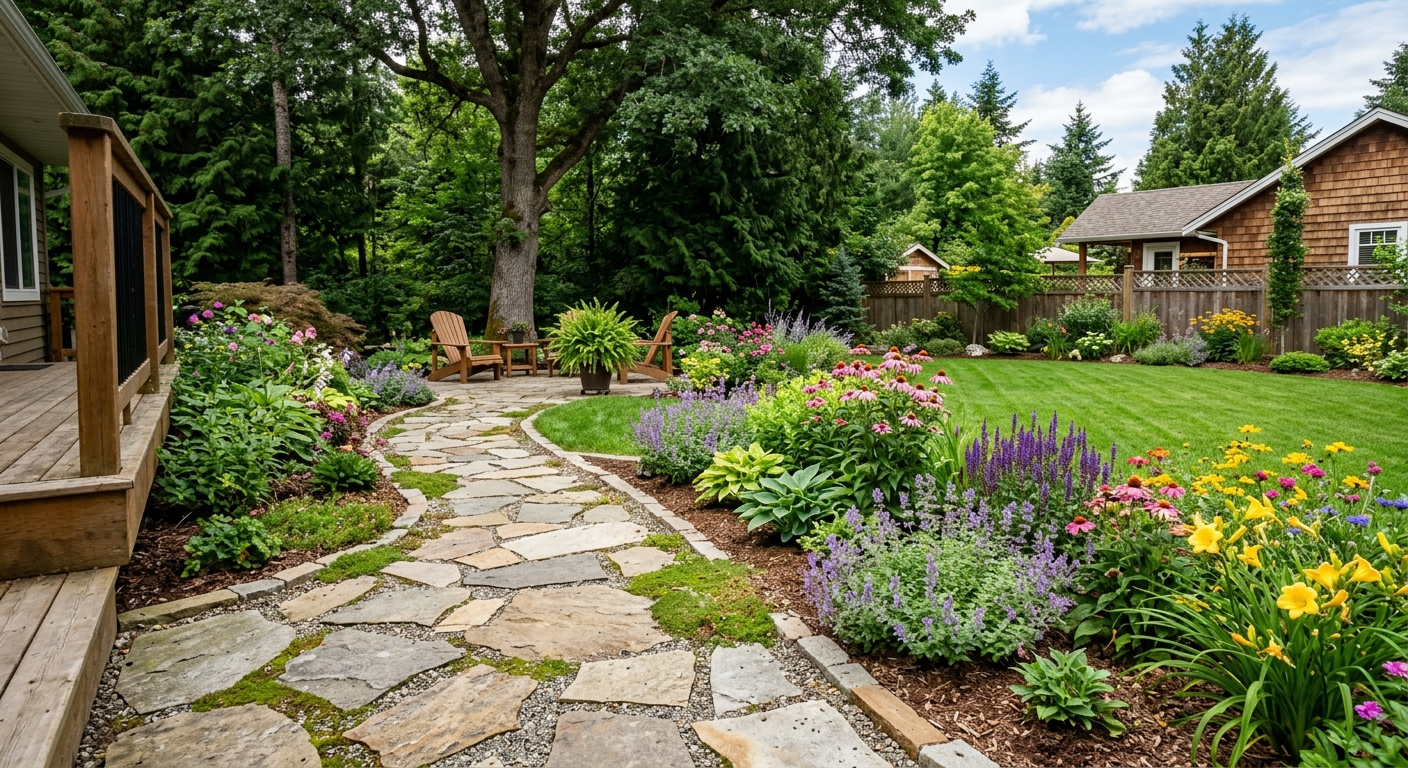
Landscaping options and costs in Medicine Hat
Medicine Hat homeowners have plenty of yard potential, and with about 63.4% of dwellings being single-detached homes, most properties can accommodate meaningful upgrades rather than small, patio-only changes. It also helps that 70.9% of households are homeowners (Statistics Canada, 2021 Census), so many people treat landscaping as a long-term investment—especially as homes age; 48.4% were built before 1981, which often means older drainage patterns, mature trees to manage, and foundations that need careful water control.
In the Lethbridge–Medicine Hat region (hardiness zone 4b), landscaping costs are strongly shaped by prairie-grade winters, short working seasons, and freeze–thaw cycles that make base preparation and drainage non-negotiable. Crews typically concentrate installs between roughly May and September, and contractor availability can tighten around spring cleanups and early-summer planting. Retaining walls, paving, and anything with compacted base layers also tend to come in higher here than in milder climates because contractors price for deeper excavation, well-compacted aggregate, and frost-resilient drainage to reduce heaving and settling.
Trades are especially busy in older, established areas such as Eastview and the neighbourhoods near downtown where yards are larger and many properties have mature landscaping to renovate. From concept through installation, the scope usually breaks into design/softscape and hardscape categories, which is why you’ll see different totals even when “the end look” looks similar. Use the ranges below as your starting point before you compare itemised quotes.
| Service |
Description |
Season |
Price Range |
| Full landscape design and installation |
On-site design, grading concept, plant layout, irrigation plan (if needed), softscape + hardscape installation |
May–September |
$8,000–$35,000 |
| Sod installation (supply, grade, lay, roll) |
Soil prep, grading to correct dips, sod delivery and installation, light rolling/initial watering guidance |
Late spring to early fall (best windows) |
$4–$8 |
| Lawn seeding (grade, seed, starter fertilizer) |
Top-dressing, seed selection for Alberta conditions, starter fertiliser, raking and light coverage |
Late spring to early summer; overseed in fall where appropriate |
$2–$5 |
| Interlocking patio or walkway |
Excavation, compacted base, edging, interlocking stone placement, jointing sand and sealing (optional) |
May–September |
$120–$300 |
| Retaining wall (interlocking block) |
Block wall build with proper base and drainage layer; includes backfill and compaction |
May–September |
$120–$300 |
| Tree and shrub planting |
Hole excavation, amendments, staking/plant protection where needed, and initial watering plan |
May–June and early fall |
$500–$8,000 |
Prices are estimates only and vary by project scope, site access and material selection.
What affects the price of landscaping in Medicine Hat
In Medicine Hat and the broader Lethbridge–Medicine Hat region, quotes for what looks like “the same job” can swing by 30–50% because the hidden work is different: excavation depth, compaction requirements, drainage details, and how much correction a contractor needs to make to existing grades. Even if two yards share a similar surface size, one property may need extra soil amendment and sub-drainage to stay stable through Alberta freeze–thaw cycles, while the other drains naturally and stays flatter longer. That’s the reality of southern Alberta’s zone 4b conditions, where cold winters and hot, dry summers compress the build window and increase the cost of doing it right the first time.
Climate and frost dates matter because what can be planted is limited by the short working season (roughly May–September), and wall/base materials must be placed with deeper, well-compacted bases that extend below the local frost-impacted zone. If you’re comparing work across regions: prairie-like zones generally need drought-tolerant, wind-hardy plant palettes; coastal BC (zone 7–8) usually allows a longer growing season and lush multi-season designs, but heavy rain areas demand excellent drainage; southern Ontario (zone 5–6) tends to have a moderate season where irrigation planning is still important during summer dry spells, but not as compressed as Alberta.
Two practical Medicine Hat examples that affect cost: (1) a small grade correction can add significant labour—often pushing a “simple” refresh into the same budget tier as parts of a full landscape install (commonly in the $8,000–$35,000 range for design + installation). (2) choosing thicker topsoil/soil amendment and adding a drainage bed or French drain can raise totals quickly, but it prevents future foundation moisture issues. Housing age also plays a role: older lots (like many built before 1981) frequently have legacy slopes, drains that no longer function, and mature trees that may require higher-cost removal before planting.
| Price Factor |
Why It Matters |
Cost Impact |
| Yard size in sq ft — the primary cost driver for softscape |
Most labour and materials scale with area (soil, seed/sod, plants, mulch) |
Often largest driver of total budget; larger lots can push toward upper ends of $8,000–$35,000 |
| Grading and drainage work — slope corrections add significant cost |
Correcting ponding and directing runoff away from the house is essential in freeze–thaw |
Commonly adds substantial excavation time and additional base layers |
| Drainage bed or French drain installation |
Helps manage water movement beneath patios and walkways |
Can materially increase the hardscape budget versus lawn-only scopes |
| Plant material tier — native shrubs vs. ornamental vs. mature specimen trees |
Hardy, prairie-appropriate plants cost differently, and mature specimens are priced higher |
Can swing planting from a few hundred dollars to several thousand |
| Hardscape vs. softscape ratio — walls and patios cost more per sq ft than lawn |
Interlocking stone and block require deeper base prep and more material |
Shifts the job toward the higher end of retaining/walkway budgets like $120–$300 |
| Irrigation system design and installation |
Drip zones and controller programming improve survival in hot, dry summers |
Adds cost, but it can reduce plant failures and rework |
| Soil amendment and topsoil required |
Improves rooting and helps compensate for poor existing soil compaction |
Shipping and volume add up quickly on larger beds |
| Tree removal or stump grinding before new planting |
Access and disposal drive labour time and equipment needs |
Can be a major “surprise” line item if not included in the initial scope |
Permits & regulations in Alberta
For most landscaping work in Alberta, you won’t need a permit. Planting, sodding, seeding, mulch placement, and most softscape installs typically proceed without permits—so long as you’re not altering services or creating drainage that affects neighbouring properties. That said, permits can come into play for certain hardscape and grading work.
Work that typically DOES require a permit: retaining walls above a height threshold (commonly around 1.0 m / 3.3 ft in many municipalities), especially if the wall is supporting soil or is near property lines. Also, any major changes to lot grading that could redirect runoff toward the street, storm sewer, or neighbouring lots may trigger approvals. If you’re tying into any service lines or changing how water leaves the property near municipal infrastructure, confirm requirements before digging.
Work that typically DOES NOT require a permit: planting trees/shrubs, installing sod/seed, building small garden borders, laying patios/walkways at normal residential scale, and adding drip irrigation (unless it involves prohibited work near services). Still, always verify local rules.
Step-by-step: how a Medicine Hat homeowner checks a contractor: (1) ask for their Alberta licence/registration information (where applicable) and confirm it through the official provincial registry listings; (2) request a current Certificate of Insurance (general liability) showing your address listed as applicable and confirming adequate coverage; (3) confirm workers’ compensation coverage (WSIB/WCB) by asking for a clearance letter or proof of account—legitimate contractors provide it readily; (4) confirm who pulls any required permits, if any, and whether utility locates are included. Before any digging, require utility locates so crews don’t hit buried services.
Planning a landscape that thrives in Medicine Hat's climate
To plan a yard that thrives in Medicine Hat, aim for “prairie-hardy and water-smart,” not coastal-style lushness. Medicine Hat sits in hardiness zone 4b, so your plant selection should lean native and Alberta-proven species that handle winter lows and bounce back after spring wind and late frost swings. In neighbourhoods with older housing stock (many built before 1981), you’ll also want drainage and moisture management integrated into the plan—because foundation moisture issues often trace back to minor grading problems that became bigger over time.
Plant selection: choose drought-tolerant, wind-tolerant plants and mulch heavily to reduce evaporation. Use plants that fit the short May–September growing season, and avoid “delicate” ornamentals that require constant protection.
Sod vs. seed: sod gives instant curb appeal and erosion control, but it costs about 3–4x more per sq ft than seeding. If you want fast coverage, sod is justified for front-yard visibility or high-traffic slopes. If you’re building a larger lawn area and can manage patience, seeding is typically the better value—seed plus starter fertiliser can outperform sod budgets in lawn renewal scopes.
Drainage and grading: correct dips and direct runoff away from the house. For yards where water pools, contractors often budget drainage beds or French drains—small surface fixes rarely solve subsurface freeze–thaw problems.
Hardscape base prep: patios and retaining walls need a deep, compacted base and proper drainage layers for frost-resilient performance. Cutting corners here tends to show up as settling, lifted edges, or wall movement in a year or two.
Low-maintenance strategies: use groundcovers, mulched borders, and a limited palette of perennials to reduce annual upkeep. Xeriscape and rain-garden layouts (sized to capture runoff efficiently) can be especially effective in Medicine Hat, where hot, dry summers punish plants that rely on frequent watering. If you compare a full hardscape-and-plant refresh, a well-designed install in the $8,000–$35,000 tier can be cheaper long-term than repeatedly replacing drought-stressed plants.
| Element |
Climate Consideration |
Maintenance Level |
Price Band |
| Sod lawn installation |
Needs reliable early-season watering and soil preparation to survive prairie wind and heat |
Low after establishment; higher watering in first weeks |
$4–$8 per sq ft |
| Native perennial garden |
Drought-tolerant once rooted; better survival in zone 4b winters |
Low to moderate (mulch refresh and light weeding) |
$500–$8,000 (by bed size and plant maturity) |
| Mulched shrub border |
Mulch reduces evaporation and helps plants handle hot, dry spells |
Low (seasonal topping and occasional pruning) |
$1,000–$6,000 |
| Interlocking stone patio |
Proper base and drainage reduce freeze–thaw movement and edge lifting |
Low (periodic joint sand top-up) |
$120–$300 per sq ft (project-dependent) |
| Retaining wall (block) |
Requires proper base depth and drainage to prevent heaving |
Low (inspection of drainage and joints) |
$120–$300 per sq ft (project-dependent) |
| Drip irrigation system |
Targets roots efficiently during short warm seasons; supports drought tolerance |
Moderate (controller adjustments and seasonal checks) |
$1,500–$6,500 |
How to choose a landscaping contractor in Medicine Hat
Start by verifying credentials properly. Ask for the contractor’s proof of Alberta coverage and confirm they carry adequate general liability insurance (request a Certificate of Insurance). For work involving crews or equipment, confirm WSIB/WCB coverage and ask for a clearance letter or current proof. Next, verify their licence/registration status through official provincial registry information when applicable. A reputable Medicine Hat contractor won’t hesitate to provide documentation before pricing begins.
Then, get 2–3 itemised written quotes—not just a single lump sum. You want a labour and materials breakdown showing excavation, base aggregates, soil/topsoil, plant types/sizes, irrigation components (if included), disposal/haul-away, and any concrete or interlocking stone items. Read the scope carefully: what’s excluded (tree removal, stump grinding, utility locating, permit pulls, disposal), and what is included (grading to final grade, base compaction specs, number of irrigation zones, watering assistance)? If a quote doesn’t mention drainage layers for hardscape, ask directly—this is often where costs and longevity diverge.
Confirm warranty details: workmanship warranty length, whether plant material is covered by the supplier or by the contractor, and whether warranties are transferable if you sell the home. Keep payments sensible: never pay more than 10–15% upfront, and use a holdback until key items are complete. Finally, require a written timeline with a start date and completion estimate so crews can schedule within the May–September window.
- Ask for insurance + proof of WSIB/WCB before the contract is signed.
- Get itemised labour/materials pricing (no vague allowances).
- Require a clear scope for grading, base depth, and drainage layers.
- Confirm utility locates are included before digging.
- Ask who handles permits (if a retaining wall exceeds local thresholds).
- Request plant lists with common + botanical names and approximate sizes.
- Verify irrigation design details if drip lines are part of the plan.
- Check disposal/haul-away: is demolition and green waste included?
- Make sure topsoil/soil amendment quantities (in volume or depth) are specified.
- Clarify warranty: workmanship length, plant warranty terms, and exclusions.
- Use a payment schedule with 10–15% max upfront and holdback at milestones.
- Confirm schedule and seasonal watering responsibilities during establishment.
Red flags in Medicine Hat include: refusing to provide proof of insurance/WSIB, quoting a hardscape job without specifying base and drainage details, using “allowance” line items that aren’t itemised until after work starts, pressuring you for large upfront payments, and starting without a written timeline or clear scope exclusions.
Frequently asked questions — landscaping in Medicine Hat
When should I aerate and overseed my lawn in Medicine Hat?
In Medicine Hat, timing matters because the growing season is short and spring winds can dry seed beds quickly. Aeration is typically best in late spring after the ground warms, or in early fall when the lawn can recover before cold settles in. For overseeding, aim for a period when you still have warm daytime temperatures and consistent moisture—then protect the seed bed with light watering and avoid traffic until germination. Many homeowners choose seeding in the fall for patch repairs rather than relying on sod refreshes. If you’re budgeting, lawn seeding often lands in the $2–$5 band (scope-dependent) versus sod at roughly $4–$8 per sq ft, so overseeding can be an economical way to thicken thin areas.
What trees grow best in Medicine Hat's climate zone?
Medicine Hat is in hardiness zone 4b, so your best results come from prairie-hardy trees that tolerate cold and wind. Homeowners commonly do well with varieties like Manitoba Maple and some hardy elms, and fruiting options where conditions fit (with proper planting and watering). You’ll also want to consider mature size so roots don’t interfere with foundations or buried services on older properties. If you have a pre-1981 yard, check existing drainage patterns around the foundation before adding larger trees; drought stress plus poor drainage can lead to premature decline. A typical tree and shrub planting budget can range widely—often starting around the $500–$8,000 band depending on how many trees, the sizes, and whether any removals are needed.
How much does sodding a yard cost in Medicine Hat?
Sodding costs in Medicine Hat are typically quoted by area and installation scope. In local pricing, sod installation is commonly estimated around $4–$8 per sq ft for supply, grading/soil prep, and installation (scope-dependent). Final totals vary based on how much grading is needed to fix dips or slope away from the home, how much topsoil amendment is required, and whether you’re replacing old turf. If your lawn has thin spots rather than full failure, overseeding can be cheaper and often more practical. For a larger front yard where instant curb appeal is the goal, sod can be worth it—but for full-lawn renewals, many homeowners compare sod to seeding before committing.
How do I prevent weeds in my Medicine Hat garden?
Weed prevention starts before planting. In Alberta gardens, laying down proper soil prep, controlling compaction, and using a consistent mulch layer makes the biggest difference. Choose drought-tolerant plants that fill in over time—open soil invites weeds, especially during hot, dry summers. Install a weed barrier only if it fits the plant bed strategy (many shrubs and perennials do better with mulch over barrier than with bare fabric gaps that can trap moisture incorrectly). Pull weeds early after spring thaw and before they set seed. Also plan for wind-driven seed sources from neighbouring areas, which means edging and maintaining bed lines. If you’re paying for professional help, tree and shrub planting projects (often in the $500–$8,000 band) are a good time to bundle soil amendment and a finished mulch plan so the bed closes faster and weeds have less space to grow.
How do I design a low-water yard in Medicine Hat?
A low-water yard in Medicine Hat works best with the right plant palette and efficient irrigation—rather than simply “using less water.” Start by selecting prairie-hardy, drought-tolerant plants suited to zone 4b, and group plants by water needs so you don’t overwater everything. Use mulch generously, and design planting beds to reduce exposed soil area; that cuts evaporation and suppresses weeds. For irrigation, drip systems and smart zoning are usually more efficient than sprinklers, targeting roots and reducing waste on windy days. If you’re considering cost, a full landscape design and installation can run from $8,000–$35,000 depending on scope, but bundling irrigation design with plant selection often prevents expensive plant failures later. Where appropriate, consider xeriscape and rain-garden features that capture runoff during thaw periods and direct it to planted areas.
How do I find a licensed landscaper in Medicine Hat?
In Medicine Hat, you should screen contractors the same way you would for any major home project. Start by asking for proof of liability insurance and confirmation of WSIB/WCB coverage; request documents before work begins. For licensing/registration, ask what registrations apply to the scope and verify through the official provincial registry information. Then get 2–3 itemised quotes that break out labour and materials—especially drainage, base prep, disposal/haul-away, and any permit-related work. A contractor should clearly state exclusions (like stump grinding or utility locates) and provide a written timeline. Finally, keep payments structured: never pay more than 10–15% upfront. If one quote is far below the others, ask what’s missing—like drainage layers or base depth—because those gaps can increase costs later when freeze–thaw damage shows up.