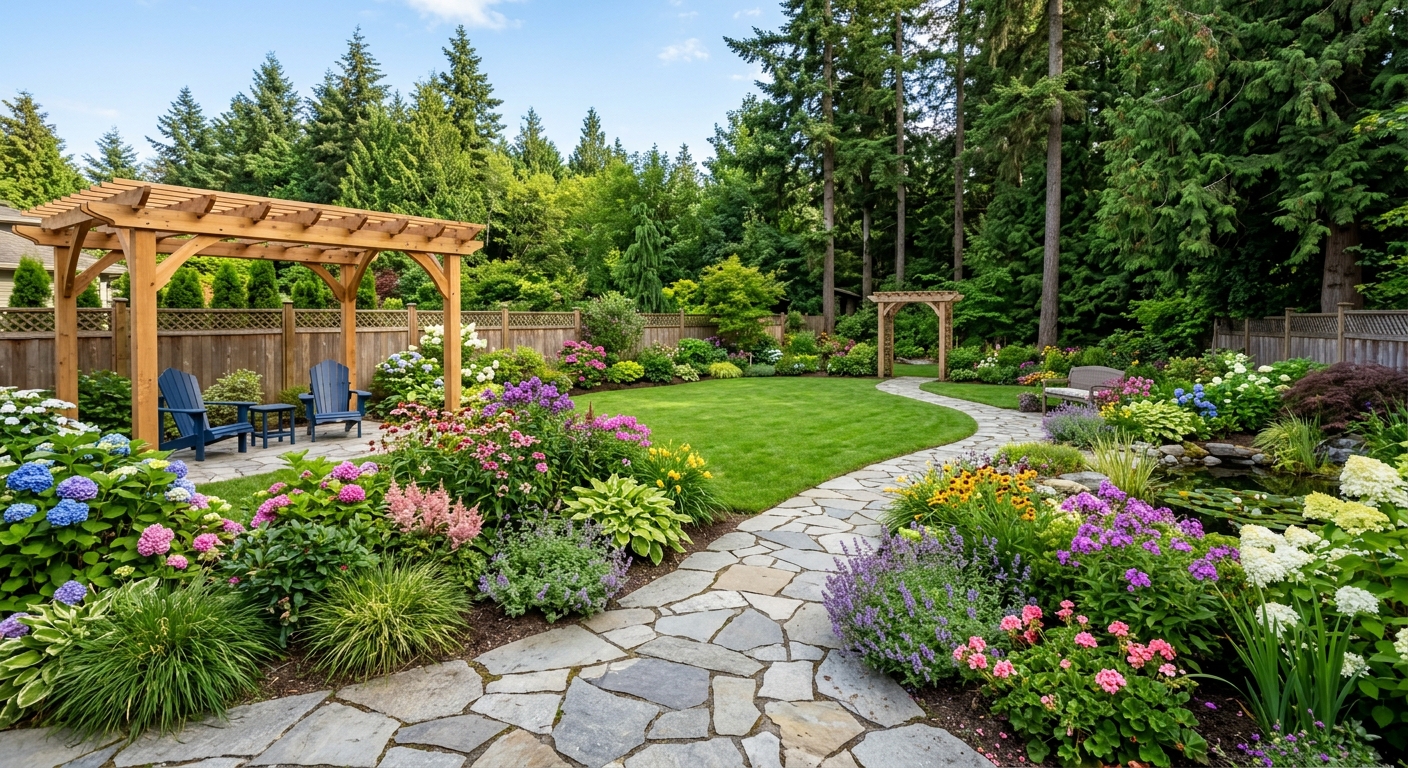
Landscaping options and costs in Burnside-Gorge
Landscaping in Burnside-Gorge typically starts with what your property can support: space, access for delivery trucks, and how much you want to change the look of your yard. With a population of 6,875 (Statistics Canada, 2021 Census), the area has a smaller customer base than bigger Vancouver neighbourhoods, so popular dates fill quickly—especially for patio and drainage builds. In Lower Mainland–Southwest, where many homes are detached or semi-detached with usable yard space, homeowners often invest early because improvements can be seen immediately and maintained over time.
Costs here are shaped by the Lower Mainland–Southwest climate: plant hardiness zones 7–8 mean you can use broadleaf evergreens and lush layering with less winter damage risk than colder regions. The long growing season (often from early spring through late fall, aside from the wettest spells) also affects scheduling and pricing—labour demand is steadier than in Prairie cities, but heavy rain periods can pause groundwork, increasing management time. For structural work like patios and retaining walls, even though winters are milder, freeze–thaw cycles still require deeper bases, compaction, and proper drainage to prevent frost heave on sloped sites common in the Burnside-Gorge area (including around older hillside lots).
Because of this mix of year-round planting potential and rain-sensitive construction, you’ll see wide price ranges even for similar projects. The comparison table below helps you benchmark what typical contractor quotes cover.
| Service |
Description |
Season |
Price Range |
| Full landscape design and installation |
Site visit, concept + detailed plan, planting palette, grading/drainage plan, and full install of softscape and/or hardscape |
Year-round planning; install often Mar–Nov |
$8,000–$45,000 |
| Sod installation (supply, grade, lay, roll) |
Weed removal, soil prep, grading, sod supply, lay and roll, starter fert, light top-dress as needed |
Late Mar–Oct (best in shoulder seasons) |
$2,500–$7,500 |
| Lawn seeding (grade, seed, starter fertilizer) |
Grading, aeration (if needed), seed selection, starter fertilizer, light mulch/tack where appropriate |
Mar–May and late Aug–Sep |
$1,800–$4,500 |
| Interlocking patio or walkway |
Excavation, base compaction, geotextile, bedding sand, pavers, edge restraint, jointing sand |
Spring–fall; avoid the wettest weeks |
$8,000–$28,000 |
| Retaining wall (interlocking block) |
Layout, excavation, compacted base, drainage rock + weeper if required, block installation, caps/finishes |
Spring–fall (footings depend on soil conditions) |
$12,000–$55,000 |
| Tree and shrub planting |
Soil amendments, spacing, staking (as needed), mulch rings, initial watering plan |
Mar–Nov |
$1,500–$12,500 |
Prices are estimates only and vary by project scope, site access and material selection.
What affects the price of landscaping in Burnside-Gorge
The same landscaping scope can land 30–50% apart across the Lower Mainland–Southwest and other parts of British Columbia because pricing follows labour availability, site complexity, and how long a crew must stay on hold during rain. Even within the Lower Mainland, wet soil can slow excavation and delay base compaction, so contractors price in weather risk when planning a full install. In coastal BC (like Burnside-Gorge in zones 7–8), the longer growing window supports larger planting palettes and layered designs, but structural work still has to handle freeze–thaw cycles—meaning deeper bases and stronger drainage details.
In colder zones (Prairie regions), short frost-free periods push clients toward drought-tolerant, low-maintenance planting and compressed construction schedules; in those areas, retaining wall footings must reach below the frost line, increasing excavation depth and labour. In the dry BC Interior, irrigation design costs rise because systems must meet stricter water-use realities; conversely, Lower Mainland yards still benefit from efficient systems, but you’re not designing for the same extreme drought stress. Southern Ontario (zone 5–6) has a moderate season and often faces dry spells during summer—another reason irrigation and soil prep show up in bids.
Concrete examples you’ll notice in Burnside-Gorge: (1) a sloped front yard that needs re-grading for drainage typically adds significant cost before any planting—often moving a “planting-only” budget into the broader softscape range such as $5,000–$50,000 when hardscape or wall work is required; (2) upgrading from a basic patio base to a proper drainage layer and geotextile can shift a walkway estimate by thousands even if the visible pavers look identical. Site age also matters—older lots can have compacted, inconsistent soils near foundations, and correcting that may require additional topsoil and amendments (a cost driver that’s commonly overlooked).
| Price Factor |
Why It Matters |
Cost Impact |
| Yard size in sq ft — the primary cost driver for softscape |
More area means more labour hours for grading, planting, and edging, plus larger quantities of topsoil, mulch, and plant stock |
Can double the job cost between small and mid-size lots |
| Grading and drainage work — slope corrections add significant cost |
Lower Mainland–Southwest rainfall demands positive drainage away from foundations; correcting slopes can take extra excavation and re-compaction |
Often the difference between a basic install and a full design/build scope |
| Drainage bed or French drain installation |
Added stone, pipe, cleanouts, and restoration work; required when water pools near downspouts or basement walls |
Material + labour increases can add thousands |
| Plant material tier — native shrubs vs. ornamental vs. mature specimen trees |
Mature trees cost more upfront and may require equipment/longer timelines for safe handling and staking |
Big swing within the tree & garden planting band |
| Hardscape vs. softscape ratio — walls and patios cost more per sq ft than lawn |
Patios/walls require excavation, base prep, and longer compaction cycles; pavers and block systems also carry higher material costs |
Shifts the project toward retaining wall & hardscaping pricing |
| Irrigation system design and installation |
Efficient layouts (often drip + smart controllers) reduce waste, but design, testing, and trenching add labour |
Can increase the landscape package but improves long-term survival |
| Soil amendment and topsoil required |
Inconsistent or compacted soils near older foundations may need added engineered topsoil and organic amendments |
Quantity-driven cost; can move smaller projects up sharply |
| Tree removal or stump grinding before new planting |
Roots can undermine new drainage and planting beds; removal adds specialised labour and waste handling |
Can add a standalone line item that affects total budget |
Permits & regulations in British Columbia
In British Columbia, most planting and softscape work typically does not require a permit. That usually includes tasks like planting trees/shrubs, adding mulch or topsoil, sodding, and doing standard lawn grading. However, some retaining walls do require a building permit—in many municipalities, walls above about 1.0 m (3.3 ft) are the common threshold, and the exact requirement can vary based on site conditions and wall design.
Grading is another area homeowners should be careful with: if proposed lot grading changes drainage patterns (for example, redirecting water toward a neighbour or a storm connection), the municipality may require approval or conditions. Before digging planting holes or wall footings, always request utility locates to mark underground services.
To verify a contractor’s credentials in Burnside-Gorge, start with licence and insurance documentation before you sign anything. Ask for: (1) their general commercial liability insurance certificate showing adequate limits and your property address (certificate of insurance should list the insured contractor and note any additional insured details where applicable); (2) proof they carry workplace coverage (WCB/WSBC coverage, where required for the contractor’s workforce); and (3) their registration/licence details if they perform regulated work (for example, engineering or building-permit-related scope). For the checks: confirm licence/registration through the applicable online registry your contractor provides, then cross-check the certificate dates and coverage details. Finally, request a written confirmation/clearance information where applicable and make sure the quote clearly states who pulls permits if the project is permit-triggering.
Planning a landscape that thrives in Burnside-Gorge's climate
To plan landscaping that actually thrives in Burnside-Gorge, think “work with the climate, not against it.” With Lower Mainland–Southwest conditions in zones 7–8, you can use native and zone-appropriate species with less winter protection than colder regions, but your biggest day-to-day challenge is managing excess moisture. Aim for plants that tolerate wet winters and cool summers, and build a drainage-first foundation so roots get air as well as water.
When choosing sod vs. seed, remember sod gives instant coverage but costs more—often about 3–4x per sq ft than seeding once you compare typical material and installation rates. If you need quick curb impact, a smaller sod area near a front entry can be justified; a seeding approach is usually more cost-effective for larger lawns, provided you accept slower establishment. In the wet shoulder seasons around early spring and fall, proper grading is critical.
Drainage and grading matter most in coastal BC: pool prevention protects foundations and reduces washouts in planting beds. For hardscape like patios and retaining walls, base preparation must account for local freeze–thaw cycles—your contractor should specify compacted base depth, restraint edges, and proper drainage layers. Finally, low-maintenance strategies—mulched shrub borders, groundcovers, and long-blooming perennials—reduce annual upkeep while still looking full.
If you’re trying to reduce irrigation demand during occasional restrictions or just manage water costs efficiently, consider rain-garden features or xeriscape-style plantings in side yards. A common “value” example: spending additional dollars on drainage rock and a properly sloped bed can prevent recurring lawn failures, whereas overspending on premium ornamental shrubs without fixing water movement often wastes budget long-term.
| Element |
Climate Consideration |
Maintenance Level |
Price Band |
| Sod lawn installation |
Handles cool, damp seasons well if soil is well-graded; requires good establishment watering during the first weeks |
Low to moderate (first-season care, then routine mowing) |
$2,500–$7,500 |
| Native perennial garden |
Zone-appropriate plants handle mild winters; mulch and spacing help manage wet-season crown rot risk |
Low (annual tidy-up and occasional weeding) |
$3,000–$12,000 |
| Mulched shrub border |
Evergreen structure performs in winter; proper drainage prevents root stress in heavy rainfall areas |
Low (mulch refresh and light pruning) |
$2,500–$9,500 |
| Interlocking stone patio |
Base compaction and drainage reduce shifting from freeze–thaw and winter saturation |
Low (occasional joint sand top-up) |
$8,000–$28,000 |
| Retaining wall (block) |
Requires proper base + drainage rock/weeper for wet coastal winters and slope stability |
Low (monitoring and cleaning; drainage is key) |
$12,000–$55,000 |
| Drip irrigation system |
Efficient delivery supports long seasons and helps plants tolerate occasional watering limits |
Moderate (seasonal checks of lines and controller settings) |
$2,000–$9,000 |
How to choose a landscaping contractor in Burnside-Gorge
Choosing the right contractor in Burnside-Gorge starts with proof, not promises. In British Columbia, verify liability insurance by requesting a current certificate of insurance (COI) showing your project/address and that coverage is active during the construction period. For workforce protection, ask for proof of WCB/WSBC coverage (where required for the contractor’s workers). If the contractor performs work that could trigger additional requirements (for example, permit-related scope or engineering inputs), ask how they handle documentation and inspections—especially for retaining walls that may require a building permit. Where to look: ask them for their insurance and coverage documents up front, confirm the dates, and review the scope language in the written quote.
Next, get 2–3 itemised written quotes that separate labour and materials (pavers/block, soil, amendments, drainage rock, irrigation components, disposal). A lump-sum quote can hide major differences—like whether geotextile and proper drainage are included under hardscape bases or whether stump grinding is extra. Read exclusions carefully: is site cleanup/disposal included? Are permit fees included if required? Are utility locates included or responsibility assigned to you?
For warranty, ask for a workmanship warranty length and confirm product/manufacturer warranties. Also ask whether any product warranty is transferable to you as the homeowner. Keep payments controlled: never pay more than 10–15% upfront; hold back a portion until the job is complete and you’ve reviewed the final grading and plant survival plan. Finally, request a written start date and completion estimate—rain can affect timelines, so the best quotes include contingency planning.
- Provide current COI (liability) and ensure the coverage period matches your planned work window.
- Provide WCB/WSBC clearance/proof for workers (ask for documentation, not verbal reassurance).
- Request itemised breakdowns: labour, materials, equipment, and disposal.
- Confirm whether the quote includes utility locates prior to digging.
- Ask what base build is proposed under patios/walkways (depth, compaction, geotextile, drainage layer).
- For retaining walls, confirm whether drainage rock + weeper pipe is included.
- Check plant lists: botanical names, sizes, and expected spacing—not just “shrubs.”
- Ask who is responsible for permit pulling if your retaining wall crosses the common threshold around 1.0 m.
- Ask for warranty terms in writing for workmanship and product components.
- Use a payment schedule that holds back until punch list items and final cleanup are done.
- Get a written timeline with milestones and what happens if weather delays excavation.
- Confirm how survival watering is handled for the first 2–4 weeks after planting.
Red flags to watch for: (1) no itemised quote and only a vague “materials included” line; (2) contractors who won’t provide insurance/WCB documentation; (3) refusing to discuss drainage design or base depth for hardscape; (4) promising “guaranteed” plant survival without watering guidance and soil prep; and (5) asking for large deposits (more than 15%) before any site work starts.
Frequently asked questions — landscaping in Burnside-Gorge
Sod vs seed — which is better for a Burnside-Gorge lawn?
In Burnside-Gorge and across coastal British Columbia (zones 7–8), both sod and seed can work well, but they’re best for different goals. Sod gives instant coverage and can look great for curb appeal—typically it costs more, often in the $2,500–$7,500 band depending on yard size and site prep. Seeding is usually cheaper (often $1,800–$4,500) and can be a smart choice for larger areas, but you’ll wait for establishment and you must keep the seed bed evenly moist during germination. If your yard has low spots or drainage issues, start with grading and drainage—otherwise either option can fail.
How much does a retaining wall cost in Burnside-Gorge?
Retaining wall pricing in Burnside-Gorge is driven by wall height, total linear feet, excavation difficulty (especially on sloped lots), and whether drainage components are included. For interlocking block retaining walls, homeowners commonly see estimates in the $12,000–$55,000 range. The biggest cost swings are: the depth and compaction of the base (accounting for freeze–thaw cycles), how much grading is required to “tie in” the wall to existing lawn/paths, and the presence of proper drainage rock and weeper pipe. If the design requires additional engineering/permit work, the total can rise. Always compare bids with the same wall height and whether drainage is included.
When is the best time to landscape in Burnside-Gorge?
For Burnside-Gorge, the “best” time depends on whether you’re planting or building hardscape. Planting (trees, shrubs, perennials) can often happen from spring through fall because coastal winters are mild and soils aren’t frozen for extended periods. Sod and seeding are best in the shoulder seasons—early spring or late summer/early fall—when temperatures are cooler and moisture is more consistent. For patios and retaining walls, crews typically target spring through fall but avoid the wettest weeks because excavation and base compaction are sensitive to saturation. Even with mild winters, freeze–thaw cycles mean builders must get drainage and base depth right to reduce future movement and frost heave risk.
Do I need a permit for a retaining wall in British Columbia?
Often, yes—depending on height and design. In British Columbia, many municipalities require a building permit for retaining walls above a threshold commonly around 1.0 m (3.3 ft), but the exact triggers can vary by site conditions. If your wall changes drainage patterns, ties into a structural element, or needs engineered design, approvals may be required. The practical step for a homeowner in Burnside-Gorge is to confirm the wall height and layout with your contractor and ask who will pull the permit (and what’s included in the quote). A good contractor should also build with proper drainage rock/weeper pipe details because permit approvals and long-term performance depend on stable, well-drained construction.
How do I improve drainage in my yard?
Improving drainage in Burnside-Gorge usually starts with observing where water goes after rain: does it pool near foundations, collect along a fence line, or wash out toward a driveway? Most solutions combine grading corrections with subsurface drainage where needed. Common approaches include re-grading to create positive slope away from the house, installing a French drain or drainage bed, and ensuring downspouts discharge away from planting areas. Under patios/walkways, proper base build and geotextile separation help prevent water from undermining the base. If you’re doing planting at the same time, ask the contractor to coordinate drainage so roots aren’t sitting in saturated soil. If you’re unsure, request a drainage assessment before buying sod.
What is xeriscaping and does it suit Burnside-Gorge?
Xeriscaping is a water-wise landscaping approach that uses drought-tolerant plants, efficient irrigation, and soil/organic strategies to reduce water demand. In Burnside-Gorge, it can suit certain yard zones—like side yards, under eaves, or areas where you want to reduce irrigation frequency—because Lower Mainland–Southwest winters are mild but rainfall patterns and water costs can still influence how homeowners manage maintenance. That said, “true xeriscape” can be optional here since coastal BC doesn’t have the same prolonged drought stress as the Interior. A practical compromise is using native shrubs/perennials with mulch and drip irrigation in targeted areas, while keeping a small, well-graded lawn section where you want traditional grass. Design choices matter more than the label.