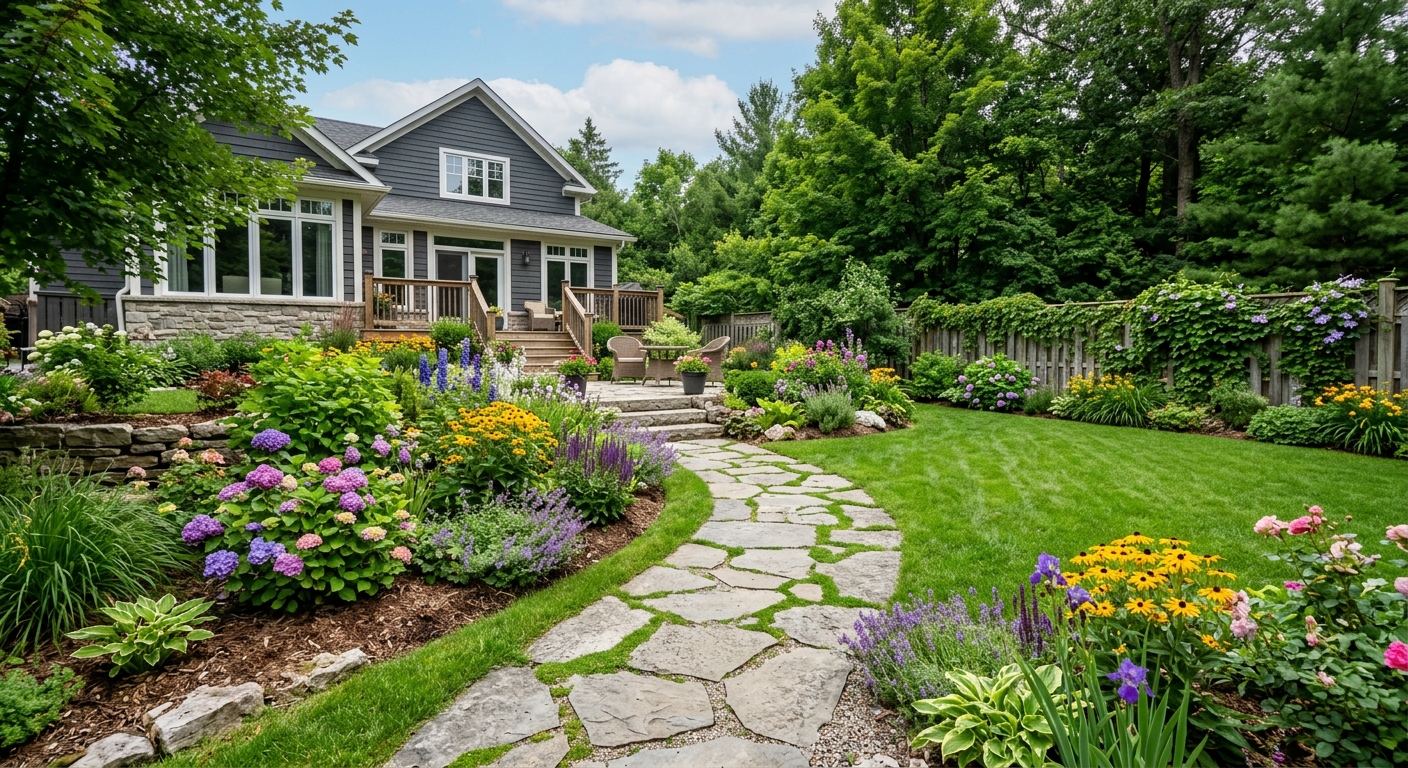
Landscaping options and costs in Central Saanich
In Central Saanich, landscaping decisions are strongly shaped by the fact that most households are homeowners and many properties are single-detached—an ownership profile that typically leads people to invest in long-term curb appeal and yard usability. With 5,680 homeowner households and a housing mix where single-detached homes make up 53.8% of dwellings (Statistics Canada, 2021 Census), you’ll often see yards designed for family life, entertaining, and—on sloped sites—practical drainage and retaining solutions. It also helps explain why contractors stay busy in areas with older housing stock: 46.4% of homes were built before 1981 (Statistics Canada, 2021 Census), and those properties commonly need upgrades like updated soil, regraded downspouts, and more resilient planting beds.
Vancouver Island and the Coast sit in mild coastal hardiness zones 7–9, so there’s a longer installation window than in colder regions. That can lower some scheduling pressure and make fall planting more viable, but it doesn’t eliminate cost drivers: wet winters mean drainage and base preparation still have to be done correctly, and slopes around Central Saanich (including parts of Brentwood Bay and North Saanich-adjacent areas) make retaining wall and grading work more common. Labour and materials also vary with access—tight drives, mature tree removal, and hauling spoil can push project totals up quickly. The result is that two “similar” yards can land in different bands depending on hardscape intensity, irrigation design, and how much drainage/soil correction is needed.
Below is a practical snapshot of common landscaping scopes and typical Central Saanich price ranges—use it as a starting point before you compare detailed, itemised quotes.
| Service |
Description |
Season |
Price Range |
| Full landscape design and installation |
Site visit + concept/layout, plant palette, soil prep, planting and/or sod, basic grading/drainage coordination, and hardscape where included |
Early spring to late fall (longer window on Vancouver Island) |
$5,000 – $40,000 |
| Sod installation (supply, grade, lay, roll) |
Minor grading/leveling, soil amendment as needed, sod supply and installation, rolling and initial watering guidance |
Spring or early fall |
$2,500 – $8,000 |
| Lawn seeding (grade, seed, starter fertilizer) |
Light grading, seed blend selection, starter fertiliser, seed installation, and short-term weed/erosion monitoring |
Spring or early fall (avoid heavy rains if possible) |
$1,500 – $5,000 |
| Interlocking patio or walkway |
Base excavation/compaction, sand/gravel layers, edging, interlocking stone placement, and finishing |
Best in dry stretch (spring through fall) |
$4,000 – $20,000 |
| Retaining wall (interlocking block) |
Wall layout, base prep/compaction, drainage backfill, block installation, and wall finishing |
Spring through fall |
$6,000 – $35,000 |
| Tree and shrub planting |
Soil prep, amendments, staking as needed, planting installation, and initial mulch ring creation |
Spring or fall (and select evergreens year-round if conditions allow) |
$800 – $15,000 |
Prices are estimates only and vary by project scope, site access and material selection.
What affects the price of landscaping in Central Saanich
In Central Saanich, quotes for the “same” yard can vary by 30–50% because the work rarely matches line-for-line once you get past the brochure-level description. A contractor may price a plan with minimal grading and modest drainage, while another includes slope correction, soil amendment, and a properly detailed drainage bed—details that are critical in Vancouver Island’s frequent rain and persistent shoulder-season moisture. Also, labour availability and scheduling can shift costs: the long working season means more installers are active, but busy stretches still affect crews and equipment bookings.
Climate and hardiness zone influence both what grows and what can be installed efficiently. Coastal BC’s mild zones 7–9 (with gentler freeze–thaw cycles than interior climates) support lush, multi-season plant palettes, yet proper drainage and base prep remain cost drivers. Retaining-wall work still needs correct retaining-wall base depth and compaction to manage winter saturation and prevent movement during seasonal temperature swings. Meanwhile, water restrictions in the BC Interior don’t drive the exact same limits in every part of Vancouver Island, but homeowners still increasingly expect efficient irrigation—so drip systems, smart controllers, and drought-tolerant choices can add cost (and value) compared with basic hose-and-timer watering. By contrast, Southern Ontario (Zone 5–6) often needs more summer irrigation planning during dry spells, which can change how irrigation budgets are structured.
Two concrete local examples: if your slope requires a retaining wall, wall base prep and drainage backfill can move a project from a mid-range hardscape band toward the higher end of retaining walls & hardscaping budgets ($4,000–$60,000). If you’re replacing a stressed lawn, sod may land you nearer $1,500–$8,000 for lawn work, while seeding can reduce early costs but may require patience for full establishment.
Finally, older homes built before 1981 often have mature trees, settled grades, and aging drainage paths. Correcting those issues can mean extra excavation and hauled-off materials, which is why Central Saanich projects frequently land anywhere from the $5,000–$40,000 range for design and installation depending on how much “invisible” prep is required.
| Price Factor |
Why It Matters |
Cost Impact |
| Yard size in sq ft — the primary cost driver for softscape |
More area means more soil prep, mulch/seed/sod, more plant spacing, and more labour hours |
Often the largest variable; can shift totals by thousands |
| Grading and drainage work — slope corrections add significant cost |
Fixing runoff paths and achieving proper pitch prevents pooling and foundation moisture |
Can add major excavation/compaction time to the job |
| Drainage bed or French drain installation |
Coastal winters demand reliable drainage layers behind walls and in problem spots |
Usually increases hardscape/installation budgets |
| Plant material tier — native shrubs vs. ornamental vs. mature specimen trees |
Species, size, and sourcing determine material price and transplant difficulty |
Young plantings may fit mid-bands; mature trees can spike totals |
| Hardscape vs. softscape ratio — walls and patios cost more per sq ft than lawn |
Stone base, compaction, and edging add cost beyond planting-only work |
Shifts projects toward retaining walls & hardscaping bands |
| Irrigation system design and installation |
Drip layout, valves, and smart controllers increase efficiency and long-term reliability |
Can add meaningful line-items, but reduces water waste and callbacks |
| Soil amendment and topsoil required |
Local soils vary; poor structure often needs compost and improved grading |
Frequent on older properties; impacts hauling and material costs |
| Tree removal or stump grinding before new planting |
Stumps affect excavation, and roots can interfere with new beds and drainage runs |
Can add equipment and disposal costs quickly |
Permits & regulations in British Columbia
In British Columbia, most planting and typical softscape work—such as sodding, seeding, shrub and tree planting, mulch installation, and installing pathways that don’t materially change lot drainage—typically does not require a permit. The big exception is retaining walls that exceed common thresholds used by municipalities. In many areas, retaining walls above about 1.0 m (3.3 ft) require a building permit, and engineering drawings may be requested depending on wall height, soil conditions, and how the wall functions structurally.
Changes to lot grading can also trigger approvals. If your project alters how water moves toward a neighbouring property or toward storm sewer connections, the municipality may require review. Before any digging for planting holes or wall footings, ensure utility locates are completed so you don’t hit buried services.
To verify contractor readiness in Central Saanich, treat it like due diligence: (1) licence/registration—confirm the contractor is in good standing in the relevant BC online registry listings where applicable for their trade; (2) liability insurance—ask for a current certificate of insurance naming you as an additional insured where appropriate for construction activities; and (3) clearance/coverage—confirm the contractor’s workers’ coverage (WSIB/WCB) status for employees and/or confirm how they meet mandatory coverage requirements for workers involved on-site. Step one is asking for proof before work starts; step two is making sure the addresses and dates on documents match your project timeframe.
Planning a landscape that thrives in Central Saanich's climate
Designing for Central Saanich means working with coastal conditions—mild winters, cool summers, and wet seasons—rather than assuming your yard will “dry out on its own.” First, plant selection: in BC’s mild coastal hardiness zones 7–9, you can use native and zone-appropriate shrubs and perennials that establish with less winter damage and typically need less intensive winter protection than delicate, out-of-zone choices. Second, sod vs. seed: sod gives instant coverage, but it’s usually more expensive—often several times the per-sq-ft cost of seeding—so it makes sense when you need a quick “finished yard” look for a specific event or when erosion control is urgent on a sloped surface.
Third, drainage and grading are non-negotiable in Vancouver Island and the Coast. Pooling water around foundations can lead to moisture issues and poor plant health. Ensure downspouts discharge where designed, and grade away from the house. For hardscape like patios and retaining walls, base preparation must account for the local frost line behaviour and saturation: you still need proper excavation depth, compacted base layers, and correct drainage backfill so the ground doesn’t shift during wet winter seasons and the milder freeze–thaw periods.
Fourth, low-maintenance strategies reduce ongoing upkeep without losing curb appeal: mulch rings, dense groundcovers, and evergreen structure (broadleaf evergreens and ornamental grasses) can keep beds neat between seasonal tidy-ups. Consider rain-garden elements or targeted xeriscape in exposed/south-facing zones using drip irrigation and drought-tolerant plants—especially where summer drying occurs.
Price-wise, here’s where the differences can be justified: if you’re comparing seeding a lawn to sod for a similar area, sod may sit near the upper lawn band (up to roughly $8,000), while seeding often lands closer to $1,500 – $5,000. The extra cost is usually worth it when you need rapid erosion control on slopes, or when you have a tight timeline for family use.
| Element |
Climate Consideration |
Maintenance Level |
Price Band |
| Sod lawn installation |
Follows good drainage; best results in spring/early fall to avoid stress in wet winters |
Low to moderate (watering during establishment, then typical mow/edge) |
$2,500 – $8,000 |
| Native perennial garden |
Zone-appropriate plants handle coastal conditions and typically need less winter protection when planted correctly |
Moderate (mulch top-ups and seasonal deadheading) |
$800 – $15,000 |
| Mulched shrub border |
Mulch improves soil moisture stability through wet/dry swings and helps prevent splash erosion |
Low (weed suppression, periodic mulch refresh) |
$1,000 – $10,000 |
| Interlocking stone patio |
Requires proper base compaction and drainage pitch to avoid standing water during rainy periods |
Low (occasional cleaning and joint material checks) |
$4,000 – $20,000 |
| Retaining wall (block) |
Needs drainage backfill and correct base preparation for wet-season stability |
Low (visual inspections; keep weep/drainage areas clear) |
$6,000 – $35,000 |
| Drip irrigation system |
Drip supports targeted watering and efficient use in drier exposed areas |
Low (smart controller set-and-forget; seasonal checks) |
$1,200 – $6,500 |
How to choose a landscaping contractor in Central Saanich
Choosing a contractor in Central Saanich is about verifying three things before price: capability, coverage, and clarity. Start with British Columbia coverage requirements. Ask for (1) proof of liability insurance—request a current certificate and confirm it’s active for the project dates; (2) workers’ coverage documentation (WSIB/WCB/WCB clearance as applicable)—the contractor should be able to provide a clearance letter or equivalent proof for workers; and (3) trade qualification where relevant for the scope (for example, if the work involves structural retaining walls, ask who provides engineering/structural sign-off if required). Don’t accept “we’re covered” as a statement—ask for documents.
Next, get 2–3 itemised written quotes. You want line items for labour and materials (not just “landscape package”), including excavation, disposal/hauling, soil/topsoil or amendments, drainage materials, and the specific planting counts and sizes. Read the exclusions: is permit work included (where required), is disposal included, and what happens if soil conditions differ from what was visible during the site visit? Also confirm start date, working days, and a completion timeline in writing.
Warranty matters. Ask for a workmanship warranty length (and what it covers), plus manufacturer warranties on products where applicable. Clarify whether warranties are transferable if you sell your home.
For payment, avoid paying the majority upfront. A common safe structure is no more than 10–15% at the start, then staged progress payments tied to milestones, with a holdback until the job is complete and deficiencies are corrected. If a contractor pressures you for more upfront money, pause and re-check the quote and scope.
- Ask for a site visit and written measurements (so “sq ft” quantities are defensible).
- Require itemised pricing for excavation, base materials, amendments, and hauling/disposal.
- Confirm what’s included in drainage (beds/French drains, geotextile, backfill, and pitch).
- Request a plant list with botanical names, container size, and quantity.
- Check liability insurance dates and limits on the certificate of insurance.
- Verify workers’ coverage through WSIB/WCB proof or clearance documentation.
- Ensure the proposal states whether retaining walls above the threshold require permits/engineering.
- Confirm warranty terms in writing (workmanship and replacement plant policy).
- Use a payment schedule with a 10–15% max upfront and a holdback for completion.
- Get a written schedule: start date, milestones, and estimated completion date.
- Ask how they handle weather delays in wet coastal seasons and how they protect installed work.
- Request a clean-up plan at the end of each visit and final job walkthrough process.
Red flags I see in Central Saanich include quotes that aren’t itemised (no disposal/base/soil line items), vague drainage descriptions (“we’ll fix it as we go”), missing insurance/coverage documents, no stated warranty, and crews starting without a clear scope or without utility locates before digging.
Frequently asked questions — landscaping in Central Saanich
What trees grow best in Central Saanich's climate zone?
Central Saanich sits in coastal zones 7–9, so many evergreen and broadleaf trees can perform well with good drainage and correct planting depth. Common choices include Pacific dogwood (with the right site conditions), Arbutus (where exposure suits and soils aren’t too wet), and a variety of ornamental evergreens that fit the mild winter pattern of Vancouver Island. For structure and year-round presence, many homeowners also do well with larger shrubs and smaller trees sized appropriately for the space—especially in older neighbourhoods where yards are established but need rejuvenation. If your property has a slope or frequent pooling, tell your contractor early: tree success often depends more on drainage and soil preparation than on species alone. For budgeting context, tree and shrub planting typically fits the $800 – $15,000 band depending on sizes and quantities.
How much does sodding a yard cost in Central Saanich?
Sodding costs in Central Saanich usually depend on yard size, how much grading is needed before installation, and whether topsoil/amendments are required to prevent future settling. For many typical homeowner lawns, sod installation (including supply, grade, lay, and roll) commonly lands between $2,500 – $8,000. If your yard has drainage issues—common on some older properties built before 1981 (Statistics Canada, 2021 Census)—you may need extra prep, which can push the job toward the higher end. Spring and early fall are generally the best windows on Vancouver Island, because establishment is easier in moderate temperatures. Ask your contractor to itemise base prep and any disposal/hauling so you can compare quotes fairly.
How do I prevent weeds in my Central Saanich garden?
Weed prevention in Central Saanich is mostly about reducing “bare soil time.” Start by controlling soil disturbance: after you grade and amend, avoid re-working beds repeatedly. Use a proper geotextile or weed-control mat where appropriate (your contractor should recommend where it makes sense—especially near paths), then apply a consistent mulch layer and keep mulch topped up seasonally. Plant density matters: a mulched shrub border with properly spaced shrubs and understory perennials shades the soil and reduces germination opportunities. For lawns, the best prevention is healthy turf—sod or seed that establishes without thinning. Because coastal BC winters can be very wet, avoid overwatering and make sure drainage is correct; soggy conditions can weaken plants and create gaps for weeds. If your contractor is proposing drainage beds, that’s often a good sign they’re thinking about long-term weed pressure indirectly by improving soil health.
How do I design a low-water yard in Central Saanich?
Even though Central Saanich has mild coastal conditions, designing a low-water yard is still smart for exposed areas and to align with efficient irrigation expectations across British Columbia. The approach is targeted watering plus plant choices that tolerate your site’s wet/dry pattern. Start by grouping plants by moisture needs (hydrozones), then use drip irrigation instead of sprinklers where feasible. Add rain-garden or swales in spots that naturally receive runoff so water soaks where it’s needed rather than pooling. For turf, consider whether you truly need full lawn coverage; replacing a portion of the lawn with mulched shrub borders and perennial beds can reduce irrigation demand while improving curb appeal. In terms of budgeting, many drip systems and related installation fall within $1,200 – $6,500 depending on zones and complexity. Combined with planting, a full design-and-install project typically sits in the $5,000 – $40,000 range depending on how much hardscape and drainage is included.
How do I find a licensed landscaper in Central Saanich?
To find a reliable, properly covered landscaper in Central Saanich, start with documentation—not just a website. Ask for evidence of liability insurance and current workers’ coverage proof (WSIB/WCB clearance documentation where applicable). If the scope includes work that may require engineering or permits—like retaining walls above common thresholds—ask how they handle those approvals and who provides any required sign-off. Next, verify the contractor’s credentials using the appropriate online registry information available in British Columbia for the trade they perform. Then request 2–3 itemised quotes so you can compare labour and materials line-by-line. Be cautious of vague proposals and lump sums without base prep, disposal/hauling, drainage details, or a defined plant list. A clear written scope and timeline are as important as the price, especially on sloped or drainage-sensitive properties common on Vancouver Island.
How much does landscaping cost in Central Saanich?
Landscaping costs in Central Saanich vary widely because “landscaping” can mean anything from a planting refresh to full grading, drainage, and hardscaping. As a realistic baseline for many typical homeowner projects, full landscape design and installation commonly falls between $5,000 – $40,000, depending on site complexity, access, and how much hardscape is included. If your project is focused on the lawn only, sod installation often ranges around $2,500 – $8,000, while tree and shrub planting commonly sits between $800 – $15,000 depending on plant sizes and quantities. On older neighbourhood properties (Statistics Canada, 2021 Census), you may also need extra grading or soil amendment, which can shift costs upward. The best way to get an accurate number is to provide clear measurements and request itemised quotes that include drainage and base preparation details.