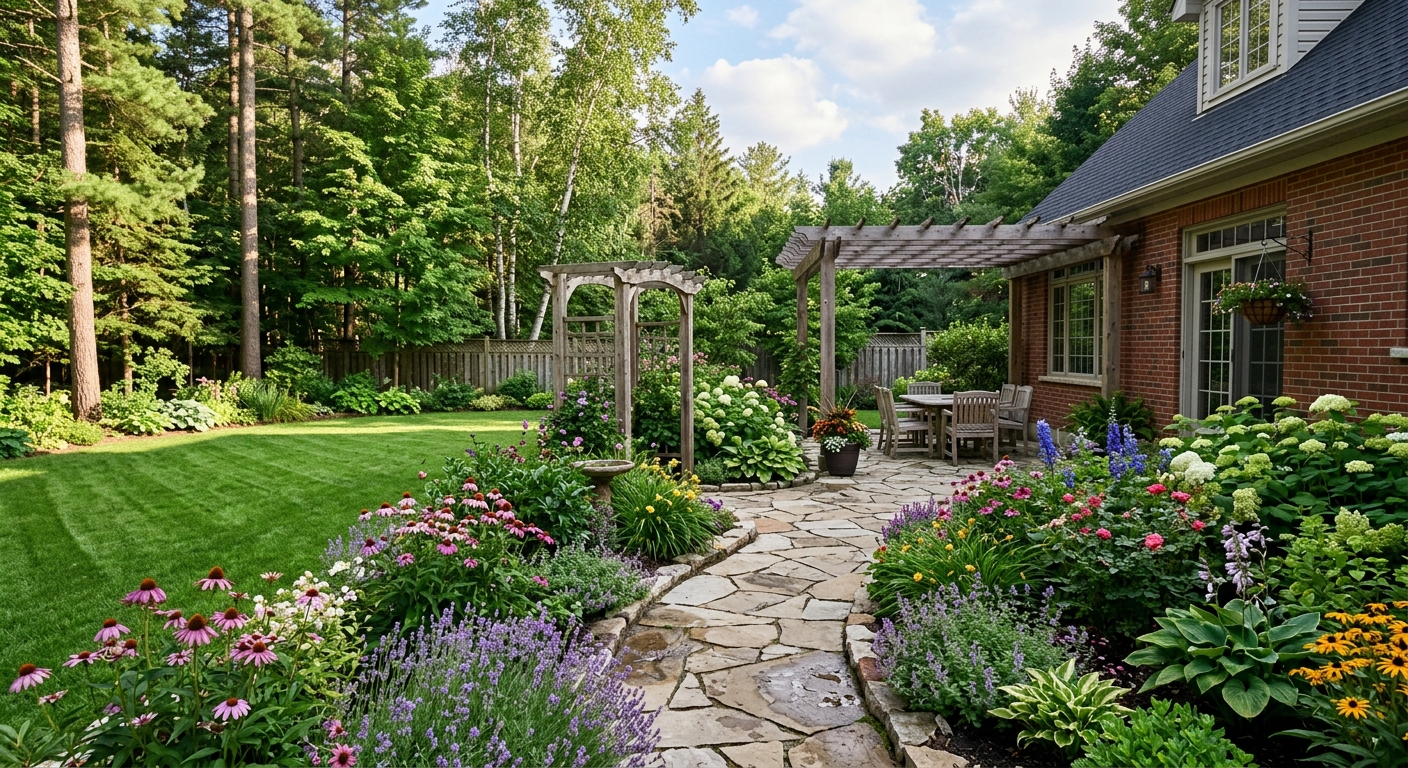
Landscaping options and costs in Chetwynd
Chetwynd homeowners often ask what landscaping will actually cost, and the answer depends on both your yard’s layout and how quickly you want results. With 57.8% of dwellings being single-detached homes (Statistics Canada, 2021 Census), most properties have the space for a full plan—grading, drainage, lawn or turf, and then plantings that can handle Northeast BC’s short frost-free window. Ownership is also common: 63.6% of households own their home (Statistics Canada, 2021 Census), so many residents invest in curb appeal improvements and functional upgrades like patios, shrub borders, and wind-resistant trees.
In the Northeast, landscaping is priced higher than many “coastal” assumptions because the working season is compressed from mid- to late spring through early fall. Contractors also face freeze-thaw cycles that demand deeper base prep and careful drainage under patios and retaining walls. The region’s Zone 2–3 conditions mean only the hardiest trees, shrubs, and perennials establish reliably; tender species are a higher-risk spend. If a job is in demand—like the older, established blocks near downtown Chetwynd and along high-visibility streets—crews may schedule faster but also add mobilization and coordination premiums due to tight summer timelines. That’s why it helps to compare the most common scopes side-by-side before you ask for a quote.
Use the table below as a practical starting point for budgeting the most requested services in Chetwynd.
| Service |
Description |
Season |
Price Range |
| Full landscape design and installation |
Site assessment, grading/drainage plan, softscape + hardscape package, plant layout, installation coordination |
Mid-late spring through early fall |
$8,000–$30,000 |
| Sod installation (supply, grade, lay, roll) |
Remove existing turf (if needed), fine grade, amend soil, lay sod, roll, starter fertilizer and light watering plan |
Late spring to early fall (weather-dependent) |
$3,000–$9,000 |
| Lawn seeding (grade, seed, starter fertilizer) |
Rough/fine grade, seed blend for short-season conditions, starter fertilizer, light covering, establishment guidance |
Spring or early fall |
$3,000–$9,000 |
| Interlocking patio or walkway |
Excavation, compacted base, edging, pavers, levelling, and jointing sand; includes drainage-friendly subgrade setup |
Mid-late spring through early fall |
$6,000–$25,000 |
| Retaining wall (interlocking block) |
Block system, drainage fabric/geotextile, base prep below frost depth, weep provision where needed |
Mid-late spring through early fall |
$6,000–$25,000 |
| Tree and shrub planting |
Plant supply (zone-hardy selections), planting holes, soil amendments, staking (as required), mulch ring, watering plan |
Late spring through early fall |
$1,500–$8,000 |
Prices are estimates only and vary by project scope, site access and material selection.
What affects the price of landscaping in Chetwynd
In Chetwynd, it’s common to see quotes for what looks like the “same” job differ by 30–50% across Northeast BC because the work is mostly about site conditions and timing, not just design preferences. In cold continental climates (Zone 2–3), the frost line and freeze-thaw cycling dictate excavation depth and base design. Contractors also operate within a shorter planting and construction window, so mobilization costs and labour availability can compress into fewer weeks. That is the main reason many Chetwynd projects land in the higher end of the ranges—especially when you need both hardscape and softscape in one season.
Here’s how regional climate differences drive cost comparisons: Prairie-like zones (Zone 2–4) require drought-tolerant, wind-resistant plant palettes and deep, well-compacted bases for patios and retaining walls. Coastal BC (Zone 7–8) can support more lush planting and longer working seasons, but must still manage drainage where heavy rainfall overwhelms shallow subgrades. In the dry BC interior, water restrictions typically favour drip layouts and efficient zoning rather than high-volume spray. Southern Ontario (Zone 5–6) has a moderate season, so the urgency to “finish before frost” is less extreme than in Chetwynd.
Concrete examples that move your price in Chetwynd: (1) A property with a slope that needs re-grading usually adds significant labour and disposal—often pushing a retaining wall project within the $6,000–$25,000 band rather than the lower end. (2) If you’re replacing old turf and building new soil structure, the combination of topsoil/soil amendment and seed or sod establishment can quickly steer a lawn budget toward the mid-range of the $3,000–$9,000 band. (3) Homes built before 1981 make drainage and utility alignment more common—older fill and grading can require extra verification before you excavate.
| Price Factor |
Why It Matters |
Cost Impact |
| Yard size in sq ft — the primary cost driver for softscape |
More area means more labour for prep, more turf/seed, more topsoil/compost, and more edging |
Can swing 20–60% depending on square footage and layout complexity |
| Grading and drainage work — slope corrections add significant cost |
Changing grades affects where water flows away from foundations and toward safe outlets |
Often adds days of labour and heavier equipment, raising totals by 10–40% |
| Drainage bed or French drain installation |
Freeze-thaw punishes poorly drained backfill; drains protect subgrade and retaining wall base |
Can add several thousand dollars when long runs or multiple outlets are required |
| Plant material tier — native shrubs vs. ornamental vs. mature specimen trees |
Hardiness, survival risk, and transplant size determine both price and success rate in Zone 2–3 |
May double material cost when moving from starter sizes to larger specimens |
| Hardscape vs. softscape ratio — walls and patios cost more per sq ft than lawn |
Stonework needs excavation, base aggregates, compaction, and precise levelling |
High hardscape budgets commonly shift jobs into the upper portion of hardscape bands |
| Irrigation system design and installation |
Efficient water use and winter-proofing reduce waste and protect plant establishment |
Can add 15–30% to planting budgets if a full system is installed |
| Soil amendment and topsoil required |
Compacted or sandy/rocky native soils often need structure and nutrients for turf and shrubs |
Raises costs when trucking, spreading, and re-compaction are required |
| Tree removal or stump grinding before new planting |
Root disturbance and debris removal can add time and disposal |
Frequently adds a few thousand dollars depending on stumps and access |
Permits & regulations in British Columbia
In British Columbia, many routine landscaping tasks—such as planting shrubs and trees, sodding, and most softscape work (grading for planting beds when it doesn’t affect drainage requirements)—typically do not require a permit. However, there are situations where you should expect permitting. Retaining walls above a height threshold—commonly around 1.0 m (3.3 ft) in many municipalities—often require a building permit and sometimes engineered drawings, especially if there’s a significant load, nearby structures, or challenging soils. Also, changes to lot grading that affect how water drains toward neighbouring properties or storm sewer connections may trigger approval requirements.
Before any digging, you should also request utility locates (a professional contractor should do this as part of safe excavation). This matters for planting holes, French drains, and retaining wall footings.
How to verify a contractor’s credentials in Chetwynd (BC): start with their licensing/registration (where applicable) using the provincial online registry for trades; confirm liability insurance with a current Certificate of Insurance that lists your project as an additional insured where required; and check coverage such as WSIB/WCB (or equivalent provincial coverage) by asking for clearance documentation and matching it to the contractor name/entity on the quote. Then request these documents as PDFs before work begins, not after.
Planning a landscape that thrives in Chetwynd's climate
Planning in Chetwynd works best when you design around the limits of Zone 2–3 conditions, short establishment windows, and freeze-thaw impacts on soil and subgrades. Start with plant selection: choose native and zone-appropriate species that can handle cold, dry windy spells, and winter exposure with minimal special protection. Next, be realistic about sod versus seed. Sod gives instant visual results and faster coverage, but it’s typically more expensive than seeding—often about 3–4x per sq ft in practice—so it’s most justified where you need quick erosion control or immediate curb appeal.
Drainage and grading are non-negotiable in the Northeast: water pooling around foundations can combine with freeze-thaw to heave soil and damage edging and plants. A good plan routes surface water away from the house, uses appropriate slopes, and includes under-surface drainage where needed. For hardscape like patios and retaining walls, base preparation must be built for frost. That means thicker, well-compacted aggregate layers and proper drainage behind walls.
Finally, low-maintenance design strategies save money long-term: use groundcovers and mulched shrub borders to reduce weeding, and select perennials that return reliably. Consider xeriscape-inspired planting (drought-tolerant perennials, mulches, and efficient watering) and rain-garden features where water can be safely stored and infiltrated—rather than letting it sit near the basement.
Dollar example: if you have a medium lawn area, a sod install might land in the $3,000–$9,000 band, while seeding may budget similarly only when the grading and soil prep are modest; if extensive grading is required, spending on site prep benefits both options. In that case, choosing seeding to reduce turf cost can free up budget for a tree and shrub planting package in the $1,500–$8,000 range—where the climate-hardy selections actually improve survival.
| Element |
Climate Consideration |
Maintenance Level |
Price Band |
| Sod lawn installation |
Needs reliable warmth for roots to grab before frost; protect during wind and dry spells |
Medium during establishment (watering guidance + first mowing) |
$3,000–$9,000 |
| Native perennial garden |
Zone-appropriate plants survive colder winters with less winter cover; mulch helps |
Low to medium (spring clean-up + seasonal weeding) |
$1,500–$8,000 |
| Mulched shrub border |
Wind-tolerant, hardy shrubs reduce die-back risk; mulch buffers freeze-thaw |
Low (top up mulch; occasional pruning) |
$1,500–$8,000 |
| Interlocking stone patio |
Requires frost-safe base and drainage to prevent heaving or settling |
Low (periodic joint sand top-up, occasional weed control) |
$6,000–$25,000 |
| Retaining wall (block) |
Needs below-frost-depth base prep and proper drainage behind the wall |
Low (visual inspections after freeze-thaw seasons) |
$6,000–$25,000 |
| Drip irrigation system |
Efficient for short-season establishment; winter-proofing reduces freeze damage |
Medium (seasonal start-up/shut-down + adjustments) |
$8,000–$30,000 |
How to choose a landscaping contractor in Chetwynd
Choosing the right contractor in Chetwynd (British Columbia) starts with verifying the basics and then confirming details in writing. Ask for their liability insurance and proof of WSIB/WCB coverage (clearance documentation). For licensing/registration, check the applicable provincial online registry for the contractor entity listed on the quote—don’t rely on a salesperson’s verbal confirmation. If they can’t produce documents promptly, treat it as a red flag.
Next, get 2–3 itemised written quotes that separate labour and materials (not just one lump sum). A proper quote for a lawn plus plantings should show what’s included for grading, soil amendment, edging, disposal, and any irrigation components. Read the exclusions carefully: does it include permit pulls (if required), utility locate, disposal of removed turf, and base materials for hardscape? For workmanship, ask for the workmanship warranty length and what it covers (settlement, drainage failures, plant establishment policy if included). Also ask about manufacturer warranties for products like retaining wall systems and select planting materials—then confirm whether the warranty is transferable to you as the homeowner.
Payment schedule matters: never pay more than 10–15% upfront. Hold back a portion until the job is complete and you’ve received final clean-up and any required handover (like irrigation shutdown instructions). Finally, insist on a start date and completion estimate in writing, because the Northeast’s short working season makes delays more expensive.
- Confirm the contractor name on the quote matches the name on insurance/coverage documents.
- Request Certificate of Insurance and proof of WSIB/WCB clearance before work begins.
- Get itemised line items (labour, materials, equipment, and disposal) rather than a lump sum.
- Ask who does utility locates and whether costs are included.
- Verify grading/drainage scope in writing (who ensures water sheds away from the foundation?).
- Confirm topsoil/soil amendment rates and whether they’re included.
- For retaining walls, require a written drainage plan (weeping/drainage behind wall).
- Confirm base depth expectations for frost protection under patios/walkways.
- Check whether disposal/haul-away is included for removed turf, stumps, or excess soil.
- Ask for the warranty terms for workmanship and what counts as a warranty claim.
- Set payment terms with a small deposit (10–15%) and a holdback until completion.
- Require a start/completion timeline that accounts for spring site conditions and weather.
Red flags in Chetwynd include: quoting without seeing the site, refusing to provide insurance/coverage paperwork, missing drainage details in retaining wall proposals, offering only lump-sum pricing with unclear inclusions, and asking for large upfront payments (beyond 10–15%) without a signed scope and schedule.
Frequently asked questions — landscaping in Chetwynd
How much does a retaining wall cost in Chetwynd?
In Chetwynd, an interlocking block retaining wall typically falls within the $6,000–$25,000 range, depending on wall length, height, access, and the amount of excavation and base preparation needed for frost. If your yard has a slope requiring extensive grading or there’s a need for a proper drainage bed/French drain behind the wall, expect the project to land closer to the upper end. Older home sites (many built before 1981) can also have buried fill or drainage patterns that require extra investigation before excavating. A clear contractor quote should itemise base materials and drainage components, not just the wall blocks.
When is the best time to landscape in Chetwynd?
The practical landscaping season in Northeast BC usually runs from mid- to late spring through early fall, because winter cold and freeze-thaw can damage poorly established turf and plants. Sod is best installed when the ground is workable and roots can establish before the first killing frosts; seeding can work in spring or early fall with correct soil contact and starter fertiliser. Hardscape like patios and retaining walls should be timed for stable ground conditions so base aggregates can be properly compacted and drained. If you’re planning planting, aim for periods with consistent moisture and avoid planting right before a hard cold snap.
Do I need a permit for a retaining wall in British Columbia?
Often, yes—retaining walls above a height threshold (commonly around 1.0 m (3.3 ft)) typically require a building permit and sometimes engineering in British Columbia. Exact triggers can vary by municipality and site conditions, especially where the wall affects drainage toward neighbouring properties or where there’s a significant load. For Chetwynd homeowners, the safest approach is to ask the contractor to confirm whether your wall height and site slope likely require a permit before scheduling excavation. A permit-required project should be reflected in the written scope, including any engineer drawings if needed.
How do I improve drainage in my yard?
In Chetwynd, drainage improvements should focus on both surface runoff and sub-surface water. Start by checking where water pools after rain or snowmelt, and confirm the grade slopes away from the foundation. If pooling persists, a contractor may recommend a drainage bed or a French drain installed with proper geotextile and cleanouts. For retaining walls, drainage behind the wall is essential so freeze-thaw doesn’t push waterlogged soil out and compromise the base. Before digging for drains or wall footings, ensure utility locates are done, and build the plan to manage water safely without sending it onto a neighbour’s property.
What is xeriscaping and does it suit Chetwynd?
Xeriscaping is a landscaping approach designed to reduce watering by using drought-tolerant, zone-appropriate plants, mulch, and efficient irrigation or water zoning. In Chetwynd and Northeast BC, it generally suits homeowners well because the climate’s wind exposure, short growing season, and occasional water restrictions make low-water design practical. That said, “xeriscape” doesn’t mean no water—it means watering smarter during establishment. You can pair hardy native perennials, mulched shrub borders, and groundcovers with drip irrigation (where feasible) to support survival without heavy spray. For budgeting, a planting package might fit within $1,500–$8,000 depending on size and plant tier.
How do I plan a low-maintenance yard?
A low-maintenance yard in Chetwynd starts with the right plant mix for Zone 2–3: hardy native shrubs, reliable perennials, and winter-tough groundcovers placed where wind and sun conditions are realistic. Use mulch to suppress weeds and buffer freeze-thaw. Reduce seasonal labour by limiting turf to what you truly need and replacing some grass area with mulched borders and perennial beds. Drainage and grading are part of “maintenance,” because pooled water increases plant failure and increases rework costs. If you want fast coverage, sod can work—typically within $3,000–$9,000—but seeding is often more budget-friendly when you have a well-prepared base and time for establishment.