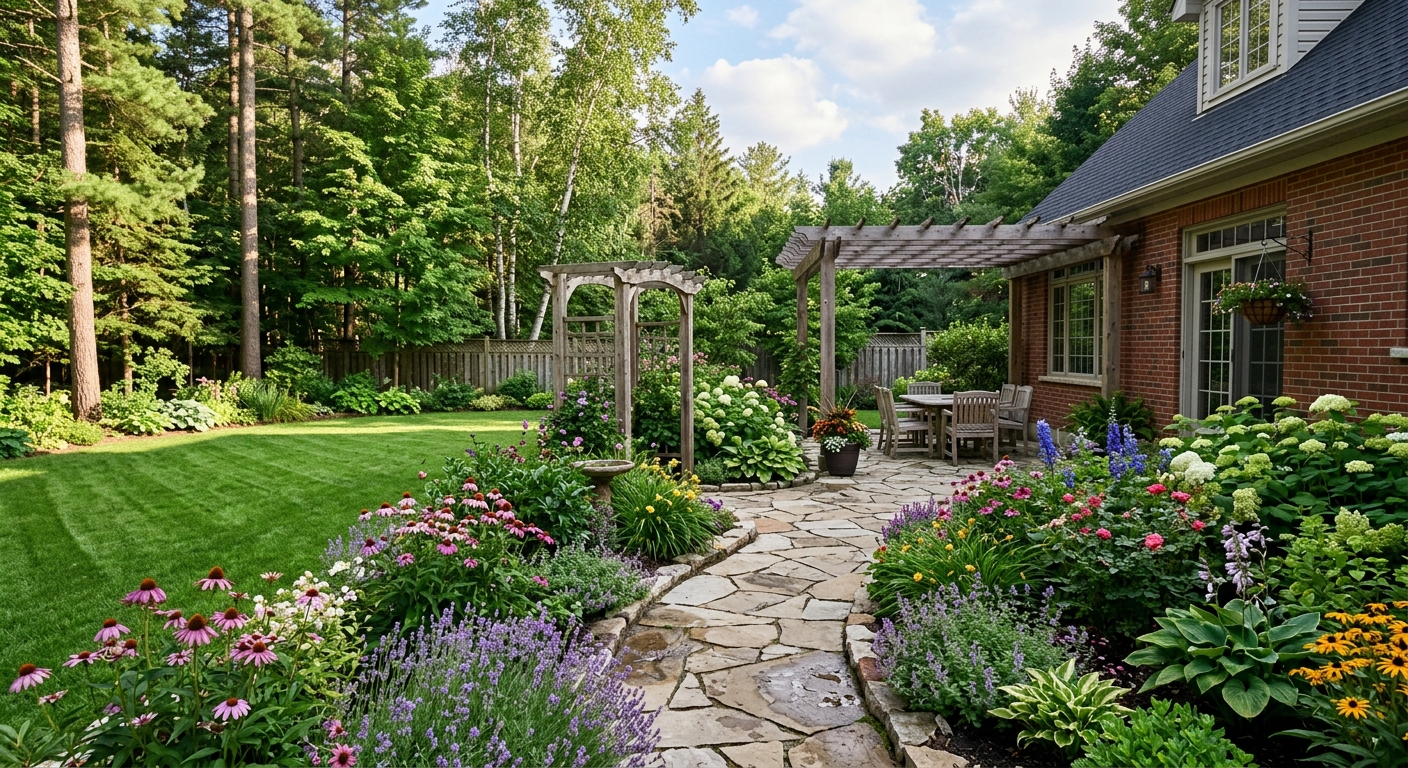
Landscaping options and costs in Hanceville
Hanceville homeowners often start by asking what landscaping will actually cost, and the answer depends on how much you want to change: a simple refresh, or a full redesign with drainage, planting, and hardscape. With a population around 10,000 (Statistics Canada, 2021 Census), the town’s housing stock is typically set up with yards that support meaningful curb-appeal upgrades—especially on the more established residential pockets where homeowners tend to invest in walkways, patios, and layered gardens as properties age. In the Lower Mainland–Southwest, we generally work within plant hardiness zones 7–8, where winter damage risk is lower and the growing and working season is longer than in many parts of BC. That extended season can reduce schedule pressure (and sometimes total labour hours) compared with shorter frost-free regions.
Even with mild winters, Lower Mainland–Southwest landscaping costs are shaped by heavy-rainfall periods and freeze–thaw cycles that still affect patios, retaining walls, and any foundation-adjacent grading. Contractors also have to design around water efficiency expectations: while Hanceville isn’t the dry BC interior, rising water costs and local bylaw trends push more efficient irrigation (often drip plus smart controllers). In practice, I see the strongest demand for full makeovers and hardscape + planting packages in the older, walkable residential areas near the town centre, where driveways and frontage often need both drainage fixes and better visual structure. Below is a practical cost comparison to help you align quotes with scope before you book a site visit.
| Service |
Description |
Season |
Price Range |
| Full landscape design and installation |
Site visit, concept + layout, grading/drainage strategy, plant plan, sod/seed or planting, edging, and hardscape components where included |
Spring to fall (softscape nearly year-round; wet weeks may shift scheduling) |
$8,500 – $45,000 |
| Sod installation (supply, grade, lay, roll) |
Minor grading, soil prep, sod supply, lay/roll, starter fertilizer, and first-season care guidance |
Late March to November (best during stable cool-to-mild stretches) |
$3,000 – $7,500 |
| Lawn seeding (grade, seed, starter fertilizer) |
Grading/overseeding, seed + starter fertilizer, light covering and initial watering plan |
Early spring to early fall (avoid hottest, driest weeks where possible) |
$2,000 – $5,500 |
| Interlocking patio or walkway |
Excavation, base material, compaction, edging, pavers/interlocking stone, and clean finishing |
Spring to fall (structure prep also protected from wet conditions) |
$10,000 – $35,000 |
| Retaining wall (interlocking block) |
Block wall build with proper drainage behind the wall, base preparation, and steps/caps if required |
Spring to fall (dry access days matter for compaction and finishing) |
$15,000 – $55,000 |
| Tree and shrub planting |
Soil/compost amendments, planting layout, staking where needed, mulch ring, and initial watering plan |
Spring to early fall (container stock often extends the window) |
$1,200 – $14,000 |
Prices are estimates only and vary by project scope, site access and material selection.
What affects the price of landscaping in Hanceville
In Hanceville and across the Lower Mainland–Southwest, it’s common to see quotes for the “same” landscaping project differ by 30–50% once you separate true scope from assumptions. Labour availability, excavation difficulty, and material choices (especially mature plants and drainage systems) all swing the total. In British Columbia, the working season is usually longer than in Prairie cities, but weather can still pause crews during the wettest winter stretches—so contractors price schedule risk into bigger builds. The plant hardiness zone also matters: here we’re typically in Zone 7–8, so we can plant a lush palette with more evergreen structure than you’d use farther inland, but we still must design for persistent moisture and drainage.
Climate influences cost in two directions. Coastal BC’s mild winters allow more planting variety and a longer growing season, which can reduce rework from winter die-off, yet the soil often stays wet, so drainage and base prep become non-negotiable. In contrast, drier BC interior areas face water restriction design pressures; that pushes irrigation upgrades earlier. Prairie regions (Zone 2–4) typically need drought-tolerant, wind-hardy planting and have compressed schedules due to frost windows, and retaining wall base depth must reach below the frost line—so wall excavation is more expensive there. Southern Ontario (Zone 5–6) has a moderate season and often needs irrigation planning during summer dry spells. Those differences are why the same paver patio can land in different price bands across Canada—here we’re often planning more for drainage efficiency and compaction on freeze–thaw than for ultra-short season construction.
Concrete examples I see often: (1) a simple lawn refresh can stay near the seeding band (for instance, roughly $2,000–$5,500) if drainage is already adequate, but if the yard has a slope that funnels water toward the foundation, grading + drainage bed work can push it closer to full landscape design territory like $8,500–$45,000. (2) Tree and shrub planting around mature specimen trees costs more due to soil volume and sometimes crane/rigging access; it can move from the lower planting band (about $1,200–$14,000) toward the top end when you add larger stock and staking. (3) If your home’s landscaping hasn’t been updated since major renovations years ago, existing compacted subsoil can force additional soil amendment and topsoil replacement—adding measurable cost.
| Price Factor |
Why It Matters |
Cost Impact |
| Yard size in sq ft — the primary cost driver for softscape |
More square footage means more excavation, soil prep, seed/sod, mulch, and maintenance labour |
Higher material + labour totals can noticeably increase quotes, often most strongly for lawns and borders |
| Grading and drainage work — slope corrections add significant cost |
Fixing pooling and directing runoff away from foundations requires excavation, re-shaping, and compaction |
Common reason for large jumps between “refresh” and “full install” scopes |
| Drainage bed or French drain installation |
BC’s wet winters demand properly placed drainage media and outlet planning |
Can add thousands depending on run length and tie-in complexity |
| Plant material tier — native shrubs vs. ornamental vs. mature specimen trees |
Larger, older specimens cost more and may require extra soil volume, staking, and careful planting |
Material cost and labour both rise; specimen work often drives the top end of planting budgets |
| Hardscape vs. softscape ratio — walls and patios cost more per sq ft than lawn |
Pavers, base stone, compaction, and labour are more expensive than seeding or typical mulch beds |
Switching from lawn to patio/walkway can quickly move a project into the interlocking band |
| Irrigation system design and installation |
Drip lines, valves, controllers, and layout planning are required for efficient coverage |
Strong price variance depending on zones and whether tied into existing services |
| Soil amendment and topsoil required |
Soil quality affects plant establishment and long-term lawn performance, especially on compacted yards |
More imported topsoil/compost and labour increases cost, especially where drainage needs fixes |
| Tree removal or stump grinding before new planting |
Removal triggers disposal, access logistics, and root-related excavation challenges |
Often a major add-on that can change both timeline and total price |
Permits & regulations in British Columbia
In British Columbia, most typical softscape work—planting, sodding, and routine lawn and garden installation—generally does not require a permit. That said, some projects do cross into permitting territory. Retaining walls above a height threshold (commonly around 1.0 m in many municipalities, though requirements can vary) typically require a building permit and, in some cases, engineered drawings. If you’re changing lot grading in a way that affects drainage toward neighbouring properties or storm connections, that can also trigger an approval pathway. Whenever you’re digging—planting holes or wall footings—confirm utility locates first so crews don’t strike buried services.
For a Hanceville homeowner, here’s the verification routine that prevents surprises: (1) Ask your contractor for their current business contact details and request proof of liability insurance. (2) Request proof they carry the correct workers’ compensation coverage (WCB) for their employees—this is especially important when crews are onsite. (3) If sub-trades are involved (excavation or hardscape specialty work), confirm they’re also insured and covered. (4) Then look up their professional credentials online using provincial registries where applicable, and verify the certificate of insurance is active and matches your project location. (5) Get a clearance letter or confirmation document if your contractor provides it as part of their normal compliance package. For permitting scope, rely on a written allowance in your quote: ask whether permits are included and who is responsible for submission.
Finally, confirm local water-use and irrigation expectations. In BC’s wider context, drought conditions in parts of the province have pushed municipalities to favour efficient irrigation; even here, good design (like drip and smart controllers) helps you stay compliant and protect plant health.
Planning a landscape that thrives in Hanceville's climate
To design a yard that truly thrives in Hanceville, the goal is to work with our Zone 7–8 conditions—mild winters, frequent rain, and freeze–thaw cycles that still stress foundations and bases—rather than trying to “fight” the site. Start with plant selection: choose native and zone-appropriate species, prioritizing plants that tolerate both wet periods and cooler shoulder seasons. Then plan your lawn strategy. In Lower Mainland–Southwest conditions, sod gives instant visual payoff and can stabilize soil quickly, but it costs roughly 3–4x more per square foot than seeding. Seeding is often the smarter value if you can accept a slower establishment timeline.
Drainage and grading are critical because pooling water can undermine both plants and nearby structures. Even a “small” grading change can impact how runoff behaves during wet winters. For hardscape—patios and retaining walls—base preparation must account for freeze–thaw: properly excavate, compact, and build the base so water can move away safely, reducing the risk of frost heave and wall movement. Low-maintenance design strategies help you keep curb appeal without constant upkeep: groundcovers, mulch layers, and long-blooming perennials reduce annual weeding compared with bare soil, while also supporting beneficial habitat.
Where water efficiency matters, consider rain-garden features or targeted xeriscape zones—particularly around downspouts—so you’re not forcing turf to do what better plantings can. Example: if a 400 sq ft lawn area needs work, seeding can often fit a budget around the lower seeding band (think approximately $2,000–$5,500), while sod for the same footprint may land closer to the sod band (roughly $3,000–$7,500) depending on prep. That price difference is justified if you need immediate usability (pets, kids, events) or if you must stabilize soil fast after grading changes. Otherwise, seeding plus a well-designed border and drip irrigation can deliver similar long-term results for less money.
| Element |
Climate Consideration |
Maintenance Level |
Price Band |
| Sod lawn installation |
Rapid establishment helps manage wet-season soil conditions and reduces erosion during cool months |
Low in the first year after establishment; moderate watering guidance early on |
$3,000 – $7,500 |
| Native perennial garden |
Zone-appropriate planting reduces winter stress and supports year-round structure in Zone 7–8 |
Low to moderate (mulch refresh and seasonal tidy-up) |
$1,200 – $12,000 |
| Mulched shrub border |
Mulch improves soil moisture balance and moderates temperature swings near foundations |
Low (weeding control and occasional pruning) |
$2,500 – $10,000 |
| Interlocking stone patio |
Proper base compaction and drainage prevent movement during freeze–thaw cycles |
Low (minor joint maintenance; occasional leveling checks) |
$10,000 – $35,000 |
| Retaining wall (block) |
Wall drainage and deep, stable bases are essential to manage wet winter runoff |
Low (periodic inspection of weep holes/edges) |
$15,000 – $55,000 |
| Drip irrigation system |
Efficient watering supports plants through cool wet periods and any dry spells without over-saturation |
Low once set up (seasonal checks and controller programming) |
$2,000 – $10,000 |
How to choose a landscaping contractor in Hanceville
Choosing the right contractor in Hanceville is mostly about verification and clarity. First, confirm British Columbia coverage items. Ask for proof of liability insurance (so you’re protected if someone’s property is damaged during excavation or hardscape work). Next, confirm workers’ compensation coverage (WCB) for employees—this matters when crews are digging, hauling, or operating equipment. If the contractor uses subcontractors for excavation or specialty drainage, request their insurance and WCB proof as well.
Then get 2–3 itemised written quotes. You want a labour + materials breakdown (not only a lump sum), with line items for grading, base prep, drainage materials, plant quantities/sizes, disposal, and any irrigation components. Read the scope carefully for exclusions: is haul-off included, is permit pulling included (if required), and are utility locates referenced? Ask whether they handle setbacks and final finishing (topsoil, edging, cleanup). For warranties, separate workmanship warranty (often a set period for installation quality) from manufacturer warranties for products (like irrigation components or some paving materials). Ask if warranties are transferable to a future homeowner—this can matter if you sell within a few years.
Payment schedule matters. Never pay more than about 10–15% upfront. Hold back a portion until the job is complete, inspected, and any deficiencies are addressed. Finally, insist on a written timeline with a proposed start date and completion estimate. A long working season in the Lower Mainland–Southwest helps, but good crews still need weather windows for drainage and base compaction.
- Confirm they’re insured with current liability coverage matching the worksite
- Verify WCB coverage for employees (request documentation)
- Ask who does excavation/drainage and confirm subcontractor credentials
- Require 2–3 itemised quotes with quantities (sq ft, linear ft, plant counts/sizes)
- Clarify what’s included: topsoil import, disposal/haul-off, compaction, edging
- Ask whether utility locates are arranged before digging
- Confirm permit responsibility if a retaining wall threshold may apply (and request permit allowance wording)
- Get a workmanship warranty in writing, including what triggers a service call
- Confirm manufacturer warranties for irrigation/pavers and whether they’re transferable
- Use a payment plan: 10–15% max upfront; staged payments tied to milestones
- Request a site schedule that accounts for wet-weekwork limitations
- Make sure the quote includes cleanup, final grading, and watering guidance
Red flags in Hanceville: (1) they won’t provide insurance/WCB documentation; (2) quotes are only one-page lump sums with no quantities; (3) they dismiss drainage as “optional” near patios/walls/foundation edges; (4) they demand large deposits upfront; (5) they can’t explain freeze–thaw base prep for hardscape or drainage tie-ins.
Frequently asked questions — landscaping in Hanceville
How do I prevent weeds in my Hanceville garden?
Weed control starts before you plant: remove roots and weed seeds, then improve the soil so your plants establish quickly. In Hanceville and the broader Lower Mainland–Southwest (Zone 7–8), I recommend a layered approach—landscape fabric is optional, but a thick, consistent mulch layer (typically 2–3 inches) plus edging that blocks grass encroachment is often more effective for long-term control than relying on fabric alone. For mulched shrub borders, budget for proper bed prep as part of the planting work (for many gardens, this sits in the mid range of the planting budget). If you’re also building a new lawn, sharp grading and seed/sod establishment reduces bare patches that weeds exploit. Finally, ask your landscaper to specify what groundcovers/perennials they’re using to fill space quickly, since open soil is where weeds take hold. (Statistics Canada, 2021 Census)
How do I design a low-water yard in Hanceville?
Even though Hanceville has a milder coastal-style climate than much of BC Interior, low-water design still pays off because water costs and efficiency expectations are increasing. Start with “right plant, right place”: use zone-appropriate native perennials, shrubs, and groundcovers in areas that get most sun, and reserve turf for the portions that truly need it. If you’re choosing between sod and seed, seeding is typically the more economical base that you can pair with targeted drip for faster savings—sod installation usually lands around $3,000 – $7,500, while lawn seeding is often closer to $2,000 – $5,500. Add a drip irrigation system designed by zone (not just a timed sprinkler upgrade) and consider rain-garden elements near downspouts to capture runoff. The key is drainage + efficient watering: too much irrigation can also worsen moss and weak turf in wet periods.
How do I find a licensed landscaper in Hanceville?
In Hanceville, the practical way to verify a landscaper is to request documentation and confirm coverage—don’t rely only on a brand name or a website photo gallery. Ask for (1) proof of current liability insurance, (2) workers’ compensation coverage (WCB) for employees, and (3) a clear, itemised quote that shows quantities, labour, and materials. If any subcontractors are used (excavation, drainage, or specialty hardscape), confirm their credentials too. You can also check the provincial online registry sources that list certain contractor credentials, but coverage documents are often the most immediate protection for homeowners. During your review, look specifically for how they plan drainage tie-ins and hardscape base prep for freeze–thaw conditions. A credible contractor in the Lower Mainland–Southwest should comfortably explain what’s included, whether haul-off/disposal is part of the scope, and how they handle scheduling during wet weeks.
How much does landscaping cost in Hanceville?
Landscaping in Hanceville usually falls into clear bands once you separate softscape (planting/lawn) from hardscape (patios/walls) and drainage. For many homeowners, a full design-and-install project with grading, planting, and some hardscape typically starts around $8,500 – $45,000. For lawn work, sod is commonly priced near $3,000 – $7,500, while seeding often lands around $2,000 – $5,500 depending on prep and square footage. Interlocking patios and walkways often run higher—commonly $10,000 – $35,000—because base prep, compaction, and labour are substantial. If drainage issues exist near foundations, the “add-ons” can shift a project upward quickly, so get quotes that itemise grading and drainage rather than assuming it’s already fine. (Statistics Canada, 2021 Census)
What plants thrive in Hanceville's climate zone?
Hanceville landscaping generally benefits from Zone 7–8 plants that handle mild winters, long cool growing periods, and wet seasons. Thriving choices often include broadleaf evergreens for structure (less winter damage risk), long-blooming perennials for seasonal colour, and hardy shrubs that tolerate both rainfall and occasional drier weeks. Native perennial gardens usually perform well because they’re adapted to local conditions and often require less fuss once established. For borders, I typically design with layered heights: taller shrubs for structure, mid-layer perennials for bloom, and low groundcovers to reduce weeds and retain moisture. If you want a lawn-adjacent look, pairing turf with mulched planting beds reduces maintenance. Your landscaper should also match plant locations to sun exposure and drainage—poorly placed plants can fail even if they’re “zone correct.” A good plan will also consider frost timing (spring planting window is generally early March to early April near the coast).
Sod vs seed — which is better for a Hanceville lawn?
Both can work well in Hanceville, but “better” depends on your timeline, budget, and site preparation needs. Sod delivers instant coverage and helps stabilize soil right away, which can be ideal if you’re finishing grading or need immediate usability. The trade-off is cost: sod installation commonly sits around $3,000 – $7,500, while seeding is often closer to $2,000 – $5,500 because materials and labour are lower. Seeding is a strong choice if you can manage establishment watering and you’re comfortable waiting for density. Also consider drainage: if your lawn area stays soggy due to grading, both sod and seed can struggle—fixing drainage/grade first is usually the real “best option.” A practical approach many homeowners take is seeding the larger lawn areas for value, then using sod only where you need fast, durable coverage (like a small frontage section).