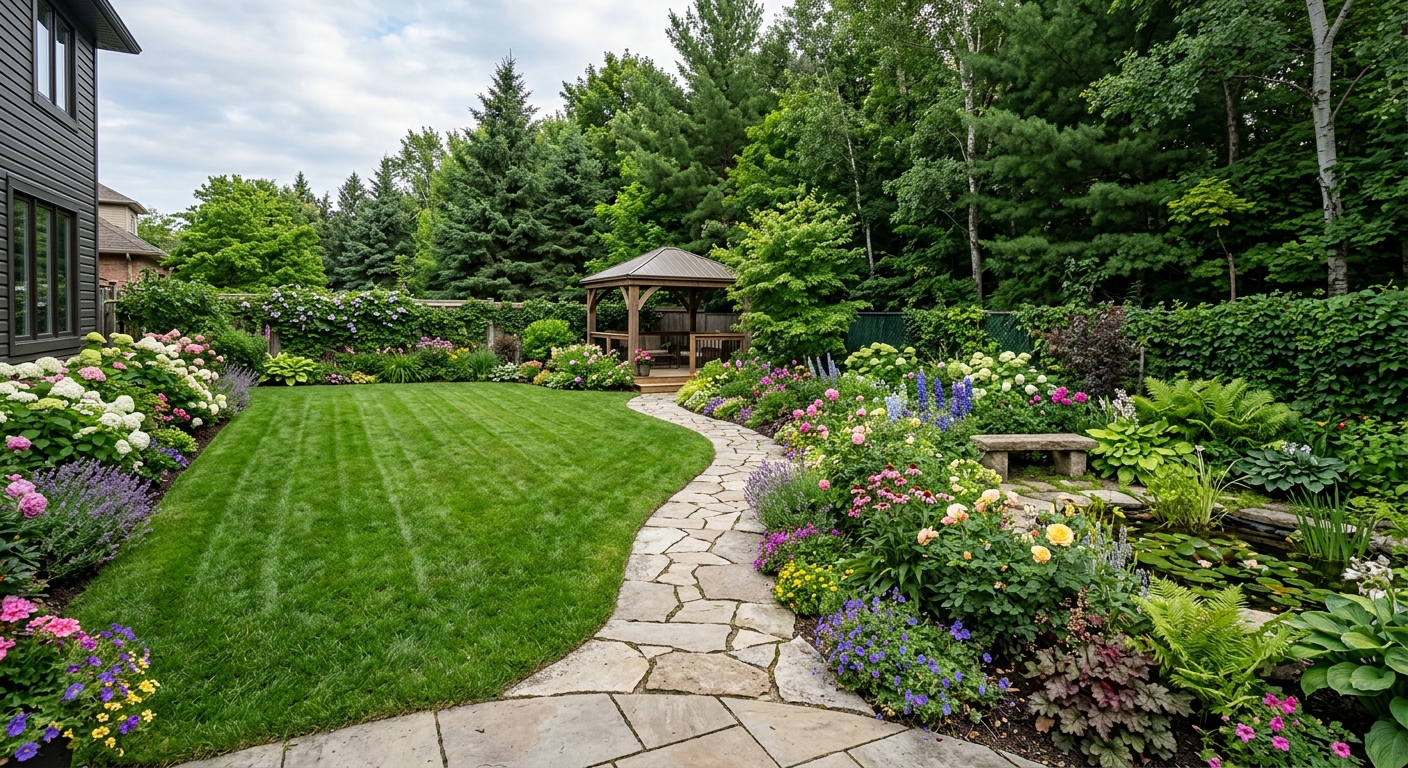
Landscaping options and costs in Fort Langley
Fort Langley homeowners typically think about landscaping in two waves: improving curb appeal for existing houses and upgrading outdoor living spaces as families spend more time at home. With a community population of 3,836 (Statistics Canada, 2021 Census), the local contractor pool is smaller than in larger Metro Vancouver centres, so well-planned projects often book earlier—especially in popular areas like downtown Fort Langley and the surrounding heritage-adjacent blocks where driveways, drainage, and mature trees affect access and staging. If you’re on a street with detached homes and more yard depth, you also tend to have more room for layered planting, a second patio zone, or a workable lawn area—so scope grows quickly compared with townhouse settings.
In the Lower Mainland–Southwest, landscaping costs reflect a long working and growing season in plant hardiness zones 7–8, plus frequent wet-season ground conditions. Contractors can plant broadly for most of the year, but freeze–thaw is still a factor for structural work (patios, retaining walls, and drainage bases), which requires deeper excavation, proper compaction, and engineered drainage so frost heave and wall movement don’t show up later. That combination—extended planting opportunities and careful hardscape base prep—helps explain why a typical “same-size” yard can land anywhere from budget softscape upgrades to full design builds.
Below are realistic cost ranges you can use to compare quotes in Fort Langley, then we’ll break down the specific drivers behind those differences.
| Service |
Description |
Season |
Price Range |
| Full landscape design and installation |
Site walk, concept + planting plan, grading/drainage coordination, material ordering, and installation of softscape and select hardscape. |
Year-round (best spring–fall for planting; hardscape depends on weather) |
$5,000–$50,000 |
| Sod installation (supply, grade, lay, roll) |
Soil prep, fine grading, sod supply, delivery, roll/fit, and post-lay rolling/initial watering guidance. |
Late spring to early fall (avoid the wettest periods and extremes) |
$2,000–$8,000 |
| Lawn seeding (grade, seed, starter fertilizer) |
Grading, seed blend, starter fertilizer, raking/rolling, and weed-control starter steps. |
Early spring or late summer/early fall |
$1,500–$6,000 |
| Interlocking patio or walkway |
Excavation, compacted base, edge restraints, interlocking stones, and jointing sand; includes a simple slope plan for drainage. |
Spring–late fall (weather-dependent) |
$8,000–$40,000 |
| Retaining wall (interlocking block) |
Layout, excavation, compacted base, drainage gravel/geotextile, block installation, and cap/finish. |
Spring–late fall |
$10,000–$80,000 |
| Tree and shrub planting |
Plant supply (starter to larger sizes), soil amendments, staking where needed, mulch rings, and cleanup. |
Most of the planting season (soft winters help) |
$1,000–$15,000 |
Prices are estimates only and vary by project scope, site access and material selection.
What affects the price of landscaping in Fort Langley
Even when two homeowners describe the “same” landscaping project, quotes across the Lower Mainland–Southwest—and across all of British Columbia—can swing by 30–50% based on scope, soil conditions, and how much of the hard work gets included. In Fort Langley, the reason is simple: the Lower Mainland–Southwest benefits from plant hardiness zones 7–8 and a longer working season, but contractors still need to build correctly for wet ground and seasonal freeze–thaw around structural bases. In Prairie regions (Zone 2–4), a shorter frost-free window and harsher winters often shift designs toward drought-tolerant, low-maintenance planting and tighter construction schedules. That changes both the materials and how labour is planned. In Southern Ontario (Zone 5–6), the season is more moderate, but summer dry spells can drive irrigation needs. When you compare British Columbia to these regions, you’re effectively comparing different growth conditions and different construction constraints—so $ work isn’t directly transferable.
Two concrete examples from Fort Langley: first, heavy rain and clay-leaning soils can force additional drainage work before sod or planting succeeds, which moves costs toward hardscape and drainage line items within the retaining wall & hardscaping band (often the same $10,000–$80,000 range when drainage and base prep balloon). Second, a sloped yard or a driveway that requires tight access means more machine time, more manual excavation, and extra haul/disposal—pushing labour-intensive projects closer to full design & installation pricing (from about $5,000 up to $50,000).
Housing age matters too. Older lots often have compacted soils and buried services; if you need soil amendment, topsoil, or re-grading, you can easily add several thousand dollars even on a “small” refresh, because the foundation for lawns and planting has to be rebuilt—not just covered.
| Price Factor |
Why It Matters |
Cost Impact |
| Yard size in sq ft — the primary cost driver for softscape |
Most labour and materials scale directly with coverage area for sod, seed, mulch, and plant spacing. |
Can change total cost by 20%–60% depending on lawn and planting footprint |
| Grading and drainage work — slope corrections add significant cost |
Proper surface grades reduce pooling, protect foundations, and improve plant survival in wet winters. |
Often adds $2,000–$12,000+ on sloped or poorly draining lots |
| Drainage bed or French drain installation |
Targets standing water and root-rot risk; requires excavation, gravel, fabric, and tie-in strategy. |
Commonly increases budgets by $3,000–$15,000 depending on length and outlet complexity |
| Plant material tier — native shrubs vs. ornamental vs. mature specimen trees |
More mature trees cost more and require extra rigging, staking, and careful transplant handling. |
Can swing $1,000–$10,000+ within the same overall planting quantity |
| Hardscape vs. softscape ratio — walls and patios cost more per sq ft than lawn |
Patios and retaining walls require deeper bases, restraints, compaction, and sometimes engineering. |
Shifting 200 sq ft from lawn to patio can add several thousand dollars |
| Irrigation system design and installation |
In BC, efficient irrigation protects investment and helps manage water costs; drip and smart controls reduce waste. |
Typically adds $1,500–$8,000+ depending on zones and coverage |
| Soil amendment and topsoil required |
Wet-season success depends on structure: amended soil improves drainage and root development. |
Often adds $500–$4,000+ on refresh projects |
| Tree removal or stump grinding before new planting |
Old roots and stumps can damage grading and compete with new beds; removal adds disposal and time. |
Commonly adds $800–$6,000 depending on size/access |
Permits & regulations in British Columbia
In British Columbia, most typical landscape work—planting, sodding, mulching, and the majority of softscape installations—does not require a permit. Where permits often come into play is structural work: retaining walls above a local height threshold (commonly 1.0 m or 3.3 ft in many municipalities) may require a building permit, and some projects may need engineered drawings. Also, changes to lot grading that can alter drainage patterns—especially where runoff direction affects neighbouring properties or storm sewer connections—can trigger approval requirements. Because Fort Langley projects vary by street and slope, treat grading and drainage modifications as “permit-check first” work.
Before any digging for planting holes, trench drains, or wall footings, confirm utility locates. That’s a practical safety step and helps avoid costly delays. For water use, check local irrigation and water-use bylaws. Even though coastal areas typically have milder winters and less routine summer drought pressure than the BC Interior, rules and watering restrictions can still apply during dry periods.
To verify a contractor’s credentials in British Columbia: (1) look up their business licence/registration on the appropriate online registry in BC; (2) request a certificate of insurance showing liability coverage for landscape installation; (3) confirm worker coverage (WSIB/WCB status) by asking for the clearance letter or proof of coverage; and (4) ensure subcontractors are covered too. A reputable Fort Langley contractor will provide documents promptly with your quote package.
Planning a landscape that thrives in Fort Langley's climate
Planning a yard in Fort Langley means designing for plant hardiness zones 7–8, frequent winter wet periods, and a frost calendar that still includes freeze–thaw cycles impacting structural bases. Start with plant selection: choose native and zone-appropriate species that handle wet winters without constant fuss. That reduces watering needs and winter protection costs because the plants are adapted to the local pattern of cool, wet months and a long growing season.
Next, decide whether you want sod or seed. Sod gives instant curb appeal and faster “usable lawn,” but it costs more—often about 3–4x per sq ft than seeding when you compare labour plus materials. That price difference can be justified if you need quick aesthetics for a sale or you want immediate erosion control on a sloped area where bare soil would wash. If you’re okay with waiting for full density, seeding is usually the smarter budget option.
Drainage and grading are the deciding factor in Lower Mainland–Southwest landscapes. Even if winters are mild, standing water can shorten the lifespan of lawns and roots, so we often slope away from foundations and correct low spots before topsoil or sod goes down. For hardscape like patios and retaining walls, proper base preparation matters for frost heave: excavation depth, compaction, and drainage gravel must be done right. Finally, build low-maintenance structure using mulch, groundcovers, and long-blooming perennials. Add rain-garden pockets or bioswale-style planting where water naturally collects—this supports both aesthetics and performance during heavy rains.
If your budget is tight, a common approach is: seed the main lawn for value, then invest in a drip system and a native perennial bed near high-visibility areas. That lets you stay in the lawn and planting bands while still achieving a “designed” look.
| Element |
Climate Consideration |
Maintenance Level |
Price Band |
| Sod lawn installation |
Fast rooting benefits Fort Langley’s long season, but sod must start with correct grading so it doesn’t sit in winter water. |
Medium (regular watering during establishment, then periodic top-up) |
$2,000–$8,000 |
| Native perennial garden |
Native, zone-appropriate plants handle coastal moisture swings and give year-round structure with layered planting. |
Low to medium (weeding early, then mulch and seasonal trim) |
$1,500–$12,000 |
| Mulched shrub border |
Mulch buffers wet/cool winters, reduces evaporation in shoulder seasons, and stabilizes soil structure. |
Low (annual mulch refresh, occasional shaping) |
$1,000–$7,000 |
| Interlocking stone patio |
Needs slope and base prep to manage moisture and withstand freeze–thaw stress on joints and sub-base. |
Low (cleaning and occasional joint sand/top-up) |
$8,000–$40,000 |
| Retaining wall (block) |
Drainage gravel and proper footing depth are essential to prevent water pressure and frost-related movement. |
Low (inspection after storms; keep weep/drain function clear) |
$10,000–$80,000 |
| Drip irrigation system |
Efficient irrigation reduces waste and supports plant health when weather swings between wet winters and drier spells. |
Low (seasonal controller checks and monitoring) |
$1,500–$8,000 |
How to choose a landscaping contractor in Fort Langley
Choosing a contractor in Fort Langley is mostly about verifying details that protect you after the plants are in and the stones are set. Start with British Columbia licensing and insurance. Ask for proof of liability insurance (a certificate of insurance is standard) and confirm worker coverage (WSIB/WCB). In practice, you should see a clearance letter or equivalent proof upon request—don’t rely on a verbal claim. If subcontractors are used for drainage, excavation, or electrical work (for irrigation), their coverage should be included as well.
Next, request 2–3 itemised written quotes. You want labour + materials broken out, not one lump sum. Ask whether permits are included if your project triggers retaining wall or drainage/grading approvals. Clarify disposal: is haul-away included for sod removal, trenching spoil, and demolition? Also check warranty: workmanship (how long they stand behind installation), product/manufacturer warranty (for irrigation components and some plants), and whether the warranty transfers to you if you sell your home.
For payment, never pay more than 10–15% upfront. Use a holdback until completion and final cleanup. Get a start date and a realistic completion estimate in writing, including weather contingencies—wet seasons can shift turf and drainage work timelines.
- Provide BC licence/business registration details and match them to the quote.
- Show liability insurance certificate naming the correct insured entity.
- Confirm WSIB/WCB clearance or proof of coverage before work begins.
- Use itemised quotes: excavation, base materials, stone/sod/seed, labour, and disposal.
- Ask exactly what’s included in grading and whether topsoil depth is specified.
- Confirm drainage plans (slope, outlet tie-ins, French drain if needed).
- For hardscape, require base thickness/compaction notes in the scope.
- Clarify irrigation: controller type, number of zones, and labour for troubleshooting.
- Get warranty terms in writing for workmanship and any product guarantees.
- Set payment schedule with 10–15% max upfront and a completion holdback.
- Verify cleanup and final haul-away are included (no “surprise dumping” costs).
- Ask for a simple schedule: start date, key milestones, and rain delay plan.
Concrete red flags in Fort Langley: (1) they won’t provide insurance/coverage documentation; (2) their quote is not itemised (only a single number) even though hardscape involves deep excavation; (3) they start without confirming utility locates; (4) they promise sod/seed “no matter the weather” without discussing drainage or establishment watering; and (5) they offer a vague warranty like “we’ll fix it” with no timeframe or scope definition.
Frequently asked questions — landscaping in Fort Langley
How much does sodding a yard cost in Fort Langley?
In Fort Langley, sod typically falls in the $2,000–$8,000 range for many homeowner-sized projects, depending on yard area, access for delivery, and how much grading is required. If your lawn area needs significant re-grading to correct low spots or improve drainage away from the foundation, costs can increase because prep work is what makes sod survive a wet winter. For a straightforward flat area with minimal excavation, you’ll usually stay toward the lower end of the band. For sloped or heavily compacted sites, we may recommend additional soil amendment and surface corrections before laying sod. Always ask for an itemised quote so you can separate “supply and lay” from drainage and soil prep.
How do I prevent weeds in my Fort Langley garden?
Weed prevention in Fort Langley is mostly about starting clean and reducing light at the soil surface. After weeding, we commonly install a weed-suppressing ground fabric under mulch or use thicker mulch layers in shrub beds. For beds with perennials and shrubs, proper spacing and healthy plant establishment matters—bare soil invites weed seed germination, especially after seasonal wet periods. If you’re laying a lawn edge or transitioning from lawn to planting, we also recommend a clear boundary and consistent maintenance so grass doesn’t invade beds. For hardscape borders, compacted edging helps keep mulch and soil in place, limiting weed pockets. If you’re quoted a “weed-free” promise without soil prep and mulch strategy, be cautious.
How do I design a low-water yard in Fort Langley?
Even in British Columbia’s Lower Mainland–Southwest, where winter moisture is often abundant, designing for low water in Fort Langley is about using the right plants and efficient irrigation—not just cutting all watering. Start with zone-appropriate native and drought-tolerant choices where possible, then group plants by water needs so you don’t overwater everything. Add groundcovers and mulch to reduce evaporation in shoulder seasons. If you’re installing or upgrading irrigation, drip lines with a smart controller are usually the most efficient path, especially for shrub borders and tree rings. A drip system often lands in the $1,500–$8,000 range depending on zones and coverage. For lawn areas, consider seed-and-scarify strategies or smaller grass footprints paired with rain-garden style planting beds.
How do I find a licensed landscaper in Fort Langley?
In Fort Langley and across British Columbia, start by asking your contractor for proof of business details and insurance. Request a certificate of liability insurance (not just a casual statement) and confirm they carry the appropriate worker coverage (WSIB/WCB) for their crew. Many reputable contractors can also provide documentation quickly as part of the quote package. Then, verify that any permits required for your specific project are understood—retaining walls over a local threshold (often 1.0 m or 3.3 ft in many municipalities) may require permitting, and grading/drainage changes can trigger additional approval steps. Get 2–3 itemised quotes so you can compare labour and materials. If someone refuses documentation, uses unclear scope language, or won’t describe warranty and payment milestones, keep looking.
How much does landscaping cost in Fort Langley?
Landscaping costs in Fort Langley depend on whether you’re doing softscape, hardscape, or a full build. Many homeowners fall into a few common bands: tree and garden planting often starts around $1,000–$15,000, sod installation commonly sits in the $2,000–$8,000 range, and interlocking patios and retaining walls can run from about $8,000 up to $80,000 depending on base prep, drainage, and size. If you want design support plus installation across multiple zones, full landscape design and installation is commonly estimated between $5,000 and $50,000. The biggest swing factors are drainage/grading (especially on sloped lots), soil amendment needs, and the hardscape-to-lawn ratio. Ask for an itemised quote and confirm what’s included for disposal, slope corrections, and any drainage work.
What plants thrive in Fort Langley's climate zone?
Fort Langley sits in plant hardiness zones 7–8, which supports a broad palette of trees, shrubs, and long-blooming perennials with less winter damage risk than colder Canadian regions. In practical terms, you’ll typically have better success with native and zone-appropriate plants that tolerate cool, wet winters and still handle summer growth. For beds, many homeowners do well with native shrubs, layered perennials, and groundcovers that build dense coverage to suppress weeds. If your yard is in a spot that stays wet, choose plants that tolerate moisture rather than forcing drought-only species; drainage and soil structure are often more important than the plant name itself. Your contractor should match plant selection to microclimates (sun/shade, wind exposure, and soil wetness) rather than giving a one-size-fits-all list.