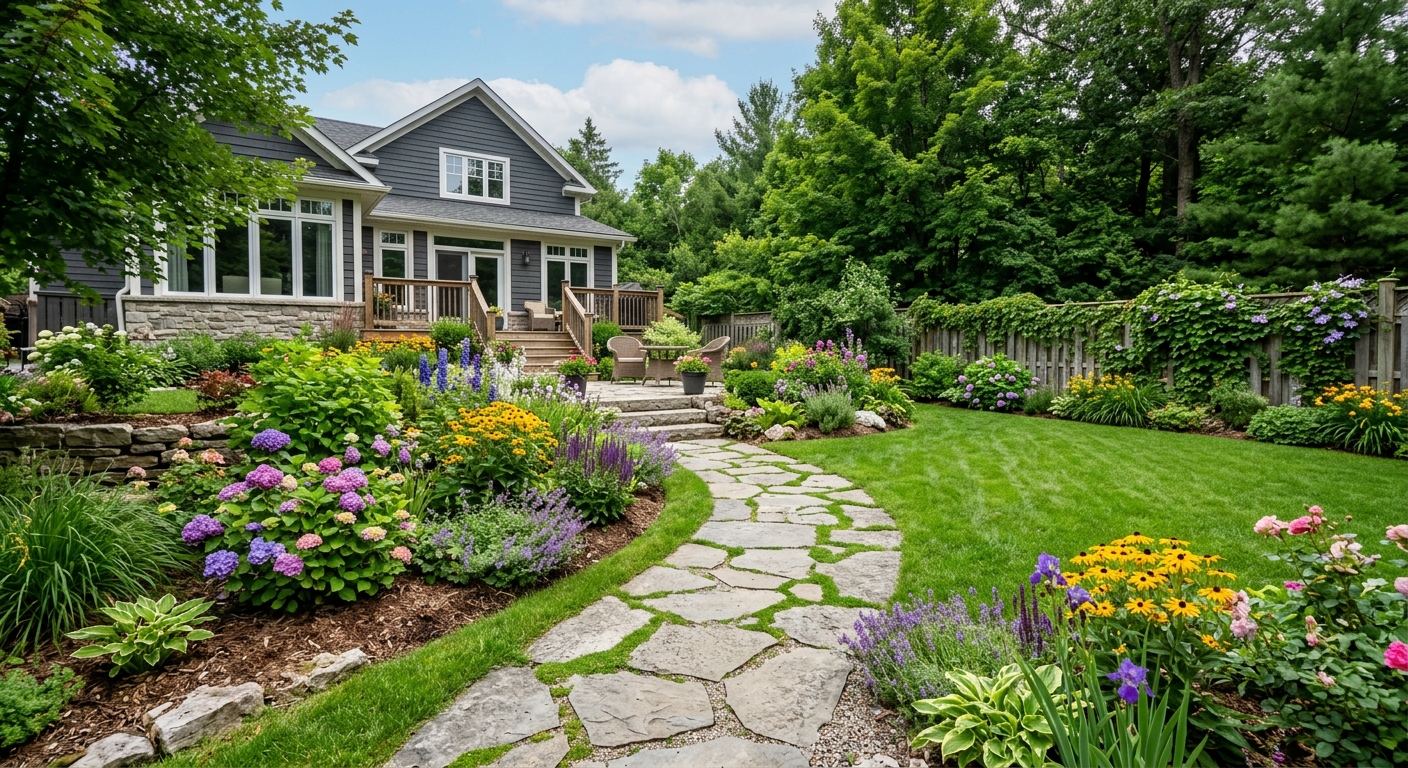
Landscaping options and costs in Lougheed
Lougheed homeowners typically have two motivations for investing in landscaping: making a modest yard feel “finished,” and protecting that investment as the house ages. In Lougheed, the local housing stock is heavily shaped by single-detached ownership—each detached property often comes with enough outdoor space to justify a full design rather than piecemeal upgrades. With a population of 15,300 (Statistics Canada, 2021 Census), the town’s service demand is steady, but crews can still get booked quickly around peak spring and early fall install windows.
In the Lower Mainland–Southwest (plant hardiness zones 7–8), mild, wet winters and long, cool summers support layered planting and broadleaf evergreen options that many homeowners value for curb appeal. That said, pricing isn’t “cheap,” because labour is competitive and good drainage work is common—soil rarely stays frozen, so contractors can build correctly, but they must still manage pooling, foundation moisture, and freeze–thaw stress in any structural base (patios, steps, retaining walls). If you’re in a neighbourhood with lots of older properties near Lougheed’s core, you’ll often see higher demand for grading corrections, re-sodding, and shrub border renewals because mature landscaping beds get tired over time.
Below is a realistic pricing snapshot to help you compare approaches, from full-service design/install to targeted upgrades—then you can align scope with your budget and timeline.
| Service |
Description |
Season |
Price Range |
| Full landscape design and installation |
Site visit, concept + planting plan, grading/drainage coordination, planting, mulch, and hardscape/softscape install as included |
Spring to fall (often flexible due to mild winters) |
$7,500 – $45,000 |
| Sod installation (supply, grade, lay, roll) |
Soil prep, fine grading, sod supply and installation, rolling, initial watering setup |
Late spring to early fall |
$3,000 – $7,500 |
| Lawn seeding (grade, seed, starter fertilizer) |
Minor grading, seed selection, starter fertilizer, light cover and establishment care |
Early spring or fall |
$1,800 – $4,800 |
| Interlocking patio or walkway |
Excavation, base (crush + compaction), edge restraints, interlocking stone installation, joint sand |
Spring to fall |
$10,000 – $35,000 |
| Retaining wall (interlocking block) |
Layout, excavate and compacted base, interlocking block install, drainage gravel + weep considerations |
Spring to fall |
$15,000 – $60,000 |
| Tree and shrub planting |
Soil amendment, planting layout, staking as needed, mulch ring, watering plan |
Spring and fall (and select mild winter windows) |
$1,500 – $14,000 |
Prices are estimates only and vary by project scope, site access and material selection.
What affects the price of landscaping in Lougheed
In Lougheed and across the Lower Mainland–Southwest, it’s normal to see the “same” landscaping concept price out 30–50% differently between contractors or quote rounds. The main reason is that scope complexity often hides behind marketing phrases. One quote might include proper drainage bedding and soil amendment; another might only add plants and mulch. Labour rates and crew availability also play a role—spring backlog can push scheduling and productivity, and that directly affects the installed price of both softscape and hardscape.
Climate and seasonal timing influence both what grows and how long crews can safely build. In zones 7–8, the long working season helps keep projects moving, but freeze–thaw cycles still matter for bases and wall footings: if a retaining wall or patio base isn’t dug deep enough and drained correctly, you’ll pay later for settlement fixes. By contrast, Prairie regions (Zone 2–4) face short frost-free windows and often need drought-tolerant species and compressed construction schedules; that changes both plant choices and labour intensity. Coastal BC lets us use a lush palette (and many homeowners choose layered evergreens and perennials), yet the heavy-rain periods make drainage corrections more common—raising costs for yards with slope or clay-like soils. In the dry BC interior and Alberta, irrigation design becomes more urgent due to water costs and restriction risk; in Ontario (zone 5–6), summer dry spells still require irrigation planning and follow-up.
Two concrete Lougheed examples: (1) If your yard slopes toward the house, correcting grades and adding a drainage bed can move a “planting-only” idea into a $10,000+ drainage-and-hardscape scope. (2) If you choose a mature specimen tree and need root-friendly soil preparation and staking, you may move from a $1,000–$15,000 planting band toward the top end due to size, labour, and aftercare. Housing age also matters: many homes built on earlier fill sites require more base prep and soil correction (in some cases, adding $2,000–$6,000 worth of topsoil/amendment work even when the footprint is small).
| Price Factor |
Why It Matters |
Cost Impact |
| Yard size in sq ft — the primary cost driver for softscape |
More area means more soil prep, mulch, plant material quantity, and labour hours |
Small yards can sit near the low end of the $5,000–$50,000 design band; larger yards often push toward mid to upper ranges |
| Grading and drainage work — slope corrections add significant cost |
Pooling water requires regrading, subgrade repair, and careful tie-in to existing slopes |
Can add thousands to a softscape job; common when correcting foundation moisture risk |
| Drainage bed or French drain installation |
Proper perforated pipe placement, gravel sizing, and outlet considerations are labour-intensive |
Often shifts projects from “plants and mulch” into hardscape-level pricing |
| Plant material tier — native shrubs vs. ornamental vs. mature specimen trees |
Higher-tier stock costs more and may require additional handling, staking, or professional planting |
Can move planting budgets across the $1,000–$15,000 range |
| Hardscape vs. softscape ratio — walls and patios cost more per sq ft than lawn |
Excavation, base compaction, and materials for stone/pavers drive up unit costs |
Even a modest patio can land in the $10,000+ territory depending on footprint and prep |
| Irrigation system design and installation |
Drip lines, valves, backflow prevention considerations, and controller setup raise complexity |
Can add a noticeable premium vs. manual watering plans; often worth it for efficiency |
| Soil amendment and topsoil required |
Clay, compaction, or poor topsoil requires amendments for root establishment |
Low amounts keep costs near base planting; heavy corrections increase the bill |
| Tree removal or stump grinding before new planting |
Access, disposal, and grinding time can be major labour drivers |
Can add several thousand dollars depending on debris volume and site constraints |
Permits & regulations in British Columbia
For most landscaping in British Columbia, homeowners can move ahead without a permit for planting and most softscape work. Typically, sodding, lawn installation, planting beds, and routine grading for landscaping (when it doesn’t alter drainage in a way that affects neighbours or services) are usually handled as standard site work without a permit. In Lougheed, your practical focus should be on utility locates and erosion control so you don’t hit buried services or create runoff problems during wet periods.
Work that often does require a permit in BC includes retaining walls above the local height threshold—commonly around 1.0 m (3.3 ft) in many municipalities—especially if the wall impacts property boundaries, slope stability, or safety. If your project includes significant grading changes that alter drainage toward neighbouring lots or toward storm connections, that may also trigger approval requirements.
Before digging any planting holes or wall footings, call for utility locates (it’s essential even for “small” post holes). Then verify the contractor properly: ask for their British Columbia licence details (where applicable for their trade), a certificate of liability insurance, and confirmation of workplace coverage for workers (WSIB or WCB coverage documentation). Where to look: use the contractor’s online credentials/registries (trade body or provincial/industry listings), review the COI certificate for effective dates and coverage amounts, and keep a copy of their clearance letter or coverage confirmation with your quote package.
Planning a landscape that thrives in Lougheed's climate
To plan a yard that thrives in Lougheed, think “work with zones 7–8” rather than fighting cold-wet extremes. Winters are mild enough that many broadleaf evergreens and winter-robust perennials establish well, but heavy rains still mean your greatest enemy is pooling water and foundation moisture. Aim to design for drainage first, then choose plants that match the precipitation pattern and the local frost calendar.
Plant selection matters most. Use zone-appropriate, native-leaning species where possible, and build in winter structure with evergreens plus hardy perennials. For lawns, compare sod vs. seed: sod gives instant results, but in the Lower Mainland it commonly costs about 3–4x more per square foot than seeding because it’s a supply-and-install product plus tighter logistics. Sod can still be the right move if you want quick curb appeal, such as preparing a home sale or finishing a front entry area before an event.
Drainage and grading are essential. If water sits after storms, you’ll struggle with weeds and patchy turf no matter how good your seed or fertilizer is. For hardscape, base preparation must account for freeze–thaw cycles: dig to depth, compact correctly, and include proper sub-base and edge restraint so patios and steps don’t shift.
Low-maintenance design strategies in Lougheed often include groundcovers, 2–3 inch mulch layers, and grouping plants by water needs so you’re not constantly hand-watering. Consider rain gardens or xeriscape-style zones along downspouts—especially where you can slow and absorb runoff. For example, if a 300 sq ft lawn conversion is your goal, going from seeding to sod can easily add several thousand dollars; that premium is justified when you need “done-now” coverage, but it’s rarely the best choice for a budget-first backyard.
| Element |
Climate Consideration |
Maintenance Level |
Price Band |
| Sod lawn installation |
Instant cover supports erosion control during rainy shoulder seasons; still needs correct grading to avoid puddling |
Medium initially (watering to establish), lower long-term with good base |
$3,000 – $7,500 |
| Native perennial garden |
Zone-appropriate plants handle wet winters and long cool summers; reduced winter die-back risk |
Low to medium (mulch refresh and seasonal tidy) |
$2,500 – $10,000 |
| Mulched shrub border |
Helps stabilize soil in wet periods; evergreen structure works well through cool seasons |
Low (weeding drops sharply with correct weed barrier + mulch depth) |
$1,500 – $8,500 |
| Interlocking stone patio |
Base depth and drainage manage freeze–thaw stresses and prevent settlement in heavy-rain cycles |
Low (occasional joint sand top-up and basic cleaning) |
$10,000 – $35,000 |
| Retaining wall (block) |
Compacted base and drainage gravel reduce wall movement; important for sloped Lougheed lots |
Low (regular inspection after major storms) |
$15,000 – $60,000 |
| Drip irrigation system |
Improves efficiency and helps you tolerate occasional restrictions; reduces leaf-wet disease risk |
Low once installed (seasonal checks and controller tuning) |
$1,800 – $6,500 |
How to choose a landscaping contractor in Lougheed
Choosing the right landscaping contractor in Lougheed starts with proof—not promises. First, verify British Columbia trade licensing where it applies to the contractor’s scope (especially for hardscaping, retaining wall work, and any specialty components). Next, confirm liability insurance: ask for a current certificate of insurance showing your address/location and adequate coverage limits. For worker coverage, request documentation showing workplace coverage (WSIB or WCB coverage confirmation). Don’t accept a verbal “yes”—ask for the certificate and keep a copy with your contract.
Then get 2–3 itemised written quotes. You want line items for labour and materials (base rock and compaction materials for patios, weed barrier and mulch types for borders, sod/seed quantities, and plant sizes). Avoid lump sums that don’t show what’s included. A good contractor will clearly state exclusions (for example: tree removal scope, disposal fees, electrical tie-ins for irrigation controllers if required, and whether permit support is included).
Warranty should be explicit: workmanship warranty length (how long they stand behind installation), product/manufacturer warranty on plants and hardscape materials, and whether warranties transfer if you sell the home. Payment scheduling matters too—never pay more than 10–15% upfront, and use a holdback until the job is complete and cleaned. Finally, timelines should be written with a start date and a realistic completion estimate, accounting for rain and crew scheduling in Lower Mainland seasons.
- Ask for COI (liability insurance) and confirm it’s active for the project dates.
- Request proof of worker coverage (WSIB/WCB) before work begins.
- Get 2–3 itemised quotes with quantities (sq ft, sq m, plant counts, tree sizes).
- Ensure drainage/grading responsibilities are written (who corrects slope and pooling?).
- Confirm whether disposal/haul-away is included for sod, soil, stumps, and debris.
- Clarify topsoil and soil amendment specifications (type, depth, and volume).
- For patios/walls, verify base thickness and compaction requirements in writing.
- Ask about irrigation scope: supply lines, backflow considerations, and controller setup.
- Confirm start date, seasonal windows, and weather contingency process.
- Check warranty terms separately for workmanship vs plant/hardscape materials.
- Set payment milestones tied to inspections (base complete, install complete, cleanup).
- Request references from similar Lougheed projects (slopes, drainage, or layered planting).
Red flags I see in Lougheed include: (1) quotes without drainage/base details for patios or retaining blocks, (2) refusing to provide insurance proof, (3) “cheap” sod or planting material substitutions not noted in writing, (4) payment requests above 10–15% upfront, and (5) no written warranty or vague “best effort” schedules.
Frequently asked questions — landscaping in Lougheed
How long does a landscaping project take in Lougheed?
Timelines in Lougheed depend heavily on whether you’re building softscape only (planting and mulch) or combining it with hardscape and drainage. In the Lower Mainland–Southwest, the long cool/wet-free intervals often mean you can install in spring to fall with fewer “lost days” to deep freezes, but heavy rain can still pause grading and base work. Simple planting refreshes (shrub border or small garden) may take a few days, while full landscape builds can run multiple weeks depending on approval needs and material lead times. If you’re doing a patio or retaining wall, base preparation and proper compaction typically extend the schedule to allow correct curing and sequencing. A practical target is to plan around 2–6 weeks for most mid-sized installs, with start dates confirmed in writing.
What is the best grass type for a Lougheed lawn?
For Lougheed (zones 7–8), many homeowners do well with cool-season turfgrasses designed for the Lower Mainland’s long cool summers and mild winters. The most common approach is to use a blend suited to shade tolerance and disease resistance—especially if you have trees or north-facing yards. If you want the fastest visual result, sod is often chosen, but it still requires correct grading so the root zone doesn’t sit in water. If you’re seeding, selecting a high-quality seed blend with starter fertilizer and good soil prep improves germination consistency in damp conditions. Cost-wise, sod installs commonly land in the $3,000 – $7,500 range depending on size, while seeding is typically less expensive and can be a smarter budget move for backyards.
When should I aerate and overseed my lawn in Lougheed?
In Lougheed, a strong rule of thumb is to aerate and overseed when the grass can recover quickly while soil temperatures are favourable and rain supports establishment. Many homeowners aerate in early spring or in the early-fall window, then overseed shortly after—just far enough from peak summer heat to avoid struggling seedlings. If you’ve had dog traffic or persistent dry patches, overseeding plus a thin topdressing can help fill thin spots. Aeration is especially useful when soil is compacted, which can happen on older driveways or near pathways. If you’re planning it this year, coordinate it with your contractor’s schedule so you can complete the process before a rainy spell settles the seedbed unevenly.
What trees grow best in Lougheed's climate zone?
In Lougheed’s zone 7–8 conditions, broadleaf trees that handle mild winters and long cool summers are often a good fit, particularly species that tolerate periodic wet ground. Many yards benefit from a mix: one feature tree near the front and smaller understory trees or accent trees where there’s less space for roots. Your best choices depend on sunlight, soil drainage, and the mature size you can accommodate near services. For example, trees that tolerate coastal-style moisture patterns tend to establish more reliably than drought-stressed selections. When budgeting, tree planting typically sits in the $1,000 – $15,000 band because larger specimens, staking, and soil prep add cost. A good contractor will also advise on spacing from foundations and future canopy clearance.
How much does sodding a yard cost in Lougheed?
Sodding costs in Lougheed typically depend on yard size, how much grading is required, and whether you’re installing in a straight rectangle or around beds, slopes, and existing drainage. For most mid-sized lawns, homeowners commonly see prices in the $3,000 – $7,500 range for supply, grade, lay, and roll—assuming normal access and straightforward base prep. If the yard needs drainage correction before sod can be successful, the scope can increase because soil amendments and regrading become part of the job. If you’re comparing to seeding, sod is often more expensive per square foot because you’re paying for the turf product plus installation logistics; however, sod can be worth it when you need instant curb appeal.
How do I prevent weeds in my Lougheed garden?
Weed prevention in Lougheed starts with the basics: correct site prep, smart mulching, and plant spacing. Start by removing existing weeds (including roots), then address the soil quality so your new plants establish quickly—healthy plants outcompete weeds. Apply mulch at a practical depth (commonly a few inches) and keep mulch pulled back from plant crowns to avoid rot. In wetter seasons, pooling can accelerate weed problems, so drainage and grading matter even in garden beds. If you use weed barrier fabric, it should be installed properly and covered with adequate mulch—otherwise it becomes ineffective. Finally, choose zone-appropriate, dense plantings such as native shrub borders and perennial groups to reduce exposed soil. For many yards, these steps reduce ongoing weeding time more effectively than relying on chemicals.