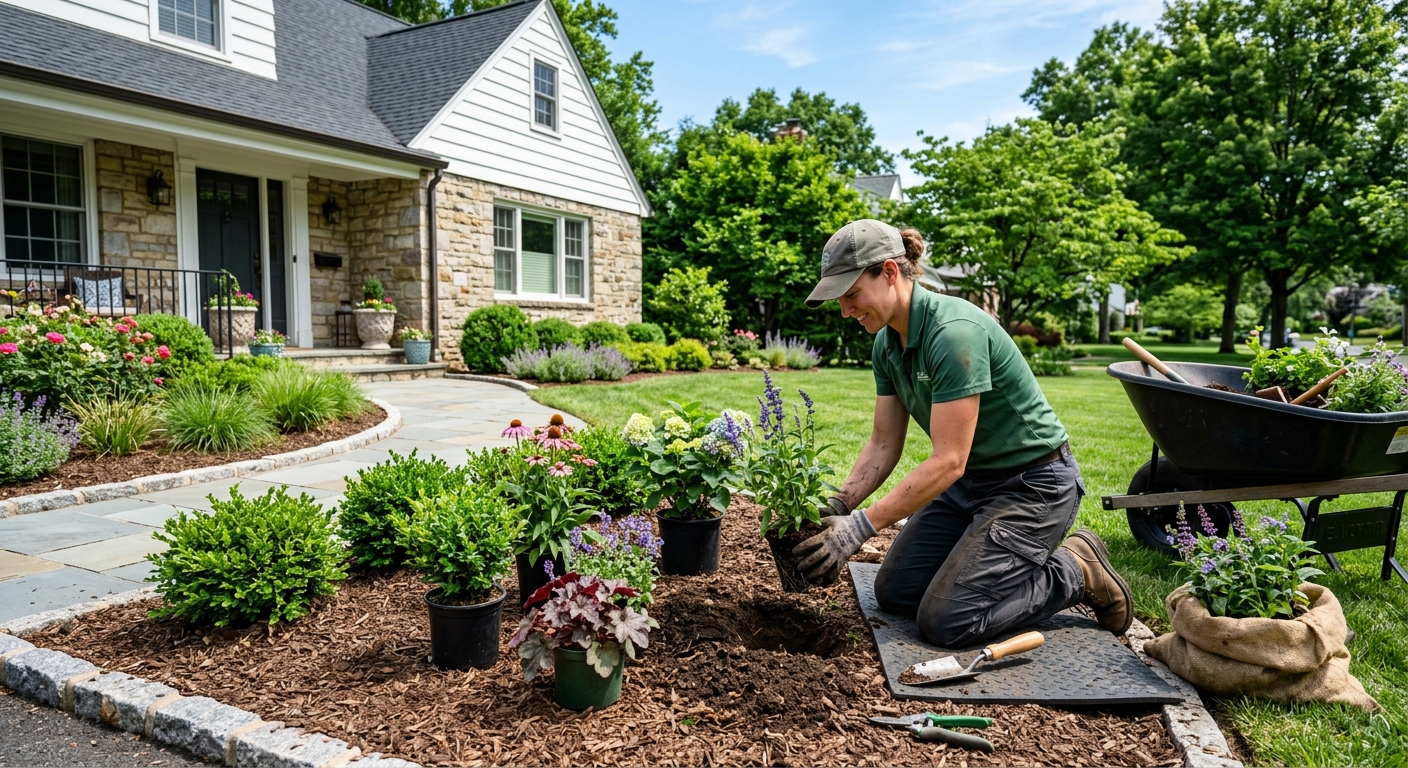
Landscaping options and costs in Popkum
Popkum, British Columbia is a great place to invest in landscaping because yards here can mature through a long, cool season rather than a short planting window. With a small local population of 1,710 people (Statistics Canada, 2021 Census), many homeowners in the Lower Mainland–Southwest keep steady contact with nearby suppliers and contractors, which helps projects get scheduled without long delays. Also, because detached homes are common in the broader region, many properties have enough continuous yard space to justify a full design—typically where landscaping value shows up best at resale.
In the Lower Mainland–Southwest (plant hardiness zones 7–8), mild, wet winters and long cool summers shape both what you can plant and how contractors price labour. You can often build a lush, layered look with broadleaf evergreens and long-blooming perennials, but costs still rise when drainage corrections are needed—winter rain can stress poorly graded lawns, and freeze–thaw cycles can shift structures if bases aren’t built properly. Contractors are especially in demand in nearby built-up pockets around Popkum Village area, where turnover and owner upgrades tend to be more frequent.
To make it easier to compare proposals, use the ranges below as a planning baseline and then align them to your yard size, site access, and desired materials.
| Service |
Description |
Season |
Price Range |
| Full landscape design and installation |
Site visit, concept + layout, planting plan, grading/drainage coordination, hardscape + softscape install |
Spring to late fall (softscape), year-round for drainage/hardscape planning |
$5,000–$50,000 |
| Sod installation (supply, grade, lay, roll) |
Final grading, soil prep, sod delivery, laying, rolling, and initial watering guidance |
Late spring to early fall (best between frost-free windows) |
$2,000–$8,000 |
| Lawn seeding (grade, seed, starter fertilizer) |
Minor grading, seed blend selection, seeding, starter fertilizer, and light compaction/rolling |
Spring and early fall |
$1,500–$6,000 |
| Interlocking patio or walkway |
Excavation, base compaction, edging, interlock pavers, bedding sand, jointing, final leveling |
Spring to fall (structural work must allow drainage and freeze–thaw durability) |
$10,000–$35,000 |
| Retaining wall (interlocking block) |
Excavation, compacted base, block installation, weep holes/backfill drainage, finishing |
Spring to fall |
$15,000–$60,000 |
| Tree and shrub planting |
Soil amendment, digging, staking (as needed), watering plan, and plant material installation |
Spring and fall planting windows; light work possible off-season |
$1,000–$15,000 |
Prices are estimates only and vary by project scope, site access and material selection.
What affects the price of landscaping in Popkum
In Popkum and across the Lower Mainland–Southwest, two bids for the same yard can easily differ by 30–50% because the scope gets interpreted differently: one contractor includes drainage corrections, extra soil, disposal and topsoil, while another assumes “light grading” and focuses on surface cosmetics. Labour availability also matters—when multiple crews are working on patios, retaining walls, and spring planting rushes, scheduling pressure can raise install-day costs even when material prices are similar.
At a structural level, zones and frost dates drive both growth and the working season. In coastal BC (zones 7–8), you can usually plan for a broader planting palette and extend the softscape season, which supports lush, layered designs. In Popkum, the soil rarely stays frozen for extended periods, but freeze–thaw still matters for retaining walls and patio bases: contractors must dig deeper, compact more carefully and plan drainage to prevent frost heave and wall movement on sloped sites. Prairie regions (zone 2–4) need drought- and wind-tolerant species and typically see compressed frost-free work windows; Southern Ontario (zone 5–6) has a moderate season but summer dry spells can increase irrigation needs. The dry BC interior and Alberta have water pressure and temporary restrictions, pushing irrigation design and plant choices toward efficiency. That’s one reason a design that’s “easy” in Popkum may cost more elsewhere—even before you touch hardscape.
Concrete examples from Popkum pricing: (1) upgrading a lawn from seeding to sod often jumps into the $2,000–$8,000 band for supply-and-install because sod is faster but labour/material heavy; (2) a simple interlock walkway can escalate quickly when soil is wet and grading needs repairs, moving costs toward the $10,000–$35,000 range once base drainage and proper base depth are included. Also, older homes commonly have settled beds and buried downspouts—reworking that for correct drainage can add thousands versus a clean, newer grade.
| Price Factor |
Why It Matters |
Cost Impact |
| Yard size in sq ft — the primary cost driver for softscape |
More square footage means more soil prep, seed/sod, mulch, and labour time |
Often the largest driver; expect material + labour to scale proportionally |
| Grading and drainage work — slope corrections add significant cost |
Correct grading prevents pooling near foundations and improves rooting success |
Can add several thousand dollars on sloped or uneven lots |
| Drainage bed or French drain installation |
Handles persistent wet areas during BC’s winter rain periods |
Typically adds meaningful cost due to excavation and aggregate volume |
| Plant material tier — native shrubs vs. ornamental vs. mature specimen trees |
Mature trees and rare ornamentals cost more and require more handling/staking |
Can swing a planting package by a wide margin within the $1,000–$15,000 band |
| Hardscape vs. softscape ratio — walls and patios cost more per sq ft than lawn |
Pavers, base aggregates, edging, and compacted bases are labour-intensive |
Shifts your project toward the $10,000–$80,000 retaining/wall and hardscape territory |
| Irrigation system design and installation |
Drip and smart controllers improve efficiency and help tolerate occasional restrictions |
May add several thousand depending on zones and trenching |
| Soil amendment and topsoil required |
Heavy clay, compacted fill, or low organic matter reduces plant performance |
Can significantly increase delivery/haul and labour on “rebuild” sites |
| Tree removal or stump grinding before new planting |
Vegetation clearing is specialized work and must be timed for safety |
Often adds direct labour and equipment charges before planting begins |
Permits & regulations in British Columbia
In British Columbia, most typical residential landscaping work—like planting shrubs/trees, sodding, and the majority of softscape installs—usually does not require a permit. Where homeowners in Popkum need to slow down is structural work and grading. Retaining walls that meet height thresholds commonly require a permit and sometimes engineered drawings; in many municipalities this is triggered around 1.0 m (3.3 ft), but you should confirm with your local bylaw office or permit portal. Also, if you’re changing lot grading in a way that alters drainage flow—especially toward neighbouring properties or toward storm sewer connections—approvals may be required.
Before any digging (for planting holes, drainage rock beds, irrigation trenches, or wall footings), request utility locates. This is critical around service lines and any buried feeds near foundations.
To verify your contractor’s credentials in British Columbia, do it in writing and keep copies:
- Licence/registration: check the provincial business/contractor registry where applicable, and confirm the company’s legal entity name matches the quote.
- Liability insurance: ask for a current certificate of insurance showing your property address listed on the COI as appropriate and confirm coverage is active during the job.
- Worker coverage: request proof of WSIB/WCB coverage (as applicable in BC) so you’re not exposed if a worker is injured.
- Clearance letters: if provided, ensure they cover the job period and match the contracting entity.
Planning a landscape that thrives in Popkum's climate
To plan a yard that thrives in Popkum, British Columbia, choose plants and build systems that match the reality of zones 7–8, wet winters, and cool growing seasons—without fighting winter moisture or freeze–thaw movement. Start with (1) plant selection: favour zone-appropriate, hardy species (and, where possible, natives) that establish well with moderate watering and good winter structure. Next, (2) decide sod vs. seeding. Sod gives instant visual coverage but usually costs about 3–4x more per sq ft than seeding because you’re paying for the sod rolls plus handling and installation. (3) Make drainage and grading non-negotiable in the Lower Mainland–Southwest: correct slopes prevent pooling, reduce foundation moisture, and protect plant roots through winter storms.
For (4) hardscape, patio and walkway bases must be built for local freeze–thaw durability: deeper excavation, proper compaction, and correct base layering reduce long-term settlement and uplift. Finally, (5) build low-maintenance structure into the design: groundcovers, mulch layers, and long-blooming perennials reduce annual upkeep while keeping curb appeal high.
Where water efficiency matters, even in coastal BC, consider rain gardens and smart drip irrigation. A rain garden can capture roof runoff and reduce soggy spots; drip with a smart controller can keep watering precise during milder spells and curb waste when schedules tighten. For a practical cost example: on a front lawn where fast curb impact matters, paying the $2,000–$8,000 sod installation range can be justified if you’re replacing a worn lawn before a sale. If timeline is flexible and you’re okay with a greener-up phase, seeding is typically the more budget-friendly route, with landscaping plans often staying in the lower end of the lawn options.
| Element |
Climate Consideration |
Maintenance Level |
Price Band |
| Sod lawn installation |
Best when frost risk is low; needs initial watering support through cool establishment |
Medium during the first 4–8 weeks; lower after rooting |
$2,000–$8,000 |
| Native perennial garden |
Zone-appropriate species handle cool summers and wet winters with less winter cover |
Low to medium (spring cleanup + occasional weeding) |
$3,000–$12,000 |
| Mulched shrub border |
Mulch buffers winter moisture swings and moderates soil temperature |
Low (light pruning, top-up mulch 1–2 times/year) |
$2,500–$10,000 |
| Interlocking stone patio |
Needs correct drainage slope and compacted base to resist frost heave and settlement |
Low (periodic joint sand top-up) |
$10,000–$35,000 |
| Retaining wall (block) |
Weep holes/backfill drainage and proper base depth manage wet winters and freeze–thaw |
Low (annual visual checks) |
$15,000–$60,000 |
| Drip irrigation system |
Efficient watering during cool summers and helps reduce waste during occasional restrictions |
Low (controller programming + seasonal checks) |
$2,000–$7,500 |
How to choose a landscaping contractor in Popkum
Choosing the right contractor in Popkum starts with verification and clear documentation. In British Columbia, confirm liability insurance by requesting a current certificate of insurance (COI) before work begins. Ask for proof of WSIB/WCB coverage (coverage type depends on the contractor’s setup) so you’re protected if a worker is injured. Then, verify the contractor’s business details: the legal company name on the quote should match the insurance COI. If the contractor uses subcontractors, request confirmation that those subs are also covered.
Next, get 2–3 itemised written quotes—not one lump sum. You want a labour + materials breakdown for excavation, base materials, soil/topsoil, plant quantities, delivery, disposal and any drainage or irrigation work. Ask whether a permit is included where required (for example, certain retaining wall heights and grading changes), and whether disposal/haul-away is part of the price.
For warranty, ask for the workmanship warranty length in writing and clarify if it covers plant replacement (and under what conditions). Separate that from manufacturer warranties on materials and controllers; also ask whether warranties are transferable to future owners.
Payment scheduling matters: never pay more than 10–15% upfront. Hold back a portion until the final walk-through confirms grading, compaction, drainage flow, and planting quality. Finally, get a start date and estimated completion window in writing so you can plan around weather interruptions.
- COI for liability insurance is current and matches the contracting entity.
- Proof of WSIB/WCB coverage is provided before any site work.
- Quotes are itemised with quantities (sq ft, linear ft, number of trees/shrubs) and unit pricing where possible.
- Scope includes excavation depth and base build-up details for patios/walls.
- Drainage plans specify how water will be managed (slope, drain rock, weep holes).
- Disposal/haul-away is explicitly listed (dump fees are often missed).
- Topsoil/soil amendment type and thickness are stated.
- Plant lists include botanical names, sizes, and spacing—not just “evergreens.”
- Irrigation scope states whether dripline, emitters, timer/smart controller and valves are included.
- Start date and completion estimate are on the contract.
- Workmanship warranty is written and covers practical items (settlement, drainage failures, workmanship on pavers).
- Payment schedule is staged, with a holdback for final completion.
Concrete red flags in Popkum: a contractor who won’t provide a written, itemised quote; missing or outdated insurance/coverage documentation; vague grading language like “we’ll level it” without drainage specs; pushing full payment upfront; and starting excavation before utility locates are done.
Frequently asked questions — landscaping in Popkum
How do I plan a low-maintenance yard?
For Popkum, British Columbia low-maintenance plans usually start with plant selection and drainage. In the Lower Mainland–Southwest (zones 7–8), you can use hardy, zone-appropriate evergreens and long-blooming perennials so you’re not constantly replacing winter-stressed plants. Next, grade the yard so water doesn’t pool against foundations—this is one of the biggest long-term “maintenance reducers” because it limits algae, mud, and plant die-off. If you want a budget-friendly lawn, seeding can be a good fit; if you need instant curb appeal before a sale, sod is faster but typically falls into the $2,000–$8,000 range. Wrap it up with 2–3 in. of mulch in borders and a drip system with a smart controller so watering is consistent without wasting time.
How deep should a retaining-wall base be for local frost?
In Popkum, you still need to respect freeze–thaw even though winter rarely stays deeply frozen like Prairie climates. The exact base depth depends on wall height, soil type, and whether engineering is required, but the “contractor standard” is to excavate to a depth that allows proper base thickness and compaction, then add compacted granular layers and drainage backfill. If a wall is around the typical permit-trigger height (often near 1.0 m in many BC municipalities), you should confirm requirements before digging. The most important practical step is drainage: weep holes and proper backfill reduce hydrostatic pressure that can undermine walls during wet winter periods. Your contractor should specify excavation depth, base thickness, and drainage details in the written scope.
How much does professional landscape design cost?
Professional landscape design in the Lower Mainland–Southwest is commonly bundled with installation, especially for full renovations in Popkum where homeowners want a single accountable team. If you’re doing a full scope (design + install), budgets often fall within the $5,000–$50,000 range depending on hardscape area, drainage corrections, and the planting palette. If you only need design work, some contractors offer design-only packages, but your total project cost still depends on how many revisions are included and whether planting plans and irrigation concepts are included. A practical tip when comparing: make sure the design quote is clear about measurements, site conditions, and whether permitting support is included for retaining walls or grading changes.
How do I compare landscaping quotes?
When comparing quotes in Popkum, start by ensuring you’re comparing the same scope. Ask for itemised lines for excavation, base materials, disposal/haul-away, soil/topsoil thickness, plant quantities and sizes, and any drainage or irrigation components. Many differences come from exclusions—one company may include drainage bed work, while another only “tops up” grade. For lawns, confirm whether it’s sod supply + installation (often $2,000–$8,000) versus seeding, and whether the quote includes final grading and starter fertilizer. For hardscape, check base prep details and compaction notes; for retaining walls, confirm weep holes and backfill/drainage are included. Finally, verify timelines and warranty terms are written the same way, not just verbally described.
How long does a landscaping project take in Popkum?
Project duration depends on weather, crew availability, and whether you’re doing softscape only or a combined hardscape + drainage job. In Popkum, spring to fall is usually workable because the frost-free window is longer than in colder Prairie areas, and softscape can often continue into late autumn when conditions are suitable. A lawn-only seeding or sod job may take days to a week depending on prep and drying time. Patios, walkways, and retaining walls typically take longer because excavation, base compaction, drainage setup, and curing/settling time are involved—plus crews may stage work across multiple days. Ask contractors for a start date and completion estimate in writing, and build in weather buffers for wet weeks during BC’s winter-rain-heavy periods.
What is the best grass type for a Popkum lawn?
In Popkum, the “best” grass is usually a cool-season blend suited to the coastal BC climate—meaning it grows well in cool temperatures and can handle wet winters when drainage is good. However, the real success factor is how the lawn is built: correct grading, proper soil amendment, and avoidance of pooling. If you’re choosing sod, the contractor typically supplies a ready-to-root sod variety that matches local performance needs; if you’re seeding, ask what seed blend they use and whether starter fertilizer is included. Cost-wise, sod installation commonly lands in the $2,000–$8,000 range because of supply and labour, while seeding is often less expensive when you can wait for establishment. If you tell your sun exposure (full sun vs part shade) and whether you have irrigation, a contractor can fine-tune the choice.