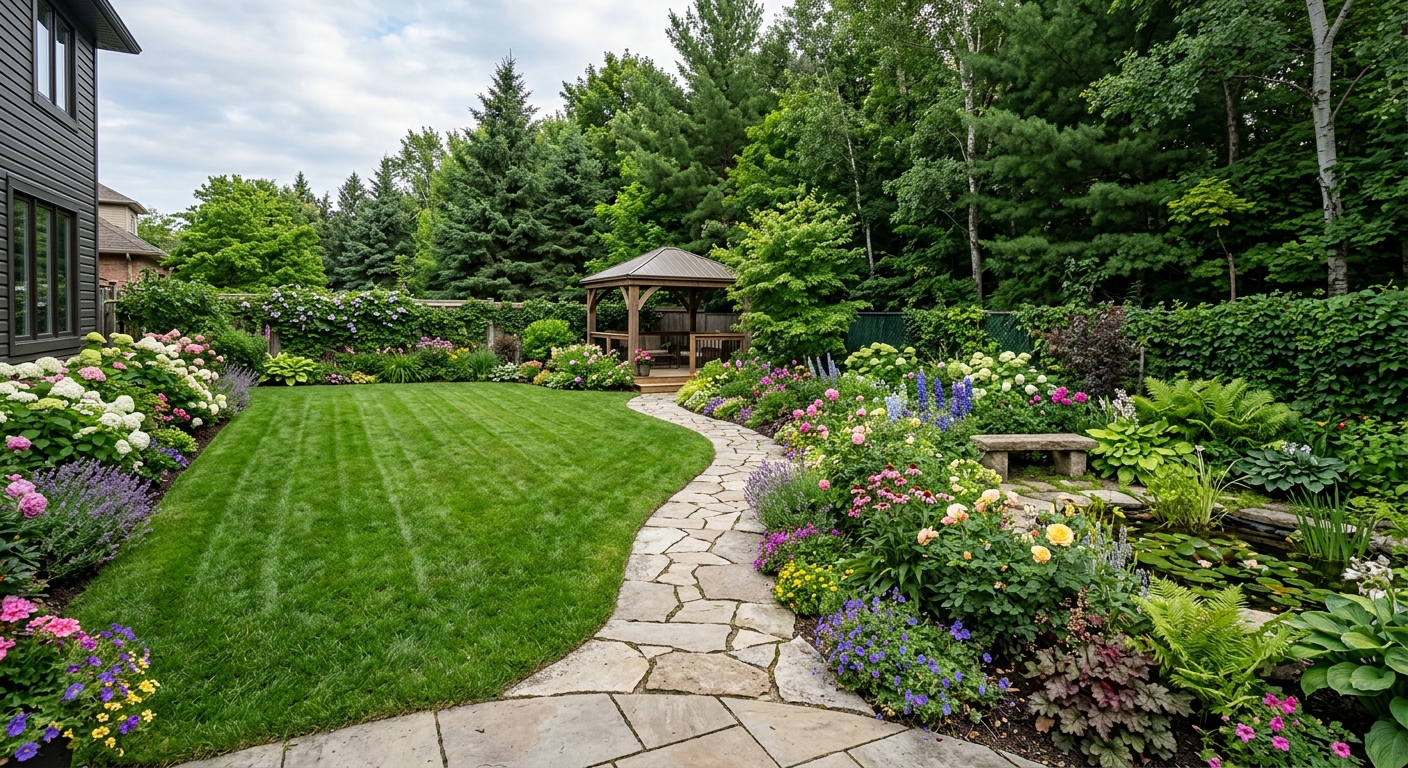
Landscaping options and costs in Riverwood
Riverwood homeowners typically have more yard space than dense urban cores, and that matters because landscaping cost scales quickly with square footage—both for lawn and for layered plantings. With a 2021 population of 9,008 (Statistics Canada, 2021 Census), Riverwood sits in the Lower Mainland–Southwest where there are plenty of contractor resources and a steady demand for curb-appeal upgrades in established areas. In older neighbourhoods around river-adjacent lots and the more mature single-family pockets near local arterial roads, we often see repeat projects each spring as homeowners replace tired turf and refresh garden beds.
In the Lower Mainland–Southwest, plant hardiness is usually in zones 7–8, with mild, wet winters and long cool growing seasons. That longer working window can lower labour bottlenecks compared with harsher regions, but it also means designers can build more lush, layered landscapes—so the scope (and price) often grows. Construction still needs freeze–thaw awareness for patios, pathways, and retaining walls: even though frost is milder than inland Canada, proper base depth, drainage, and compaction prevent movement and frost heave.
Because Riverwood’s climate supports broadleaf evergreens and extended-bloom perennials, many families choose a full plan rather than piecemeal upgrades. If you’re comparing options, the easiest way is to look at typical ranges side-by-side, starting with full design and installation, then narrowing down to sod, hardscape, and planting packages.
| Service |
Description |
Season |
Price Range |
| Full landscape design and installation |
Site visit, concept + planting plan, grading approach, soil amendments, planting, mulch, and softscape/hardscape install as specified |
Mar–Nov (weather breaks in wet weeks) |
$10,000–$35,000 |
| Sod installation (supply, grade, lay, roll) |
Existing removal as needed, compacted base prep, topsoil leveling, delivery, sod cutting/laying, rolling, starter watering guidance |
Mar–Nov (best before the wettest winter stretch) |
$3,500–$7,000 |
| Lawn seeding (grade, seed, starter fertilizer) |
Fine grading, seed selection, starter fertiliser, light topdressing, initial watering plan |
Mar–Apr and Aug–Sep |
$2,000–$4,800 |
| Interlocking patio or walkway |
Excavation, base course, bedding sand, interlocking stone layout, edge restraints, compaction and jointing sand |
Apr–Oct (allowing dryer curing windows) |
$12,000–$38,000 |
| Retaining wall (interlocking block) |
Layout, drainage behind wall (weep holes/drain rock), block installation, compaction, tiered planting ledge if included |
Apr–Oct |
$18,000–$55,000 |
| Tree and shrub planting |
Soil improvement, planting holes, amendments, staking/watering plan, mulch rings/bed prep |
Mar–Nov |
$2,500–$12,000 |
Prices are estimates only and vary by project scope, site access and material selection.
What affects the price of landscaping in Riverwood
In the Lower Mainland–Southwest, homeowners often see quotes for the “same” landscaping job swing by 30–50% across British Columbia, because labour availability, site conditions, and material sourcing change the real installation effort. A big driver is that “what grows” and “how long we can work” are tightly connected to climate: Lower Mainland–Southwest is typically zone 7–8 with fewer hard freezes, so contractors can install more varied palettes and keep working longer into the year. In contrast, Prairie regions (zones 2–4) face short frost-free windows and harsher winter stress, so retaining wall base depth and scheduling costs can become non-negotiable. Coastal BC (zone 7–8) supports lush plantings, but heavy-rainfall yards still need drainage design to prevent foundation moisture and bed failure. In the drier BC Interior, water restrictions push irrigation design and drought-tolerant planting choices; southern Ontario (zone 5–6) can have a moderate season but often requires summer irrigation planning during dry spells.
Two Riverwood examples explain why you can land on very different price bands. First, a sloped backyard that needs grading to shed water to an approved discharge point can add substantial labour and haul-off—easily moving a job toward the higher side of retaining wall & hardscape budget ranges (often aligned with $10,000–$80,000 in this region). Second, replacing weeded beds with a thicker, multi-layer shrub + perennial design can raise the plant material tier and create a longer installation day, shifting a landscaping project toward the broader design-and-install estimate band (commonly $5,000–$50,000).
Riverwood’s housing stock also plays a role. Many established properties have older lawns, compacted subsoil, and mature roots near foundations—so soil amendment and careful grading can add hundreds to thousands of dollars even when the yard “looks” similar on paper. In heavy-rain lots, we prioritise drainage bedding and French drains earlier, which reduces the chance of early rework (and future retainer costs).
| Price Factor |
Why It Matters |
Cost Impact |
| Yard size in sq ft — the primary cost driver for softscape |
More area means more labour for prep, more sod/seed, and larger quantities of mulch, soil, and plant material |
Often the biggest swing (small yards can be 25–40% less) |
| Grading and drainage work — slope corrections add significant cost |
Lowering/high spots and reshaping toward proper flow can require excavation, haul-off, and re-compaction |
Commonly adds several thousand dollars on uneven lots |
| Drainage bed or French drain installation |
Helps control pooling and foundation moisture in wet months; includes trenching, pipe, gravel, and access |
Can shift a project into a higher total budget |
| Plant material tier — native shrubs vs. ornamental vs. mature specimen trees |
Specimen sizes cost more and can require extra handling, staking, and protective practices |
Mature trees can increase planting budgets substantially |
| Hardscape vs. softscape ratio — walls and patios cost more per sq ft than lawn |
Stone, base materials, and compaction for hardscape drive higher unit costs |
Patios/walkways often price higher than planting equivalents |
| Irrigation system design and installation |
Drip lines, zones, backflow prevention, and controller setup change labour and materials |
Better efficiency costs more upfront but reduces issues during restrictions |
| Soil amendment and topsoil required |
Improving structure supports rooting and turf density; heavy clay may need more than basic top-dressing |
Can add measurable costs, especially for regrading |
| Tree removal or stump grinding before new planting |
Access, debris hauling, and stump removal affect schedule and disposal |
Often a hidden “scope unlock” that changes the total |
Permits & regulations in British Columbia
In British Columbia, most planting and everyday softscape work typically does not require a permit—meaning you can usually proceed with sod installation, lawn seeding, mulching, and installing planting beds (including new trees and shrubs) without pulling approvals. The main permit triggers homeowners run into are structural or drainage-affecting changes, especially where a wall becomes a more substantial retaining structure.
What often DOES require a permit in BC is a retaining wall above the typical municipal threshold of about 1.0 m (3.3 ft) in many areas. Some projects may also require engineered drawings depending on wall height, soil conditions, and proximity to structures. Changes to lot grading that direct water toward neighbouring properties or tie into storm connections can also require approval, because drainage impacts can become a regulatory and insurance issue.
Step-by-step for Riverwood homeowners: (1) Confirm the utility locate process before digging—any planting holes, drainage trenches, or wall footings should be preceded by utility location requests. (2) When you’re dealing with any wall near or above ~1.0 m, ask the contractor whether they will check permit requirements with the municipality and whether drawings/engineering are needed. (3) Verify contractor credentials before work starts: check the BC licence status through the provincial online registry, ask for a current certificate of liability insurance naming you as additional insured if applicable, and request proof of appropriate coverage for workers (WSIB/WCB equivalent coverage as applicable for the contractor’s staffing model). (4) If a contractor provides only one-page quotes without insurance details or job scope clarity, pause and request documentation before approving scheduling.
Planning a landscape that thrives in Riverwood's climate
To plan landscaping that thrives in Riverwood, the goal is to work with zone-appropriate plants, a cool-season growing pattern, and a frost timeline that still includes freeze–thaw impacts on hardscape. Riverwood typically sits in plant hardiness zone 7–8, where you can use broader planting palettes than coastal-interior dry zones—think broadleaf evergreens, long-blooming perennials, and layered shrub borders. But “mild” winters don’t mean zero risk: poor drainage can cause root stress, and shallow base preparation for patios or walkways can contribute to movement when wet weather and temperature swings repeat.
Start with plant selection: prioritise native and zone-suited species that handle winter wet and cool summers with less watering and minimal winter protection. Then choose sod vs. seed. Sod gives instant curb appeal, but it typically costs about 3–4 times more per sq ft than seeding because you’re paying for premium turf, logistics, and more intensive base prep. For drainage and grading, keep water moving away from foundations by shaping the yard and using drainage beds or French drains where pooling occurs. For hardscape, design base preparation to manage the local frost line effects—meaning deeper excavation, proper compaction, and a well-draining base. Finally, use low-maintenance strategies: mulch rings, groundcovers between shrubs, and perennials that return reliably reduce annual upkeep without sacrificing a layered, “designed” look.
If you’re comparing options, a common decision point is whether speed justifies cost. For instance, if sod for a 500 sq ft area lands around the $2,000–$8,000 lawn band, seeding the same footprint often comes closer to the lower end of that range when soil prep is straightforward. If you truly need immediate coverage before a listing or event, sod can be justified; if you can tolerate a slower establishment phase, seeding plus targeted soil amendments is usually the better value.
| Element |
Climate Consideration |
Maintenance Level |
Price Band |
| Sod lawn installation |
Best in cool, workable months; requires good drainage so turf doesn’t stay waterlogged |
Low to moderate (watering/establishment first, then seasonal checks) |
$3,500–$7,000 |
| Native perennial garden |
Zone-appropriate plants handle wet winters and cool summers; group by sun and moisture |
Low (mulch refresh and occasional weeding) |
$2,500–$9,500 |
| Mulched shrub border |
Mulch moderates soil temperature and moisture during long wet/cool periods |
Low (pruning and light upkeep) |
$2,500–$8,500 |
| Interlocking stone patio |
Base prep and compaction reduce freeze–thaw movement on temperature swings |
Low (periodic joint sand and inspection) |
$12,000–$38,000 |
| Retaining wall (block) |
Needs drainage behind the wall to prevent hydrostatic pressure in wet seasons |
Low (visual inspections; vegetation maintenance on top ledges) |
$18,000–$55,000 |
| Drip irrigation system |
Efficient for occasional restrictions and can prevent overwatering during cool, wet stretches |
Low (controller adjustments and seasonal checks) |
$1,500–$6,000 |
How to choose a landscaping contractor in Riverwood
Choosing a contractor in Riverwood comes down to verifying credentials and getting clear, itemised documents. In British Columbia, confirm the contractor’s licence status using the provincial online registry (then record the licence number on your quote). Request a current certificate of liability insurance and verify the coverage amount and dates—don’t accept “it’s in the works.” If the contractor uses staff, ask for proof of appropriate worker coverage for the labour component (WSIB/WCB coverage where applicable). For your peace of mind, ask whether the company can provide a clearance letter for their coverage status.
Next, get 2–3 itemised written quotes. You want labour and materials broken out—especially for soil/topsoil, drainage components, stone quantities, and plant sizes. A fair quote should explain what’s included and what’s excluded: permit pull responsibility, excavation limits, disposal/haul-away, erosion control, and whether irrigation is part of the scope or a separate add-on.
Warranty matters. Ask for the workmanship warranty length and what it covers (for example, re-grading and re-planting due to installation errors). Also ask about the product/manufacturer warranty for plants or hardscape materials and whether it transfers to you. For payments, never pay more than 10–15% upfront; hold back a portion until the job is complete and cleanup is done. Finally, lock in the timeline: ask for a start date and a realistic completion estimate in writing, tied to weather windows common in coastal BC.
- Ask for licence number and confirm it on the BC online registry before signing.
- Request a certificate of liability insurance (and additional insured wording if applicable).
- Verify worker coverage (WSIB/WCB as applicable) before any digging starts.
- Get 2–3 itemised quotes (labour + materials), not a single lump sum.
- Confirm disposal/haul-away is included for removed sod, topsoil, and debris.
- Confirm whether utility locates are requested before holes, trenches, or footings.
- Ask what grade/drainage targets are included (and whether you’ll get a drainage note).
- For hardscape, ask about base thickness, compaction method, and edging restraints.
- For planting, ask for plant sizes, counts, and spacing (and whether substitutions are allowed).
- Request a written warranty for workmanship and a clear rework process.
- Agree to payment schedule: small deposit (10–15%) only, with holdback until completion.
- Get a schedule note on weather contingencies and how wet-week delays are handled.
Red flags I see in Riverwood: quotes that are vague on drainage and base prep, no proof of insurance or licence details, “we’ll handle permits” without specifying who pulls them and what’s included, large deposits beyond 15%, and start dates that change repeatedly with no written timeline.
Frequently asked questions — landscaping in Riverwood
Sod vs seed — which is better for a Riverwood lawn?
For Riverwood in coastal British Columbia (zone 7–8), both sod and seeding can work, but the “best” option depends on timing and your tolerance for establishment. Sod gives instant coverage and stronger curb appeal right away, which is why many homeowners choose it for spring or early summer events. The trade-off is cost: lawn sod installation commonly lands around the $3,500–$7,000 range depending on site prep and access. Seeding costs less (often closer to the lower band), but you need to be patient through germination and early growth. If you have drainage issues or compacted subsoil, sod can still fail if the grade isn’t corrected—so the real decision is whether you need base work and how quickly you want results. A properly graded lawn is the deciding factor in Riverwood.
How much does a retaining wall cost in Riverwood?
Retaining wall pricing in Riverwood usually depends on wall height, total linear feet, soil conditions, and how much drainage work is required behind the wall. In the Lower Mainland–Southwest, contractors also price for freeze–thaw movement control by digging adequate bases and ensuring compaction, which helps the wall perform over wet winters and temperature swings. For many block retaining walls, you’ll commonly see totals around $18,000–$55,000 in Riverwood, with higher costs when grading, haul-away, and drainage beds are extensive. If the wall approaches the permit-trigger height (often around 1.0 m in many BC municipalities), expect additional steps like documentation or engineered considerations, which can increase your budget. The best way to confirm your number is an itemised quote with drainage provisions included.
When is the best time to landscape in Riverwood?
The best window for landscaping in Riverwood is usually from spring through early fall, when the ground is workable and crews can complete base prep, planting, and grading without getting stuck in saturated conditions. In Lower Mainland–Southwest, last spring frost typically falls from early March to early April near the coast, with first fall frost often not arriving until November. That’s why many gardens can be installed from March to November, with the wettest weeks potentially shifting schedules slightly. For turf, sod and seeding are often planned around cool, stable temperatures. For hardscape like patios and walkways, aim for dryer periods to support proper compaction and curing. For retaining walls, spring-to-early fall generally allows safe excavation and proper drainage installation so the wall performs through the next wet winter.
Do I need a permit for a retaining wall in British Columbia?
In British Columbia, many small landscape projects don’t need permits, but retaining walls are where homeowners should check carefully. In many municipalities, retaining walls above about 1.0 m (3.3 ft) typically require a building permit, and some projects may need engineered drawings depending on soil and design. Also, changes to lot grading that affect drainage toward neighbouring properties or storm connections can trigger approval requirements. For your Riverwood project, don’t rely on assumptions—ask your contractor to confirm whether your proposed wall height and drainage approach fall under permit requirements. Before any digging, ensure utility locates are requested (for planting holes, drainage trenches, or wall footings). A reputable contractor will clearly note permit responsibility in the written scope and quote.
How do I improve drainage in my yard?
In Riverwood, drainage improvements are often the difference between a thriving yard and one that struggles with pooling and foundation moisture. The typical first step is correcting grade so water flows away from the house, then adding structured drainage where needed. Options include swales, grading corrections, and drainage beds; for persistent wet spots, a French drain (with proper pipe placement, gravel, and outlet strategy) is commonly used. Because coastal BC winters can be very wet, you also want erosion control during installation and careful compacted base preparation around hardscape. If you’re also installing turf, turf edges and soil structure matter—poor topsoil can lead to spongy areas even when lawns look “level.” Most drainage upgrades are scoped within hardscape/retaining wall work, but they can be priced as part of design-and-install packages or as standalone drainage bed installs. Ask for an itemised plan so you’re not paying for rework later.
What is xeriscaping and does it suit Riverwood?
Xeriscaping is a landscaping approach that reduces water use by using drought-tolerant plants, efficient irrigation, and soil strategies like mulch and improved soil structure. In Riverwood and the Lower Mainland–Southwest, xeriscaping can still suit your yard, but it’s often better thought of as “efficient landscaping” rather than fully arid-drought design. Coastal BC generally has more rainfall than the BC Interior, so the goal is not necessarily zero-watering; it’s avoiding waste during drier spells and staying resilient if seasonal restrictions come up. Efficient drip irrigation and well-mulched planting beds can keep established plants healthy without overwatering during cool, wet periods. If you want a xeriscape-style garden, pair it with native or zone-appropriate plants and design it around your sun exposure. Many homeowners find this approach pairs well with perennial gardens and shrub borders that still look lush in coastal winters.