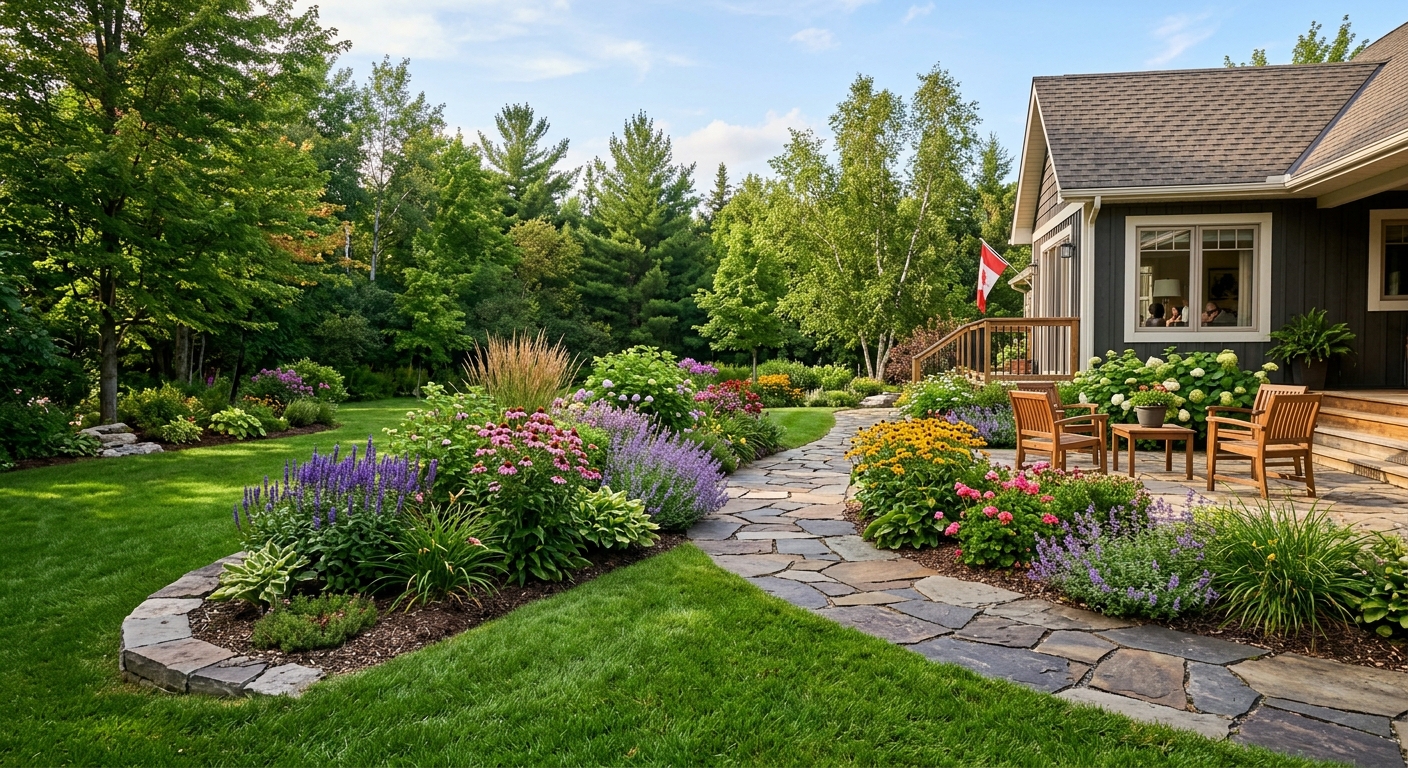
Landscaping options and costs in Roberts Creek
Roberts Creek is a small, coastal community, and landscaping choices there tend to reflect both the green, layered look homeowners want and the realities of short travel distances for crews—most builders can mobilize efficiently, but site access (driveways, slopes, and wet ground) still drives labour time. With a population of 1,949 (Statistics Canada, 2021 Census), the local market is tight enough that skilled installers are busy during peak spring and early autumn, especially around the broader Sechelt Peninsula area where many properties sit close to forest edges. In Roberts Creek, many homeowners also have the yard space to invest in multi-year upgrades, from drainage improvements to planting beds that mature into a privacy buffer.
In the Lower Mainland–Southwest, hardiness zones 7–8 and the long planting window (often early March to early April for last spring frost, with first fall frost commonly not until November) help keep costs more stable than in shorter-season regions. That said, heavy winter rain means contractors price grading and drainage carefully to avoid pooling and future foundation moisture. Structural work is still sensitive to freeze–thaw cycles, so patio bases and wall footings require proper depth, drainage, and compaction—work that can add thousands even when the final “look” seems simple.
Below are realistic cost bands you’ll see for common projects in Roberts Creek, including both design packages and the most-requested installs around neighbourhoods such as the Beach/creekside pockets near the village core. Use this table to compare like-for-like scopes, then we’ll break down what moves the price up or down.
| Service |
Description |
Season |
Price Range |
| Full landscape design and installation |
On-site consultation, layout plan, planting palette, grading/drainage coordination, labour for install |
Spring to early winter (best value: shoulder-season) |
$5,000–$50,000 |
| Sod installation (supply, grade, lay, roll) |
Soil prep, grading, sod delivery/laying, rolling, starter fertilizer, clean-up |
Late March to October (avoid waterlogged weeks) |
$2,000–$8,000 |
| Lawn seeding (grade, seed, starter fertilizer) |
Light grading, seed selection, starter fertilizer, seed coverage, initial watering plan |
April–May and again in early September |
$1,500–$6,000 |
| Interlocking patio or walkway |
Excavation, compacted base, edging, pavers, joint sand, slope considerations |
Spring to fall (base prep quality matters most) |
$8,000–$35,000 |
| Retaining wall (interlocking block) |
Block wall layout, base and drainage (weep controls), compaction, backfill |
Spring to early fall |
$10,000–$80,000 |
| Tree and shrub planting |
Soil amendment, planting, staking (if required), mulch, watering plan, wrap/handling |
Spring, fall (winter structure planting when access allows) |
$1,000–$15,000 |
Prices are estimates only and vary by project scope, site access and material selection.
What affects the price of landscaping in Roberts Creek
In Roberts Creek and across the Lower Mainland–Southwest, two quotes for the same “basic” landscape can easily diverge by 30–50% because the invisible work changes: drainage corrections, soil volume, access constraints, and how mature plants and stone are sourced. In coastal BC (Zone 7–8), you can grow a wider palette and get lush results, but contractors still must account for saturated soils in winter and the cost of getting bases and drainage “right” for long-term performance. By contrast, Prairie regions (Zone 2–4) typically face shorter frost-free windows and harsher conditions, so labour is compressed and budgets often shift toward drought-tolerant planting and simpler grading. Southern Ontario (Zone 5–6) often balances moderate summers with irrigation needs during dry spells. Water restrictions in the drier BC Interior and Alberta also push irrigation design costs and plant choices.
Two concrete examples from Roberts Creek: (1) a small slope correction can cost materially more than homeowners expect. When a job needs regrading to redirect runoff away from foundations, you’re not just moving dirt—you’re changing excavation volume, disposal, and compaction. (2) drainage beds/French drains can look like a “hidden” item, but they’re frequently the difference between a lawn that stays green and one that stays soggy or patchy. That’s why a comprehensive install can land in a full design band like $5,000–$50,000, while a focused lawn-only scope might sit closer to $2,000–$8,000—even when the surface area seems similar.
Local housing-stock age also matters. Older homes often have established service lines and uneven topography from decades of runoff patterns. Retrofitting around those constraints can add hours of careful locating, more precise soil amendment, and additional base depth—moving costs upward quickly in areas that experience persistent wet spots.
| Price Factor |
Why It Matters |
Cost Impact |
| Yard size in sq ft — the primary cost driver for softscape |
More area means more soil prep, more plantable square footage, and more material and labour hours |
Often the largest swing; can change the total by several thousand dollars |
| Grading and drainage work — slope corrections add significant cost |
Changing elevations affects runoff paths and requires excavation, re-compaction, and often disposal |
Commonly adds substantial cost on sloped coastal lots; can represent 15–40% of the budget |
| Drainage bed or French drain installation |
Reduces pooling near foundations and prevents plant loss in heavy-rain seasons |
Can add thousands; a lifesaver for problem areas, not optional when required |
| Plant material tier — native shrubs vs. ornamental vs. mature specimen trees |
Installed cost rises sharply with bigger caliper, specialty availability, and planting labour |
Smaller beds stay affordable; mature specimens can spike overall totals |
| Hardscape vs. softscape ratio — walls and patios cost more per sq ft than lawn |
Stone and base prep are labour-intensive and require compaction and proper slopes |
Shifts budget quickly toward retaining wall and patio bands |
| Irrigation system design and installation |
Coastal BC still benefits from efficiency; good design reduces water waste and labour |
Can raise softscape costs but prevents long-term plant failures |
| Soil amendment and topsoil required |
Heavy rainfall and existing soils often need improvement for drainage and rooting |
Added transport and labour can meaningfully increase totals |
| Tree removal or stump grinding before new planting |
Ground disturbance, disposal, and access planning add time and equipment needs |
Usually spikes costs on larger removals or tight access sites |
Permits & regulations in British Columbia
In British Columbia, most routine landscape work—planting, sodding, and the majority of softscape installs—typically does not require a permit. That means you generally can proceed with tasks like seeding, installing mulch, planting shrubs and trees, and laying sod as part of a normal landscaping scope, provided the contractor follows standard safety practices and protects existing utilities.
Work that often does require permits includes certain retaining walls: if a wall is above the municipality’s height threshold (commonly around 1.0 m (3.3 ft) in many BC communities), you may need a building permit and sometimes engineered drawings, depending on the site conditions and wall design. Also, if your project involves changes to lot grading that could alter drainage patterns toward neighbouring properties or storm connections, approval requirements can be triggered. Before any digging—whether it’s for planting holes or wall footings—utility locates are essential so you don’t hit buried services.
To verify a contractor in Roberts Creek, use a simple checklist: (1) confirm they are properly licensed where required for the scope (ask for their business/licence details); (2) request a certificate of insurance showing liability coverage with your address listed as the job site; (3) confirm worker coverage through WSIB/WCB documentation (ask for proof of clearance or coverage where applicable); and (4) keep a copy of all paperwork with your contract. If anything is unclear, ask before the job starts—legitimate contractors can provide documents quickly.
Planning a landscape that thrives in Roberts Creek's climate
Designing for Roberts Creek means working with a mild coastal climate in hardiness zone 7–8, frequent rainfall, and frost that typically comes later in the year. Start by choosing plants that handle our cool, wet winters without staying waterlogged in spring thaw, and pair them with placement that supports airflow. In practical terms, that means selecting zone-appropriate native and drought-tolerant options (even in a wetter region, irrigation efficiency matters) and grouping plants by moisture preference so soggy spots don’t become plant graveyards.
Sod vs. seed is another key decision. Sod gives instant curb appeal, but it’s typically about 3–4 times the cost per square foot compared with seeding. If you’re trying to “buy back time” for a short-term event or you need quick erosion control on a slope, sod can be justified. If your goal is long-term value, seeding plus good soil prep is often the better investment—especially when combined with mulch and targeted overseeding.
Drainage and grading are non-negotiable in the Lower Mainland–Southwest. Proper base preparation for patios and retaining walls needs to respect freeze–thaw cycles: excavate to proper depth, install compacted base, and include drainage where water can’t safely disperse. Low-maintenance strategies that still look lush include perennial layering, groundcovers, and thick mulch rings that suppress weeds and stabilize soil moisture. For water-smart designs, consider rain-garden basins and thoughtfully sized drip irrigation zones with smart controllers—helpful even when you’re not under strict drought bans.
To see where cost differences make sense: if sod lands in the $2,000–$8,000 range for your lawn area, you’re paying for speed and instant coverage; if you’re comfortable waiting and can address drainage correctly, seeding often reduces that up-front spend while building a more resilient lawn foundation.
| Element |
Climate Consideration |
Maintenance Level |
Price Band |
| Sod lawn installation |
Needs good drainage to avoid soggy roots during rainy periods; install in suitable weather windows |
Low to moderate (initial watering and monitoring) |
$2,000–$8,000 |
| Native perennial garden |
Zone-appropriate plants tolerate wet winters better when spaced for airflow and amended soils |
Low (seasonal mulch refresh and light weeding) |
$3,000–$12,000 |
| Mulched shrub border |
Mulch moderates soil moisture and temperature; choose shrubs that handle coastal rain |
Low (weed control and occasional prune) |
$1,500–$9,000 |
| Interlocking stone patio |
Requires compacted base and correct slopes to move water away from the home |
Low (periodic joint sand top-up) |
$8,000–$35,000 |
| Retaining wall (block) |
Drainage and base depth prevent movement through freeze–thaw cycles on sloped lots |
Low (keep weep/drainage paths clear) |
$10,000–$80,000 |
| Drip irrigation system |
Efficient watering reduces waste and supports establishment during cool, variable seasons |
Moderate (seasonal adjustment and controller settings) |
$1,500–$7,500 |
How to choose a landscaping contractor in Roberts Creek
Start with verification, not just a nice portfolio. In British Columbia, you’re looking for the contractor’s ability to do the work safely and legally for the scope you’re buying: confirm appropriate licensing/business registration where applicable, request a certificate of liability insurance that covers the job site, and verify worker coverage through WSIB/WCB documentation (ask for proof of coverage or clearance). If a contractor can’t provide these within a day or two, treat that as a red flag.
Next, get 2–3 itemised written quotes. You want a breakdown of labour and materials, including line items for excavation, soil/topsoil, drainage components, plant quantities/sizes, paver or block quantities, and disposal. Avoid quotes that only state a lump sum without showing what’s included. Pay attention to exclusions: is permit pulling included where required, is equipment included, and is disposal of excess soil accounted for? On wet coastal sites, disposal can be a big cost driver—make sure it’s written clearly.
Warranty matters. Ask for a workmanship warranty length for installation (grading, base prep, planting establishment practices) and confirm whether product warranties apply separately from labour. Also ask if warranties are transferable if you sell the home.
Payment schedule: never pay more than 10–15% upfront. Hold back a portion until the job is complete and you’ve reviewed the final grading, irrigation functionality (if included), and cleanup. Finally, require a start date and completion estimate in writing so your project stays anchored despite weather delays common in coastal BC.
- Request proof of liability insurance and confirm it matches your job address.
- Verify WSIB/WCB coverage status (ask for clearance or proof of coverage).
- Ask for licence/business details for the exact contractor who will perform the work.
- Get itemised quotes (quantities, unit rates, labour hours, material types).
- Confirm what drainage work is included (French drains, grading changes, outfalls).
- Make disposal/excess soil removal explicit in writing.
- Check base requirements for patio/wall work (depth, compacted material, compaction testing if stated).
- Clarify plant sizes and counts (container sizes, caliper for trees, spacing).
- Ensure topsoil/soil amendment volumes are specified (in cubic yards or depth).
- Ask about irrigation: controller type, zone counts, and winter shutoff provisions.
- Confirm warranty terms for workmanship and whether plant establishment is covered.
- Use a payment schedule with a holdback until you’ve inspected the completed work.
Red flags in Roberts Creek include: vague scopes that don’t list quantities or plant sizes, refusing to provide insurance/coverage documentation, starting excavation without utility locates, pressuring for large upfront payments, and a warranty that only covers “materials” with no workmanship responsibility.
Frequently asked questions — landscaping in Roberts Creek
What trees grow best in Roberts Creek's climate zone?
In Roberts Creek (coastal BC, hardiness zones 7–8), many trees perform well because winters are mild and soil doesn’t stay frozen for long stretches. Homeowners commonly do well with broadleaf evergreens and coastal-tolerant species, especially when placed in the right microclimates (sun vs. shade) and not planted in standing water. Good results often come from choosing trees suited to wet, cool conditions and giving them space for airflow and mature width. Your site’s slope and drainage matter as much as the species—if water pools near foundations, tree roots can struggle. A good contractor will also consider wind exposure around the peninsula and the yard’s irrigation plan. If you’re budgeting for a mixed planting, tree-and-shrub installs often fall within $1,000–$15,000 depending on sizes and counts.
How much does sodding a yard cost in Roberts Creek?
Sodding costs in Roberts Creek typically land in the $2,000–$8,000 range for most common residential lawn refresh sizes, depending on how much grading and soil prep is required. If your yard has uneven low spots, drainage correction can add time and material, but it’s also what prevents new sod from failing in the rainy season. Contractors generally price sod higher than seeding because you’re buying ready-to-lay turf plus the labour for careful rolling and immediate establishment. For best value on coastal timelines, sod is usually planned for late spring through summer conditions when the ground is workable and you can maintain establishment watering without saturating the base. Ask for a quote that separates soil prep, sod supply, and disposal so you can compare like-for-like.
How do I prevent weeds in my Roberts Creek garden?
Weed prevention starts before planting. In Roberts Creek and across coastal BC, it’s tempting to focus on plant choice, but poor soil prep and thin mulch layers are what usually drive ongoing weed pressure. Begin by removing persistent weeds at the roots, then improve soil and add a proper weed barrier only where it makes sense for your planting style (overuse can hinder planting beds and long-term soil health). Use a thick mulch layer—enough to block light—to reduce germination, and keep mulch refreshed each season. For beds that are repeatedly weedy, a professional can help with targeted drainage and proper plant spacing; crowded plantings leave bare soil, which weeds exploit. If your contractor proposes under-prepping the site to save money, that often shows up as “weeds later,” not “healthy beds now.”
How do I design a low-water yard in Roberts Creek?
Even in Roberts Creek, designing for low water is smart because costs and occasional watering limits still influence homeowners, and drip systems establish plants with less waste than sprinklers. Start with planting density and placement: use zone-appropriate species with similar moisture needs, add groundcovers, and avoid leaving bare soil where evaporation is highest. Incorporate mulch aggressively and consider rain-garden features or swales in low spots so water doesn’t run off uselessly during heavy rain events. For irrigation, drip with a smart controller reduces overwatering and helps you meet watering windows efficiently. It’s often worth spending a bit more on system design if your yard has multiple exposure zones (sun, shade, slope). If you’re also considering turf, remember sod is generally pricier than seeding—so choose based on performance goals, not just speed.
How do I find a licensed landscaper in Roberts Creek?
To find a reliable landscaping contractor in Roberts Creek, ask for documentation up front and verify it before signing. In British Columbia, you should request proof of appropriate licensing/business details for the scope, plus a certificate of liability insurance that lists the job address. Next, verify worker coverage through WSIB/WCB documentation—good contractors can provide proof quickly, including clearance or coverage status where applicable. Then, compare itemised written quotes so you can confirm each company is bidding the same scope: quantities of materials, drainage work, disposal, and plant sizes. If they won’t detail what they’re including, you can’t fairly compare. Finally, confirm timeline and warranty terms in writing so you understand workmanship coverage. A trustworthy contractor will welcome these checks; evasive ones usually struggle with quality or compliance.
How much does landscaping cost in Roberts Creek?
Landscaping cost in Roberts Creek depends mainly on how much softscape (planting/lawn) and hardscape (stone, walls) you’re adding, plus grading and drainage needs on your particular lot. For many residential projects, full design and installation commonly fall within $5,000–$50,000, especially when drainage corrections, patio/base work, and a designed planting palette are included. If you’re focusing on lawn or turf, sod typically sits in $2,000–$8,000 for a typical refresh size, while planting-only scopes often range within $1,000–$15,000 depending on plant counts and sizes. Retaining walls and larger stone features are usually the biggest cost drivers, often landing between $10,000–$80,000. Expect quotes to vary because coastal BC requires proper drainage and base prep, and access/excavation conditions change labour time.