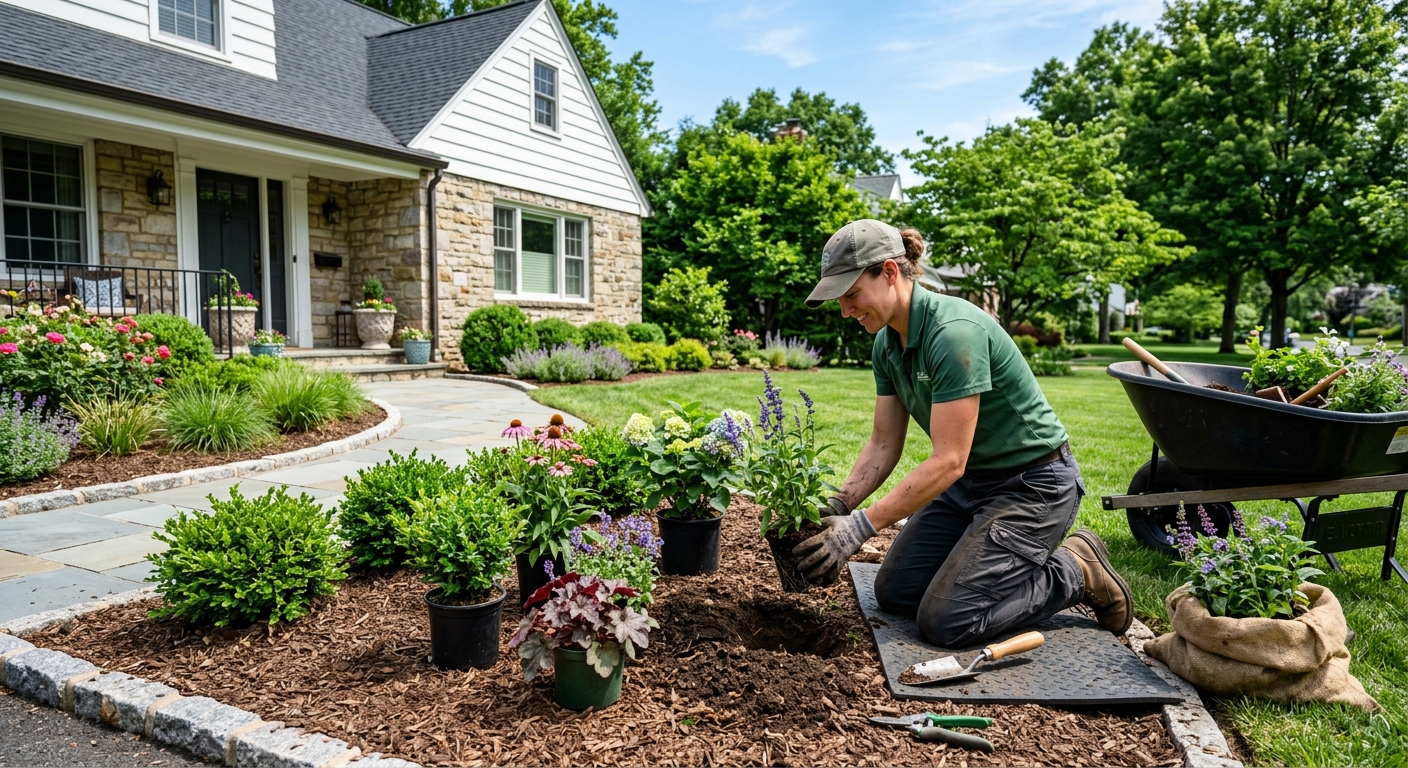
Landscaping options and costs in Sunshine Hills
In Sunshine Hills, British Columbia, landscaping is one of the easiest ways to make everyday living feel more comfortable—especially for homeowners with more room to work with. With Sunshine Hills sitting at about 9,900 residents (Statistics Canada, 2021 Census), there’s enough neighbourhood momentum that contractors stay busy, and scheduling can be tight in peak spring. Detached homes are common in family-oriented pockets, and those properties typically have yard space plus an incentive to invest in improvements that protect foundations and boost curb appeal over the long run. That matters for pricing because design scope and access costs move quickly when crews have multiple active projects.
In the Lower Mainland–Southwest (mostly plant hardiness zones 7–8), mild winters and a long growing window often lower the “season risk” premium compared with shorter frost-free regions. You can plant and build earlier and later in the year, so labour can be planned more efficiently. At the same time, the region’s wet winter spells and freeze–thaw cycles mean retaining walls, patio bases, and drainage details aren’t “optional add-ons”—they’re what keeps the structure from shifting. That’s why a driveway-adjacent interlocking patio or a sloped-lot retaining wall usually prices higher than a straightforward lawn refresh, even when the square footage looks similar.
Demand is especially strong around the Sunshine Hills local commercial corridor and the nearby residential streets where front-yard upgrades and drainage corrections are most visible after winter rains. Below is a practical comparison of common services and typical Sunshine Hills pricing to help you line up your next quotes.
| Service |
Description |
Season |
Price Range |
| Full landscape design and installation |
Site assessment, plant palette, grading/drainage plan, hardscape/softscape build-out, project management |
Year-round planning; install best spring–fall (with weather-dependent winter exceptions) |
$5,000–$50,000 |
| Sod installation (supply, grade, lay, roll) |
Fine grading, soil prep, sod delivery/laying, rolling and starter watering setup |
Best: spring to early summer; limited late fall windows |
$2,000–$8,000 |
| Lawn seeding (grade, seed, starter fertilizer) |
Light grading, seed selection, starter fertilizer and cover where needed |
Best: early spring and early fall |
$1,500–$6,000 |
| Interlocking patio or walkway |
Excavation, base, compaction, bedding sand, interlocking stone and edge restraint |
Spring–fall; base work needs dry/controlled conditions |
$10,000–$45,000 |
| Retaining wall (interlocking block) |
Terraced or single wall build with proper base, drainage gravel and weep provisions |
Best: spring–early fall; avoid wet ground for compaction |
$12,000–$70,000 |
| Tree and shrub planting |
Soil amendment, planting, staking (as needed), mulch rings and first watering plan |
Planting windows: early spring through fall (weather permitting) |
$1,000–$15,000 |
Prices are estimates only and vary by project scope, site access and material selection.
What affects the price of landscaping in Sunshine Hills
Even when two homeowners in the Lower Mainland–Southwest ask for the “same” job, quotes can swing by 30–50% across British Columbia because the variables are usually hidden: soil conditions, drainage, slope complexity, and how much labour is required to prep properly. Coastal BC landscaping often benefits from a longer working season and a wider plant palette (zones 7–8), but contractors still need to build for heavy rain periods and freeze–thaw cycles—especially on sloped yards and near foundations. In Prairie zones (2–4), shorter frost-free windows and harsher winters push projects toward drought-tolerant planting and compressed scheduling; structural work also has to be planned for deeper base requirements. Southern Ontario (zone 5–6) sits in between, while irrigation demand often peaks during summer dry spells. These different climate realities are exactly why the same patio or planting plan can cost very differently.
In Sunshine Hills, two local conditions commonly raise cost: (1) grading corrections to stop pooling near the house, and (2) drainage improvements where downspouts or yard runoff need to be re-routed. For example, a simple lawn upgrade might land in the $2,000–$8,000 band, but once we add subgrade prep plus a drainage bed to prevent wet spots, the scope begins to look more like a full landscape project in the $5,000–$50,000 range. Similarly, a basic tree and shrub planting can be close to $1,000–$15,000, but switching to larger, mature specimens or adding topsoil/compost to fix poor soils can add thousands. Labour and equipment time in coastal rain can also push costs up because excavation and compaction can’t be rushed on saturated ground.
Housing age matters too: older homes with established foundations often have settled grades and buried drainage lines that must be tested or replaced, adding excavation and materials—sometimes several thousand dollars—before any plants go in.
| Price Factor |
Why It Matters |
Cost Impact |
| Yard size in sq ft — the primary cost driver for softscape |
More area means more topsoil/seed or sod, more labour hours, and more mulch/planting materials |
Typically increases cost roughly in proportion to square footage; smaller yards can feel more expensive per sq ft due to minimum labour charges |
| Grading and drainage work — slope corrections add significant cost |
Proper slopes prevent foundation moisture and standing water after storms |
Commonly adds a meaningful premium on sloped lots or older drainage layouts; can shift the project from “lawn” pricing toward full landscape pricing |
| Drainage bed or French drain installation |
Captures runoff and directs it to a safe outlet; requires excavation depth and filter fabric |
Often one of the biggest hidden line items; can add several thousand dollars depending on trench length and depth |
| Plant material tier — native shrubs vs. ornamental vs. mature specimen trees |
Mature trees/shrubs cost more and require larger holes, better backfill, and sometimes staking |
Switching from standard stock to larger specimens can add substantial cost while reducing long-term growth timelines |
| Hardscape vs. softscape ratio — walls and patios cost more per sq ft than lawn |
Stone, excavation, base materials, and compaction are labour- and material-intensive |
Hardscape-heavy plans can move the budget into the retaining wall & hardscaping bands quickly |
| Irrigation system design and installation |
Efficient watering (often drip with smart control) is increasingly expected and protects plants during dry periods |
Can add noticeable cost, but it often prevents plant loss and reduces ongoing water use |
| Soil amendment and topsoil required |
Correcting poor native soil affects root development and long-term lawn thickness |
“Small” topsoil loads can be inexpensive; hauling and engineered soil volumes can add several thousand dollars |
| Tree removal or stump grinding before new planting |
Removal adds crew time, disposal, and stump grinding equipment |
Often pushes a planting project into a higher bracket; costs vary widely by access and stump size |
Permits & regulations in British Columbia
In British Columbia, most planting and softscape work—like planting trees and shrubs, sodding, lawn seeding, adding mulch, and installing typical landscape edging—generally does not require a permit. If your project is mostly “surface” work and doesn’t change how water flows off your property, it’s usually straightforward from a permitting standpoint.
Where permits can come into play is structural and drainage-related work. Retaining walls above a local height threshold (commonly 1.0 m / 3.3 ft in many municipalities) typically require a building permit and sometimes engineered drawings, especially if the wall is substantial or supports significant surcharge loads. Also, changes to lot grading that alter drainage toward neighbouring properties or connect/redirect runoff to a storm sewer may trigger approval requirements. Because these rules can vary by municipality within the Lower Mainland–Southwest, it’s smart to confirm with your local permitting office or the contractor’s permit coordinator before work begins.
Step-by-step for Sunshine Hills homeowners: (1) ask for the contractor’s proof of British Columbia licence/registration if applicable to their scope, (2) request a certificate of insurance showing liability coverage (and ensure it includes landscaping-related activities), (3) verify coverage for workers via the appropriate provincial workers’ coverage documentation (contractors should be able to provide clearance/verification), and (4) check references for similar jobs with retaining walls or drainage. Finally, call for utility locates before digging holes for plants, tree pits, French drains, or wall footings—hit rates improve dramatically when everyone follows the locate process first.
Planning a landscape that thrives in Sunshine Hills's climate
Planning in Sunshine Hills is about working with the reality of plant hardiness zones 7–8: mild, wet winters, long cool summers, and frost typically spanning early spring to late fall. That means you can use a richer palette than many other parts of Canada, but you still need to design for saturated soil periods and winter freeze–thaw cycles that can move poorly built bases. Start with plant selection: choose zone-appropriate natives and proven evergreens/perennials that handle local rainfall patterns and require less winter protection. For low-watering goals, add mulch-heavy borders and groundcovers to reduce evaporation during the drier shoulder periods.
Sod versus seed is a big decision. Sod gives instant curb appeal but often costs 3–4x more per sq ft than seeding. That’s justified when you need immediate “finished” look—like preparing the yard for a sale or hiding mud during construction. If your goal is long-term lawn cost control, seeding is usually the better value when you can tolerate a growth period. In wet winters and spring shoulder weather, drainage and grading remain critical: pooling near foundations leads to foundation moisture complaints and plant failures. For patios and retaining walls, base preparation must account for the local frost depth behavior—meaning proper excavation depth, compacted subbase, and correct drainage layers to reduce heaving and movement.
For maintenance, go layered: mulched shrub borders, reliable perennials, and seasonal interest reduce annual upkeep while keeping the yard lush. Where water planning matters, consider rain gardens or xeriscape zones using plants that tolerate periodic wetting then drier spells—often achieved with graded swales and drip irrigation for targeted watering instead of broad lawn irrigation.
As a dollar example: if a sod lawn refresh is in the $2,000–$8,000 range for your yard size, but you only need “good enough” turf while plants establish, seeding into the $1,500–$6,000 band can preserve budget for drainage corrections that protect hardscape and foundations longer.
| Element |
Climate Consideration |
Maintenance Level |
Price Band |
| Sod lawn installation |
Best timing leverages early growth; needs good grading so sod roots aren’t sitting in winter water |
Low to moderate (watering in establishment period) |
$2,000–$8,000 |
| Native perennial garden |
Zone-appropriate perennials handle wet winters better; mulch supports winter resilience and reduces fungal stress |
Moderate (spring clean-up and occasional weeding) |
$1,500–$12,000 |
| Mulched shrub border |
Helps manage heavy-rain seasons and reduces erosion; supports consistent soil moisture |
Low (annual top-up mulch) |
$1,200–$10,000 |
| Interlocking stone patio |
Requires frost-aware base prep and drainage so it doesn’t lift during freeze–thaw cycles |
Low (occasional joint sand topping) |
$10,000–$45,000 |
| Retaining wall (block) |
Needs engineered-style drainage gravel and proper base for local freeze–thaw movement control |
Low (inspection after heavy weather) |
$12,000–$70,000 |
| Drip irrigation system |
Targets watering during establishment and dry spells; can be designed to reduce runoff |
Low to moderate (seasonal adjustments) |
$1,500–$8,500 |
How to choose a landscaping contractor in Sunshine Hills
Choosing the right contractor in Sunshine Hills, British Columbia is mostly about verifying coverage and getting clarity in writing. First, confirm licensing/registration where applicable to their scope, and ask for proof of liability insurance (certificate of insurance). For workers’ compensation, Saskatchewan isn’t relevant here—what you want is the provincial workers’ coverage and the contractor’s ability to provide verification/clearance documentation for their workers. A reputable company will provide documents promptly and won’t pressure you to skip checks.
Next, request 2–3 itemised written quotes. You should see labour and materials broken out (excavation, base materials, soil/topsoil, drainage rock, seed/sod, plant counts/sizes, edging, and any equipment surcharges), not just a single lump sum. Make sure the scope includes disposal (green waste and excess soil), and that permits—if required for retaining walls above the threshold—are addressed in the proposal (who pulls them, and what’s included). Also ask about warranty: a workmanship warranty should be stated clearly (length, what it covers, and claim process). Product/manufacturer warranties should be documented too, and you should ask whether the warranty is transferable if you sell the home.
On payment schedules, never pay more than 10–15% upfront. Use a holdback until key milestones are complete (after rough grading/drainage, after base compaction, and at final acceptance). Get the start date and a completion estimate in writing; in Lower Mainland–Southwest weather, crews often plan in phases, so ask how rain delays are handled.
- Ask for proof of liability insurance (certificate of insurance) and verify dates/coverage limits.
- Request workers’ coverage verification documentation and confirm it includes landscaping crews.
- Choose a contractor who will do utility locates before digging—plants, French drains, and wall footings.
- Get quotes that list labour, materials, and quantities (plant counts and sizes; stone thickness; base layers).
- Confirm drainage/grading responsibilities: who guarantees slope and outlet performance.
- Check what disposal includes: soil hauling, green waste, and debris clean-up frequency.
- Ask whether a permit is needed for your retaining wall and who handles it.
- Review warranty terms for workmanship and plant material replacement policies.
- Agree on irrigation scope clearly (drip heads, zones, timers/smart controllers) and coverage.
- Verify base-prep standards: excavation depth, compaction, bedding sand, and edge restraint.
- Confirm the payment schedule: small deposit, milestone payments, holdback at substantial completion.
- Request a written timeline with weather contingencies for wet days and frost-affected periods.
Red flags to watch for in Sunshine Hills: quotes that exclude drainage while promising “levelled results,” vague scope language (“materials as needed”), unwillingness to provide insurance/coverage documents, no written warranty terms, and crews that ask for a large upfront payment before any site assessment or measurements are done.
Frequently asked questions — landscaping in Sunshine Hills
When is the best time to landscape in Sunshine Hills?
In Sunshine Hills, the best window is typically spring through early fall because soil temperatures and daylight make excavation, planting, and base compaction more reliable. You’ll often see a last spring frost stretching from early March to early April near the coast, and first fall frost often not until November, so there’s flexibility to schedule softscape work. Hardscape construction (patios, walkway bases, retaining walls) still needs weather control; wet ground can compromise compaction, and that can lead to settlement later. If you’re aiming for a sod refresh, spring to early summer usually gives the lawn the longest establishment period. For planting, plan early to mid-spring or fall for strong root growth with less heat stress.
Do I need a permit for a retaining wall in British Columbia?
Often, yes—if your retaining wall is above a typical threshold such as 1.0 m (3.3 ft) in many municipalities. In British Columbia, most small landscaping work (mulch, planting, sodding, and general softscape) usually doesn’t require a permit, but retaining walls are different because they’re structural. It’s also possible you’ll need approval if the project changes lot grading and drainage patterns toward neighbouring properties or storm connections. The best approach is to provide your contractor with wall height, length, and a site description so they can confirm whether a building permit and/or engineered drawings are required. A solid contractor will include permitting responsibility in the quote.
How do I improve drainage in my yard?
In Sunshine Hills and the wider Lower Mainland–Southwest, drainage improvements are about directing runoff away from foundations and preventing pooling during wet winter weeks. Start with assessment: identify low spots, check downspout discharge points, and observe where water collects after heavy rain. Common fixes include grading corrections (slight slope adjustments), adding a drainage bed, or installing a French drain with filter fabric and proper outlet direction. If the yard is sloped, drainage often costs more than simple lawn work because excavation depth and compaction matter for long-term performance. If your lawn refresh quote is in the $2,000–$8,000 range, drainage changes can move the job toward the broader landscape design & installation band—so it’s worth budgeting early and getting a clear written scope.
What is xeriscaping and does it suit Sunshine Hills?
Xeriscaping is a water-wise landscaping approach that reduces irrigation demand through plant selection, groundcovers, mulch, and smart layout (for example, focusing water on plant beds rather than broad turf). In British Columbia, it can still make sense in Sunshine Hills because occasional dry periods and water-cost concerns affect how homeowners water—even if municipal restrictions aren’t as common as in the drier Interior. With zones 7–8, you can combine lush coastal-friendly plants with drought-tolerant companions, plus rain-garden or swale features to capture and store runoff. Xeriscaping is not about turning everything into rock; it’s about choosing the right plant in the right microclimate and using drip where it’s most effective.
How do I plan a low-maintenance yard?
A low-maintenance yard in Sunshine Hills comes from reducing the “repeat tasks” that cost time each season. Prioritise good drainage and then design with mulch and groundcovers to suppress weeds and stabilise soil moisture. Choose proven native and zone-appropriate perennials and evergreen shrubs so you’re not constantly replacing winter-stressed plants. For turf, sod can be low effort after establishment, but seeding is often a lower-cost path if you can tolerate a longer grow-in period. Consider irrigation that targets beds (drip) instead of watering lawn broadly. If you’re allocating budget, remember that a yard with both softscape and hardscape can land anywhere from the $5,000–$50,000 landscape range up to higher structural costs—so a staged plan (drainage first, then planting, then surfacing) keeps maintenance predictable.
How deep should a retaining-wall base be for local frost?
For a retaining wall in Sunshine Hills, the base depth needs to be built for freeze–thaw behaviour and stable soil, not just a one-size number. Coastal BC generally has less severe frost than inland Canada, but winter freeze–thaw cycles still affect unsound base layers. That’s why reputable contractors excavate to a depth that allows proper compaction, drainage gravel placement, and a stable footing below the zone where movement is most likely. The exact depth depends on wall height, soil type, and how much surcharge/load the wall is holding. Because your design may also require a permit if the wall exceeds typical height thresholds (often 1.0 m / 3.3 ft), the contractor should be able to explain their base section and drainage provisions in writing before construction starts.