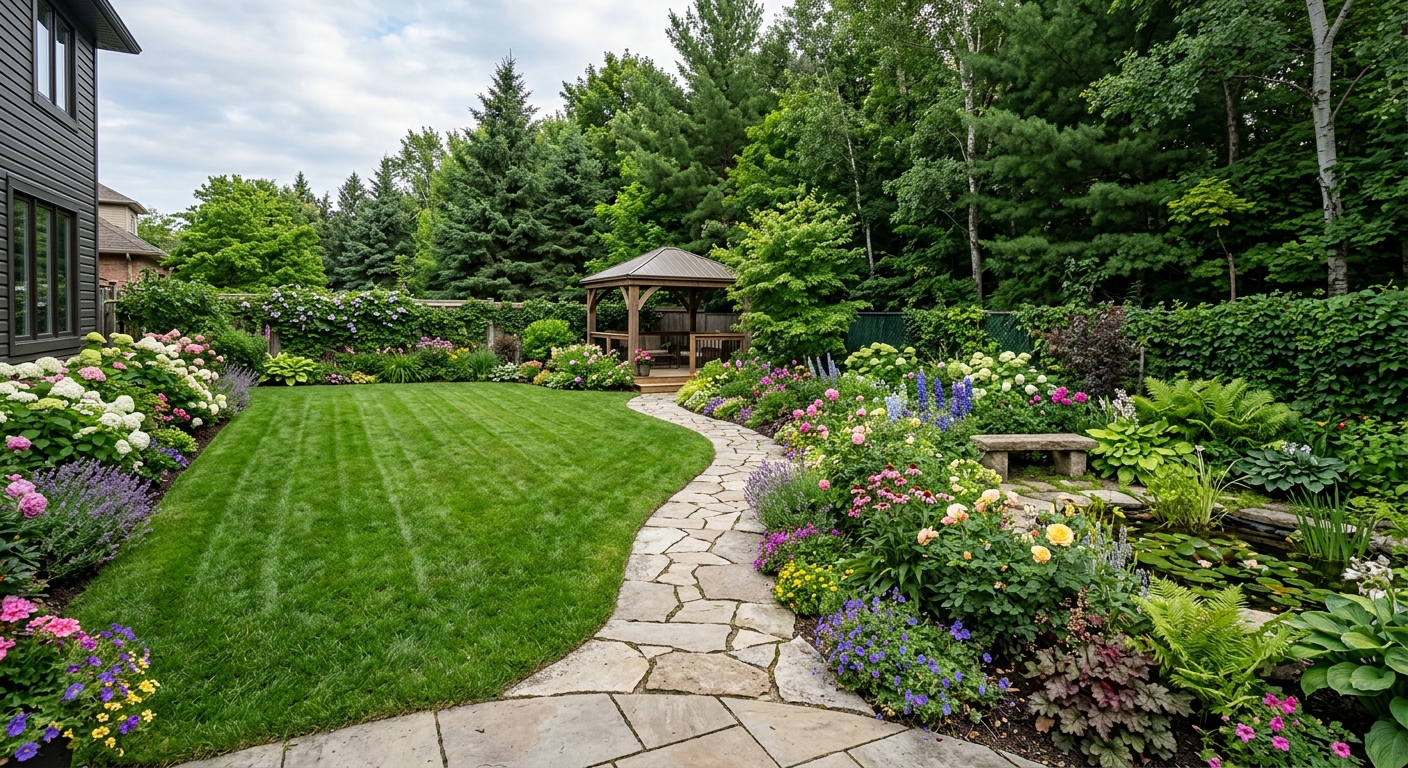
Landscaping options and costs in Belmont
Belmont homeowners typically start with a wish list, then narrow it to what will actually fit the season and soil reality of Southern Ontario. With a total population of 1,140 (Statistics Canada, 2021 Census), Belmont is small enough that contractors often book quickly when the weather window opens. Most buyers there also arrive with yard space that matters—detached homes generally give more contiguous softscape area to improve than low-rise options, which is why many projects in Belmont begin with lawn upgrades, new borders, or a patio extension rather than touch-ups. Overall pricing is driven by the Toronto market: demand for skilled labour is steady, and the work is concentrated into a roughly May-to-October install window.
In the GTA, landscaping costs are also affected by freeze–thaw cycles and heavier clay/fill soils that can hold water near foundations. That’s why even “simple” upgrades like grading for a patio or redoing a lawn often include excavation, soil amendment, and drainage attention. In demand pockets include areas around residential pockets such as downtown/central Belmont where curb appeal improvements are visible and priorities often shift toward interlocking stone, walkways, and tidy garden borders.
Below is a practical cost range you can use to compare quotes for Belmont, then we’ll break down the main price drivers in the next section.
| Service |
Description |
Season |
Price Range |
| Full landscape design and installation |
Site walk, concept + plan, grading/drainage strategy, plantings, sod/seed, hardscape (patio/walkway), and cleanup |
Spring or early summer through fall (weather-dependent) |
$8,000–$40,000 |
| Sod installation (supply, grade, lay, roll) |
Weed control, topsoil/grade correction, sod supply, laying, rolling, and initial watering guidance |
Late spring to early fall |
$2,500–$8,000 |
| Lawn seeding (grade, seed, starter fertilizer) |
Light grading, seed blend, starter fertilizer, seeding/coverage, and first-season care plan |
Late spring to early fall |
$1,500–$5,000 |
| Interlocking patio or walkway |
Excavation, base + bedding, edging, interlock installation, compaction, and jointing sand |
Spring to early fall |
$6,000–$30,000 |
| Retaining wall (interlocking block) |
Wall layout, proper granular base, block installation, geogrid (as required), drainage gravel, and finishing |
Spring to early fall |
$6,000–$30,000 |
| Tree and shrub planting |
Soil prep, planting holes, amendments, staking (if required), mulch rings, and initial watering setup |
Spring or fall for best survival |
$800–$6,000 |
Prices are estimates only and vary by project scope, site access and material selection.
What affects the price of landscaping in Belmont
In Belmont, two quotes for the same “look” can differ by 30–50% because the underlying scope is rarely identical. One contractor may price only surface work (topsoil + seed), while another includes grading, excavation, soil amendment, drainage correction, and disposal. Those hidden elements matter more in the Toronto area because the hardiness zones in our region (typically 6a–7a) support a broad palette, but freeze–thaw and frost heave demand proper base depth, compaction, and drainage layers. That also affects contractor availability: the best crews are booked around the reliable install weeks, so scheduling constraints can push pricing up when a site isn’t ready.
Local conditions raise cost in Belmont in straightforward ways. For example, heavier clay or fill soils often require additional excavation and replacement before a patio or walkway is stable—this is one reason patios and retaining-wall work tend to land in the $6,000–$30,000 band rather than looking “simple” on paper. If your backyard slope is pushing water toward the house, drainage beds or a French drain can add labour and aggregate, especially when they must connect to safe discharge routes. Conversely, costs can come down when the site is already well-graded, with clean access for a mini-excavator and minimal soil rework.
How the climate compares across Ontario explains why contractors plan differently. Prairie regions (zone 2–4) often need drought-tolerant, wind-hardy planting and simpler palettes because working seasons are shorter and summers can be drier; in coastal BC (zone 7–8) growth is faster, but drainage design is still crucial in wet pockets. Southern Ontario offers a moderate season with irrigation needs during summer dry spells, so many Belmont projects focus on balancing plant survivability with water-smart layout. Even housing age plays a role: newer infill lots often have tighter landscaping access, while older neighbourhood properties may have more mature trees that require removal or stump grinding, which can shift a $8,000–$40,000 full project into the upper range.
| Price Factor |
Why It Matters |
Cost Impact |
| Yard size in sq ft — the primary cost driver for softscape |
More area increases labour hours for excavation, soil prep, and materials (seed/sod, topsoil, mulch) |
Often the biggest swing; doubling area can multiply cost beyond 2× due to mobilization and access |
| Grading and drainage work — slope corrections add significant cost |
Toronto-area freeze–thaw and clay soils can trap water; proper slope away from the house is critical |
Can add thousands when regrading requires haul-away and re-compaction |
| Drainage bed or French drain installation |
Subsurface water control protects foundations and stops soggy lawn zones |
Typically moderate-to-high addition depending on length, outlet, and depth |
| Plant material tier — native shrubs vs. ornamental vs. mature specimen trees |
Hardier natives cost less long-term to maintain; mature trees cost more to supply and install |
Switching tiers can change a planting budget by several thousand dollars |
| Hardscape vs. softscape ratio — walls and patios cost more per sq ft than lawn |
Stone, excavation depth, and base construction drive price more than mulch/seed |
Higher hardscape share pushes the project toward the upper landscape bands |
| Irrigation system design and installation |
In Belmont’s GTA summers, targeted irrigation supports establishment and reduces plant loss |
Can be a major line item if zones, timers, and backflow protection are included |
| Soil amendment and topsoil required |
Clay and fill often need organic amendments and proper depth for roots and stability |
Adds material + delivery/haul-away time; impacts both lawn and planting success |
| Tree removal or stump grinding before new planting |
Roots and stumps complicate grading, sod prep, and drainage routes |
Can increase cost quickly based on stump size and access |
Permits & regulations in Ontario
In Ontario, most homeowners don’t need a permit for typical soft landscaping. Planting beds, sodding, and the majority of grade-level softscape work (like topsoil placement for gardens or laying sod/seed) usually falls under “no permit required.” You also generally don’t need a permit for standard mulching, garden edging, or small groundcover installations.
Where permits do come into play is most often with hard structures and drainage reconfiguration. Retaining walls above a height threshold—commonly 1.0 m (3.3 ft) in many Ontario municipalities—typically require a building permit, and sometimes engineered drawings depending on the wall details. Additionally, changes to lot grading that significantly affect drainage direction toward neighbouring properties or storm connections may trigger approval or review. If you’re planning a deeper French drain that ties into an existing system, confirm with your contractor and municipality before digging to avoid problems after the fact.
Before any excavation, call for utility locates. Even digging for planting holes or wall footings can strike underground services. For contractors in Belmont, ask for their Ontario licence/registration details (where applicable), a certificate of liability insurance, and proof of WSIB/WCB coverage (or equivalent coverage accepted for workers). A homeowner can verify by: (1) checking the contractor’s listing on the applicable Ontario registry/industry listing page, (2) requesting a current certificate of insurance with your address listed as jobsite, and (3) asking for a clearance letter and/or coverage documentation that names the correct company.
Planning a landscape that thrives in Belmont's climate
To plan a yard that thrives in Belmont, you have to design around the conditions we reliably see in the Toronto area: winter lows near –23 to –18°C, freeze–thaw cycles, and summer stretches where lawns and new plantings need consistent moisture to establish. Start with plant selection. Choose zone-appropriate trees, shrubs, and perennials that can handle winter cold and rebound in spring. Where possible, use native or well-adapted species; they typically require less watering and are easier to maintain year-to-year. Pair that with realistic site drainage—especially on clay or fill soils where water can pool after heavy rains.
For lawns, compare sod vs. seed based on your timeline and budget. Sod gives instant curb appeal but costs roughly 3–4× more per sq ft than seeding because it includes sod supply, handling, and more labour. If you want the look fast, sod is worth it; if you can wait for establishment, seeding is more economical and forgiving. For example, on a mid-size back yard upgrade, a seeding approach is often aligned with the lower end of the lawn bands (while sod projects typically track closer to $2,500–$8,000 depending on area).
Hardscape base preparation is non-negotiable in Southern Ontario. Patios and walkways need properly compacted granular bases and adequate drainage to reduce heave and shifting. Retaining walls require a stable base and drainage layer; don’t “eyeball” depths because local frost forces structural decisions. Low-maintenance strategies that still look polished include mulched shrub borders, groundcovers, and perennial drifts that repeat along the property line to reduce weeding. If water is a concern, consider a rain garden for downspout capture or xeriscape pockets with drought-tolerant plants; in Belmont, these work best when paired with careful grading and a drip-ready layout rather than broad, flashy irrigation.
| Element |
Climate Consideration |
Maintenance Level |
Price Band |
| Sod lawn installation |
Establishment needs consistent moisture through warm spells; winter freeze can heave poorly prepped bases |
Low to moderate (more watering during establishment) |
$2,500–$8,000 |
| Native perennial garden |
Better cold tolerance and resilience through –23 to –18°C; mulch protects roots through freeze–thaw |
Low (annual pruning, seasonal weeding) |
$800–$4,000 |
| Mulched shrub border |
Winter structure and summer moisture retention; clay soils benefit from proper topsoil depth and mulch rings |
Low (weed suppression, periodic mulch refresh) |
$1,200–$5,000 |
| Interlocking stone patio |
Requires base depth and compaction to resist heave; drainage prevents water from undermining joints |
Low (occasional joint sand top-up) |
$6,000–$30,000 |
| Retaining wall (block) |
Needs stable granular base and drainage layer to manage freeze–thaw pressure and water behind the wall |
Low to moderate (inspection of drainage and weep holes) |
$6,000–$30,000 |
| Drip irrigation system |
Supports consistent moisture for new plantings during hot, humid stretches; helps reduce runoff on clay |
Moderate (seasonal tune-ups) |
$1,200–$6,000 |
How to choose a landscaping contractor in Belmont
Choosing a contractor in Belmont is less about a catchy photo and more about documentation and clarity. First, verify Ontario licensing/registration where applicable, then request proof of liability insurance and WSIB/WCB coverage for their workers. To check: (1) look up the company on the relevant Ontario business/contractor registry or association listing if they’re members, (2) ask for a current certificate of insurance and confirm it covers the work type (landscaping/hardscape and excavation if included), and (3) request WSIB/WCB clearance or coverage confirmation that names the correct legal entity.
Next, get 2–3 itemised written quotes—not a single lump sum. The best estimates break labour and materials separately (excavation, base layers, interlock supply, drainage rock, topsoil, plants, mulch, disposal). Ask what’s excluded: removal of old sod, stump grinding, utility locates, permit pulls (if required for retaining walls), hauling away, and whether they include edge restraint or subdrains. For warranty, ask for the workmanship warranty length, whether the product/manufacturer warranty applies to plants/materials, and if it’s transferable to you as the homeowner.
Payment schedule matters. In landscaping, never pay more than 10–15% upfront. Use holdback: release the final portion only after inspection and completion—especially for base compaction, drainage connections, and the final grade. Demand a timeline in writing with a start date, weather contingency, and an estimated completion window.
- Request their insurance certificate and confirm it is current for the project start date.
- Ask for WSIB/WCB coverage proof before any digging begins.
- Get an itemised quote showing excavation, base layers, and disposal (if included).
- Confirm whether utility locates are arranged or you are asked to do it.
- Ask what permit is needed (e.g., retaining walls above typical thresholds) and whether they handle it.
- Verify plant guarantees: survival period and replacement terms for failing stock.
- Ask how they handle drainage: slope plan, outlet route, and any sub-surface work.
- Check interlock/hardscape compaction methods and base thickness (not just “we do a base”).
- Require product specs: interlock thickness, block type, fabric/geogrid use (where required).
- Get disposal/haul-away listed line-by-line if excavation is expected.
- Use a written start date, completion estimate, and weather delay policy.
- Plan your payment schedule with a holdback until you approve final grading and cleanup.
Red flags in Belmont: (1) quotes that only list a total price without dimensions or material specifications, (2) promises to install during “any time of year” without addressing freeze–thaw limits, (3) no proof of WSIB/WCB or liability coverage, (4) vague statements like “we’ll sort out drainage later,” and (5) requests for large upfront payments beyond 10–15% without a clear schedule and contract terms.
Frequently asked questions — landscaping in Belmont
How do I improve drainage in my yard?
In Belmont and across the Toronto area, drainage improvements usually start with a simple question: where does the water go after a heavy rain? If your lawn stays soggy near foundations, contractors typically evaluate grading, downspout discharge, and the need for a drainage bed or French drain. Clay and fill soils can trap moisture, so simply adding more topsoil without correcting slope can make the problem worse. A proper fix often includes regrading away from the house, installing a stone drainage layer, and connecting to an appropriate outlet. If you also want new softscape, consider bundling work so the lawn prep and drainage correction happen together. Budget-wise, drainage added to a lawn or bed project can push a larger landscape plan into the higher end of the $8,000–$40,000 range if excavation and disposal are required. Always confirm utility locations before digging.
What is xeriscaping and does it suit Belmont?
Xeriscaping is a water-smart approach that uses drought-tolerant plants, mulch, and smart layouts to reduce irrigation demand. In Belmont, it can work well, but it shouldn’t be “rock-only” landscaping. The GTA climate still has seasonal cold and freeze–thaw, so the plant palette must be zone-appropriate (not just desert plants). I often recommend xeriscape pockets—like along fences or sunny sides—paired with a mulch strategy and groundcovers that can handle winter. If you do use irrigation, consider drip lines targeted at establishment rather than broad sprinkler coverage. A common mistake is trying xeriscaping without addressing grading; standing water in clay soils will kill many drought-tolerant plants. When designed correctly, xeriscaping can lower seasonal watering needs while keeping curb appeal high. For budget context, adding a drip-ready plan can shift a planting-focused project toward the $800–$6,000 tree and shrub planting band, depending on plant count and system complexity.
How do I plan a low-maintenance yard?
A low-maintenance yard in Belmont is usually planned around fewer, stronger plant decisions: native or zone-appropriate shrubs, perennial drifts, and mulched borders that suppress weeds. In Southern Ontario, freeze–thaw cycles mean plants need enough root protection—mulch and healthy soil depth help—while well-set hardscape reduces the annual “topping up” that people end up doing with shifting grades. Choose sod only if you want fast results; otherwise seeding can be cheaper and still low-maintenance once established. For hardscape, a properly built interlocking patio is typically low maintenance (mostly joint sand top-up) compared with a lawn that needs mowing, edging, and spot repairs. If you’re mixing approaches, we often see the best balance when you keep lawn areas functional and use shrub borders for structure. If your project scope includes design + installation plus multiple zones, it can land within the $8,000–$40,000 band; smaller planting-only updates may fit within the $800–$6,000 range.
How deep should a retaining-wall base be for local frost?
In Belmont, retaining walls must be built for freeze–thaw, which means the base needs to be properly excavated and compacted—not shallow. The exact depth depends on wall height, block system, and local site conditions, so a contractor should confirm it based on engineering guidance or the block manufacturer’s installation requirements. As a homeowner check: ask for the planned granular base thickness, whether geogrid is required for that height/soil, and how drainage gravel and weep holes will be handled behind the wall. The key is that the foundation and drainage layers must sit below the frost-susceptible zone and remain stable under water pressure. If you’re within the typical permit-trigger range (often around 1.0 m / 3.3 ft in many Ontario municipalities), the project may require a building permit and sometimes engineered drawings, so depth should be documented in the scope. This is one area where “good enough” can lead to settling or bulging after a couple of winters.
How much does professional landscape design cost?
Professional landscape design pricing varies widely depending on whether you’re getting concept-only or a full plan with measurements, plant lists, and hardscape layouts. In Belmont and the Toronto area, design is often packaged with design-and-install projects rather than priced separately, especially when the contractor is managing both the plan and the build. For homeowners comparing quotes, use the overall band: full landscape design and installation commonly falls within the $8,000–$40,000 range depending on yard size, drainage work, and how much hardscape is included. If your scope is only planting refresh or a smaller perimeter update, costs can fit more easily within the $800–$6,000 tree and garden planting band. When comparing design costs, make sure the quote includes what you’ll receive: a scaled plan, plant quantities, and the technical details needed for accurate pricing and installation. If permits are required for a retaining wall, good designers also consider the documentation needs early so you’re not redesigning mid-project.
How do I compare landscaping quotes?
To compare landscaping quotes in Belmont, start by making sure you’re looking at apples-to-apples scope. Ask each contractor for a written, itemised breakdown separating labour and materials: excavation, base prep, drainage components, topsoil/compost, edging restraints, sod/seed supply, plant list and sizes, and disposal/haul-away if included. Confirm season and timing: Toronto-area projects are typically executed when freeze–thaw risk is manageable, and timelines should reflect that. Check whether a permit is included where needed (commonly retaining walls above typical height thresholds) and whether utility locates are part of their process. Look for warranty terms in writing—workmanship and product coverage for plants/materials—and confirm if warranties are transferable. Payment terms should be reasonable; don’t accept quotes asking for large upfront payments. Finally, ensure quote totals align with the expected price bands: if one quote for a full project lands dramatically below the $8,000–$40,000 range, it may be missing drainage, grading, or hardscape base work.