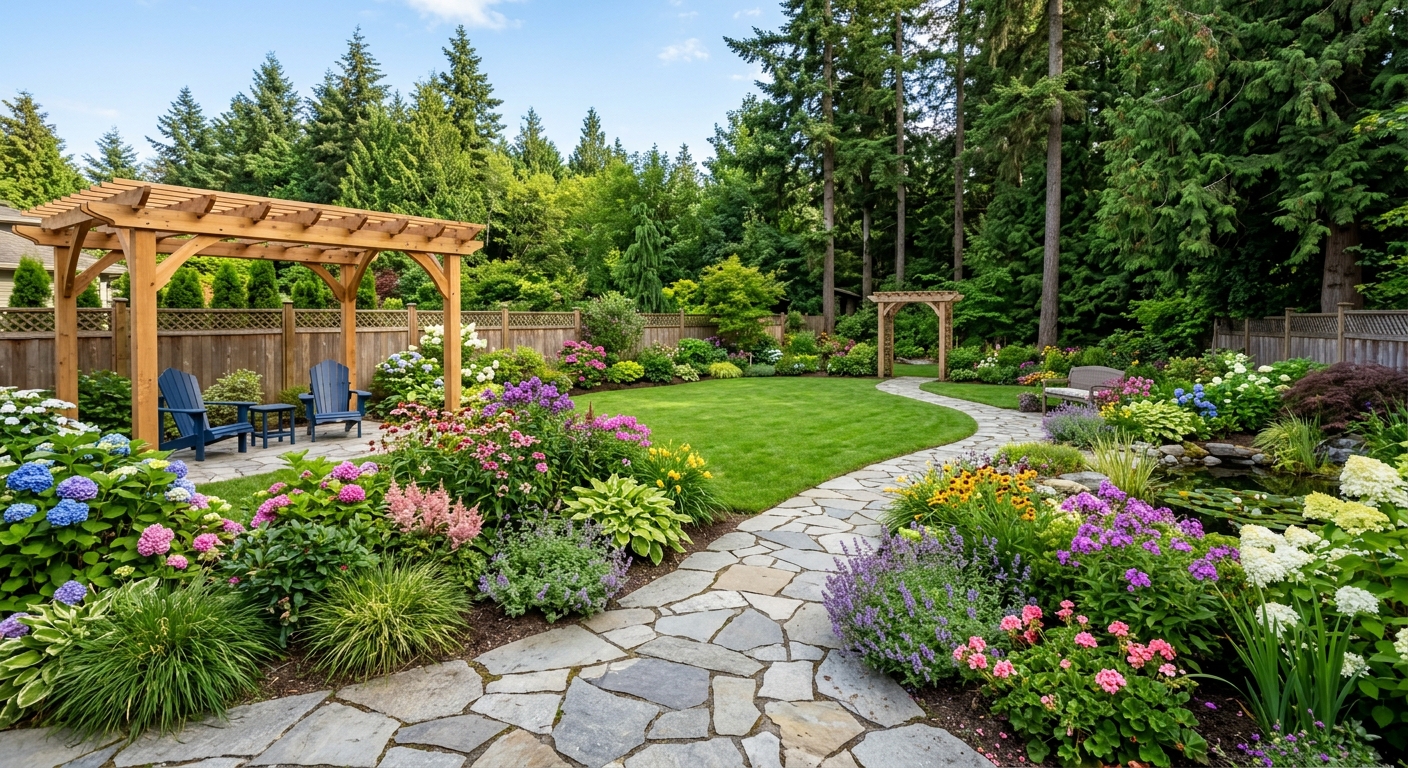
Landscaping options and costs in Millbrook
Millbrook, Ontario homeowners typically start landscaping with a practical goal: improve curb appeal, manage water around the foundation, and make the backyard usable. With a population of 1,695 (Statistics Canada, 2021 Census), Millbrook is small enough that the same few experienced crews are often booked for weeks when demand spikes. That reality matters for pricing and scheduling—especially during the GTA’s short, frost-limited installation window. On many Millbrook streets, detached homes dominate yard space decisions, which is why full property makeovers and backyard hardscapes are common upgrades (rather than “tiny” garden projects). In the Toronto economic region, pricing is also influenced by freeze–thaw cycles, local clay and fill soils, and the labour intensity of digging, drainage work, and building properly compacted bases.
In the GTA, we generally plan installations around roughly May to October for reliable plant establishment and solid hardscape performance. Winter lows near –23 to –18°C (plant zones 6a–7a) mean we select hardy woody plants and perennials, and we build patios, steps, and retaining walls with enough granular depth and drainage to resist movement over time. If you’re in an area with older housing stock and heavier soils—like the North Millbrook/nearby village core area—expect more excavation and soil amendment, which increases cost, but it also prevents problems like water pooling, soggy beds, and shifting interlocking. Below is a clear comparison of common options so you can map your goals to realistic budget ranges.
| Service |
Description |
Season |
Price Range |
| Full landscape design and installation |
Site visit, concept + planting/hardscape plan, layout, grading/drainage adjustments, soil prep, planting, and installation coordination |
Spring–Fall (typically May–October) |
$8,000–$40,000 |
| Sod installation (supply, grade, lay, roll) |
Remove debris/old sod, rough grade and fine grade, amend as needed, lay rolls, roll and water plan |
Late Spring–Early Summer; early Fall for best results |
$2,500–$8,000 |
| Lawn seeding (grade, seed, starter fertilizer) |
Grade corrections, seed selection for sun/shade, starter fertilizer, light raking and top-dressing where required |
Spring after frost; early Fall (shorter window, good germination) |
$1,000–$4,500 |
| Interlocking patio or walkway |
Excavation, base course and compaction, edge restraints, interlock laying pattern, joint sand, and sealing (optional) |
Late Spring–Fall |
$6,000–$30,000 |
| Retaining wall (interlocking block) |
Layout, excavation, geogrid/footing depth, drainage backfill, wall block install, and cleanup |
Spring–Fall |
$6,000–$30,000 |
| Tree and shrub planting |
Planting layout, soil improvement, staking/anchoring where needed, watering plan, and mulching |
Spring/Fall planting windows |
$800–$6,000 |
Prices are estimates only and vary by project scope, site access and material selection.
What affects the price of landscaping in Millbrook
In the Toronto-area market around Millbrook, it’s common to see quotes for the “same” landscaping scope swing by 30–50%. The difference usually isn’t the finished look—it’s what’s happening underground: excavation depth, soil amendment, drainage design, base preparation for concrete/stone, and the labour hours required to achieve stable compaction and clean edges. Contractors pricing by the yard of topsoil or the metre of drain line are also reacting to GTA conditions like freeze–thaw movement, winter frost depth considerations, and the fact that skilled crews may be working across multiple jobs at once.
Plant hardiness zones 6a–7a and our frost timing define both what grows and what we can install reliably. In the Prairies (Zone 2–4) contractors must shift toward ultra-hardy, drought-tolerant palettes and often contend with a shorter working season; that can compress schedules and simplify plant selection. Coastal BC (Zone 7–8) supports lush, longer seasons—good for broadleaf evergreens—but heavy rain means drainage details can be crucial. Dry BC interior demands drip irrigation and low-precipitation heads due to water restrictions. Southern Ontario (Zone 5–6) offers a moderate season, but we still get summer dry spells where irrigation design becomes the difference between lush growth and stressed beds.
In Millbrook specifically, two common cost drivers can move your budget quickly. First, clay/fill soils often require more excavation and granular base depth for patios and walls to reduce frost movement—where a retaining wall can land in the $6,000–$30,000 range, under-built bases can force expensive rework. Second, yard grading for drainage—especially where water runs toward foundations—can push a project toward the $8,000–$40,000 band when the scope includes drainage bed installation, subdrains, and replanting. Even with a smaller population (Statistics Canada, 2021 Census), labour availability can be tight during peak weeks, so planning and site prep help keep costs under control.
| Price Factor |
Why It Matters |
Cost Impact |
| Yard size in sq ft — the primary cost driver for softscape |
More area means more labour for excavation/soil prep, and more materials for soil, mulch, sod, or seeding |
Small changes in area can shift budgets by thousands |
| Grading and drainage work — slope corrections add significant cost |
Fixing slope and directing water away from structures requires additional excavation, base, and shaping time |
Often a major driver for 30–50% quote variation |
| Drainage bed or French drain installation |
Clean-out access, correct pipe grade, and proper gravel backfill protect walls and foundations |
Can add several thousand depending on length and depth |
| Plant material tier — native shrubs vs. ornamental vs. mature specimen trees |
Mature trees cost more and require careful handling, staking, and larger soil volumes |
Material-only differences can swing $1,000–$5,000+ |
| Hardscape vs. softscape ratio — walls and patios cost more per sq ft than lawn |
Stone work needs engineered base prep, compaction, and edge restraints |
Increasing hardscape increases cost faster than planting |
| Irrigation system design and installation |
Coverage mapping, zone planning, and freeze-safe components add design and install time |
Typically increases budget but boosts survival of new sod/plantings |
| Soil amendment and topsoil required |
Clay or poor fill often needs compost/topsoil blends and sometimes regrading to support roots |
Delivers better long-term results; can add $500–$3,000+ |
| Tree removal or stump grinding before new planting |
Access, haul-away, and root disruption affect excavation and replant planning |
Can add meaningful labour and disposal costs |
Permits & regulations in Ontario
In Ontario, many common landscaping tasks don’t require a permit—planting beds, sodding, seeding, mulch installation, and most softscape work are typically handled as private site improvements. However, retaining walls are where permitting often comes up. In most Ontario municipalities, retaining walls above a height threshold (commonly around 1.0 m or 3.3 ft) usually require a building permit, and sometimes engineered drawings depending on wall height, soil conditions, and whether drainage/structural support is involved. Another trigger is changes to lot grading that affect drainage direction, especially if it increases runoff toward neighbouring properties or connects near storm services.
Before you dig in Millbrook, always plan for utility locates. Call for locates to protect buried services before installing drain lines, footings, or planting holes near buried utilities. If your plan includes new irrigation heads or shifting sprinkler lines, confirm local irrigation and water-use rules for your season—while those restrictions are more widely discussed in dry regions, Ontario cities can still impose limits during drought-like spells.
Step-by-step, here’s how to verify your contractor: (1) check for an Ontario business profile/licence details as applicable for their trade work; (2) request a current certificate of insurance for general liability—coverage should match the project scale; (3) confirm WSIB/WCB clearance (the contractor should provide proof of coverage/clearance); and (4) ensure the quote includes what permits are (and aren’t) the contractor’s responsibility. You can also ask for the written scope that identifies exactly what will be excavated, how drainage will be managed, and how debris/disposal is handled.
Planning a landscape that thrives in Millbrook's climate
To plan a yard that thrives in Millbrook, Ontario, design for our zone 6a–7a winters, our humid summer growth, and the freeze–thaw cycles that stress foundations and hardscape. Start with plant selection: choose hardy, zone-appropriate trees, shrubs, and perennials, and favour native species where it fits your aesthetic. These typically establish better with less winter protection, and they reduce the risk of winter dieback. For lawns, your choice matters: sod gives instant visual coverage, but it’s more expensive and depends heavily on correct grading and watering to take root. Seeding is more budget-friendly and works well when soil contact is consistent and you follow the proper schedule.
Drainage and grading are the difference between “pretty” and “functional” in the Toronto market. Pooling water around foundations leads to soft soils, weed pressure, and recurring maintenance. For patios, steps, and retaining walls, base preparation has to be built for local frost and movement: correct excavation depth, compacted granular layers, and proper drainage backfill prevent shifting. Low-maintenance design strategies—mulch rings, groundcovers, and perennial layers—cut annual upkeep without sacrificing curb appeal. If you want a water-smart angle, consider a rain garden in low spots (instead of pushing water into the foundation) or xeriscape-inspired planting beds with deep-rooted perennials and mulch to slow evaporation in summer dry spells.
Cost reality check: for a medium front lawn refresh, sod often costs about 3–4x more per square foot than seeding because of labour, turf supply, and the need to grade correctly before rolls are installed. If your goal is a quick front-yard finish for guests, sod can be justified; if budget is tighter and you can tolerate a gradual green-up, seeding usually stretches dollars further while still performing well in Ontario’s growing season.
| Element |
Climate Consideration |
Maintenance Level |
Price Band |
| Sod lawn installation |
Needs good soil contact and consistent watering to survive early heat waves; best planted within the GTA’s reliable frost window |
Medium (watering and early mow schedule) |
$2,500–$8,000 |
| Native perennial garden |
Zone-appropriate plants tolerate winter lows near –23 to –18°C and often handle humidity better once established |
Low (mulch refresh and seasonal trimming) |
$800–$6,000 |
| Mulched shrub border |
Mulch moderates soil temperature and reduces moisture loss during summer dry spells in southern Ontario |
Low (weeding reduced with proper bed prep) |
$1,200–$7,000 |
| Interlocking stone patio |
Freeze–thaw cycles require deeper base and compaction to keep joints and edges stable |
Low (occasional cleaning/sealing optional) |
$6,000–$30,000 |
| Retaining wall (block) |
Footing depth and drainage behind the wall are critical so water doesn’t build up during wet springs |
Low (periodic inspection of drainage/settlement) |
$6,000–$30,000 |
| Drip irrigation system |
Useful for new beds and water-smart planting in the GTA; freeze-safe components and winter shutoff are essential |
Medium (seasonal checks and timer settings) |
$1,200–$6,500 |
How to choose a landscaping contractor in Millbrook
Choosing the right landscaping contractor in Millbrook starts with verification. First, confirm licensing and trade qualifications where applicable, then ask for proof of liability insurance—this matters most when excavation, machinery, and hardscape work are involved. Next, request WSIB/WCB clearance (or a clearance letter) showing the contractor has workers covered for onsite labour. If a contractor can’t provide current documentation, that’s a major warning sign.
Then get 2–3 itemised written quotes, not lump sums. The best quotes break labour and materials separately (e.g., base material quantities, drain pipe length, block count, soil/topsoil volumes, plant list with sizes). Read the scope: what’s excluded (tree removal, disposal, rock excavation, geotextile, subdrain tie-ins), what’s included (permit pulling, if required), and whether the contractor provides weekly cleanup and final grading verification. For example, two patios that both “include interlock” can still vary widely if one includes proper drainage and deep compacted base. Warranty should be specific: workmanship warranty length, what’s covered (settlement, edging failures, plant replacement), and whether it’s backed by the manufacturer for products or only by the contractor. A transferable warranty is especially helpful for larger plantings.
Payment schedules should stay sensible: never pay more than 10–15% upfront. Hold back a portion until the job is complete, surfaces are cleaned, and you’ve accepted the final walk-through. In the GTA, a predictable timeline matters because planting and base work have seasonal windows—ask for a written start date and a realistic completion estimate.
- Provide certificate of insurance (liability) with project name and address
- Provide WSIB/WCB clearance letter for the contractor and/or crew
- Itemise labour vs materials (base, aggregate, drain lines, plants, and mulch)
- List plant varieties and sizes (not just “shrubs”)
- State what disposal/haul-away is included
- Confirm grading and drainage responsibilities (slope away from house)
- Clarify whether permits are included for retaining walls above the typical threshold (around 1.0 m)
- Ask for proof of compaction/bases approach (geotextile, geogrid if needed)
- Define irrigation scope if included (design, install, winterisation/timer)
- Set a warranty term in writing for workmanship and clarify plant replacement policy
- Keep deposits to 10–15% and use a holdback until final completion
- Get a written schedule with milestones (excavation, hardscape install, planting, cleanup)
In Millbrook, watch for these red flags: a quote that doesn’t describe drainage/grading depth or base prep; asking for a large deposit (more than 10–15%) before any work starts; vague scope language like “standard soil” without quantities or amendments; refusal to provide insurance/WSIB/WCB documentation; and no clear timeline or warranty details in writing.
Frequently asked questions — landscaping in Millbrook
How deep should a retaining-wall base be for local frost?
For Millbrook and the wider Toronto area, retaining-wall stability is driven by frost and the freeze–thaw cycle. In practice, the base depth needs to reach below the zone where frost heave can affect the wall system, and it must be paired with proper compaction and drainage behind the wall. Contractors typically base the design on the wall height, block system requirements, and the site’s soil conditions (clay/fill often needs more preparation). The “right” depth also depends on whether a geogrid and drainage backfill are included. When you’re comparing quotes for a retaining wall—often in the $6,000–$30,000 range—ask specifically what footing depth, base course thickness, and drainage backfill will be used. If those details aren’t stated clearly, budget for variability—or re-evaluate the quote.
How much does professional landscape design cost?
In Ontario, professional landscape design fees vary based on whether you’re getting a concept only versus a full install-ready plan with planting lists and hardscape layouts. For Millbrook homeowners, design commonly becomes most valuable when you’re mixing hardscape (patio, walkway, retaining wall) with planting and grading changes—because design protects you from expensive rework after excavation. As a rule of thumb for budgeting, many full projects land in the broader $8,000–$40,000 design-and-install band when you include site grading, drainage work, plant materials, and installation coordination. If you already have a contractor ready and only need a planting plan, you may be able to keep design costs lower—just ensure the plan is detailed enough to bid properly. A good designer will also account for Toronto-area frost dates and zone-appropriate plant choices.
How do I compare landscaping quotes?
To compare landscaping quotes in Millbrook fairly, insist on itemised scopes. Look for labour vs materials breakdown, quantities (square footage for sod/seeding, metres/feet for drains, depth and type of base for patios), and whether drainage and grading are included. Quotes that seem close on the total can differ significantly if one includes a proper granular base, subdrain installation, or more thorough soil amendment. Also compare season timing: sod and planting have tight windows, and base work needs good conditions for compaction. Ask whether the contractor will pull required permits for retaining work above the typical threshold (often around 1.0 m in many Ontario municipalities). When bids fall in the same category—like interlocking or retaining walls in the $6,000–$30,000 range—focus on what’s underneath the finish, not just the visible pattern or plant names.
How long does a landscaping project take in Millbrook?
Project length in Millbrook depends on scope and the GTA’s seasonal limits (roughly May to October for reliable installation and plant establishment). A simple planting job can take a few days once materials are on site. Lawn work also varies: seeding may take less labour day-to-day than sod, but you’ll need follow-up watering and maintenance during establishment. Interlocking patios and retaining wall projects usually take longer because excavation, base preparation, compaction, and curing/setting steps require more staged work. Full landscape design and installation can take several weeks overall due to layout approvals, material lead times, and scheduling trades. If you’re budgeting with the $8,000–$40,000 design-and-install band, plan for a project timeline that includes at least one week for preparation and multiple install days. A reputable contractor should provide a written schedule with start and completion dates.
What is the best grass type for a Millbrook lawn?
For Millbrook lawns, the “best” grass type depends on sun exposure and use (kids/pets, shade, traffic). In the GTA, homeowners often choose cool-season turf grasses because they handle Ontario winters and bounce back in spring. Many contractors select a blend tailored to sun and shade conditions and then back it with proper seeding rates, soil contact, and starter fertilizer. If you’re doing sod, ask what cultivar/seed blend is being used and whether it’s appropriate for your light conditions. For seeding or overseeding, a contractor should match the blend to sun/shade and include soil prep steps so germination isn’t wasted. The big budgeting difference between approaches is that sod installation—commonly in the $2,500–$8,000 range—costs more upfront, while seeding is typically lower cost but takes time to fill in. The best grass choice is the one matched to your yard conditions and maintenance plan.
When should I aerate and overseed my lawn in Millbrook?
For Millbrook and the Toronto area, aerate and overseed schedules generally work best in spring or early fall, when temperatures support germination but heat stress is lower. Many homeowners aim for spring after the ground is workable and not frozen hard, or in early fall to take advantage of cooler nights while the lawn can still grow roots before winter. If your yard is compacted (common with clay-heavy soils or frequent driveway/foot traffic), aeration helps seed-to-soil contact. Overseeding works best when you lightly top-dress with the right material and keep watering consistent during establishment. Because Ontario lawns respond to freeze–thaw cycles, avoid overseeding too late in the season when growth can’t keep up. If you’re also planning sod or a full lawn refresh, coordinate the schedule with your installer—especially if your budget is closer to the $2,500–$8,000 sod range versus seeding.