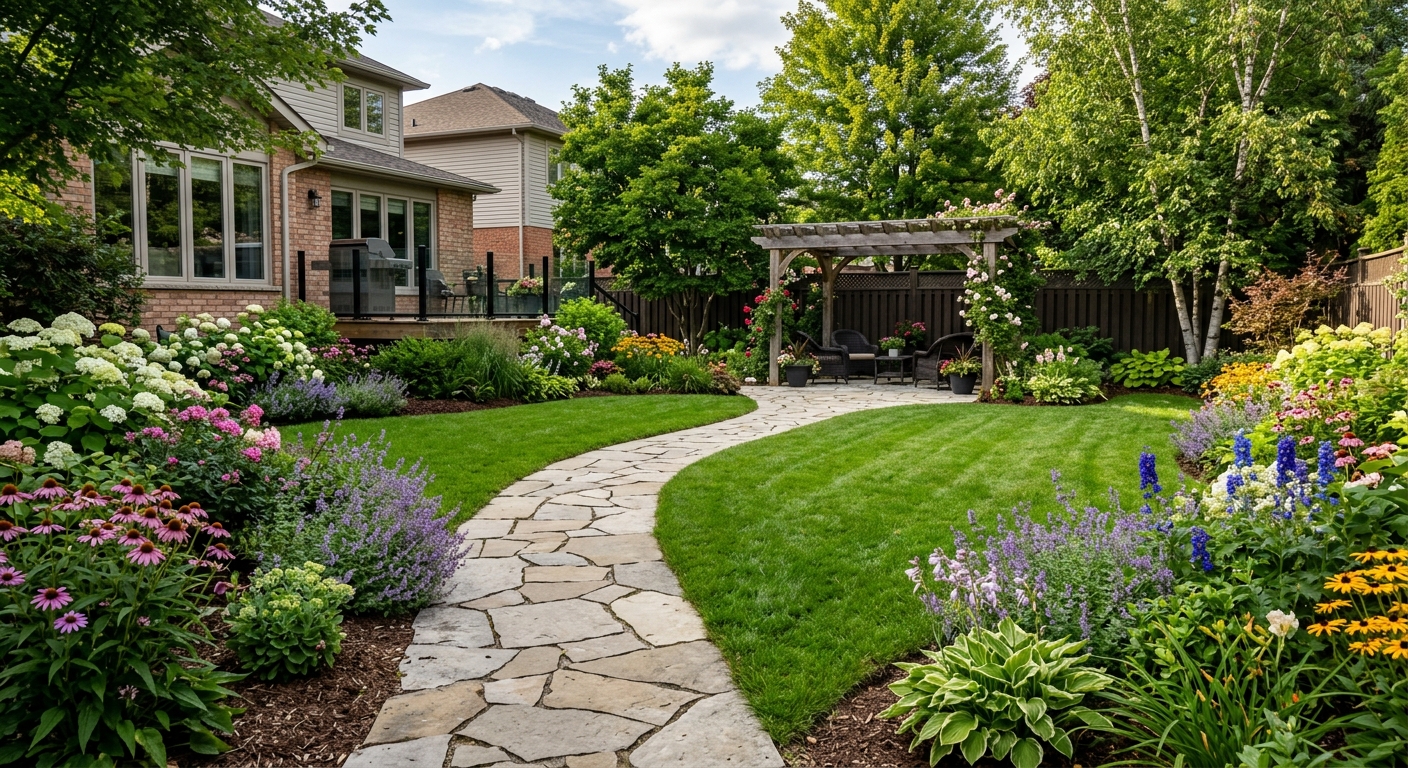
Landscaping options and costs in South River
South River homeowners typically have yard space to work with—most of the housing stock is detached (81.4% of dwellings), and with 59.4% of households owning, there’s a steady appetite to invest in curb appeal and winter-ready outdoor spaces. On top of that, many homes in the area were built before 1981 (77.1%), which often means older foundations, mature trees, and settled drainage patterns that affect how hard a contractor must work to re-grade, protect weeping tile routes, and rebuild planting beds.
In the Northeast, landscaping costs are driven by a short, practical working season and tougher freeze-thaw conditions. For most projects, scheduling is compressed into mid-to-late spring through early fall, and crews need extra time for excavation, base prep, and drainage restoration before cold weather returns. Contractors also have to plan around a colder continental climate with hardiness limits—plant choices, soil amendments, and winter installation practices all influence labour and material selection. In practice, that’s why the same scope (for example, “front walkway and beds”) can land higher than you might expect when frost-depth excavation and drainage detailing are included.
Demand is especially strong in established pockets like the South River waterfront and riverbank-side residential areas, where yards often need erosion control and foundation-aware grading. Below is a quick comparison of common services to help you line up budget expectations before requesting a tailored quote.
| Service |
Description |
Season |
Price Range |
| Full landscape design and installation |
On-site design consultation, layout plan, grading/drainage coordination, planting and turf, plus hardscape such as patio/walkway where included |
Mid/late spring to early fall |
$8,000–$30,000 |
| Sod installation (supply, grade, lay, roll) |
Existing turf removal (if needed), soil prep, topsoil blend, weed control, sod delivery/laying, rolling, starter fertilizer, light watering guidance |
Late spring to mid-summer (best success before peak heat) |
$3,000–$9,000 |
| Lawn seeding (grade, seed, starter fertilizer) |
Grading touch-ups, seed selection, starter fertilizer, light raking/rolling, and establishment care instructions |
Spring or early fall seeding windows |
$1,600–$5,500 |
| Interlocking patio or walkway |
Excavation, compacted base (frost-conscious), edging, interlocking stones, jointing stone, and basic site cleanup |
Late spring to early fall |
$6,000–$22,000 |
| Retaining wall (interlocking block) |
Engineering-style base considerations for stability, drainage behind wall (weeping/debris-free layers), block installation, finishing and seeding/restoration |
Mid-spring through early fall |
$6,000–$25,000 |
| Tree and shrub planting |
Soil amendment, planting holes, staking (as needed), mulching rings, and a placement plan suited to sun/wind and winter exposure |
Spring to early fall |
$1,500–$8,000 |
Prices are estimates only and vary by project scope, site access and material selection.
What affects the price of landscaping in South River
In the Northeast, the same “average” landscaping job can come in 30–50% apart because the details that control plant survival and winter performance are the ones that cost time and money. Quotes vary with how each contractor measures your yard and how much frost-protection and drainage work they include. Even when you’re comparing a basic hardscape with softscape—say, a patio plus beds—the base preparation, compaction depth, and slope corrections can swing labour hours quickly. For South River, this matters because many properties were established decades ago (77.1% built before 1981), and older sites often need more regrading and careful drainage tie-in to keep water away from foundations.
Climate is the other major driver. Hardiness and frost timing dictate what can be planted reliably and what can be installed during a short working window. Prairie-like conditions (Zone 2–4 in much of the Northeast) favour drought-tolerant, wind-resistant species and efficient irrigation layouts; freeze-thaw cycles also mean retaining wall and paving bases must be built stronger and deeper than you’d do in milder regions. Water restrictions and dry spells in the wider interior context push designs toward drip zones instead of high-water spray. In southern Ontario (Zone 5–6), you typically get a moderate season, but summer dry spells still require irrigation planning—especially for new sod and newly planted shrubs.
Concrete cost examples help: upgrading from seeding to sod often jumps your turf line item because sod installs material instantly but carries higher supply and handling costs (often within the $3,000–$9,000 band). If your slope needs drainage work before stones or walls go in, that can increase hardscaping from a lower estimate into the $6,000–$25,000 retaining wall range once excavation depth, base aggregate, and drainage layers are included.
| Price Factor |
Why It Matters |
Cost Impact |
| Yard size in sq ft — the primary cost driver for softscape |
More area means more labour hours and more material (topsoil, seed, sod, mulch) |
Small changes in square footage can shift total cost by thousands |
| Grading and drainage work — slope corrections add significant cost |
Correcting run-off and foundation direction prevents standing water and frost heaving |
Can increase a project by 10%–30% depending on excavation volume |
| Drainage bed or French drain installation |
Intercepts saturated soils behind walls and near downspouts |
Often adds substantial labour and aggregate, moving costs upward in hardscape projects |
| Plant material tier — native shrubs vs. ornamental vs. mature specimen trees |
Hardier, smaller stock generally establishes faster with less winter risk |
Premium tiers can double material spend and add planting labour |
| Hardscape vs. softscape ratio — walls and patios cost more per sq ft than lawn |
Stonework requires deeper base, edging, and stricter compaction |
Projects with more hardscape commonly land near the upper parts of bands |
| Irrigation system design and installation |
Efficient zoning reduces winter damage and improves establishment of sod and shrubs |
Can add meaningful cost, but prevents replacement after failure |
| Soil amendment and topsoil required |
Compacted or poor soil needs improved structure and fertility for rooting |
Extra truckloads and amendments can noticeably increase the quote |
| Tree removal or stump grinding before new planting |
Removal affects access, root disturbance, and how beds and grading are rebuilt |
Often triggers additional permits, disposal, and extra labour |
Permits & regulations in Ontario
In Ontario, most landscaping work—planting trees and shrubs, sodding, seeding, and typical softscape installations—generally does not require a permit. Where it frequently changes is when your project affects structural elements or lot grading. Retaining walls above a height threshold (commonly around 1.0 m in many municipalities) may require a building permit, and some situations call for engineered details depending on location, height, and soil conditions. Also, changes to lot grading that redirect water toward neighbouring properties, alter flow paths, or connect to storm services may trigger municipal review. Because South River is in a region where freeze-thaw can magnify drainage issues, contractors should plan drainage first—not after the wall or stones are set.
Before any digging for planting holes, footings, or drainage lines, always arrange utility locates. This helps prevent damage to buried lines and avoids delays.
To verify a contractor for a South River project, confirm three things step-by-step: (1) Ontario licence/registration status—use the contractor’s legal business information and any relevant provincial registry they should be associated with; (2) liability insurance—ask for a current certificate of insurance naming you as additionally insured where applicable; and (3) WSIB coverage (or the applicable exemption documentation) and proof of coverage status. Your contractor should provide paperwork before work starts. If they refuse, keep looking.
Planning a landscape that thrives in South River's climate
To plan a yard that thrives in South River’s conditions, design with winter hardiness and drainage in mind, not just summer appearance. Start with plant selection: choose hardy, zone-appropriate natives and proven perennials to reduce winter dieback and watering demand. In Northeast-influenced climates with short frost-free windows and aggressive freeze-thaw, the best “low-water” yards still need a smart establishment period—so you design efficient zones, mulched beds, and wind-aware placement.
Next, decide whether turf should be sod or seed. Sod gives instant green coverage, but it’s typically costlier—often landing in the $3,000–$9,000 band once soil prep and access are included. Seeding is usually more budget-friendly and can be a smart choice on slopes or where a slower, thicker establishment is acceptable. If you’re restoring a worn front lawn for curb appeal before sale season, the sod premium can be justified because it delivers immediate visual impact.
Drainage and grading are the make-or-break items in this region. Even small pooling near foundations can cause freeze-thaw heaving and repeated landscaping failure. For patios and retaining walls, base preparation must be frost-conscious: deeper excavation, thicker base aggregates, proper compaction, and a drainage plan behind walls so water doesn’t push through.
Finally, use low-maintenance strategies: groundcovers, 2–3 cm of quality mulch in beds, perennial structure, and selective shrub borders reduce annual upkeep. If you want a xeriscape-style approach, pair it with drip irrigation in planting zones and consider a rain-garden where downspouts can be routed safely (not toward the foundation).
As a simple budget reality check: if sod raises the turf line item by roughly a few thousand compared with seeding, that difference is often worth it when you need fast cover and erosion control on a sloped front yard—but it’s rarely worth it when drainage problems are the real root cause.
| Element |
Climate Consideration |
Maintenance Level |
Price Band |
| Sod lawn installation |
Better winter aesthetics, but requires careful prep and establishment watering during the short growing window |
Medium (establishment + seasonal inspections) |
$3,000–$9,000 |
| Native perennial garden |
Hardy plants reduce winter dieback; mulching helps roots through freeze-thaw |
Low to medium (weeding first year, then reduced) |
$1,500–$6,000 |
| Mulched shrub border |
Wind-resistant shrubs and mulch buffer help retain soil moisture during dry spells |
Low (top-ups and light pruning) |
$2,000–$7,000 |
| Interlocking stone patio |
Requires frost-conscious base and compaction to prevent movement |
Low (occasional joint stone refresh) |
$6,000–$22,000 |
| Retaining wall (block) |
Drainage behind the wall is essential in freeze-thaw climates |
Low once installed correctly |
$6,000–$25,000 |
| Drip irrigation system |
Efficient water delivery supports establishment without waste; better suited to zone control |
Medium (seasonal adjustments, winterization) |
$1,200–$5,500 |
How to choose a landscaping contractor in South River
Choosing the right contractor in South River starts with proof, not promises. Ask for verification of Ontario licence/registration where applicable for the services they provide, then request liability insurance (a current certificate of insurance) and confirmation of WSIB/WCB coverage for workers. The simplest way to check: (1) verify the business name matches their documents; (2) ensure the certificate shows active coverage and appropriate limits; and (3) ask whether they can provide a WSIB clearance letter (or exemption documentation where applicable) before work begins. If a contractor won’t share documentation, that’s a stop sign.
Next, get 2–3 itemised written quotes. You want labour and materials broken out—especially excavation/hauling, base aggregate, drainage items, disposal, topsoil, seed/sod, and plant material. Avoid quotes that use one all-in lump without noting what’s included (and what’s excluded).
Check the scope line-by-line: is disposal included or an extra charge? Is the permit pull (if required for a retaining wall height or grading changes) included or the homeowner’s responsibility? What warranty is provided for workmanship, and how long is it? Also confirm product/manufacturer warranty coverage and whether it’s transferable to you.
For payment scheduling, never accept more than about 10%–15% upfront. Use a holdback until completion and final cleanup. Finally, insist on a written timeline with a start date and estimated completion window; with South River’s seasonal constraints, delays can’t be “hand-waved.”
- Ask for a detailed item list: excavation, base, drainage, edging, topsoil, seed/sod, mulch, and plant sizes.
- Confirm utility locates will be arranged before digging.
- Require a start date and completion estimate in writing.
- Request photos of similar South River projects (especially drainage fixes and older property regrades).
- Verify liability insurance with a certificate and confirm coverage dates.
- Verify WSIB/WCB status with clearance documentation before work starts.
- Confirm warranty: workmanship length plus what it covers (and what it doesn’t).
- Review disposal: “included” versus “extra” for soil and construction debris.
- Ask who is responsible for any required permits (if retaining wall height/grading triggers review).
- Ensure soil specs are stated (depth, compaction expectations, and amendment plan).
- For turf, ask about seed/sod type and establishment steps (rolling, watering plan, weed control).
- Use a staged payment schedule with a holdback until the final walk-through.
Red flags we commonly see in South River: quotes with no drainage/base details for paving or walls, refusal to provide insurance/WSIB documentation, “best effort” timelines with no dates, vague warranty language that offers no defined remedy, and add-on charges discovered only after excavation when disposal, truckloads, or grading fixes weren’t priced.
Frequently asked questions — landscaping in South River
How much does sodding a yard cost in South River?
Sodding in South River usually lands in the $3,000–$9,000 range for typical small-to-mid lawns, depending on how much prep is required. If your yard needs heavy grading, removal of existing turf, or soil amendment for poor drainage, costs can move toward the upper end. For context, South River’s housing mix is dominated by detached homes (81.4% of dwellings), so many projects involve front or side-yard turf areas with good visibility—contractors often recommend proper base prep before laying sod to improve winter survival. In colder inland conditions, sod establishment matters: watering and early-season care during the short growing window often determine whether you’ll need re-sod next season. Always ask for a breakdown of topsoil depth, disposal, and whether weed control is included.
How do I prevent weeds in my South River garden?
Weed control in South River starts before planting. First, correct soil issues: if water pools or the area stays compacted, you’ll get weed pressure and weak plant stands. Second, prepare beds with proper edging so lawn grass doesn’t creep in, and use a thick mulch layer (commonly 5 cm) to block light. Third, install weed suppression under mulch in high-risk areas—especially near paths and foundation edges—then plant densely enough that weeds can’t “own” the empty space. Since many South River homes are older (77.1% built before 1981), you may have legacy soil and root fragments; plan on thorough debris removal and, if needed, targeted stump/root work before planting. If you’re comparing costs, you’ll often find that spending a bit more on soil amendment and bed preparation reduces repeat maintenance more than buying additional chemicals.
How do I design a low-water yard in South River?
A low-water yard in South River works best when you design for efficient watering and plant survival through winter and dry spells. Choose hardy, native, and zone-appropriate shrubs and perennials, and layer groundcovers so soil stays shaded and moisture is retained. For turf, seeding is often cheaper than sod, but sod can be justified for immediate erosion control on visible fronts; sod generally sits in the $3,000–$9,000 range, while seeding is usually lower. For irrigation, consider drip lines and zoning rather than broad spray—this reduces waste and helps new plantings establish during the short season. If your site allows it, a rain garden can capture downspout runoff and reduce hose time (just make sure it drains away from foundations). During restricted-water periods common in broader interior climates, drip systems and smart scheduling make a noticeable difference in both bills and plant health.
How do I find a licensed landscaper in South River?
Start by asking the contractor directly for proof of coverage and eligibility. In South River and across Ontario, you should request a certificate of liability insurance and documentation of WSIB coverage (or applicable clearance/exemption paperwork). Many homeowners also verify the business registration and any relevant provincial listing the contractor should be associated with for the work being done. Next, ask for itemised written quotes—not just a total number—so you can see labour versus materials, and disposal, grading, drainage, and base prep inclusions. For hiring confidence, require a defined workmanship warranty and a clear timeline. If a contractor can’t provide insurance/WSIB documents or won’t explain what’s included (for example, whether a retaining wall above the usual threshold needs permits), that’s a red flag. Use that list to compare 2–3 bids before signing.
How much does landscaping cost in South River?
Landscaping in South River is highly scope-dependent, but realistic budgets often fall within common Ontario tiers. A full design-and-install project typically budgets around $8,000–$30,000, especially when grading, drainage, planting, and hardscape are combined. Turf-only projects are usually less: sod installation often sits in the $3,000–$9,000 band depending on lawn size and prep. Tree and shrub planting commonly ranges around $1,500–$8,000 depending on plant sizes and how much soil amendment is needed. Because many local homes were built before 1981 (77.1%), older drainage patterns can require extra excavation and drainage detailing, which pushes quotes upward. If you want the most accurate estimate, provide photos, rough measurements, and ask for a quote that breaks down grading/drainage, base work, and materials separately.
What plants thrive in South River's climate zone?
In South River’s climate, the plants that thrive are the ones that are hardy enough for winter and tolerant of freeze-thaw and windy conditions. Focus on zone-appropriate natives and proven perennials, then build around shrubs that can handle early spring temperature swings. Many homeowners with older properties (77.1% built before 1981) benefit from choosing plants that are stable in established soils and don’t require constant winter protection. A well-designed border usually includes a mix: structure shrubs, hardy perennials for repeated bloom, and groundcovers to reduce weeds and moisture loss. If you’re considering a full yard update, remember that planting costs commonly sit around $1,500–$8,000 depending on whether you’re buying smaller native stock or adding mature specimens. Your best next step is a site-specific planting plan that considers sun, wind exposure, drainage, and how close the beds are to foundations.