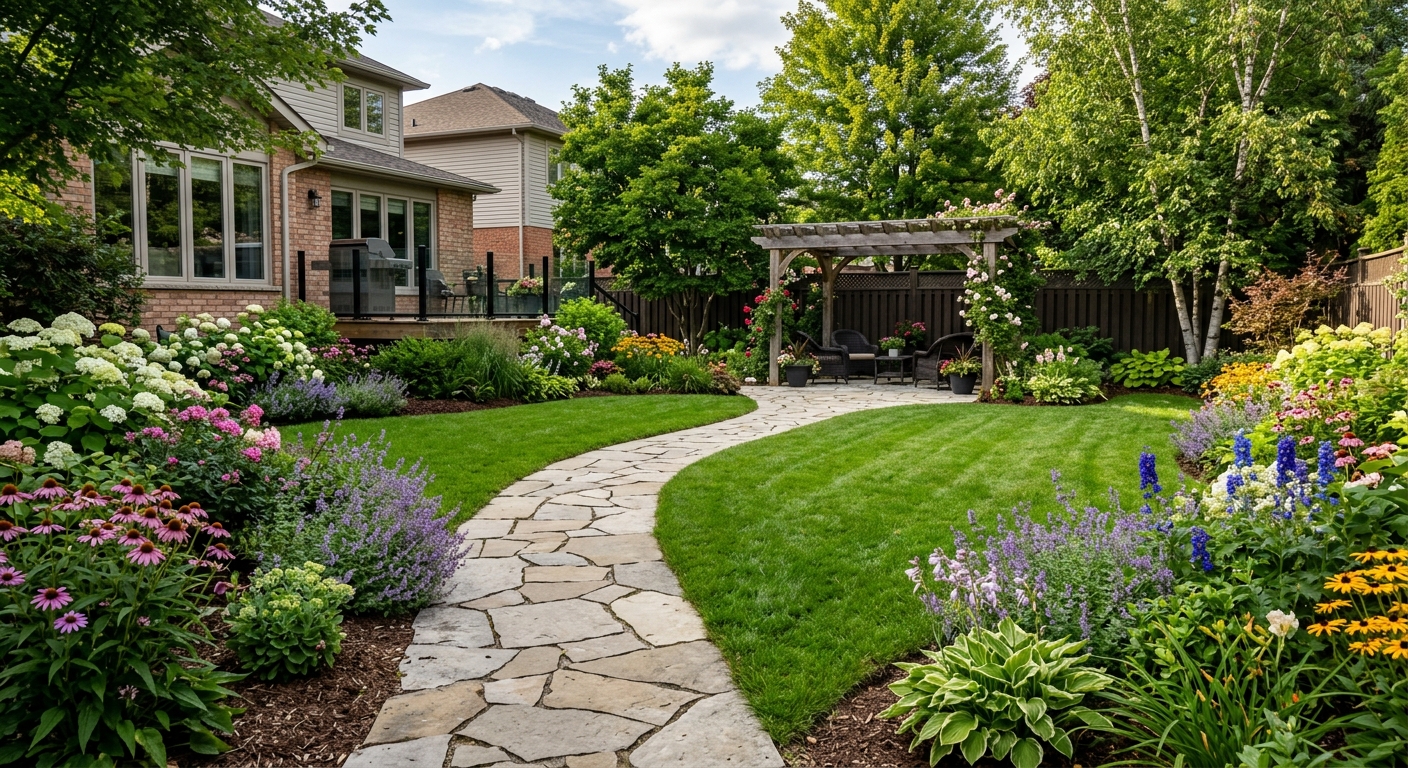
Landscaping options and costs in Stoney Point
Stoney Point homeowners typically start landscape planning with practical upgrades—sod, new plantings, and walkways—because the area’s properties offer room to make a visible difference. With a 2021 population of 1,087 people (Statistics Canada, 2021 Census), the local contractor pool is smaller than central Toronto, so availability can tighten quickly for spring and early fall installs. In this setting, landscaping spend often rises when yards are easier to access and when homeowners want curb appeal changes that feel “ready for visitors,” particularly around the more built-up pockets near Main St. / Stoney Point Road corridor where seasonal foot traffic makes renovations more noticeable.
Prices in the Greater Toronto area (GTA) are shaped by freeze–thaw cycles, clay-leaning soils, and the fact that the workable season is mainly May to October. That means frost-safe bases for patios and deeper wall footings aren’t optional if you want long-term performance. Planting and turf choices also follow Toronto’s hardiness range (often Zone 6a–7a), so we select shrubs and perennials that can handle winter lows near –23 to –18°C, plus hot, humid summers that can stress lawns.
If you’re comparing contractor quotes, the quickest way to level the playing field is to use consistent scopes—so the table below breaks down typical options, seasons, and price bands you can expect in Stoney Point.
| Service |
Description |
Season |
Price Range |
| Full landscape design and installation |
Site visit, layout plan, plant palette, grading/drainage coordination, installation of softscape and hardscape |
May–October (design can start earlier) |
$8,000–$40,000 |
| Sod installation (supply, grade, lay, roll) |
Remove existing turf if required, base prep, topsoil/till as needed, sod delivery and installation |
Late April–June and late August–mid October |
$2,500–$8,000 |
| Lawn seeding (grade, seed, starter fertilizer) |
Light grading, seed selection, starter fertilizer, raking and rolling; includes initial watering guidance |
April–May and early fall (weather-dependent) |
$1,800–$6,000 |
| Interlocking patio or walkway |
Excavate, compacted granular base, edging, geotextile/geogrid as needed, leveling sand, stone installation |
May–September (best before heavy rains) |
$6,000–$30,000 |
| Retaining wall (interlocking block) |
Excavate, wall base construction, compaction, drainage stone/weep setup, block placement and cap |
May–September |
$6,000–$30,000 |
| Tree and shrub planting |
Soil prep, planting, mulching, staking (as required), initial watering plan |
Spring and fall (planting windows vary) |
$800–$6,000 |
Prices are estimates only and vary by project scope, site access and material selection.
What affects the price of landscaping in Stoney Point
In Stoney Point, you can see the same “headline” project priced 30–50% differently across quotes, even within the Toronto market, because contractors price risk and prep work: excavation depth, soil conditions, drainage requirements, disposal, and how much of the scope is truly included. Climate and seasonal timing also matter. In Southern Ontario, winter freeze–thaw cycles and typical clay/fill soils can force extra base depth for patios and deeper, well-compacted granular construction for retaining walls—costs that don’t show up in a basic estimate.
The broader comparison helps explain the variance. Where plants come from and how they’re installed is driven by hardiness and frost timing. In prairie regions (Zones 2–4), shorter seasons and frequent drought often push designs toward ultra-hardy, drought-tolerant species and simpler palettes. In coastal BC (Zone 7–8), the longer growing season supports lush, broadleaf options, but heavy-rain areas still require drainage details. In the dry BC interior and Alberta, water restrictions shape irrigation and encourage drip systems. In Stoney Point and the wider GTA, the frost-free window roughly runs May to October, so we plan installation timing accordingly—seed, sod, and planting need to be finished early enough for roots to establish before cold snaps.
Concrete examples that raise or lower costs here: (1) clay soil and poor drainage often mean more topsoil amendment and sometimes subdrains, pushing a “simple” lawn job toward the upper end of the $2,500–$8,000 sod range; (2) adding a retaining wall with proper drainage can push your budget into the $6,000–$30,000 band, because wall performance depends on what’s under the block—not just the visible height. With older housing stock in many Ontario communities, grading around foundations can be uneven, and that may mean more excavation and regrading measured in hours and cubic yards rather than just landscaping materials.
| Price Factor |
Why It Matters |
Cost Impact |
| Yard size in sq ft — the primary cost driver for softscape |
More area increases labour hours, materials (seed/sod/topsoil), and equipment time |
Often the biggest swing; can move projects several thousands |
| Grading and drainage work — slope corrections add significant cost |
Fixing pooling and directing water away protects foundations and prevents lawn failure |
Can add a substantial portion of the budget before planting |
| Drainage bed or French drain installation |
Requires excavation depth, washed stone, perforated pipe, and proper daylighting |
Material + labour intensive; commonly increases hard-to-guess costs |
| Plant material tier — native shrubs vs. ornamental vs. mature specimen trees |
Mature trees cost more, need better soil prep, and may require professional handling |
Can shift totals dramatically even on small planting plans |
| Hardscape vs. softscape ratio — walls and patios cost more per sq ft than lawn |
Hardscape requires deeper base preparation and more stone/block/finishing |
Patios/walls often dominate the budget |
| Irrigation system design and installation |
Zones, layout, trenching depth, and heads all affect performance and water efficiency |
Upfront cost, but reduces plant and sod stress during hot spells |
| Soil amendment and topsoil required |
Clay soils may need amendments for roots; topsoil quantity depends on existing grade |
Can add thousands if significant rework is needed |
| Tree removal or stump grinding before new planting |
Stumps and root systems add disposal and extra labour |
Often an “unseen” budget line that changes final totals |
Permits & regulations in Ontario
For most landscaping in Ontario—including planting, sodding, and the majority of softscape work—you typically do not need a permit. However, there are important exceptions that can affect Stoney Point homeowners. Retaining walls above the usual municipal threshold—commonly around 1.0 m (3.3 ft)—often require a building permit, and some cases may need engineered drawings depending on wall height, soil conditions, and load conditions.
Also pay attention to lot grading. Any grading changes that affect drainage toward a neighbour, alter how water reaches storm infrastructure, or significantly change the slope near property lines can trigger approval requirements. Before digging for planting holes, trenching for drains, or installing wall footings, arrange utility locates so you and the contractor can mark buried services. It’s one of the most overlooked steps that can cause delays and added costs if missed.
To verify your contractor’s compliance in Ontario, do this step-by-step: (1) confirm they’re a legitimate business and ask for their Ontario licence information if applicable for their work scope; (2) request a certificate of insurance and verify general liability coverage; (3) ask about WSIB/WCB coverage and whether they provide a clearance letter or proof; and (4) ensure the contract states who pulls any required permits (if permits are needed for a retaining wall or grading approval). When in doubt, request the documentation before work starts so you avoid surprises after excavation.
Planning a landscape that thrives in Stoney Point's climate
Planning for Stoney Point means designing with Ontario’s freeze–thaw reality and a hardiness mindset, not against it. In the GTA, many gardens fall into the practical range of Zone 6a–7a conditions, with winter lows near –23 to –18°C and humid summer stretches that can thin turf if it’s not established well. Start with plant selection: choose native and zone-appropriate shrubs and perennials that can handle winter without elaborate protection and that don’t demand constant watering once established.
For turf, the sod vs. seed decision is about timeline and rooting. Sod gives instant curb impact, but it’s typically 3–4x more per sq ft than seeding once you include prep. If you need a “finished look” for a moving date, sod can be worth it—especially if you’re also correcting drainage. If time isn’t critical, seeding can be a smarter budget move, provided grading is right and watering is consistent during germination.
Drainage and grading are non-negotiable in Toronto-style winters. Pooling water freezes, expands, and undermines both lawns and stonework. For hardscape, base preparation should account for frost-related movement: excavate to stable depth, use proper granular layers, and compact thoroughly. For retaining walls and patios, that’s where costs are justified—good bases prevent costly settling later.
Low-maintenance design helps: mulch rings, groundcovers, and layered perennial borders reduce annual tasks while keeping the yard attractive. Toronto homeowners often benefit from rain-garden style features where you can safely manage roof runoff, and if you want “xeriscape-like” water savings, use drought-tolerant plants in zones that actually dry out (while still selecting winter-hardy varieties). For a simple example, upgrading from seeding to sod for a moderate lawn can land in the $2,500–$8,000 band; that extra spend is most justified when grading issues are addressed at the same time, so the lawn establishes instead of struggling and rework starts.
| Element |
Climate Consideration |
Maintenance Level |
Price Band |
| Sod lawn installation |
Needs root establishment before cold; avoids winter burn and early freeze issues when timed in spring or fall |
Low to moderate (watering/establishment care) |
$2,500–$8,000 |
| Native perennial garden |
Zone-appropriate species tolerate Toronto winters; well-planned plants handle humid summers with less supplemental watering |
Moderate (weeding in year 1, then lighter) |
$1,200–$6,000 |
| Mulched shrub border |
Mulch buffers freeze–thaw heaving around root zones; shrubs handle wind and temperature swings better when spaced right |
Low (annual mulch top-up) |
$800–$4,500 |
| Interlocking stone patio |
Requires frost-safe base depth and drainage to prevent edge heaving during winter cycles |
Low (occasional cleaning and sand refresh) |
$6,000–$30,000 |
| Retaining wall (block) |
Proper sub-drainage and well-compacted base prevent water build-up behind the wall during thaw |
Low after completion |
$6,000–$30,000 |
| Drip irrigation system |
Helps during humid but dry spells; keeps moisture consistent and reduces runoff during storms |
Moderate (seasonal adjustments/checks) |
$1,000–$6,000 |
How to choose a landscaping contractor in Stoney Point
Choosing the right contractor in Stoney Point starts with proof, not promises. First, verify Ontario business legitimacy for the scope being quoted, and ask for their general liability insurance certificate. Confirm they also have WSIB/WCB coverage (as applicable) and request a clearance letter or proof of coverage—this matters for site safety when equipment is running and labour is working around trenches and stone.
Next, get 2–3 itemised written quotes. You want labour and materials broken out: excavation, granular base, stone/block supply, topsoil/compost, drainage stone, edging, delivery fees, disposal, and any restoration (like re-seeding damaged turf). Avoid quotes that only present a lump sum without showing what’s included.
Read the scope carefully. Does the quote include disposal of excavated soil? Is permit pulling included if a retaining wall permit is required? Are utility locates included? What’s excluded—tree removal, stump grinding, or additional topsoil beyond a certain depth? For warranty, confirm the workmanship warranty length and whether the product/manufacturer warranty transfers to you. Finally, protect your cash flow: never pay more than 10–15% upfront, and hold a portion until the job is complete and inspected.
Ask for a written start date and a completion estimate tied to weather windows (especially for sod/planting). In Southern Ontario, a delayed base or rushed planting can lead to winter loss—so timeline realism is part of quality.
- Provide a certificate of insurance (general liability) before mobilizing.
- Show WSIB/WCB clearance or proof of coverage for their workers.
- Use itemised quotes with line-by-line labour and material costs.
- Clarify disposal: where excavated soil/stone waste goes.
- Confirm utility locates are arranged for any digging/trenching.
- Verify base depth and compaction method for patios/walls (frost-safe approach).
- Ask whether geotextile/geogrid is included where needed.
- Confirm drainage details (weep holes/sub-drains) for retaining walls.
- Get an explicit seed/sod spec (variety/type) and coverage area in writing.
- Confirm soil amendment quantities (topsoil depth and compost rate) if needed.
- Review warranty terms: workmanship length + product warranty transfer.
- Agree on payment schedule: small deposit (10–15%) + holdback until completion.
Concrete red flags in Stoney Point include: contractors who won’t provide insurance/WSIB proof, quotes that don’t specify drainage or base prep for stonework, “cheap” sod jobs that skip grade correction and topsoil requirements, asking for large deposits up front, and vague contracts that exclude disposal or utility locates without explaining the consequences.
Frequently asked questions — landscaping in Stoney Point
How much does landscaping cost in Stoney Point?
In Stoney Point, most homeowners land within the common GTA pricing bands: full landscape design and installation often sits around $8,000–$40,000, depending on how much softscape and hardscape is included. For turf, sod installs typically run about $2,500–$8,000 once grading and prep are accounted for. Costs vary because freeze–thaw cycles and Toronto-style clay soils can increase excavation, soil amendment, and drainage work before plants or stone go in. If your yard already drains well and access is easy, you’ll usually stay closer to the lower end of the bands; if you need regrading, sub-drains, or deeper bases for hardscape, the price climbs quickly.
What plants thrive in Stoney Point's climate zone?
For Stoney Point (Ontario), success comes from choosing winter-hardy, zone-appropriate plants that tolerate both cold lows and humid summers. In the GTA context, we typically plan around the practical hardiness range of Zone 6a–7a, so you’ll want shrubs and perennials that can handle winter lows near –23 to –18°C. Native perennials and sturdy deciduous shrubs often perform well with less watering once established. We also size plants correctly—overcrowding increases stress and winter dieback. For texture and structure, use woody plants that provide year-round interest while still being cold-tolerant. If you want a low-maintenance yard, we usually build in mulch beds and groundcovers so the soil stays insulated through winter and doesn’t dry out too fast in summer.
Sod vs seed — which is better for a Stoney Point lawn?
Sod is usually better when you need instant results, want a faster “wear-in” timeline, or you’re installing while correcting drainage and grade. In the Stoney Point area, sod costs more upfront—often within $2,500–$8,000 depending on size and prep—because you’re paying for turf supply and installation. Seeding is typically more budget-friendly, but it requires perfect grade, consistent moisture during germination, and a longer time to fully knit in. For many lawns, the deciding factor is your timeline and how well the base drains. If pooling is present, even the best seed can fail; in that case, fixing grading first usually makes both seeding and sod outcomes more reliable.
How much does a retaining wall cost in Stoney Point?
Retaining wall costs in Stoney Point commonly fall in the $6,000–$30,000 range for interlocking block walls, depending on height, length, soil conditions, and what’s behind the wall. The big drivers are excavation depth, granular base construction, compaction, and drainage provisions (like drainage stone and weep setups) needed to manage thaw water. Because Ontario has freeze–thaw cycles, wall performance depends on proper sub-structure, not just the visible blocks. If you’re working in clay fill soils or you need added topsoil and regrading after installation, expect your price to skew toward the upper end. Always ask the contractor what drainage solution is included.
When is the best time to landscape in Stoney Point?
In Stoney Point and the broader Ontario market, the best window is generally May to October. Sod and active lawn establishment are typically best in late spring and again in late summer through mid fall, when soils are warm enough for rooting but before prolonged cold snaps. Planting is often done in spring and fall because plants are less stressed and can establish roots before peak heat or deep winter. Stonework like patios and walkways is usually planned for May through September so weather doesn’t disrupt base compaction and leveling sand placement. Winter freeze–thaw is a major risk factor in Ontario, so base prep quality matters most when conditions are stable enough to compact correctly.
Do I need a permit for a retaining wall in Ontario?
Often, yes—at least in the sense that you may need a building permit depending on the wall’s height and site conditions. In Ontario municipalities, retaining walls above a common threshold of about 1.0 m (3.3 ft) typically require a permit, and some projects may require engineered input. Grading changes that affect drainage toward neighbouring properties or storm connections can also trigger approval requirements. The safest approach is to ask your contractor to confirm the permit requirements for your specific design before excavation. Whichever contractor you hire in Stoney Point, make sure the contract clearly states who pulls the permit (if needed) and that utility locates are completed before digging for wall footings or drainage lines.