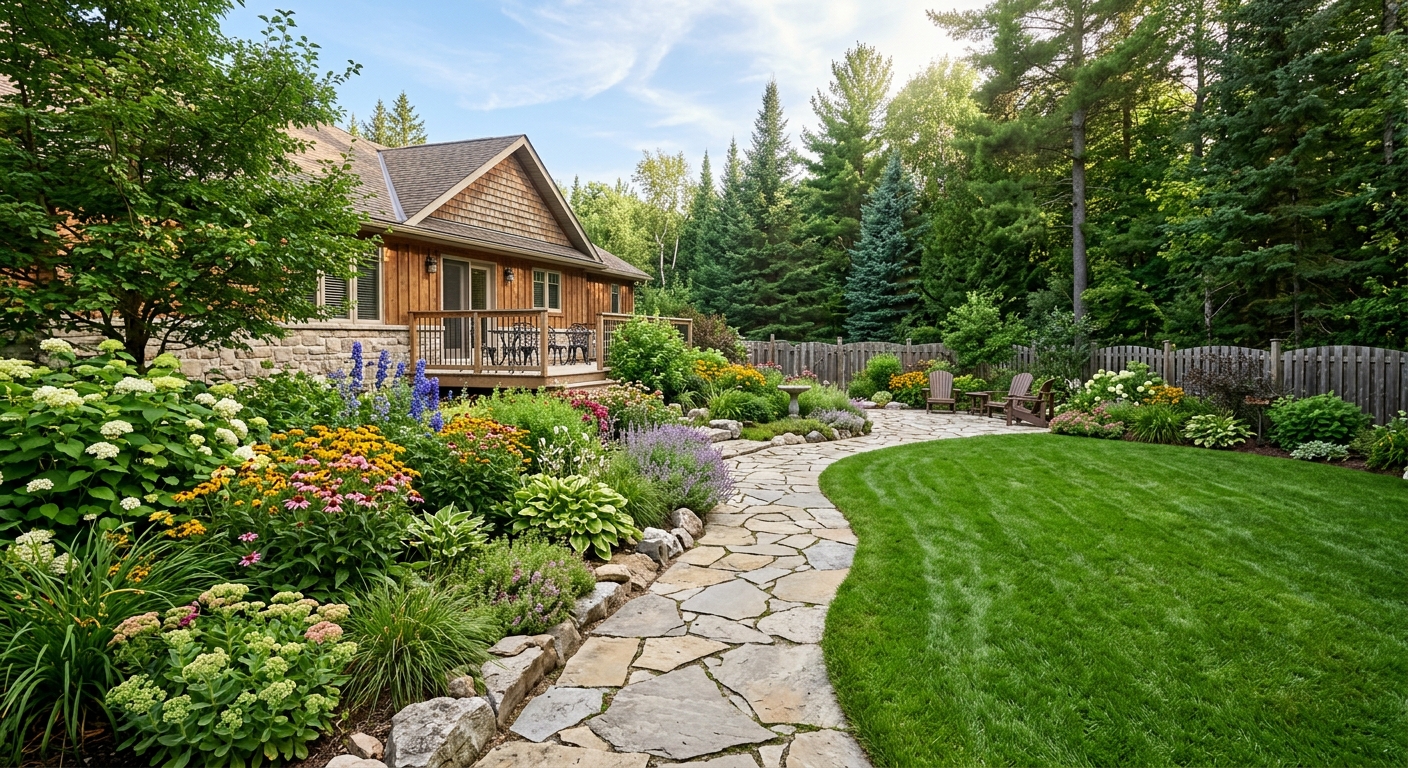
Landscaping options and costs in Kirkland Lake
Kirkland Lake homeowners typically have plenty of yard space to work with—single-detached houses make up 62.9% of dwellings—so landscaping decisions often focus on creating usable outdoor areas that still survive harsh winters. With 2,350 homeowner households (62.3% owning), many families invest in curb appeal upgrades like patios, mature trees, and regraded drainage after a few years of settling into the home. At the same time, most housing stock in town is older; 88.7% of homes were built before 1981, which often means driveways, walkways, and foundations can be tight to work around and drainage patterns may already be inconsistent.
In the Northeast market context, the cold continental conditions and short working season shape both plant survival and contractor availability. Freeze-thaw cycles mean deeper base preparation for hardscaping and more careful drainage detailing to prevent heaving and ponding. That labour intensity can push budgets toward higher tiers, especially in neighbourhoods where demand is steady and crews are booked—South Porcupine Road / adjacent residential blocks are a common spot for walkway, patio, and tree-planting demand. From here, you can compare common service types and realistic price bands before getting itemised quotes.
| Service |
Description |
Season |
Price Range |
| Full landscape design and installation |
Site walk, concept + layout, grading plan, plant/softscape selection, base prep, planting, lawn integration, and final clean-up |
Mid–late spring to early fall |
$8,000–$30,000 |
| Sod installation (supply, grade, lay, roll) |
Soil testing/adjustment (as needed), grade correction, sod delivery + installation, rolling, starter fertiliser, and first watering guidance |
Late spring to early fall (best during warm, wet periods) |
$3,000–$9,000 |
| Lawn seeding (grade, seed, starter fertilizer) |
Light grade corrections, seed + starter fertiliser, surface prep, and an initial maintenance plan for establishment |
Spring or early fall |
$1,800–$6,000 |
| Interlocking patio or walkway |
Excavation, compacted base + edge restraints, interlocking stone, bedding sand, jointing, and basic drainage considerations |
Late spring to early fall |
$6,000–$25,000 |
| Retaining wall (interlocking block) |
Wall layout, deeper frost-aware base, geotextile + drainage layer (if required), block installation, and backfill |
Mid–late spring to early fall |
$7,000–$24,000 |
| Tree and shrub planting |
Soil amendment, planting layout, watering plan, staking (where needed), and replacement-ready planting techniques |
Spring planting and early fall planting |
$1,500–$8,000 |
Prices are estimates only and vary by project scope, site access and material selection.
What affects the price of landscaping in Kirkland Lake
For the same “square-foot” landscaping request, Kirkland Lake quotes can swing by 30–50% across Ontario and the broader Northeast market because the drivers aren’t just materials—they’re seasonal risk, base-building complexity, and how long crews must work to finish before the freeze. In cold continental conditions, the plant hardiness zone and frost dates determine both what can survive and how much of the year contractors can actually install. In the Prairie-like interior (often Zone 2–4), the working season is short and plant palettes must be drought-tolerant and wind-resistant; retaining wall base depth must reach below the frost line to reduce heaving. Coastal BC (Zone 7–8) can support a longer growth season and lush planting, but can also demand stronger drainage practices where rainfall is heavier. Water restrictions in drier interior areas further steer customers toward efficient drip zoning rather than high-water spray layouts. Southern Ontario (Zone 5–6) typically has a more moderate season, but still sees summer dry spells that impact irrigation planning and maintenance.
In Kirkland Lake, two common cost examples come up fast. First, an older yard (88.7% pre-1981 homes) often needs more grading corrections and drainage fixes; even small slope changes can add significant labour, pushing a basic patio toward the $6,000–$25,000 hardscaping band. Second, winter reliability matters—if you choose hardy trees and shrubs properly, you avoid costly replanting; if you choose borderline plants, replacements after winter can push the project toward the $8,000–$30,000 full landscape tier quickly.
| Price Factor |
Why It Matters |
Cost Impact |
| Yard size in sq ft — the primary cost driver for softscape |
More area means more topsoil, seed/sod, edging, labour hours, and maintenance inputs |
Medium to high (softscape scales almost directly with area) |
| Grading and drainage work — slope corrections add significant cost |
Freeze-thaw cycles punish low spots; correct drainage protects foundations and prevents heaving |
High (often the difference between a “basic” and “major” quote) |
| Drainage bed or French drain installation |
Sub-surface drainage requires excavation depth, rock, geotextile, and proper tie-in |
High (add-on that can reshape the whole project budget) |
| Plant material tier — native shrubs vs. ornamental vs. mature specimen trees |
Mature trees cost more upfront and require careful handling, staking, and planting technique |
Medium to very high (specimens can dominate material spend) |
| Hardscape vs. softscape ratio — walls and patios cost more per sq ft than lawn |
Hardscape needs deeper excavation, base aggregate, and compaction; lawn is comparatively lighter |
High (drives you into the retaining wall / patio bands) |
| Irrigation system design and installation |
Efficient zoning (often drip in dry interior climates) reduces waste but adds design + install time |
Medium (bigger lawns/borders push it upward) |
| Soil amendment and topsoil required |
Poor native soil or compacted fills may need added organics and structure for root establishment |
Medium (variable depending on site conditions) |
| Tree removal or stump grinding before new planting |
Equipment access, disposal, and root disruption can be time-intensive |
Medium to high (can be a project “reset” factor) |
Permits & regulations in Ontario
In Ontario, most common landscaping tasks—planting new trees and shrubs, sodding, seeding, and typical softscape work like mulching beds and building garden borders—typically do not require a permit. The biggest permit triggers tend to be structural retaining walls, grading that affects drainage, and any work that intersects utilities.
What often DOES require a permit in practice: retaining walls above a municipal height threshold, commonly around 1.0 m (3.3 ft) in many Ontario municipalities, can require a building permit and sometimes engineered drawings depending on height, soil conditions, and surcharge loads. Changes to lot grading that alter how water flows—especially if it redirects drainage toward neighbouring properties or ties into storm/sewer connections—may trigger approval requirements. Even when the landscaping itself doesn’t need a permit, utility rules still apply: call for utility locates before digging planting holes or wall footings to avoid striking buried services.
How to verify your contractor in Kirkland Lake, step by step: (1) confirm Ontario licensing/registration status where applicable by checking the contractor’s business details and any trade-specific registration they claim; (2) request proof of liability insurance—review that the certificate includes your address as the certificate holder/additional insured if offered; (3) ask for WSIB clearance (or applicable WCB coverage evidence) and keep the clearance letter on file. Then confirm the scope matches the quote—permit responsibility, excavation/disposal, and restoration—before work starts.
Planning a landscape that thrives in Kirkland Lake's climate
Planning for Kirkland Lake means working with a cold climate, short summers, and winter freeze-thaw behaviour rather than trying to “push” tender plants or shallow bases. Start with plant selection: favour zone-appropriate and native-leaning species that handle cold and wind without heavy winter protection. Next, choose sod vs. seeding strategically. Sod gives instant coverage, but it’s costlier and can fail if grading and soil prep aren’t right—while seeding is usually more budget-friendly and can still establish well when timed properly.
Drainage and grading are critical in Northeast-like conditions to prevent pooling near foundations and to reduce winter heave. If water sits in low areas, you’ll see turf thinning, rutting, and premature edging failure. For hardscape—patios and retaining walls—the base preparation needs to be built for the frost line: deeper excavation, compacted aggregate, and proper edge restraint matter as much as the stone selection. Finally, design for low maintenance: mulch, groundcovers, and layered perennials reduce annual upkeep, and they look more “finished” than bare soil beds.
Where water context matters, consider xeriscape-inspired beds (drought-tolerant shrubs, mulched zones, and efficient irrigation where needed) and rain-garden style depressions that capture roof runoff safely. A practical money example: if you’re tempted to sod a new lawn but you have budget limits, seeding plus a well-planned drainage correction can keep you closer to the $1,800–$6,000 range for lawn establishment; going full sod often moves you into the $3,000–$9,000 band. If your grading is off, spend first on drainage—then seed; that usually gives better long-term results than buying more sod to mask problems.
| Element |
Climate Consideration |
Maintenance Level |
Price Band |
| Sod lawn installation |
Needs warm establishment and consistent moisture; frost season punishes poor grading |
Medium (regular watering during establishment, then normal seasonal care) |
$3,000–$9,000 |
| Native perennial garden |
Hardier species handle cold snaps and wind; good root structure supports winter |
Low to medium (mulch top-up, fall cleanup, light pruning) |
$2,500–$10,000 |
| Mulched shrub border |
Mulch protects roots from freeze-thaw heave and reduces winter desiccation |
Low (weed suppression and occasional plant replacement) |
$1,500–$7,500 |
| Interlocking stone patio |
Requires frost-aware base and compaction to prevent movement under freeze-thaw |
Low (occasional joint brushing and cleaning) |
$6,000–$25,000 |
| Retaining wall (block) |
Backfill and drainage are non-negotiable in cold climates; deeper base reduces heave |
Low to medium (inspection of drainage and weep performance) |
$7,000–$24,000 |
| Drip irrigation system |
Efficient water use supports establishment during short warm windows; reduces overspray waste |
Medium (seasonal winterisation and line checks) |
$1,200–$6,000 |
How to choose a landscaping contractor in Kirkland Lake
Start by verifying credentials and coverage. Ask for proof of liability insurance and confirm the certificate is current; if they can’t provide it, treat that as a serious gap. Next, request WSIB clearance evidence (or the correct WCB coverage proof for their workforce) and confirm it applies to the work being quoted. For licensing and compliance, verify the business details and any trade-specific registration they claim, and confirm they operate as a real entity (not just a phone number). A good contractor in Kirkland Lake will have no problem emailing documents quickly before you book a site visit.
Then get 2–3 itemised written quotes—not just lump sums. Ensure the breakdown clearly separates labour and materials (stone supply, base aggregate, soil/topsoil, plant material, delivery, and disposal). Read the exclusions line-by-line: is disposal included for excavated material? Is permit pulling included where required? Are utility locates included, and who calls? Ask for the workmanship warranty length and what it covers (settlement, edging movement, plant replacement terms). Also ask if warranties are transferable if you sell the home.
Payment schedule matters: never pay more than 10–15% upfront, and hold a portion until completion and final grading/cleanup are done. Get a written timeline with an estimated start date and completion window—cold-weather constraints often compress schedules, so you need clarity early.
- They provide a written, itemised quote with labour and material line items
- They show proof of current liability insurance
- They provide WSIB clearance/appropriate WCB coverage evidence for their workers
- Scope includes excavation limits, disposal, and any restoration of lawn/edges
- Base thickness and drainage approach are described for patios/walkways/walls
- Plant list is included with quantities and (if possible) botanical names
- A clear watering plan is written for newly planted material and new turf
- They state permit responsibility (and when a permit is expected)
- Warranty terms are in writing for workmanship and product where applicable
- Payment schedule keeps upfront costs to 10–15% and includes a holdback
- They confirm equipment access and site protection (driveways, walks, lawns)
- You get a written start date and completion estimate
Red flags I see in Kirkland Lake: (1) quotes that don’t explain grading/drainage but still promise “no settling,” (2) refusal to provide insurance or WSIB/WCB proof, (3) cash-only pricing without a contract and scope, (4) vague timelines like “sometime in summer” with no start/completion estimate, and (5) no written warranty or a warranty that excludes common freeze-thaw failures.
Frequently asked questions — landscaping in Kirkland Lake
How long does a landscaping project take in Kirkland Lake?
Project duration in Kirkland Lake depends on weather, frost limits, and how much excavation or base-building is required. Most softscape work (mulch, planting, minor grading) can be completed in 1–3 days once crews are on site, while a sod or seeding job can take a few days to a week depending on yard size and soil prep. Hardscape projects typically run longer because they require careful excavation, compaction, base installation, and curing time for bedding materials—an interlocking patio often takes about 1–2 weeks end-to-end once delivery and mobilization are included. Retaining walls are usually the most time-compressed because drainage layers and deeper frost-aware base work must be done properly. For budgeting reference, you’ll often see hardscape spend within the $6,000–$25,000 range, which usually aligns with more multi-day scheduling.
What is the best grass type for a Kirkland Lake lawn?
In Kirkland Lake, the “best” choice is usually a cold-tolerant, fine fescue–leaning lawn mix (or blends designed for northern climates) because it holds colour reasonably well and copes with winter stress better than many warm-season types. The exact blend should be matched to sun exposure and traffic patterns in your yard. If you have partial shade near mature trees (common in older neighbourhood lots), fine fescues typically perform better than rigid “single-type” lawns. If you need a quick visual upgrade, sod can work well, but the long-term success is still about grading, soil quality, and how you water during establishment. If you’re deciding between approaches, lawn seeding is often the lower-cost option at roughly $1,800–$6,000, while sod typically lands higher at $3,000–$9,000, depending on preparation and area.
When should I aerate and overseed my lawn in Kirkland Lake?
For Kirkland Lake lawns, the most reliable window is usually late spring after the ground thaws enough to avoid rutting, and again in early fall when temperatures are cooler but the soil still supports germination. Aerate when the grass is actively growing—if you aerate too early (still cold and wet) or too late (when nights are consistently near frost), establishment suffers. After aeration, overseed with a blend suited to northern conditions and keep the seed-to-soil contact firm (raking lightly and top dressing where recommended). Watering should be frequent and light during germination, then taper as roots establish. Because 88.7% of local homes are older, some yards have compacted zones near downspouts or walkways; spot aeration in those areas can be more effective than treating the whole lawn. A contractor can also recommend whether scarifying is needed based on thatch depth.
What trees grow best in Kirkland Lake's climate zone?
Kirkland Lake’s cold winters favour hardy trees that tolerate wind and freeze-thaw cycles and that have proven performance in northern Ontario landscapes. Common choices often include species like white spruce (excellent for wind and cold tolerance), Norway maple (if site conditions suit and you’re mindful of local considerations), and resilient varieties of birch and elm-type ornamentals where appropriate. For privacy and screening, spruces and hardy conifers generally perform well. The key is picking the right tree for your microclimate: soil drainage, sunlight, and whether the yard has low spots that hold water. If your home is near older driveways or foundations (common in pre-1981 neighbourhoods), shallow root setbacks and drainage corrections may matter. Many homeowners bundle tree and shrub planting budgets in the $1,500–$8,000 band, which typically covers soil amendment, staking, and a proper planting plan so trees establish before winter.
How much does sodding a yard cost in Kirkland Lake?
In Kirkland Lake, sodding usually costs more than seeding because sod is labour- and material-intensive, and proper grading is essential for long-term survival. For typical residential properties, you’ll generally see sod installation come in around $3,000–$9,000 depending on lawn size, access (front versus side/back yard), soil amendments needed, and whether there’s drainage correction before sod goes down. If the yard has low areas near foundations or downspouts, some contractors will include the drainage/grading work in order to prevent washouts or bald spots after thaw. Because Kirkland Lake’s frost cycles are tough on poorly prepared bases, “cheap sod” often becomes expensive if the grade is corrected poorly. Ask for an itemised quote so you can see what portion is sod supply, what portion is base/soil prep, and whether disposal and clean-up are included.
How do I prevent weeds in my Kirkland Lake garden?
Weed prevention in Kirkland Lake is mostly about reducing germination opportunities and stabilising soil. Start with correct bed prep: remove existing weeds, loosen compacted soil, and address drainage so beds don’t become muddy. Then use a quality mulch layer (often 2–4 in depending on product) and refresh it as it breaks down over the season. Landscape fabric is controversial—on its own it can fail and make future removal harder—so many homeowners do better with mulch plus a proper planting density to shade the soil. Dense native perennial gardens and mulched shrub borders can suppress weeds naturally once plants establish. If you’re doing new planting in older neighbourhood lots where soil may be compacted, soil amendment can help plants root quickly so they compete better. If you want irrigation efficiency, a targeted drip layout can reduce weed pressure compared with broad spray patterns. Always avoid disturbing mulch repeatedly with edging or new digging without a re-mulch plan.