Landscaping options and costs in Abbottsfield
Abbottsfield, Alberta is a great place to invest in a practical, good-looking yard—but Calgary-area weather makes “pretty on day one” less important than “stable through freeze–thaw.” With a small local population (1,775 residents per the Statistics Canada, 2021 Census), contractor scheduling can tighten when multiple projects hit at once. In addition, many homes in the wider Calgary area are single-detached, which typically means homeowners want fuller front yards and back patios, and they’re willing to fund comprehensive upgrades.
In Prairie plant hardiness zones 3–4, late-spring frosts and early fall cold snaps influence both what survives and when we can work on-site. Severe freeze–thaw cycles also drive the cost of patios, walkways and retaining walls: you need deep, well-compacted bases and proper drainage to reduce heaving and long-term settlement. Labour availability and site logistics around established neighbourhoods (vehicle access, spoil removal routes, and soil conditions) often decide whether a project lands near the lower or upper end of the market.
Demand is especially consistent near the busier residential corridors around the community core and along major arterials, where curb appeal and snow-plough access matter. If you’re considering a full refresh—design, grading, hardscape, planting and irrigation—use the ranges below as a starting point before we walk your property.
See the comparison table for typical options and budget expectations in Abbottsfield.
| Service |
Description |
Season |
Price Range |
| Full landscape design and installation |
Consultation, grading plan, materials, hardscape (patio/walk), planting, and irrigation setup as needed |
Apr–Oct (weather-dependent) |
$15,000–$45,000 |
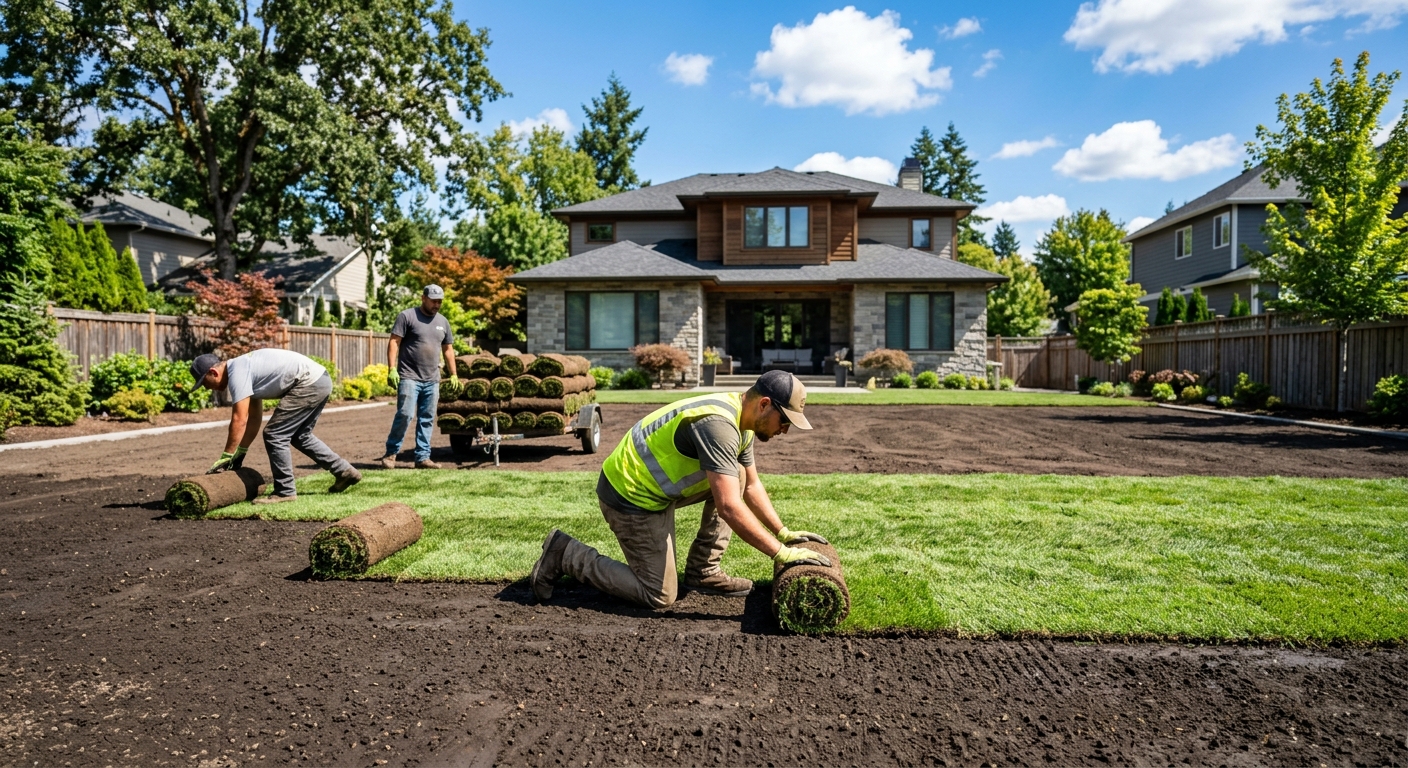
| Sod installation (supply, grade, lay, roll) |
Minor grading, topsoil/base preparation, sod delivery and installation |
May–Sep |
$2,500–$5,800 |
| Lawn seeding (grade, seed, starter fertilizer) |
Grade correction, seed mix, starter fertilizer, light topdressing where required |
Apr–Jun or Aug (cooler windows) |
$1,500–$3,600 |
| Interlocking patio or walkway |
Base excavation, compacted granular base, pavers, edging, and finishing |
May–Oct |
$8,000–$28,000 |
| Retaining wall (interlocking block) |
Excavation, reinforced base, drainage layer, block system, caps/finishing |
May–Sep |
$12,000–$35,000 |
| Tree and shrub planting |
Soil improvement, spacing, staking (if needed), mulching, and plant establishment |
Apr–Jun, Sep–Oct |
$1,200–$10,000 |
Prices are estimates only and vary by project scope, site access and material selection.
What affects the price of landscaping in Abbottsfield
In Abbottsfield (Calgary market), the same “standard” landscaping job can swing by 30–50% between quotes because the work behind the scenes is rarely identical: base depth, drainage design, haul distances, and the number of crews needed to keep within the short workable season. With Calgary’s labour share commonly representing 40–60% of a full project, scheduling delays or extra excavation can quickly add costs.
Climate plays a direct role. Prairie plant hardiness zones 3–4 have late frosts and early cold snaps, so contractors must build for longevity, not just appearance. That means retaining wall base depth needs to reach below the effective frost influence, and patios/walkways require deep, well-compacted bases to reduce heaving. In coastal BC, contractors often have longer planting windows (different zone conditions) and a lush palette, but drainage still matters because rainfall patterns can be intense. In the dry BC interior, water restrictions can push designs toward efficient irrigation and xeriscaping. Southern Ontario has a moderate season and often sees more summer irrigation demand, but frost patterns and freeze–thaw intensity are different from Alberta’s.
Two real examples that change your final price in Abbottsfield: (1) a yard with standing water or a low corner may require a French drain and drainage bed—this can move a “tree and shrub planting” budget closer to the upper band (up to about $15,000 for larger scopes), because drainage work is excavation-heavy; and (2) older homes with settled slopes sometimes need more grading before sod or seeding can succeed, which can shift lawn budgets from the lower end (around $1,500–$3,600 for seeding) toward more comprehensive install costs.
Next, let’s break down the specific price factors that most often drive those differences.
| Price Factor |
Why It Matters |
Cost Impact |
| Yard size in sq ft — the primary cost driver for softscape |
More area means more soil prep, mulch, sod/seed, and labour hours |
Often the biggest swing; can change total cost by several thousand dollars |
| Grading and drainage work — slope corrections add significant cost |
Correct slopes protect foundations and prevent pooling after rain or snowmelt |
Can add several thousand dollars depending on cut/fill volume |
| Drainage bed or French drain installation |
Freeze–thaw damage accelerates when water can’t move away from structures |
Frequently pushes projects into the mid five-figure range on larger lots |
| Plant material tier — native shrubs vs. ornamental vs. mature specimen trees |
Mature trees and specialty ornamentals cost more and require stronger planting systems |
Can double plant-line items even when the area looks similar |
| Hardscape vs. softscape ratio — walls and patios cost more per sq ft than lawn |
Patios/walkways need excavations, compacted bases, and thicker installation details |
Shifts budgets toward the $8,000–$40,000 retaining/hardscaping band |
| Irrigation system design and installation |
Zoned sprinkler/drip design reduces wasted water and protects new plantings |
Can add meaningful cost—especially if trenches and controls are included |
| Soil amendment and topsoil required |
Poor native soils need amendments to support roots and turf establishment |
Smaller improvements are affordable; major remediation increases totals fast |
| Tree removal or stump grinding before new planting |
Extra excavation, disposal, and time on-site add labour and equipment charges |
Often changes timeline and can add several thousand dollars |
Permits & regulations in Alberta
In Alberta, most typical residential landscaping tasks—like planting, sodding, seeding, and routine softscape installation—usually do not require a building permit. If you’re regrading lightly to improve drainage away from your house, that’s also typically handled as part of the landscaping scope. However, retaining walls can be different: in many Alberta municipalities, retaining walls above about 1.0 m (3.3 ft) in height typically require a building permit and sometimes engineered drawings, depending on the design and site conditions.
Also pay attention to lot grading. Changes that meaningfully alter drainage patterns (for example, directing water toward neighbouring properties or modifying how stormwater connects to services) may trigger approval requirements. Before any digging—planting holes, irrigation trenches, or wall footings—make sure utility locates are done to protect gas, power, and communications lines.
For your Abbottsfield project, verify your contractor the right way:
- Alberta licence/registration: check the appropriate online registry for the landscaping/trades credentials they claim to hold.
- Certificate of insurance: request current liability coverage and confirm the expiry date; the COI should list you as an additional insured where applicable.
- WSIB/WCB coverage: obtain a clearance letter or coverage confirmation. If they’re subcontracting, confirm coverage applies to their labour on your site.
- Permit responsibility: ask who pulls any required permit and whether that cost is included in the written quote.
Taking 15 minutes to confirm these items before work starts can prevent delays and expensive disputes later.
Planning a landscape that thrives in Abbottsfield's climate
To plan a landscape that thrives in Abbottsfield, design around Alberta’s freeze–thaw cycles and zone 3–4 realities rather than fighting them. Start with plant selection: choose cold-hardy, wind-tolerant species that can handle short growing windows. Native-leaning shrubs, perennials with proven local performance, and trees suited to our winter conditions typically require less fuss and less replacement after harsh seasons.
For lawn, decide between sod and seed based on your timeline and your site. Sod gives instant curb appeal, but it costs more—often about 3–4× per sq ft compared with seeding—because you’re paying for production, delivery, and live-root installation. Seeding is slower, but it’s a good match for budget and for areas that need careful soil build-up.
Drainage and grading are non-negotiable in the Calgary market. Pooling water around foundations can lead to soil movement and long-term moisture issues. In hardscape zones, ensure base preparation is built for the frost line: compacted granular layers, correct slopes, and proper edge restraints. Finally, use low-maintenance design strategies so your yard looks good even when spring is busy—mulch beds, groundcovers, and a managed perennial structure reduce annual upkeep.
If you want a more water-smart approach, consider a rain-garden or xeriscape-style planting beds with drip irrigation (zoned). In a typical mid-size front yard, the extra budget for drip can be justified when it replaces broader sprinkler coverage and protects new plants through Alberta’s dry stretches.
As a quick cost reality check: a seeding approach might land closer to $1,500–$3,600, while sod installation commonly starts around $2,500–$5,800. If curb appeal matters before you sell or host, sod can be worth it; if your main goal is long-term value, seeding plus soil improvement often gives the best return.
| Element |
Climate Consideration |
Maintenance Level |
Price Band |
| Sod lawn installation |
Needs proper base prep and fast establishment before late-spring frosts and summer dry spells |
Medium (watering/rolling early season) |
$2,500–$5,800 |
| Native perennial garden |
Better cold tolerance in Zone 3–4; roots stabilize soil through freeze–thaw |
Low to medium (spring tidy, occasional weeding) |
$2,000–$8,000 |
| Mulched shrub border |
Mulch buffers temperature swings and reduces moisture loss from wind |
Low (replenish mulch annually) |
$1,200–$6,500 |
| Interlocking stone patio |
Requires deep, well-compacted base and correct slope to prevent heaving and pooling |
Low (sweep/weed control) |
$8,000–$28,000 |
| Retaining wall (block) |
Drainage layer and proper base depth protect against freeze-related movement |
Low (inspect drainage outlet after spring melt) |
$12,000–$35,000 |
| Drip irrigation system |
Zoned drip supports cold-hardy plant establishment while minimizing water waste |
Medium (seasonal adjustments/checks) |
$1,500–$6,000 |
How to choose a landscaping contractor in Abbottsfield
Choosing the right contractor matters in Abbottsfield because a lot of the “hidden” cost is in preparation: excavation depth, base compaction, drainage layers, and how they protect plantings through Alberta’s temperature swings. Start by verifying Alberta coverage and professionalism.
- Alberta licensing/registration: confirm they’re registered for the work they claim to do and that the registration is active.
- Liability insurance: request a current certificate of insurance; check the expiry date and that your property address is included if your insurer requires it.
- WSIB/WCB coverage: ask for proof/clearance for their workers. If they subcontract, require that coverage applies to the crews working on your site.
Then request 2–3 itemised written quotes. You want a breakdown that separates labour and materials (not just a lump sum), and it should specify what’s included: soil/stone quantities, base depth assumptions, edging type, disposal, and whether utility locates are handled. Also ask whether permits—if a retaining wall crosses the typical ~1.0 m threshold—are included in the price or billed separately.
Warranty is another differentiator. Ask for the workmanship warranty length and whether product/manufacturer warranties apply to plant material and hardscape components. Confirm if any warranty is transferable to a future buyer.
For payment, never pay more than 10–15% upfront. Use a holdback until the job is complete and final cleanup and finishing details are verified. Finally, get a firm start date and an estimated completion window in writing. In Calgary-area projects, timelines shift when freeze dates tighten—so a clear plan helps prevent delays.
- Scope clarity: written base depth, compaction method, and drainage plan (not “as required”).
- Material specifics: paver thickness, block system details, soil amendments, and topsoil specs.
- Disposal included: confirm spoil removal and debris haul-off in the quote.
- Irrigation design: ask how zones are determined and what controller is included.
- Permit responsibility: who pulls it, what triggers it, and what’s the cost.
- Plant list: exact species/cultivars and pot sizes, not “similar replacements.”
- Staking/anchoring approach: how they handle wind exposure for young trees/shrubs.
- Work hours and access: confirm equipment entry points to avoid driveway damage.
- Protection plan: edging tape, plywood for pathways, and how they prevent soil compaction.
- Communication cadence: when site photos/updates are provided and who to call on changes.
- Change order process: pricing method and approval requirement before extras.
- Seasonal plan: how they handle early frosts, seeding windows, and sod establishment.
Concrete red flags I see in Abbottsfield include: quotes that omit drainage/base prep details, refusal to provide insurance/WSIB/WCB proof, “similar products” language without a written substitution policy, vague timelines with no start/completion targets, and demanding large upfront payments (well beyond 10–15%).
Frequently asked questions — landscaping in Abbottsfield
How much does professional landscape design cost?
In Abbottsfield and the wider Calgary area, professional landscape design is commonly quoted as a flat design fee or as a consultation credit applied to the installation. For smaller yards, you might see design work bundled into the overall project, especially when the scope includes grading, hardscape, planting, and irrigation. For budgeting, many homeowners treat design as a meaningful “start-up” line item—then compare quotes based on what’s actually designed (plant list, grading intent, drainage notes, and hardscape layout), not just a concept sketch. If you’re planning a full project, keep your total expectations aligned with the broader landscape design & installation band, often starting around $15,000–$45,000 once implementation is included.
How do I compare landscaping quotes?
To compare quotes in Abbottsfield, insist that each quote lists the same items: base preparation depth, drainage solutions, exact materials, and quantities where possible. Ask for labour and materials breakdown rather than only a lump sum. Pay attention to season timing too—quotes made for sod installation should address soil readiness and establishment before cold snaps and late frosts. If one contractor includes a French drain or drainage bed and another doesn’t, their “cheaper” price may fail later and cost more in repairs. A good comparison also checks whether the quote covers disposal, utility locates, and any permit requirements if a retaining wall is near or above the typical ~1.0 m threshold. Use the price bands as a sanity check: patios/walkways and retaining walls often land in the $8,000–$40,000 and $12,000–$35,000 neighbourhoods, depending on complexity.
How long does a landscaping project take in Abbottsfield?
Project length depends on weather windows and the scope. In Abbottsfield, crews often work Apr–Oct, but late frosts and early cold snaps can slow things down—especially for sod establishment, seeding germination, and any soil work that’s sensitive to freezing. A planting-only project (trees and shrubs) can typically be a faster turnaround, while comprehensive builds with grading, hardscape, drainage, and irrigation need more time and coordination. For example, a smaller interlocking patio might be completed in about a few days of active work (with prep time), whereas a full landscape with retaining walls, drainage, and irrigation can stretch to several weeks including material scheduling. If you’re choosing between seeding and sod, remember sod is installed quickly but requires early-season watering and protection for roots to knit.
What is the best grass type for a Abbottsfield lawn?
For Alberta’s climate around Abbottsfield (zone 3–4 conditions), cool-season turfgrasses with good cold tolerance are typically the best fit. Many homeowners choose seed mixes that include hard-wearing varieties known for surviving winter and handling spring melt and summer dry stretches. Whether sod or seed, the real success factor is not just grass type—it’s soil prep, drainage, and how you manage early establishment watering. Sod can look great immediately, but if the base is wrong or drainage is poor, you can still get weak patches after freeze–thaw. If you’re building a lawn from seed, seeding budgets commonly sit around $1,500–$3,600, and that works best when the soil is properly graded and you follow a consistent early watering schedule.
When should I aerate and overseed my lawn in Abbottsfield?
Aeration and overseeding in Abbottsfield usually works best in the shoulder seasons when soil is cooling but not freezing hard—typically spring after the worst frost risk or in early fall before sustained cold. Timing matters because freeze–thaw cycles can disrupt young seedlings, and winterkill risk increases if the lawn isn’t established with enough root development. In practical terms, if your lawn has traffic wear, compaction, or thinning patches, aerate to relieve compaction, then overseed with a mix suited for Alberta’s cool-season turf. Keep watering consistent during germination, and avoid heavy foot traffic on newly seeded areas. If your goal is a full reset, compare seeding (budget often around $1,500–$3,600) versus sod (often $2,500–$5,800), since sod bypasses the wait for germination but costs more per sq ft.
What trees grow best in Abbottsfield's climate zone?
In Abbottsfield’s zone 3–4 climate, the best trees are those proven for Alberta winters and wind exposure. Common successful choices often include hardy deciduous species such as some varieties of Manitoba maple, native/zone-adapted serviceberries, and other tough street-tree selections that tolerate cold snaps and dry periods. For smaller yards or along windy sides, consider trees with strong root systems and good cold hardiness rather than delicate ornamentals that may struggle after harsh winters. Planting strategy also matters: proper spacing, soil improvement, staking when needed, and mulching help young trees survive winter stress. If you’re planning a combined planting and soil program, tree and shrub planting budgets frequently fall into the $1,200–$10,000 range depending on the number of trees and whether any removals or soil amendments are required.