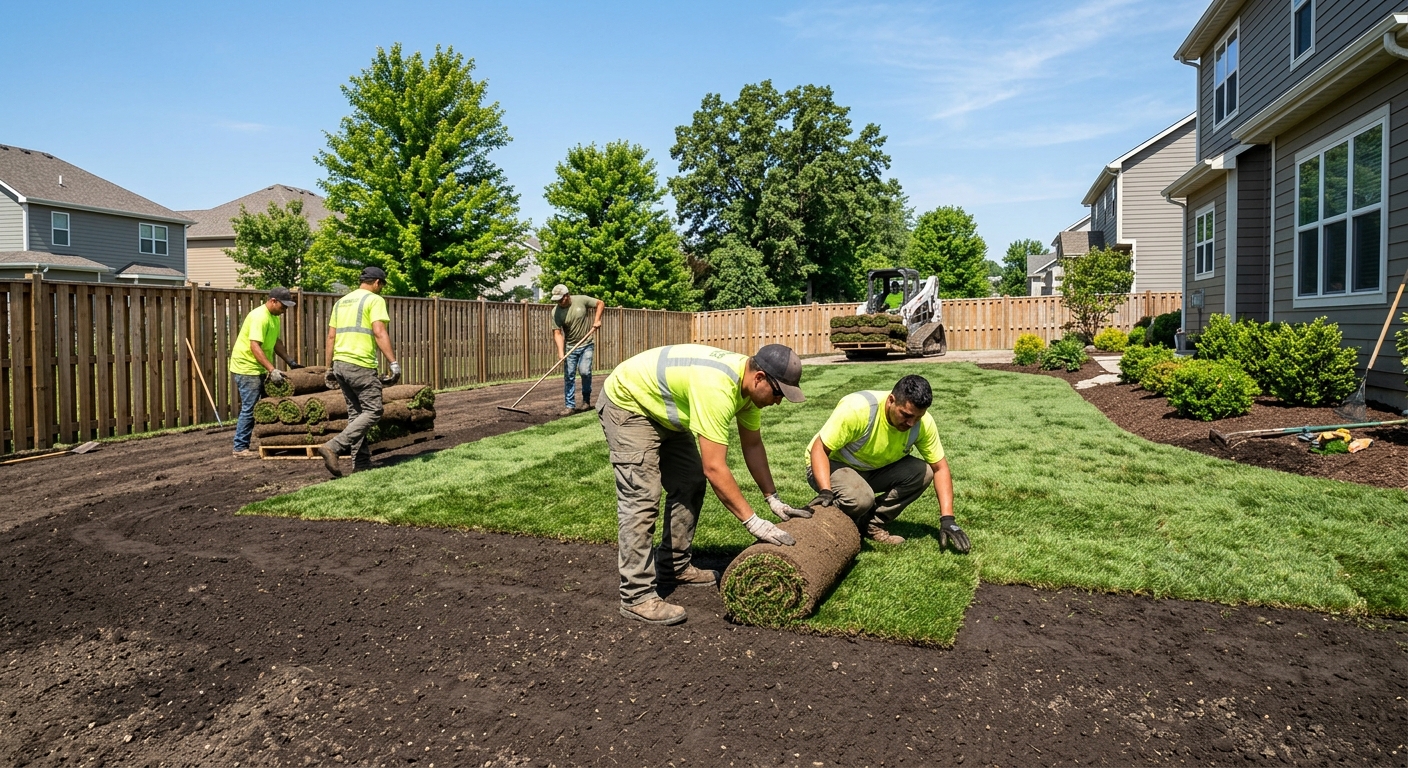
Landscaping options and costs in Bergman
Bergman is a small community in the Calgary area where homeowners typically invest in landscaping because detached houses come with usable yard space and a long-term payoff in curb appeal and daily comfort. With a 2021 population of 1,452 residents (Statistics Canada, 2021 Census), local crews can be stretched during peak season, so timing and site access often influence both availability and pricing. In a community built around practical, year-round living, landscapes that tolerate freeze–thaw cycles and chinook swings tend to hold value better than high-water designs.
Calgary’s Prairie plant hardiness zones (3–4) and Alberta’s late-spring frosts and early fall cold snaps affect costs in two ways: first, it limits the window when sod, planting, and base prep can be done safely; second, it pushes projects toward cold-hardy, drought-tolerant species and robust installation methods. Freeze–thaw is severe here, so patios, walkways, and retaining wall systems require deep, well-compacted bases and proper drainage to reduce heaving and long-term settlement. That base prep depth is a major reason interlocking and wall projects often land in the mid-range of the “hardscaping” band even when the patio surface looks modest. Areas with good access—especially near established retail and the busier routes around the Calgary region—tend to see more demand for walkways, curbside upgrades, and backyard drainage fixes as families update older properties.
Below is a practical cost comparison for Bergman homeowners, to help you translate “scope” into line-item expectations before you review quotes.
| Service |
Description |
Season |
Price Range |
| Full landscape design and installation |
Site visit, design plan, grading/drainage strategy, hardscape + softscape build, planting plan, and irrigation recommendations |
Late spring to early fall |
$8,500 – $38,000 |
| Sod installation (supply, grade, lay, roll) |
Regrade as needed, soil prep, sod delivery/labour, rolling, light topdressing, and initial watering plan |
May to September (best in warm spells) |
$2,000 – $6,000 |
| Lawn seeding (grade, seed, starter fertilizer) |
Fine grading, seeding mix, starter fertiliser, and erosion control where required |
Spring or early fall |
$1,500 – $3,800 |
| Interlocking patio or walkway |
Excavation, deep base, geotextile, compaction, bedding sand, edge restraints, and paver installation |
Late spring to fall |
$6,500 – $30,000 |
| Retaining wall (interlocking block) |
Excavation and base build, wall blocks, drainage behind wall, and tying into grade |
Late spring to fall |
$10,000 – $40,000 |
| Tree and shrub planting |
Soil improvement, planting, staking as required, mulch rings, and a seasonal care plan |
Spring and early fall |
$900 – $14,500 |
Prices are estimates only and vary by project scope, site access and material selection.
What affects the price of landscaping in Bergman
In Bergman and across the Calgary economic region, you can see the same “type” of job land 30–50% apart between quotes because contractors price for risk and for what’s actually under the surface. Two yards that both “look flat” can require very different grading and base depths once we find clay pockets, buried debris, or drainage paths that push water toward foundations. Labour also varies: crews may be booked solid in warm weeks, and that impacts how quickly excavation, hauling, and compaction can be scheduled and completed.
The plant hardiness zone and frost timing directly shape both plant cost and the allowable working season. Bergman sits in Prairie Zone 3–4, so cold-hardy, drought-tolerant, and wind-robust species are the practical choice—not just for survival, but to reduce repeated replacement costs. Retaining wall bases must be built deep and stable, typically reaching below frost-affected soil movement, which increases excavation and aggregate volume. Freeze–thaw cycles are more punishing than in coastal BC (Zone 7–8), where longer growing seasons allow broader palettes and faster establishment, but heavy-rain drainage design becomes the key cost driver. In the drier interior climate near Calgary, irrigation design still matters, but smart zoned systems and soil improvement usually cost less long-term than trying to force high-water turf.
Concrete examples from local projects: (1) A 20–30 mm per foot grade correction can add meaningful excavation and re-compaction time—especially if we must replace weak subgrade—pushing a patio project toward the upper end of the interlocking patio band. (2) Adding French drains or a drainage bed behind a wall quickly moves a job from the lower “hardscape” range toward the retaining wall range because drainage rock, fabric, and daylighting/tying-in add labour and material. If your home is older, buried topsoil and foundation drains (or their absence) can turn what seems like simple planting into a full regrade; that’s where budget gaps of a few thousand dollars often appear.
| Price Factor |
Why It Matters |
Cost Impact |
| Yard size in sq ft — the primary cost driver for softscape |
More area means more labour, materials, and longer watering/establishment time |
Often +20% to +60% based on square footage and complexity |
| Grading and drainage work — slope corrections add significant cost |
Freeze–thaw makes settlement and pooling expensive to fix after the fact |
Can add $1,500 to $10,000+ depending on regrade depth |
| Drainage bed or French drain installation |
Prevents water pressure behind walls and reduces foundation moisture risk |
Commonly adds $2,000 to $8,000 |
| Plant material tier — native shrubs vs. ornamental vs. mature specimen trees |
Mature stock costs more and may require careful handling, staking, and larger pits |
$800 to $12,000 swing across the planting scope |
| Hardscape vs. softscape ratio — walls and patios cost more per sq ft than lawn |
Pavers/blocks demand deep bases, restraints, and compaction passes |
Shifts a project toward hardscape band pricing |
| Irrigation system design and installation |
Zone design + controller + heads and trenches vary by slope and planting layout |
Typically adds $1,200 to $6,000 depending on complexity |
| Soil amendment and topsoil required |
Calgary-area soils often need improvement for rooting and water movement |
$500 to $4,500 depending on depth and quality |
| Tree removal or stump grinding before new planting |
Clearing drives disposal, equipment time, and additional excavation |
Can add $600 to $3,500+ per issue |
Permits & regulations in Alberta
In Alberta, most landscape work—like planting beds, sodding, seeding, mulch installs, and typical softscape grading—generally does not require a permit. The key exceptions are usually tied to structures and significant changes that affect drainage. Retaining walls are the most common “permit trigger”: in many Alberta municipalities, walls above a threshold—often around 1.0 m (3.3 ft)—may require a building permit and sometimes engineered drawings depending on height, location, and how the wall is designed. Also, if you’re changing lot grading in a way that alters how water flows toward neighbouring properties or into storm sewer connections, the city may require approvals.
Before any digging (for planting holes or wall footings), contractors should complete utility locates. This is not optional: it’s how you avoid gas, power, and communication service hits during excavation. You should also confirm local irrigation and water-use bylaws, even though Bergman’s Calgary-region context is generally semi-arid—restrictions can change during drought periods, and that affects how irrigation lines and controllers are set up.
To verify an Alberta contractor in Bergman, ask for three things and check them in writing: (1) Alberta business licensing status (and any relevant trade registration if they claim to hold specific scopes), (2) liability insurance certificate of insurance showing sufficient limits and your address listed, and (3) WSIB/WCB clearance or equivalent coverage confirmation. For the clearance, look for a clearance letter and the effective dates; if they won’t provide it, that’s a major red flag. Then confirm the scope includes any required permits by the contractor—so you’re not surprised by delays later.
Planning a landscape that thrives in Bergman's climate
Planning in Bergman means designing for the realities of Prairie Zone 3–4: cold winters, late-spring frosts, and early fall cold snaps. The goal is to choose plants and materials that can handle temperature swings and wind, while directing water correctly through grading and drainage. When we design “with” the climate instead of “against” it, the yard needs less rework and fewer replacements. That matters in a region where freeze–thaw cycles can heave shallow bases or cause pooling if drainage is not built into the plan.
Start with plant selection. Native and zone-appropriate shrubs and perennials typically require less watering and winter protection than delicate ornamentals. Then decide sod versus seed: sod gives instant green coverage, but it costs about 3–4x per square foot compared with seeding because it requires material supply and logistics, plus careful establishment timing. In most Calgary-area projects, that price difference is justified when you need quick curb impact or when erosion control is urgent. If you can wait through early establishment, seeding often fits budgets better while you build out planting beds.
Drainage and grading are the foundation for everything else. In Calgary-area soils, pooling next to foundations can show up as damp basements or icy walkways in winter. For patios and walkways, deep, well-compacted bases down to frost-impacted zones reduce movement. For low-maintenance design, we lean on mulch rings, groundcovers, perennials, and strategic seasonal colour—plus xeriscape or rain-garden elements where appropriate—so you’re not constantly irrigating or re-seeding.
To make the “value” concrete: if sod for a small front lawn pushes you toward the $2,000 – $6,000 band, seeding might land closer to $1,500 – $3,800. That gap is worth it when you need immediate appearance, otherwise seeding plus a robust mulch-and-shrub plan can deliver better long-term cost control.
| Element |
Climate Consideration |
Maintenance Level |
Price Band |
| Sod lawn installation |
Establishment window is shorter; needs careful watering before roots take hold through Prairie freeze–thaw |
Medium (watering + light care during establishment) |
$2,000 – $6,000 |
| Native perennial garden |
Zone-appropriate plants handle wind and winter better; deeper roots improve drought tolerance |
Low to medium (spring cleanup, occasional weeding) |
$2,000 – $9,000 |
| Mulched shrub border |
Mulch moderates soil temperature swings and helps retain moisture between cold snaps and chinook thaws |
Low (mulch refresh, pruning) |
$1,200 – $7,500 |
| Interlocking stone patio |
Requires deep base prep for freeze resistance and proper drainage slope |
Low (occasional cleaning + joint sand touch-ups) |
$6,500 – $30,000 |
| Retaining wall (block) |
Needs robust base and drainage behind wall to resist soil movement in freeze–thaw cycles |
Low after completion (visual checks for drainage performance) |
$10,000 – $40,000 |
| Drip irrigation system |
Zoned drip supports drought-tolerant planting and helps manage irrigation during seasonal restrictions |
Medium (winter shut-down, seasonal adjustments) |
$1,200 – $6,000 |
How to choose a landscaping contractor in Bergman
Choosing a contractor in Bergman comes down to verifying coverage, getting itemised pricing, and ensuring the scope is clear enough that you won’t pay twice. Start with Alberta licensing status for their business scope (and any trade-specific approvals if they claim specialized work). Next, ask for liability insurance and confirm the certificate of insurance is current—then check the effective dates and ensure your property/address is included. For worker protection, request WSIB/WCB coverage confirmation and look for a clearance letter or equivalent documentation showing it’s active. If a contractor can’t provide these documents promptly, don’t assume they’ll “figure it out later.”
Then get 2–3 itemised written quotes. “Itemised” means a labour + materials breakdown (excavation/haul/compaction, base materials, drainage rock/fabric, paver/block quantities, plants, and irrigation components) instead of one lump sum that hides exclusions. Confirm if disposal is included, whether permits (if required) are included, and what the contractor excludes—like trench restoration, turf replacement beyond the work area, or any electrical/plumbing tie-ins for irrigation.
Warranty matters too. Ask for the workmanship warranty length (how long they stand behind labour), the manufacturer warranty for pavers/blocks/plants, and whether product warranties are transferable if you sell the home. For payment, avoid paying more than 10–15% upfront. Hold back remaining funds until substantial completion and final walkthrough. Finally, require a written start date and a realistic completion estimate based on Alberta weather windows; freeze–thaw affects when crews can safely compact bases and install sod or plants.
- Verify Alberta licensing/business registration and date it on their proposal.
- Request a current certificate of liability insurance (ask for limits and your address on it).
- Confirm WSIB/WCB clearance or active coverage—don’t accept verbal assurances.
- Get at least 2–3 written quotes with line items for excavation, base, drainage, and materials.
- Ask for quantities: paver/block count, linear feet of edging, cubic yards of base rock, and plant counts.
- Clarify what “grading” includes (slope targets, topsoil depth, and disposal/haul-away).
- Confirm drainage is addressed: French drain/weep routing, slope away from foundation, and tie-in plans.
- Check whether irrigation is included or excluded—controllers, zones, heads, backflow, and winterization.
- Ask about utility locate responsibility and whether they schedule it before digging.
- Read the exclusions: permit responsibility, seasonal plant losses, and snow removal during build.
- Require a workmanship warranty in writing and ask how long it lasts for both hardscape and softscape.
- Set a payment schedule: small deposit, milestone payments, and a holdback until punch list completion.
Red flags I see in Bergman: (1) quotes that are not itemised and don’t specify base depth/compaction, (2) no proof of liability insurance or WSIB/WCB coverage, (3) unclear drainage plan for sloped lots or wall projects, (4) requests for large upfront payments beyond 10–15%, and (5) vague timelines that ignore weather constraints in Prairie Zone 3–4.
Frequently asked questions — landscaping in Bergman
How deep should a retaining-wall base be for local frost?
For Bergman-area conditions, the retaining-wall base needs to be built below the depth of frost-affected movement so the wall doesn’t settle or heave during freeze–thaw cycles. Practically, that means contractors should excavate to a stable, frost-resistant depth and then construct a well-compacted granular base (and usually drainage behind the wall), not just “a couple inches of gravel.” Exact depth varies with soil type and wall height, but you should expect a meaningful excavation and not a shallow set. When you compare quotes, look for details like compaction methods, base material specs, and the inclusion of a drainage layer. If you’re budgeting around $10,000 – $40,000 for an interlocking-block wall, the cost difference between “good” and “bad” jobs is often the quality and depth of the base plus proper drainage.
How much does professional landscape design cost?
Professional landscape design in the Calgary region typically depends on whether you’re doing a concept-only plan, a full construction-ready drawing set, and how complex the grading/drainage and plant palettes are. For most Bergman homeowners, design is bundled into “design and installation” packages when the scope includes hardscape, irrigation, and planting layout. Those full projects commonly start at the lower end and move higher once grading and robust drainage are needed—often landing somewhere within $8,500 – $38,000 for comprehensive builds. If you choose design-only, some contractors charge a separate fee that’s either applied to construction later or is calculated based on hours. The best way to compare is to ask: what deliverables do you get (plan set, plant list, estimated quantities) and does the design include drainage recommendations tied to Alberta freeze conditions?
How do I compare landscaping quotes?
To compare landscaping quotes in Bergman, insist on itemised line items so you’re not comparing apples to oranges. Look for an excavation and base section that specifies depth, aggregate type, and compaction—especially for patios and walkways that must resist freeze–thaw heaving. For drainage, check whether the quote includes French drains or drainage rock/fabric and how water will be directed away from foundations. Compare plant lists: are they listing native, hardy species appropriate to Zone 3–4, or vague “shrubs” without sizes? Also confirm irrigation scope: zoning, controller, and whether winterization is included if a system is installed. Price-wise, it’s normal for projects in the Calgary area to vary by 30–50% when drainage, base prep depth, or materials change. Use the table bands as a reality check—e.g., sod might be expected around $2,000 – $6,000 and interlocking walkways/patios often start higher once base prep is included.
How long does a landscaping project take in Bergman?
Project length depends mostly on how much excavation and base prep is required, how complex drainage is, and what season timing you’re working in. In Bergman (Prairie Zone 3–4), crews need workable conditions to excavate, place base, compact properly, and complete installs before early cold snaps. A small tree and shrub planting can often be completed in a day or two (weather permitting). Sod installation can be quicker than seeding, but it still needs accurate grading and good compaction prep ahead of delivery/laying, plus care during establishment. Bigger builds—like full design-and-install packages—commonly take multiple days for excavation/hauling and then additional days for hardscape, planting, and irrigation commissioning. If your scope includes a retaining wall (often in the $10,000 – $40,000 range), plan extra time for base build, drainage components, and curing/compaction steps so the wall performs through winter.
What is the best grass type for a Bergman lawn?
For Bergman and the broader Calgary area, the “best” lawn type is usually a cold-tolerant, drought-aware mix chosen for Prairie conditions and reseeding/maintenance realities. Many homeowners do well with perennial cool-season grasses designed for Alberta winters and summer dry spells. The practical decision is less about a single magic species and more about using a reputable seed blend suited to the region, preparing soil correctly, and managing watering efficiently during warm spells. If you’re comparing lawn options, seeding often fits well when you want good value and can tolerate establishment time; typical lawn seeding scope is around $1,500 – $3,800. If you need immediate coverage, sod in the $2,000 – $6,000 range can be a faster visual fix, but it still needs careful establishment watering to root securely through freeze–thaw transitions.
When should I aerate and overseed my lawn in Bergman?
In Alberta near Bergman, aeration and overseeding are usually timed around the growing season when the lawn can recover and new seedlings can establish before frost stress. Spring aeration works best after the ground thaws and temperatures support active growth; early fall can also be effective when nights cool down but the soil still isn’t locked up by deep cold. The exact timing shifts with weather—late frosts can delay schedules—so base decisions on soil conditions (not just the calendar). If your lawn is patchy or thinning, overseeding can improve density, but you’ll still need proper watering and occasional mowing height adjustments so young seedlings aren’t stressed. When quoting lawn work, compare whether the contractor includes grading, starter fertiliser, and cleanup; those details affect germination. For reference, lawn seeding projects often fall around $1,500 – $3,800, and aeration is commonly bundled or handled as a separate line item depending on turf thickness and compaction.