Landscaping options and costs in Delton
Delton, Alberta is where homeowners want curb appeal without fighting the elements, and that starts with choosing the right landscaping package. With a population of 2,009 (Statistics Canada, 2021 Census), Delton is a smaller community where landscaping capacity can be tighter than in the larger Calgary-area centres, so booking sooner often helps lock in a realistic timeline. Also, the housing stock in the Calgary economic region is heavily oriented toward detached lifestyles—when you have yard space, you’re more likely to invest in full buildouts like patios, drainage improvements, and mature tree planting rather than quick cosmetic fixes. That affects pricing because contractors price for materials, labour, and access to your lot.
In Calgary’s Prairie plant hardiness zones 3–4, late spring frosts and early fall cold snaps determine what can be planted and when crews can dig without damaging base work. Severe freeze–thaw cycles mean patios, walkways, and retaining walls must be built on deep, well-compacted bases with proper drainage, which raises labour intensity and base-prep depth compared with milder climates. Pricing in Delton often reflects these realities: labour commonly represents 40–60% of a full project, and comprehensive jobs across the Calgary area typically land in the mid five-figure range once grading, hardscape, planting, and irrigation are included. This trade is especially in demand around newer residential pockets in and near the Delton-area developments where driveways, slopes, and drainage often need attention early.
Below is a practical comparison of common options and current cost bands to help you translate quotes into scope.
| Service |
Description |
Season |
Price Range |
| Full landscape design and installation |
Site visit, grading plan, planting layout, hardscape/softscape build, and optional irrigation |
May–October |
$8,000–$45,000 |
| Sod installation (supply, grade, lay, roll) |
Topsoil/grade prep, base shaping, sod placement, rolling, and first watering guidance |
Late April–June; early September (weather dependent) |
$1,800–$6,000 |
| Lawn seeding (grade, seed, starter fertilizer) |
Fine grading, seed mix application, starter fertilizer, light covering, and watering schedule |
Late April–June; early September |
$1,500–$4,500 |
| Interlocking patio or walkway |
Excavation, compacted base, interlocking stone/pavers, edging, and joint sand |
May–October |
$8,500–$30,000 |
| Retaining wall (interlocking block) |
Block wall, reinforced base/behind-wall drainage, geotextile, and cleanup |
May–October |
$10,000–$38,000 |
| Tree and shrub planting |
Plant layout, amendments, staking (as required), mulch rings, and water-in plan |
May–June; September (hardening-off helps) |
$900–$15,000 |
Prices are estimates only and vary by project scope, site access and material selection.
What affects the price of landscaping in Delton
In Delton, you’ll often see quotes for the “same” landscaping project vary by 30–50%, even when homeowners think they’re comparing apples to apples. The difference is usually in how contractors handle base preparation, drainage, and plant/stone selections—those items are where labour and material complexity drive cost. For example, a straightforward sod refresh can look similar on paper, but if one quote includes full grading and soil amendment while another only lays sod over existing grade, the end result (and longevity through Alberta freeze–thaw) will be very different. That same principle scales up to full builds, where labour can represent 40–60% of the total and where access and excavation depth matter.
Prairie zones 3–4 mean a shorter growing season than coastal regions. In Zone 2–4, we typically recommend drought-tolerant, wind-hardy species and we design irrigation around water efficiency—both affect material choice and irrigation programming costs. Retaining walls also need base depth below the frost line equivalent for the wall’s system, which is why a wall quote can jump based on how deep the contractor must excavate and how much drainage rock and behind-wall piping is required. Compared with coastal BC (Zone 7–8), where a longer growing season allows broader planting palettes, Alberta projects often need more winter-minded design decisions to prevent heaving and root stress. Southern Ontario (Zone 5–6) can be moderate in summer, but Calgary-area labour and base prep are still higher because freeze–thaw is severe and patio/walkway failures are more expensive to fix.
Concrete Delton examples that raise or lower cost: (1) a yard that slopes toward a foundation often requires additional grading and proper catchment work; that commonly pushes an interlocking patio/approach project toward the upper end of the $8,500–$30,000 band. (2) If your lawn area is small and well-drained, seeding can stay closer to the $1,500–$4,500 range; but if it needs significant regrade and soil amendment, pricing starts to approach sod territory. (3) A mature tree planting package with root balls, staking, and protective mulch rings can add several thousand dollars to a standard border.
| Price Factor |
Why It Matters |
Cost Impact |
| Yard size in sq ft — the primary cost driver for softscape |
More area increases materials (seed/sod/soil) and labour hours |
Small changes can shift totals by thousands |
| Grading and drainage work — slope corrections add significant cost |
Fixing drainage prevents pooling and foundation moisture issues |
Often the biggest variable in “same-size” quotes |
| Drainage bed or French drain installation |
Requires trenching depth, geotextile, perforated pipe, and rock |
Can add several thousand depending on length and outlet |
| Plant material tier — native shrubs vs. ornamental vs. mature specimen trees |
Hardier, locally matched plants can be lower-risk and often cheaper long-term |
Mature specimens can dramatically increase material costs |
| Hardscape vs. softscape ratio — walls and patios cost more per sq ft than lawn |
Pavers/blocks need deeper excavation and engineered-style base prep |
Shifts budgets toward the mid five-figure range for full builds |
| Irrigation system design and installation |
Zoned, frost-aware installs improve survival but add system components and programming |
Can add thousands depending on zones and heads |
| Soil amendment and topsoil required |
Compacted fills and clay-heavy mixes reduce root growth unless amended |
Adds material and labour, especially for re-establishing lawns |
| Tree removal or stump grinding before new planting |
Creates disposal and equipment time; stumps can undermine regrading |
Often increases project cost and schedule by days |
Permits & regulations in Alberta
In Alberta, most planting, sodding, and typical softscape work usually does not require a building permit—you're generally allowed to replace topsoil, install sod, plant trees/shrubs, and build standard garden borders without a permit. Where permitting commonly comes in is for structural hardscape. Retaining walls above a local height threshold—typically around 1.0 m (3.3 ft) in many municipalities—often require a building permit and, in some cases, engineered drawings. Also, changes to lot grading that materially affect drainage patterns (especially toward neighbouring properties or storm sewer connections) can trigger approvals or inspections, because drainage failures can become a municipal and liability issue.
Before any digging in Delton or the wider Calgary region, call for utility locates. That applies to planting holes, trenching for French drains, and any wall footings—hitting gas, power, or communication lines can be dangerous and expensive. Then confirm irrigation and water-use bylaws with your municipality, particularly during drought conditions (and even when watering restrictions vary by season).
To verify an Alberta contractor, follow a simple checklist: (1) request your contractor’s licence details and verify it through the appropriate Alberta online registry for their business category; (2) ask for a certificate of insurance showing liability coverage that matches your project risk (and confirm it’s current); (3) confirm WSIB/WCB coverage by requesting clearance documentation; (4) keep these documents on file before work starts. A legitimate contractor should provide these quickly and clearly—no guessing.
Planning a landscape that thrives in Delton's climate
To plan a yard that thrives in Delton, design around zone-appropriate plants and the reality of Prairie freeze–thaw cycles. Aim for plants and materials that handle winter cold, spring thaw, and early fall cold snaps—because Alberta doesn’t just “start” in spring; it keeps challenging your landscape through repeated freeze cycles. For plant selection, choose native and proven Zone 3–4 species that tolerate wind and periodic drought. Pair them with mulch and soil amendments to improve moisture retention without relying on heavy watering. In a Calgary-area market, this approach also protects your budget: drought-tolerant choices reduce the risk of costly replacements after harsh winters.
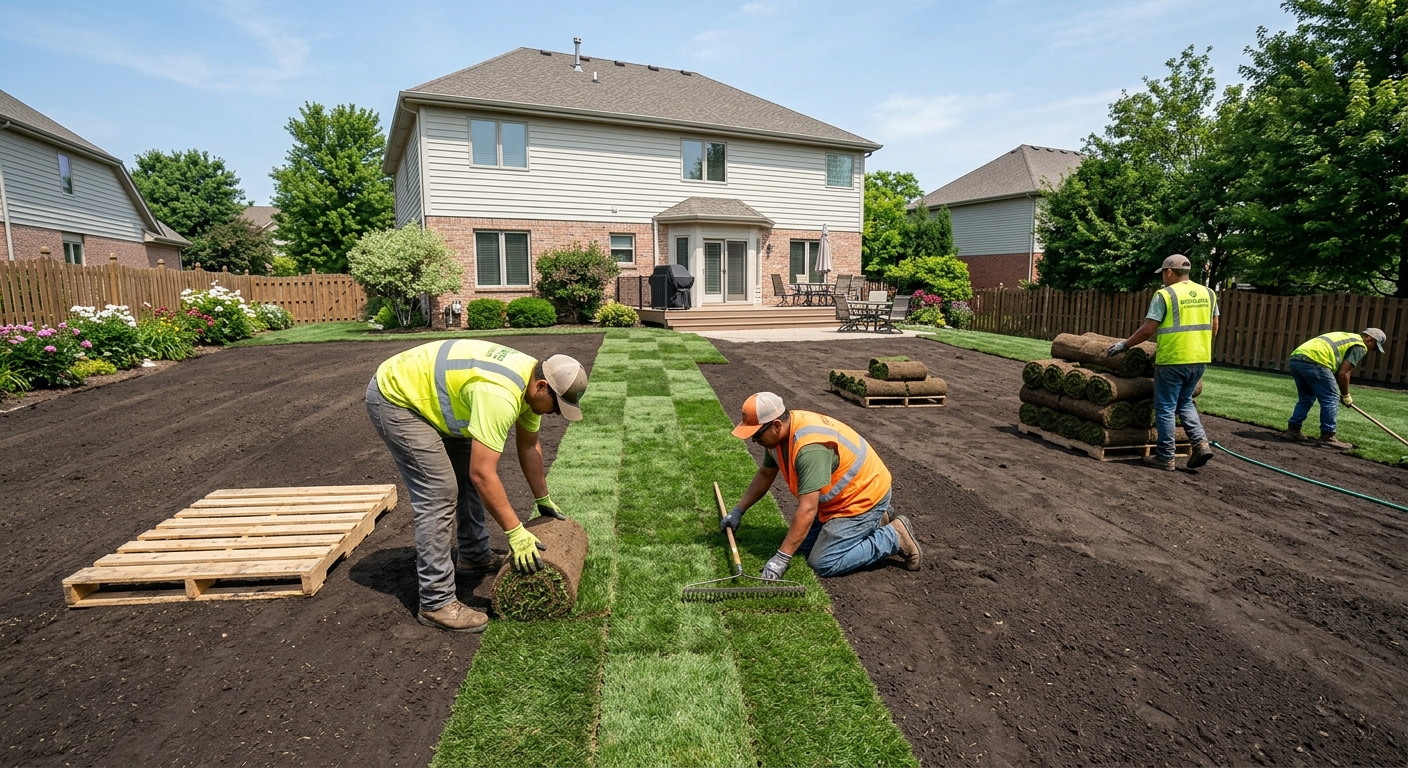
Sod versus seed is another key decision. Sod gives instant visual coverage and immediate erosion control, but in our area it typically costs 3–4x more per sq ft than seeding once you include base prep and handling. If you’re budget-conscious and the lawn area isn’t heavily compacted, seeding can be the smarter path; if you need quick coverage to stabilize slopes or prevent washout, sod can justify the higher $1,800–$6,000 range.
Drainage and grading are critical in Calgary-style lots: we slope patios and walkways, and we build retaining walls with deep, well-compacted bases and behind-wall drainage to reduce heaving and pooling near foundations. For hardscape, your base preparation depth and compaction matter more than the paver name. Finally, low-maintenance design—groundcovers, perennials, and mulched borders—reduces seasonal labour while keeping curb appeal strong.
Where it makes sense, include xeriscape or rain-garden elements. In Calgary’s semi-arid conditions, smart irrigation zoning and efficient soil strategies can outperform “high-water” turf.
| Element |
Climate Consideration |
Maintenance Level |
Price Band |
| Sod lawn installation |
Needs strong root establishment before freeze; base prep and drainage reduce winter heaving |
Medium (watering windows first season) |
$1,800–$6,000 |
| Native perennial garden |
Better wind/drought tolerance in Zone 3–4; mulch helps through cold snaps |
Low (seasonal tidy-up) |
$2,000–$10,000 |
| Mulched shrub border |
Winter structure with hardy shrubs; mulch insulates roots during freeze–thaw |
Low–Medium (weed control, occasional topping up) |
$1,200–$7,500 |
| Interlocking stone patio |
Base depth and compaction control frost-related movement; proper slope sheds water |
Low (sweeping, occasional joint sand) |
$8,500–$30,000 |
| Retaining wall (block) |
Deep base and behind-wall drainage prevent saturation and heave |
Low (periodic inspection of drainage) |
$10,000–$38,000 |
| Drip irrigation system |
Zoning reduces water stress during Prairie dry spells; design for efficient coverage |
Low–Medium (seasonal checks) |
$2,500–$12,000 |
How to choose a landscaping contractor in Delton
Choosing the right contractor in Delton starts with verification. In Alberta, ask for proof of general liability insurance (current certificate), confirm WSIB/WCB clearance for worker coverage, and ensure they can legally do the scope you’re hiring for—especially if your project includes hardscape excavation, drainage trenching, or any permit-triggering structural elements. You can check licence/business registration details via the relevant Alberta online registries for the contractor’s business category, and you should always request certificate of insurance and WSIB/WCB clearance documentation before signing. If they can’t provide clear, current paperwork, that’s a serious risk.
Next, get 2–3 itemised written quotes that break out labour and materials—don’t accept a vague lump sum that doesn’t specify excavation depth, base thickness, drainage components, or the plant sizes and quantities. Confirm exclusions: is disposal included? Is site clean-up included? Are utilities locates booked? Is a permit pull included for a retaining wall if it exceeds the typical height threshold in many municipalities? Then match warranty terms: workmanship warranty length, product/manufacturer warranty (and whether it’s transferable if you sell the home), and what maintenance actions are required to keep coverage valid.
For payments, keep it conservative. Never pay more than 10–15% upfront; use progress payments tied to milestones, and hold back until completion and walk-through. Finally, demand a timeline with a start date and an estimated completion date in writing—Prairie weather can shift schedules, but good contractors plan for it.
- Ask for project-specific references in Calgary-area conditions (freeze–thaw, base prep, drainage).
- Verify liability insurance is current and the insured party matches the contract.
- Request WSIB/WCB clearance documentation before work begins.
- Ensure the quote lists excavation depth, base material type, and compaction expectations.
- Confirm whether drainage work (French drain/gravel bedding) is included when grading is required.
- Get plant lists with quantities, sizes, and whether plants are container-grown or balled-and-burlapped.
- Check whether sod/seed quotes include soil amendment and any fertility/seed mix specifics.
- Ask who handles utility locates and whether the contractor confirms markings before digging.
- Confirm disposal/haul-away is included (topsoil removal, excess rock, construction waste).
- Request warranty details in writing and what “workmanship” covers (settlement, heaving, failures).
- Clarify payment schedule and keep a holdback until the final walk-through.
- Make sure the contract includes an estimated start date, completion estimate, and change-order process.
Red flags I see too often around Delton: quotes that omit drainage or base depth details; “lowest price” bids with no itemisation; contractors who won’t provide insurance/WSIB/WCB documentation up front; unclear warranty wording (especially for patios/walls); and payment requests that exceed 10–15% before any measurable work starts.
Frequently asked questions — landscaping in Delton
How much does landscaping cost in Delton?
Landscaping costs in Delton typically depend on how much you change the yard’s grading, drainage, and hardscape footprint. For a full design-and-install package, many homeowners land in the mid five-figure range once grading, planting, hardscape, and optional irrigation are included. If you’re starting with lawn or a smaller refresh, sod installation often falls around $1,800–$6,000, while seeding is commonly less once soil prep is straightforward. Patios and walkways usually run higher because they require deeper base prep to resist freeze–thaw movement, with many projects fitting in $8,500–$30,000. Because Delton is in the Calgary region with zones 3–4, base preparation, drainage, and winter survival planning are key cost drivers (not just the visible “top” materials) (Statistics Canada, 2021 Census).
What plants thrive in Delton's climate zone?
Delton sits in the Prairie hardiness zones 3–4, so the best-performing plants are those that tolerate cold snaps, wind, and periodic dry periods. I recommend focusing on hardy, proven species rather than broad “import” palettes—especially for shrubs and foundation borders. In practice, homeowners do well with hardy ornamental grasses, native or regionally adapted shrubs, and perennials that come back reliably after winter. For trees, choose cold-hardy varieties that won’t struggle with short growing seasons. Since freeze–thaw cycles can stress roots, mulch and soil amendment are just as important as species choice. If you want a low-water approach, pairing hardy plantings with zoned irrigation or drip lines helps you maintain growth without overwatering during shoulder seasons.
Sod vs seed — which is better for a Delton lawn?
In Delton, sod and seed can both work, but the “better” choice depends on your timeline and the condition of the lawn area. Sod gives instant coverage and erosion control, which can be helpful if your grade is being corrected or you need quick establishment. The trade-off is cost: sod commonly sits around $1,800–$6,000 for typical residential areas, while lawn seeding is often less—frequently within $1,500–$4,500 when grading and soil prep are manageable. If you can wait for germination and you’re okay with patchy early coverage, seeding is usually the value option. Either way, Prairie timing matters: late spring frosts and early fall cold snaps mean you want the soil warm enough and you need a watering routine that supports establishment before freeze.
How much does a retaining wall cost in Delton?
Retaining wall costs in Delton depend heavily on wall height, length, excavation depth, and drainage requirements behind the wall. Because freeze–thaw cycles are severe in the Calgary region, walls need a deep, well-compacted base and proper behind-wall drainage to prevent saturation and heaving. For many typical residential installations, homeowners see wall pricing around $10,000–$38,000, but it can shift if the job requires significant regrading or additional drainage features. If your wall is near the common height threshold (often around 1.0 m in many municipalities), permit requirements can add time and documentation. A good quote will include base prep, geotextile, drainage rock, and piping details—not just the block material.
When is the best time to landscape in Delton?
For Delton (Calgary region, zones 3–4), the best window is typically late spring through early fall. Crews can usually start grading and hardscape prep in May when conditions allow safe excavation and compaction, and they can plant through the season as long as temperatures cooperate. For planting trees and shrubs, many homeowners also have success in early/mid fall (September) when it’s cooler and plants can harden off before winter. Sod has narrower timing: it needs consistent establishment time, so we usually target late April to June or early September depending on weather. Because late spring frosts and early fall cold snaps can occur, avoid committing to planting too close to those risk periods. Your contractor should schedule around the weather, not just the calendar.
Do I need a permit for a retaining wall in Alberta?
In Alberta, permits are most commonly tied to retaining wall height and the structural impact of the work. Many municipalities use a typical threshold of around 1.0 m (3.3 ft); above that, a building permit is often required and engineered drawings may be requested. Even when a permit isn’t triggered, drainage changes and lot grading can still require approval if they affect drainage toward a neighbour or storm connections. For Delton homeowners, the safest approach is to ask your contractor to confirm whether your wall height and design exceeds the local permit threshold and to include permit handling in the scope if it applies. Also remember to call for utility locates before digging, and verify contractor documentation (insurance and WSIB/WCB clearance) before starting excavation.