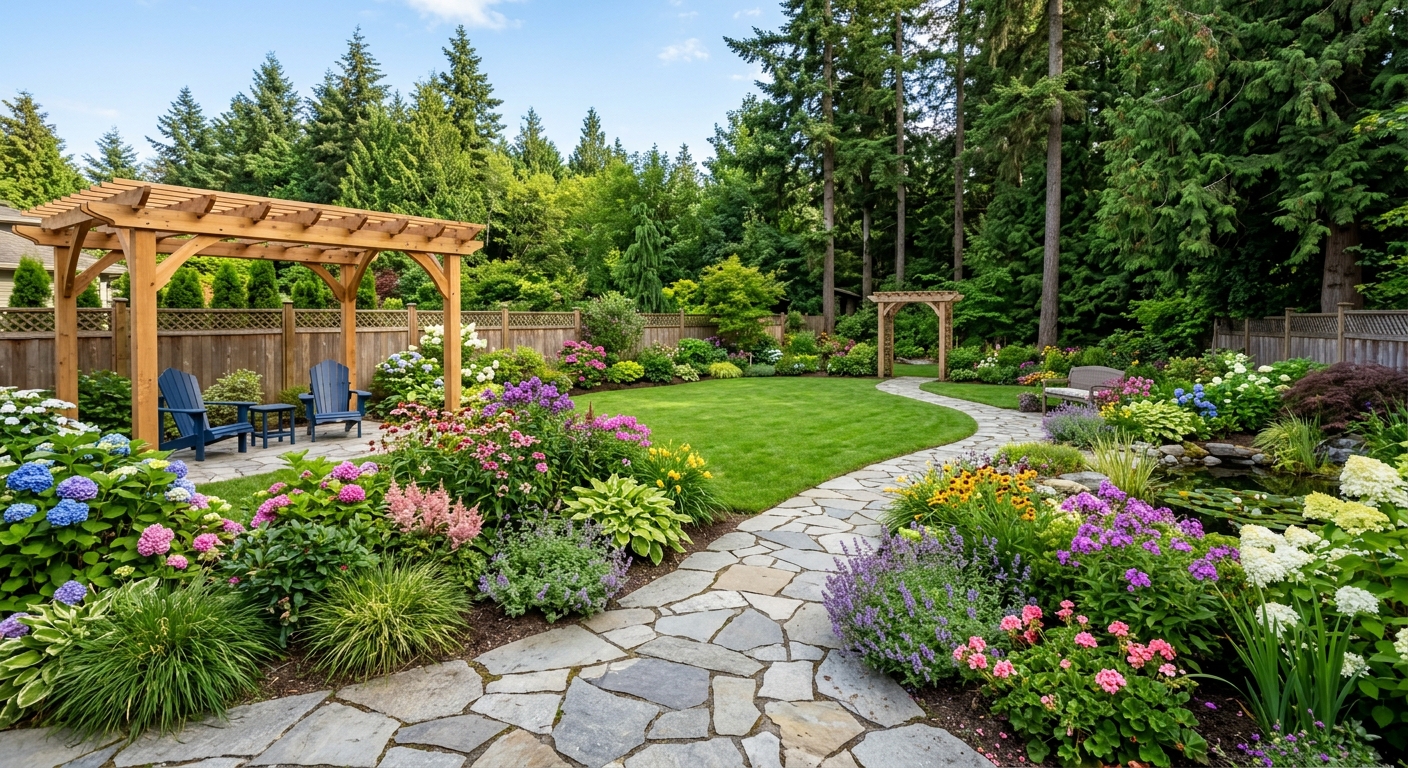
Landscaping options and costs in Peace River
Peace River homeowners typically start by choosing a practical mix of softscape (grass, plantings) and hardscape (patios, walkways, retaining walls). That’s especially common here because 61.8% of homes are single-detached, and detached yards usually offer room to improve drainage, add planting beds, and create usable outdoor space. With 59.1% of households owning their home, many residents invest beyond quick curb appeal—often upgrading the lawn and grading around older homes; 52.9% of dwellings were built before 1981, so foundation moisture and soil settlement can be ongoing concerns.
In the Athabasca–Grande Prairie–Peace River region, pricing is shaped by a short working season and freeze-thaw cycles. Contractors plan around late spring/early fall frost risk, which affects how quickly sod can root and when gravel base work can be compacted properly. Planting costs also reflect cold-hardiness needs—most designs prioritize drought-tolerant, wind-hardy species and soil preparation that helps roots establish before winter. On the hardscape side, patios and retaining walls require deeper, well-compacted bases and drainage to reduce heaving during winter temperature swings.
Demand is strong in established residential areas like the West Hill neighbourhood, where homeowners often want curb upgrades and better walkability from the driveway. If you’re comparing options for a front yard refresh or a backyard build-out, the table below gives realistic starting ranges for typical Peace River scopes.
| Service |
Description |
Season |
Price Range |
| Full landscape design and installation |
Site walk, concept + layout, grading/drainage plan, planting plan, and installation of beds, lawn, and selected hardscape |
May–September |
$5,000–$20,000 |
| Sod installation (supply, grade, lay, roll) |
Minor grade correction, topsoil/compaction, supply and install sod, starter fertilizer |
Late May–August (best results before first frost) |
$3,500–$12,000 |
| Lawn seeding (grade, seed, starter fertilizer) |
Rake/prepare surface, grade to remove low spots, seed blend and starter fertilizer, light topdressing where needed |
Spring or early fall |
$2,000–$7,500 |
| Interlocking patio or walkway |
Excavate, compacted base, edge restraint, interlocking pavers, polymeric sand jointing |
May–September |
$8,000–$25,000 |
| Retaining wall (interlocking block) |
Excavate and rebuild slope, geogrid/compaction as needed, drainage gravel, block wall install |
May–September |
$8,000–$30,000 |
| Tree and shrub planting |
Soil amendments, planting holes, watering plan setup, staking as required, mulch rings/beds |
May–early October (weather permitting) |
$1,500–$10,000 |
Prices are estimates only and vary by project scope, site access and material selection.
What affects the price of landscaping in Peace River
In the Athabasca–Grande Prairie–Peace River region, two quotes for the same “typical” backyard refresh can differ by 30–50% because the real drivers—site conditions, plant sizing, base depth, and drainage—show up only after measurement and soil/grading assessment. That gap is also common across Alberta because labour availability and material sourcing can vary by distance, and contractors often adjust crews and equipment plans for the short working season.
Climate and hardiness are the biggest levers. Alberta Prairie zones generally support cold-hardy, wind-tolerant choices, and your working season is constrained by frost risk. If a plan requires deeper excavation to get below the frost line for walls and properly compacted patio bases, labour hours rise. In coastal BC (Zone 7–8), longer seasons support lush palettes, but heavy rainfall shifts the cost toward drainage and irrigation control; in the dry interior, water restrictions influence irrigation design. Southern Ontario (Zone 5–6) tends to offer a longer window than Peace River, though summer dry spells still require irrigation strategy. In Peace River, winter survivability and drainage performance matter more than flashy, short-lived growth.
Concrete examples: (1) If your yard has low areas that hold water after snowmelt, adding grading corrections and a drainage bed/French drain can push a softscape project upward into the $5,000–$20,000 design-and-install band. (2) If you’re replacing a lawn with sod, the cost usually lands within the $3,500–$12,000 sod range because you’re paying for turf supply plus careful compaction and establishment. Older homes (52.9% built before 1981) often have subtle settlement, so fixing drainage around foundations can add scope that newer lots may not need.
| Price Factor |
Why It Matters |
Cost Impact |
| Yard size in sq ft — the primary cost driver for softscape |
More area means more excavation, base material, seed/sod, labour hours, and edging length |
Often the largest swing factor; small yards can be 20–40% cheaper than “average” listings |
| Grading and drainage work — slope corrections add significant cost |
Fixes pooling, improves runoff direction away from foundations, and supports successful turf establishment |
Can add substantial labour and hauling, commonly pushing jobs toward higher end bands |
| Drainage bed or French drain installation |
Protects against freeze-thaw heaving by moving water from saturated soils |
Adds trenching, perforated pipe, gravel, and disposal—material-heavy work |
| Plant material tier — native shrubs vs. ornamental vs. mature specimen trees |
Cold-hardiness and size at planting determine survival and visual impact in year one |
Mature specimens can cost multiples of small liners; drives upsell into the upper planting band |
| Hardscape vs. softscape ratio — walls and patios cost more per sq ft than lawn |
Base prep and paver/block materials increase unit costs |
Shifting a patio or wall into scope often changes the total budget more than adding extra planting beds |
| Irrigation system design and installation |
Peace River lawns and beds may need targeted watering for establishment; design prevents waste and freezes |
Design + install can move a lawn refresh into a higher total even with the same yard size |
| Soil amendment and topsoil required |
Compaction and poor drainage need corrected soil structure for roots to take hold |
Haul + labour can add cost quickly where existing soil is sandy, clay-heavy, or construction-compacted |
| Tree removal or stump grinding before new planting |
Access, debris disposal, and root disturbance affect what can be replanted right away |
Can add several thousand dollars depending on stump size and access constraints |
Permits & regulations in Alberta
In Alberta, most landscaping work such as planting, sodding, and typical softscape installation does not require a permit. However, retaining walls can be different: in many municipalities, retaining walls above a height threshold—typically around 1.0 m (3.3 ft)—may require a building permit and, in some cases, engineered drawings. Because thresholds and requirements can vary, it’s important to confirm with the City/County permitting office before construction begins.
Also note that changes to lot grading can trigger approval when they affect drainage patterns—especially if runoff is directed toward a neighbouring property or toward a storm sewer connection. Even if your goal is “just to fix pooling,” contractors should document the drainage plan so the intent matches municipal expectations.
Before any digging, call for utility locates. Utility markings help prevent damage to buried services when you’re installing planting holes, drainage gravel trenches, or wall footings.
How a Peace River homeowner can verify a contractor in Alberta, step-by-step: (1) Ask for their Alberta business information and confirm they carry liability insurance; request a certificate of insurance naming you as the certificate holder where applicable. (2) Request WSIB/WCB coverage proof if they employ workers—your contractor should provide a clearance letter or coverage documentation. (3) Check the relevant Alberta online registry for licensing status if the scope includes regulated trades (for example, electrical work tied to irrigation controllers). (4) Don’t skip a written scope: confirm who handles disposal and whether permits (when required) are included or billed separately.
Planning a landscape that thrives in Peace River's climate
Planning for Peace River means working with the local hardiness conditions and frost cycle rather than trying to force a “southern” look. Start by selecting zone-appropriate plants—native and cold-hardy shrubs, perennials, and small trees that handle winter freeze and early-season cold snaps with less winter protection. Then design the yard around drainage: in Athabasca–Grande Prairie–Peace River conditions, spring melt and freeze-thaw can turn small low spots into persistent muddy areas and foundation moisture. If grading doesn’t move water away from the house, even the best planting palette struggles.
Sod versus seeding is also a climate-fit decision. Sod gives instant coverage and faster early erosion control, but it’s more expensive and more labour-sensitive to install correctly. In Peace River, sod typically costs about 3–4 times more per sq ft than seeding once you factor in supply and careful compaction. For example, if you’re aiming for 1,000 sq ft of lawn, seeding may land closer to the lower end of lawn seeding budgets, while sod often pushes you into the higher part of the sod band depending on site prep and access—so it’s worth choosing sod when timing is tight, you need quick usability, or the area erodes.
Hardscape planning matters too. Patio bases, walkways, and retaining walls need proper depth and compaction to resist heaving during winter. Include drainage gravel layers behind walls and ensure edges are restrained so pavers don’t shift. Low-maintenance design strategies—mulched shrub borders, groundcovers, and durable perennials—reduce annual upkeep while keeping curb appeal consistent. Xeriscape-style options can be practical here: plan drought-tolerant groupings and consider a rain-garden or engineered drainage bed where runoff collects, turning a drainage problem into a controlled feature.
| Element |
Climate Consideration |
Maintenance Level |
Price Band |
| Sod lawn installation |
Needs careful establishment during short growing windows; avoids washouts but requires correct base prep |
Medium (initial watering/monitoring, then reduced upkeep) |
$3,500–$12,000 |
| Native perennial garden |
Cold-hardy plants establish over time and handle wind and temperature swings better |
Low to medium (spring clean-up and occasional weeding) |
$1,500–$8,500 |
| Mulched shrub border |
Mulch moderates soil temperatures and helps retain moisture between late summer dry spells |
Low (top up mulch once or twice a year) |
$2,000–$9,500 |
| Interlocking stone patio |
Freeze-thaw resistance depends on base depth, compaction, and drainage away from the house |
Low (occasional leveling checks and joint maintenance) |
$8,000–$25,000 |
| Retaining wall (block) |
Needs drainage gravel and proper footing depth to reduce winter heaving |
Low once installed correctly |
$8,000–$30,000 |
| Drip irrigation system |
Targets watering for establishment while reducing waste; lines must be designed to handle freeze risk |
Medium (seasonal adjustments and inspections) |
$2,000–$10,000 |
How to choose a landscaping contractor in Peace River
Start by verifying coverage and compliance. In Alberta, a reputable landscaper will carry liability insurance; ask for a certificate of insurance and confirm it’s active for the project dates. If they employ workers, they should also provide proof of WSIB/WCB coverage and clearance (often requested as documentation that the account is in good standing). If the scope involves regulated work—such as electrical components for irrigation controllers or specialty drainage tied into services—ask how licensing is handled for those parts and request proof.
Next, get 2–3 itemised, written quotes. For Peace River projects, you want the labour and materials broken out (excavation/hauling, base rock, pavers/blocks, topsoil/compost, sod/seed, disposal, and any drainage components). Avoid “lump sum only” quotes because scope changes are easier to dispute when it’s vague. Read the scope line-by-line: what’s excluded? Is permit pulling included if a retaining wall exceeds the local threshold? Who supplies and who disposes of excess soil? Will edging be installed? Is there a winterization or establishment watering plan?
Warranty matters. Ask for workmanship warranty length and whether product warranties apply (for sod, materials, irrigation components, or wall systems). Confirm if warranties are transferable if you sell the home. Payment schedule should be conservative: never pay more than 10–15% upfront for a typical landscaping job, and hold back a portion until the work is completed and cleaned up. Finally, ensure you receive a written timeline with a start date and a realistic completion estimate based on Peace River weather windows.
- Confirm liability insurance is active and aligned with your project dates.
- Request WSIB/WCB clearance or coverage proof if the contractor has employees.
- Ask for a written scope: quantities, elevations/grade notes, and material list.
- Check whether disposal and hauling are included or billed separately.
- Look for base depth notes for patios/walks and drainage details for walls.
- Verify plant lists include species and mature size (not just “shrubs”).
- Ask who handles utility locates and how they confirm safe digging.
- Ensure erosion control steps are included for spring melt or disturbed soil.
- Get warranty details in writing (workmanship + any manufacturer coverage).
- Use an itemised quote so you can compare like-for-like bids.
- Review payment schedule—limit upfront and require holdback until completion.
- Ask what happens if early frost limits sod/plant establishment; get a contingency plan.
Red flags in Peace River include contractors who won’t provide insurance/coverage proof, quotes that don’t specify drainage/base preparation, very low “too good to be true” pricing with vague scope, pressure to pay most of the total upfront, and crews who can’t show examples of similar cold-climate installs (especially drainage and wall base work).
Frequently asked questions — landscaping in Peace River
How do I design a low-water yard in Peace River?
In Peace River, low-water design starts with plant selection and soil drainage—not just with “less grass.” Use cold-hardy, drought-tolerant species suited to northern interior conditions, group them by water needs, and avoid scattering high-demand plants across exposed areas. Improve soil structure with compost/soil amendments so moisture lasts longer between watering. Reduce turf area where you can by replacing parts of the lawn with mulched shrub borders and hardy perennials. If you keep lawn, plan watering for establishment and deep, infrequent so the roots grow stronger. Many homeowners also benefit from drainage beds or rain-garden style swales to capture meltwater and reduce pooling, which lowers the need to “fight” wet zones with extra watering. Even on a $1,500–$10,000 planting budget, a smart layout can cut long-term watering.
How do I find a licensed landscaper in Peace River?
In Alberta, start by asking any contractor for proof of liability insurance and WSIB/WCB coverage (or a clearance letter if they provide it). For landscaping, permits are usually not needed for planting/sodding, but retaining wall requirements may trigger building permits depending on height and local rules—so you also want a contractor who understands documentation and drainage expectations. When you request quotes, ask for itemised breakdowns (labour and materials) so you can compare apples-to-apples. You can also check online business and licensing registries relevant to their trade scope if specialized work is included (for example, electrical components related to irrigation controls). Finally, don’t rely only on ads: ask for recent Peace River project photos showing drainage and hardscape base preparation, and confirm warranty terms in writing before signing.
How much does landscaping cost in Peace River?
Landscaping costs in Peace River commonly fall into three main bands depending on what you’re building. A full landscape design and installation typically starts around $5,000–$20,000 for most residential scopes (especially where grading, drainage, and multiple elements are included). If your focus is the lawn, sod installation often lands in the $3,500–$12,000 range depending on yard size and site prep. Hardscape projects like interlocking patios or retaining walls can add significant cost because freeze-thaw protection demands deeper, compacted bases and drainage layers—retaining walls commonly match the $8,000–$30,000 band. Exact totals vary with access, disposal/hauling, soil amendment needs, and whether your home (many were built before 1981) has legacy drainage or settlement issues that require extra grading work.
What plants thrive in Peace River's climate zone?
Peace River landscaping should prioritize cold-hardy, wind-tolerant plants that can handle northern Prairie winter conditions and short growing seasons. In practice, contractors usually build plans around native shrubs and perennials, plus hardy small trees that establish well in Alberta’s freeze-thaw environment. The exact species list depends on sun exposure and soil moisture, but the approach is consistent: choose plants that tolerate drought and cold, and match them to drainage conditions (especially where meltwater collects). If your yard has exposed, dry wind corridors, you’ll generally pay for fewer replacements by using hardy, drought-tolerant varieties rather than trying lush ornamentals. When homeowners budget for planting, the typical realistic range for tree and shrub planting is $1,500–$10,000, but the best value comes from correct placement and soil preparation, not just plant selection.
Sod vs seed — which is better for a Peace River lawn?
Sod is often better when you need fast visual results and immediate erosion control, but it’s more expensive and requires good base preparation to root before the cold season returns. Seeding costs less and can be an excellent strategy for Peace River lawns when the grade is corrected and you can manage establishment watering. In your Peace River context, sod typically falls within the $3,500–$12,000 band, while seeding projects usually land below that, depending on area and prep. The “better” choice comes down to your timeline, soil condition, and risk of frost returning early. If the area has low spots or drainage problems, fix grading first—otherwise either sod or seed can struggle. Many homeowners get the best outcome by seeding where conditions are stable and using sod in problem zones that need instant coverage.
How much does a retaining wall cost in Peace River?
Retaining wall pricing in Peace River reflects the construction details needed to survive Alberta winters: excavation, compacted base, proper block installation, and crucial drainage gravel behind the wall to reduce freeze-thaw pressure. That’s why retaining walls are not priced like simple garden borders. For typical residential interlocking block walls, homeowners often see costs around $8,000–$30,000 depending on length, height, soil conditions, and how much base/drainage work is required. If the wall exceeds local height thresholds (commonly around 1.0 m in many municipalities), a building permit may be required and can add time and documentation. Because older properties may have settled slopes, a site assessment is key to avoid underbuilding the base. Always ask for drainage details in the written scope before you approve the quote.