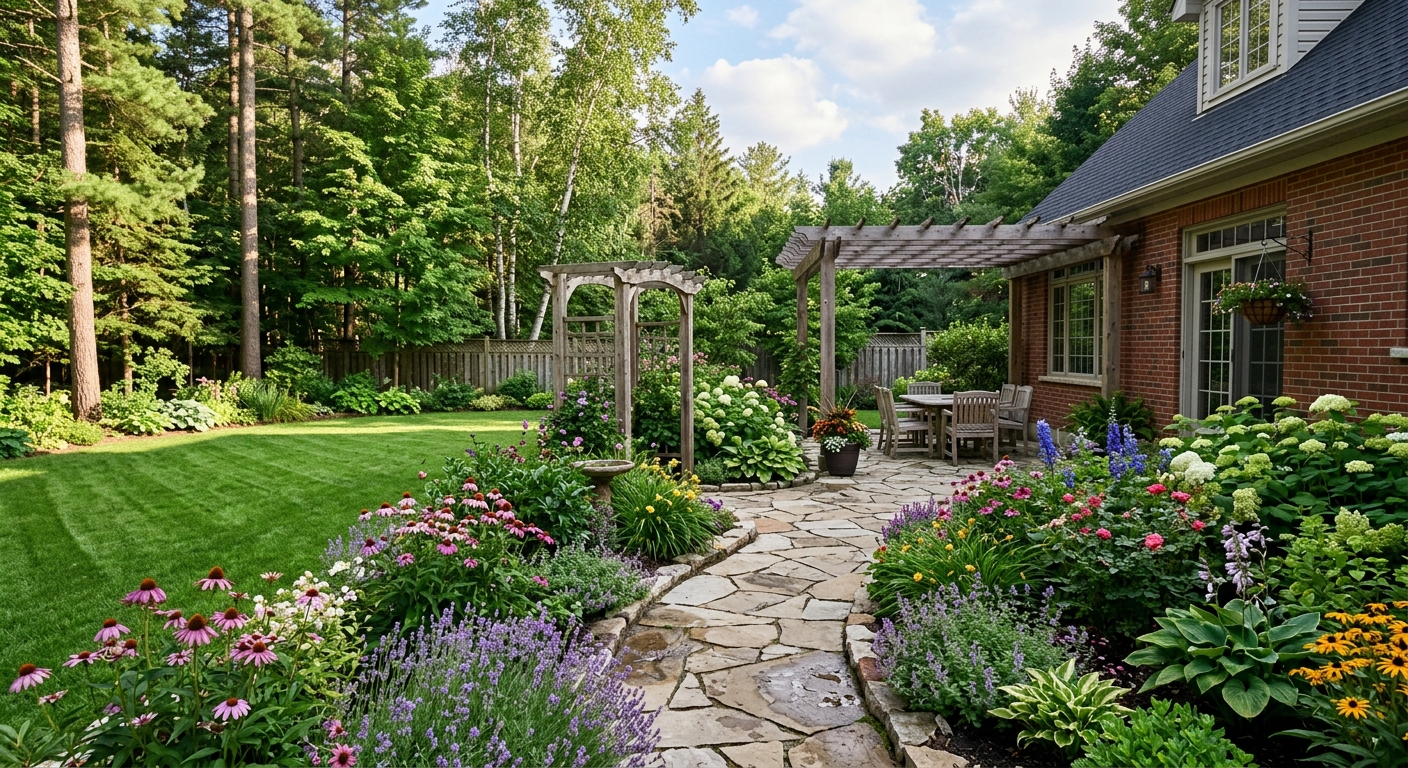
Landscaping options and costs in Rocky Ridge
Rocky Ridge, Alberta is a great place to invest in a finished yard, especially when you want curb appeal that also holds up through chinooks, hail, and Rocky Mountain–driven freeze–thaw cycles. With a population of 8,195 (Statistics Canada, 2021 Census), the surrounding Calgary market is big enough to support steady contractor availability, but still competitive for the best crews during peak spring installs. Many homeowners here also live in a community where single-detached homes are common, which typically means you have more yard to shape, grade, and plant—so full-service landscaping becomes a practical value-add rather than a “nice-to-have.”
In Calgary’s Prairie plant hardiness zones 3–4, late-spring frosts and early fall cold snaps affect both plant choices and how long we can work on site. Severe freeze–thaw means retaining walls, patios, and walkways need deep, well-compacted bases and proper drainage to prevent heaving and water-driven settlement. That’s why you’ll often see total project quotes land in the mid five-figures when grading, hardscape, planting, and irrigation are bundled—particularly in demand areas like the Rocky Ridge NW corridor where lots are developed and driveways/side yards need efficient rework.
Below are common scope options we price for Rocky Ridge homeowners, so you can compare proposals apples-to-apples before you pick a design and schedule.
| Service |
Description |
Season |
Price Range |
| Full landscape design and installation |
Site walk, concept/design, grading & drainage plan, hardscape layout, planting plan, irrigation design (if needed), supply and installation of softscape + hardscape |
Spring–Fall (peak May–Sep) |
$12,000–$45,000 |
| Sod installation (supply, grade, lay, roll) |
Topsoil/till touch-up, grading to address low spots, sod supply, lay/roll, starter fertilizer, light irrigation guidance |
Late Apr–Jun; Aug–Sep |
$2,500–$6,000 |
| Lawn seeding (grade, seed, starter fertilizer) |
Minor grade correction, seed blend, starter fertilizer, rake-in/rolling, establishment care |
Apr–May; Aug–Sep |
$1,500–$3,800 |
| Interlocking patio or walkway |
Excavation, compacted base (often frost-considerate depth), geotextile, edging, interlocking stones, final bedding and joint sand |
Spring–Fall |
$8,000–$22,000 |
| Retaining wall (interlocking block) |
Layout, excavation, compacted base, block installation, drainage stone/weep considerations, finishing and cleanup |
Spring–Fall (best before freeze) |
$14,000–$38,000 |
| Tree and shrub planting |
Soil prep, planting pits, amendments, staking (as required), mulch rings/beds, seasonal watering plan |
Spring–Fall |
$2,000–$12,000 |
Prices are estimates only and vary by project scope, site access and material selection.
What affects the price of landscaping in Rocky Ridge
In Rocky Ridge and across the Calgary region, you can see quotes for the “same” job vary by about 30–50% once you compare the real scope. The big drivers are how much base and grading is required (especially under patios, walkways, and retaining work), whether irrigation is engineered for zones, and the level of material tier for plants and hardscape. Labour also matters here: local trades typically account for 40–60% of a full project, and the best crews can book up in peak summer—so scheduling and manpower availability can affect costs.
Climate is the other cost lever. Rocky Ridge sits in Prairie hardiness zones 3–4 with freeze–thaw cycles that are tough on improperly built foundations. Short growing seasons mean fewer weeks to install sod and perennials successfully, and any delays can force reprogramming. In a Prairie zone, we prioritize drought-tolerant, wind-hardy choices and soil improvement rather than lush, high-water palettes. By contrast, coastal BC’s milder zone (often 7–8) allows broader planting options over a longer season, but heavy rainfall there makes drainage design critical in different ways; interior BC water patterns often push drip and xeriscape. In southern Ontario (zone 5–6), the season is longer than ours, but summer dry spells still demand irrigation planning.
Concrete examples from Rocky Ridge: (1) A walkway that needs extra excavation and deeper compacted base for frost stability will cost more even if the square footage looks similar—hardscape base prep is where budgets move. (2) A yard with drainage issues (standing water or down-slope flow toward the neighbour’s fence) can add drainage beds or French drains, pushing the project toward the higher end of hardscaping bands such as $8,000–$40,000 for retaining & hardscape. (3) Planting can jump from entry shrubwork to a full mixed border if you add mature specimens; that’s why tree & garden planting commonly scales within $800–$15,000 depending on size and quantity. In older Rocky Ridge housing stock, some lots have entrenched issues—settled topsoil, buried downspout discharge, or compacted fill—so remediation costs can land into that mid five-figure range once you add proper base and drainage.
| Price Factor |
Why It Matters |
Cost Impact |
| Yard size in sq ft — the primary cost driver for softscape |
More area means more soil work, more seed/sod, more edging, and more labour time |
Low–high swing depending on turf removal and bed layout; commonly moves total by thousands |
| Grading and drainage work — slope corrections add significant cost |
Calgary freeze–thaw punishes pooling; proper slope and fall direction protect foundations |
Often increases scope substantially for driveways/side yards with existing low spots |
| Drainage bed or French drain installation |
Captures and redirects subsurface water; reduces heaving risk near hardscape |
Can add a mid-to-high single-line cost item; frequently shifts a project upward |
| Plant material tier — native shrubs vs. ornamental vs. mature specimen trees |
Mature sizes need larger pits, more soil, staking, and higher unit pricing |
Small changes in plant count/size can increase planting budgets significantly |
| Hardscape vs. softscape ratio — walls and patios cost more per sq ft than lawn |
Pavers, compacted base, and edging/finishing are labour- and material-intensive |
Shifting the plan from turf to stone often raises total into the hardscaping bands |
| Irrigation system design and installation |
Zone design, backflow prevention, trenching, and controller programming add cost but improve survival |
Frequently a major add-on; worthwhile where wind and drought stress new plantings |
| Soil amendment and topsoil required |
Improves drainage and root establishment; essential for clay/compacted subsoils |
Can be a noticeable cost if haul is needed or existing soil is poor |
| Tree removal or stump grinding before new planting |
Clearing affects labour, disposal, and makes room for correct grading and bed construction |
Often adds a non-trivial line item before planting can start |
Permits & regulations in Alberta
For most Rocky Ridge landscaping projects in Alberta, planting and basic softscape work typically does not require a permit. That generally includes: sodding and seeding, planting trees and shrubs, installing mulch/landscape beds, and most routine grading for planting areas (as long as drainage and runoff responsibilities are respected). However, some hardscape and drainage-related work can require approval depending on height, location, and how runoff is affected—so the safest approach is to confirm with your municipality before digging.
What usually DOES require a permit: retaining walls above a typical height threshold of 1.0 m (3.3 ft) in many Alberta municipalities, and sometimes engineered drawings if the wall is taller, subject to surcharge loads, or involves complex drainage. Also, changes to lot grading that materially affect how water drains toward neighbouring properties or toward storm sewer connections can trigger approval requirements. Before any digging for wall footings or irrigation trenches, homeowners should arrange utility locates—especially for any work that could intersect buried power/communications/cable lines.
Step-by-step verification for a contractor in Rocky Ridge: (1) Ask for their Alberta licence information (and confirm it on the appropriate provincial registry/verification method provided by Alberta regulators). (2) Request a current Certificate of Insurance showing general liability coverage naming you as “additional insured” where applicable. (3) Confirm WSIB/WCB coverage (or an equivalent clearance document). (4) Get the clearance letter or proof documents dated for the project start date. (5) Ensure the permit responsibility is clear in writing—who pulls it, if needed, and what costs are included.
Planning a landscape that thrives in Rocky Ridge's climate
To plan a yard that thrives in Rocky Ridge, design around zone-appropriate plants and around the realities of our frost calendar and freeze–thaw. Rocky Ridge sits in Prairie hardiness zones 3–4, where late spring frosts and early fall cold snaps can damage tender growth and where soil can heave if foundations and bases aren’t properly built. Start with plant selection: choose hardy, often native-friendly species adapted to colder winters and wind, and prioritize drought-tolerant choices once established. Add mulch and windbreak layout (fences, taller shrubs, or strategic placement) to protect new plantings during drying Chinook winds.
For turf, compare sod versus seed honestly. Sod gives instant coverage and helps new yards look finished quickly, but it costs roughly 3–4× more per sq ft than seeding in Calgary when you include supply, prep, and roll logistics. Seeding is more budget-friendly and works well for gradual establishment—particularly where you can keep moisture consistent during germination. Drainage and grading are non-negotiable in Calgary: pooling near foundations can become a long-term maintenance cost, especially after freeze–thaw. Hardscape needs base prep aligned with frost considerations: deep, well-compacted aggregate and correct slope protect patios, walkways, and wall footings.
Low-maintenance design strategies can still look high-end here. Use groundcovers, mulched shrub borders, and perennials suited to zones 3–4 to reduce annual mowing and watering. Consider xeriscape or rain-garden elements where downspouts discharge or where you see frequent runoff paths. For example, if you want curb impact on a budget, directing spend into an interlocking patio (often within $8,000–$22,000) and using seeded turf around it can be a smarter trade than covering everything with sod. That way you get a “finished yard” feel without paying full sod pricing everywhere.
| Element |
Climate Consideration |
Maintenance Level |
Price Band |
| Sod lawn installation |
Needs consistent moisture to root before summer heat and after spring/fall frosts |
Medium (establishment watering, first season mowing) |
$2,500–$6,000 |
| Native perennial garden |
Hardy growth through winter; tolerates dry spells once established |
Low–Medium (spring tidy, occasional weeding) |
$3,000–$9,500 |
| Mulched shrub border |
Mulch buffers freeze/thaw, reduces moisture loss, and helps plants survive cold winds |
Low (mulch refresh yearly or as needed) |
$2,000–$7,500 |
| Interlocking stone patio |
Requires deep, compacted base and correct slope to prevent heaving and water pooling |
Low (periodic joint sand/top-up if required) |
$8,000–$22,000 |
| Retaining wall (block) |
Footings and drainage must be built for freeze conditions to reduce settlement |
Low (visual inspections, vegetation management on top) |
$14,000–$38,000 |
| Drip irrigation system |
More efficient water delivery for drought-tolerant plantings during restrictions or dry stretches |
Low (seasonal checkups, winterization) |
$1,800–$7,500 |
How to choose a landscaping contractor in Rocky Ridge
Choosing the right contractor in Rocky Ridge starts with proof, not promises. First, verify Alberta licensing for the trades involved (and confirm what scope they personally cover versus subcontractors). Next, request liability insurance documentation—your contractor should provide a current Certificate of Insurance with adequate coverage. For coverage clarity, ask about WSIB/WCB: the contractor should supply WSIB/WCB clearance or proof of coverage for the period of the job. If the paperwork is vague, out of date, or missing, that’s your first warning sign.
Then get 2–3 itemised written quotes. You want labour + materials broken down (e.g., excavation/base prep, drainage components, stone/sod/seed quantities, plant list and sizes, irrigation components). A good quote will specify what’s included and excluded: permit pulling (if required), utility locates, disposal of excess soil, topsoil depth, and what happens if you discover buried obstacles during excavation.
Review warranty terms carefully: workmanship warranty length should be in writing, and you should also know whether manufacturer warranties are for the product only or if there’s any transfer option if you sell your home. Ask about the payment schedule—never pay more than 10–15% upfront. Keep a holdback until key milestones are complete and the final inspection is done. Finally, get timing confirmed: start date and an estimated completion window, along with how weather delays are handled in Calgary’s freeze–thaw season.
- Ask for proof of Alberta licensing and confirm it matches the scope in your contract.
- Request a Certificate of Insurance before work begins (not after).
- Confirm WSIB/WCB clearance/proof for the job period.
- Get 2–3 itemised quotes with quantities and unit rates (not only a lump sum).
- Ensure drainage and base prep depth are described, especially for patios/walkways/walls.
- Clarify disposal: where spoils go and whether haul-away is included.
- Ask who pulls permits if a retaining wall height threshold requires one.
- Confirm utility locates are scheduled before digging.
- Require a plant list with sizes (e.g., container size/canopy height) and spacing.
- Ask about irrigation: is it designed for zones and includes winterization.
- Check warranty: workmanship duration and what “exclusions” apply to plant survival.
- Set a payment schedule with a holdback until completion and cleanup are verified.
Red flags we commonly see around Rocky Ridge: contractors who won’t provide insurance/WSIB documents; quotes that omit drainage/base prep details but price the work aggressively; unclear disposal and topsoil depth; pushing large upfront payments; and contracts without a defined warranty or with “no responsibility” language for plant establishment.
Frequently asked questions — landscaping in Rocky Ridge
How do I find a licensed landscaper in Rocky Ridge?
Start by asking every contractor for proof of the exact coverage you need: Alberta licensing confirmation for their scope, a current Certificate of Insurance, and WSIB/WCB clearance or equivalent proof for the project start period. In Rocky Ridge, we also recommend you request references for comparable Calgary hardscapes (patios, walkways, or retaining walls) because freeze–thaw performance depends on base prep. When you get proposals, check that the scope aligns with the quote: who does drainage, who does utility locates, and who is responsible for any permit requirements if a retaining wall exceeds the typical 1.0 m (3.3 ft) threshold. If the contractor can’t explain their verification documents or won’t provide them early, move on.
How much does landscaping cost in Rocky Ridge?
Landscaping costs in Rocky Ridge usually depend on how much grading, hardscape base prep, drainage work, and irrigation design are required. For many homeowners, a partial project stays in the low-to-mid range, while comprehensive installs often land in the mid five-figure territory once you add planting, irrigation, and hardscape. As a quick benchmark, sod installs commonly fall around $2,500–$6,000 depending on area and prep, while interlocking patio or walkway work is often in the $8,000–$22,000 range for typical scopes. Retaining wall projects commonly start higher because of excavation, drainage materials, and frost-considerate base construction. Get itemised quotes so you can compare like-for-like quantities and inclusions.
What plants thrive in Rocky Ridge's climate zone?
Rocky Ridge is in Prairie hardiness zones 3–4, so thriving plants need cold tolerance, wind resilience, and drought tolerance once established. In practice, that means choosing hardy shrubs and perennials suited to Alberta winters and using mulch plus wind-smart placement for new plantings. Many homeowners do best with zone-appropriate native-friendly plants and layered borders: taller shrubs for shelter, mid-height perennials for colour, and groundcovers to reduce weeds and protect soil during freeze–thaw. Because you have a shorter growing season and late frosts, we focus on species that can handle early cold snaps, not just summer performance. A good contractor will build a planting plan around your sun exposure, soil type, and whether you’ll add drip irrigation for establishment.
Sod vs seed — which is better for a Rocky Ridge lawn?
Both work in Rocky Ridge, but the “better” choice depends on your timeline and your ability to manage establishment moisture. Sod gives instant curb appeal and quick coverage, but in Calgary it typically costs about 3–4× more per sq ft than seeding once you include supply, prep, and installation logistics. Seeding is usually more budget-friendly and is great when you can keep moisture consistent during germination in spring or early fall. If your yard has drainage issues or compacted subsoil, either option will fail without grading improvements—so the real determinant is base prep and slope. For most homeowners, we recommend sod for high-visibility areas and seeding for larger lawns where you want cost control, then address drainage so the turf roots evenly.
How much does a retaining wall cost in Rocky Ridge?
Retaining walls cost more than patios because they require deeper excavation, a properly compacted base, and drainage stone/considerations to control water pressure—critical under freeze–thaw cycles in Alberta. In Rocky Ridge, typical block retaining wall projects commonly fall within $14,000–$38,000 depending on wall height, length, soil conditions, and whether a drainage system is needed. Costs can climb if the site is tight for equipment access, if base depth is increased for frost stability, or if there are existing obstacles that must be removed before construction. Ask for an itemised quote that separates wall block/materials from excavation, drainage, and base prep so you can see what’s driving the number.
When is the best time to landscape in Rocky Ridge?
In Rocky Ridge, the best timing usually aligns with when freeze–thaw risk is lower and soil is workable: late spring through summer, and early fall for many planting and seeding projects. Sod and seed both perform best when you can manage establishment watering during the germination/rooting window, so we often target late April to June, and again in August to September. Hardscape and retaining work should be scheduled so material delivery and base compaction are completed before colder weather sets in, since incomplete base work is vulnerable to winter heave. If you’re planning irrigation, build it during the same window so trenching and winterization are handled correctly. Always confirm seasonal timelines in writing with your contractor.