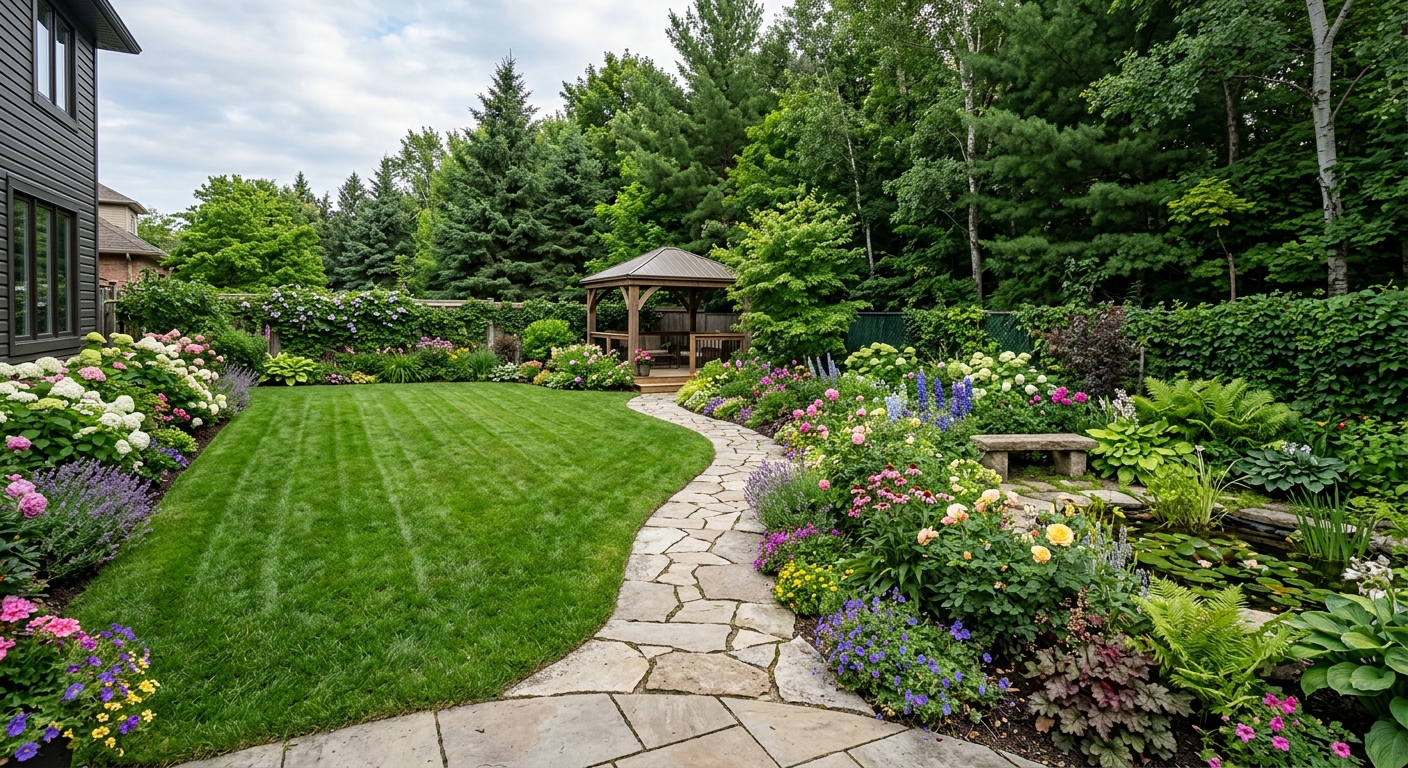
Landscaping options and costs in Castlegar
Castlegar homeowners have plenty to choose from when upgrading curb appeal, but the right option depends on how your yard drains, how much winter heaving risk you have on slopes, and how quickly you want results. With Castlegar having 8,338 residents and about 76.1% of households owning their homes (Statistics Canada, 2021 Census), many property owners plan landscapes that last—especially where older housing stock (64.5% built before 1981) often comes with settled grades, mature trees, and original drainage patterns.
In the Kootenay, landscaping costs are shaped by freeze–thaw cycles and shortened frost-defined working windows. Crews typically plan installs from mid-April through October, but last spring frost and first fall frost can narrow planting days and affect how quickly subgrades can be excavated and compacted. That’s why hardscape (patios, walkways, and retaining walls) often costs relatively more per square foot than softer, quick-turn work: retaining-wall bases and drainage layers need extra excavation and proper compacted aggregate to prevent movement. At the same time, lawn improvements can be cost-effective if you’re seeding or using targeted sod only where you want instant trafficability.
Work is especially in demand in areas like the Kootenay Landing / downtown edge where many homes have front-yard visibility and sloped sites that need drainage improvements. If you’re comparing approaches, use the cost ranges below as a starting point for conversations and budget planning.
| Service |
Description |
Season |
Price Range |
| Full landscape design and installation |
Site visit, concept + layout, plant palette, grading plan, and full build (softscape + hardscape as scoped) |
Spring–Fall (mid-April through October) |
$8,000–$60,000 |
| Sod installation (supply, grade, lay, roll) |
Small-area or full-lawn sod install with prep/grade, rolling, and starter fertilizer |
Late spring to early summer; avoid heat stress |
$6–$14 |
| Lawn seeding (grade, seed, starter fertilizer) |
Final grading, seed blend, starter fertilizer, light covering/rolling as needed |
Spring or early fall for best germination |
$3–$7 |
| Interlocking patio or walkway |
Excavation, base + compacted aggregate, sand setting bed, pavers, edge restraints, and final leveling |
Late spring through September (weather dependent) |
$120–$400 |
| Retaining wall (interlocking block) |
Excavation to proper base depth, compacted backfill, drainage/gravel layer, block installation, and steps if required |
Spring–Fall |
$120–$400 |
| Tree and shrub planting |
Planting holes, soil amendments, staking as needed, mulching, and watered establishment plan |
Spring and early fall |
$500–$15,000 |
Prices are estimates only and vary by project scope, site access and material selection.
What affects the price of landscaping in Castlegar
In Castlegar and across British Columbia, you can see the same “simple” landscaping scope come in 30–50% apart between quotes. That gap usually isn’t because contractors are trying to upsell—it’s because local conditions translate directly into labour hours, excavation depth, drainage complexity, and plant sourcing. Hardiness zone realities also matter: Kootenay landscapes sit roughly in Zone 5–6, so what survives winter and how we plan planting around frost dates drives both plant selection and the viable working season. A job scheduled in a valley with colder pockets may need extra protection, while a higher, rockier bench can require more excavation and hauling.
For comparison: prairie regions (Zone 2–4) often face short growing seasons and wind exposure, so designs lean drought- and wind-hardy options and tough topdressing strategies; retaining-wall base depth there still must go below the frost line, but frost management is more about exposure. Coastal BC (Zone 7–8) has a longer growing season and lush palettes, yet it often demands careful drainage detailing due to heavier winter wet conditions. In the dry BC interior—and many parts of Alberta—water restrictions and higher evapotranspiration shift irrigation design toward drip, zoned controllers, mulch, and lawn alternatives instead of large high-input turf. Southern Ontario (Zone 5–6) is more forgiving for growth, but summer dry spells still require irrigation planning.
Concrete examples that commonly raise cost in Castlegar include: (1) lots with slope and soft, uneven soils that require more grading and imported topsoil, (2) freeze–thaw “pump” risk around foundations that calls for deeper drainage beds and properly compacted base material for patios and walls, and (3) higher-volume plant sourcing when you want mature trees or specific cultivars. If your plan is closer to a full install (often aligned with the $8,000–$60,000 band), you’ll typically pay for layout, sequencing, and longer material lead times—while targeted improvements like tree planting can still sit within a $500–$15,000 range depending on size and count.
| Price Factor |
Why It Matters |
Cost Impact |
| Yard size in sq ft — the primary cost driver for softscape |
More area means more soil prep, seed/sod, mulch, and labour time per day |
Often the biggest swing; larger yards can move you from a mid-range to full-install budget |
| Grading and drainage work — slope corrections add significant cost |
Regrading to move water away from foundations needs excavation, compaction, and sometimes new elevation control |
Can add a major portion of the total for sloped lots and older settling yards |
| Drainage bed or French drain installation |
Interior drainage solutions require proper fall, gravel, and outlet decisions |
Frequently a noticeable add-on to hardscape projects to prevent future pooling |
| Plant material tier — native shrubs vs. ornamental vs. mature specimen trees |
Mature stock costs more to source and plant; it also affects staking, hole size, and labour |
Can multiply planting budgets even when quantities are the same |
| Hardscape vs. softscape ratio — walls and patios cost more per sq ft than lawn |
Pavers and block require base preparation, material handling, and stricter tolerances |
Shifts the project toward the higher end of the landscape install bands |
| Irrigation system design and installation |
Drip and zoned controllers cost more upfront but prevent water waste and improve establishment |
Often a meaningful line item; can be worth it for lawns, new plantings, or drought-limited plans |
| Soil amendment and topsoil required |
Compacted or rocky soils need amendments for root health and to support plant establishment |
Increases hauling and labour; essential for reliable results on older sites |
| Tree removal or stump grinding before new planting |
Removal adds excavation, debris handling, and sometimes access challenges |
Can turn a simple planting into a multi-day project depending on size and access |
Permits & regulations in British Columbia
In British Columbia, most landscaping activities—planting, sodding, and typical softscape work like mulching and seeding—generally do not require a permit. The work that often does trigger permitting is retaining wall construction above the local height threshold, which is commonly around 1.0 m (3.3 ft) in many municipalities. Some cases require engineered drawings, especially where walls retain more load or sit near property lines or structures.
Also watch for approval triggers tied to lot grading: if your proposed changes affect drainage so that water is directed toward a neighbour’s property or alters how storm water connects to services, approvals may be needed. Because landscaping involves digging, utility locates are a must: call before you dig for planting holes, trenching for drainage, or installing wall footings so utilities aren’t damaged.
To verify a Castlegar contractor’s credentials in British Columbia, start with three checks in this order. First, confirm their business licensing/registration and trade eligibility through provincial and business registries (where applicable) and any publicly listed company profile details. Second, request a current certificate of liability insurance; the COI should match the business name and include coverage adequate for excavation and hardscape work. Third, confirm workers’ compensation coverage (WSIB/WCB) for the crew—ask for their account coverage or clearance documentation. If the contractor can’t provide clear, current documentation before start date, treat it as a red flag and request it before signing.
Planning a landscape that thrives in Castlegar's climate
Planning for Castlegar means designing with hardiness (roughly Zone 5–6) and with frost-defined timing, not fighting it. Start with plant selection: favour zone-appropriate, native-leaning species and shrubs that handle cold winters and occasional late spring frosts without constant replanting. This typically reduces watering demand once established and limits winter dieback. If you’re aiming for lower maintenance, choose plants that grow to fill space—groundcovers and dense perennials help suppress weeds and reduce mulch depth loss over time.
Next, decide on sod versus seed based on your goal. Sod gives instant visual results and faster “curb-ready” results, but it’s typically about 3–4x more per square foot than seeding because you’re paying for mature turf and handling/installation logistics. Seeding takes longer to thicken, yet it can be a better fit for budget-conscious areas where you can protect germination. For example, if you budget roughly $6–$14 per sq ft for sod installation versus seeding in the lower band, you can justify sod only for high-traffic front areas while seeding a broader side yard to stay within a $8,000–$60,000 whole-project budget.
Drainage and grading are critical in the Kootenay because pooling and foundation moisture can show up after thaw cycles. Build patios and retaining walls on a properly compacted base. In practical terms, that means excavation and drainage layers designed to manage freeze–thaw forces and water movement. For low-maintenance, use mulch strategically, install a drip or zoned system where you need it, and consider a rain garden or drought-tolerant planting islands to capture and use water efficiently instead of letting it run off.
| Element |
Climate Consideration |
Maintenance Level |
Price Band |
| Sod lawn installation |
Needs careful timing around last frost and moisture management during establishment |
Medium (watering during establishment, then mow) |
$6–$14 |
| Native perennial garden |
Better winter resilience and fewer failures after freeze–thaw when planted in the right soil |
Low (mulch refresh and seasonal tidy-ups) |
$500–$15,000 |
| Mulched shrub border |
Mulch helps moderate soil temperature swings and reduces evaporation |
Low to medium (weed control and watering in year one) |
$500–$15,000 |
| Interlocking stone patio |
Base prep and drainage must withstand winter freeze cycles without settling or rocking |
Low (occasional joint sand top-up) |
$120–$400 |
| Retaining wall (block) |
Requires proper base depth and drainage backfill to prevent heave and movement |
Low (inspection for drainage performance) |
$120–$400 |
| Drip irrigation system |
Improves water efficiency during shoulder-season and drier spells; reduces waste during restrictions |
Low to medium (seasonal checks and winterisation) |
$8,000–$60,000 |
How to choose a landscaping contractor in Castlegar
Choosing a contractor in Castlegar is mostly about verifying they can legally and safely deliver the scope—especially where excavation, drainage, and hardscape foundations are involved. Start with British Columbia licensing/business registration details and request proof of liability insurance. The certificate of insurance should clearly name the contractor’s business and show coverage that fits excavation and heavy material handling. Next, confirm workers’ compensation coverage (WSIB/WCB for the contractor’s workers). Ask for a clearance letter or account proof, and don’t accept “we’re covered” without documentation.
Then get 2–3 itemised written quotes. Good quotes separate labour and materials, and they list quantities (sq ft of pavers, linear feet of drain, number/size of trees). Avoid “lump sum only” proposals without clear exclusions. Read the scope carefully: is site grading included, is disposal/hauling included, will the contractor pull permits if retaining walls or drainage work triggers approvals, and what exactly happens if weather limits installation during the short frost-defined window?
Warranty matters too. Ask for a workmanship warranty length for installation, and whether the product warranties (plants, paving materials, block systems) transfer to you if you sell the property. For payment, never pay more than 10–15% upfront; use milestones and hold back a portion until completion and cleanup are verified. Get a written timeline with the start date and a realistic completion estimate, since Kootenay weather can delay paving base work and planting.
- Provide B.C.-relevant business/licensing details and insurance before contract signing.
- Show workers’ compensation (WSIB/WCB) proof for the crews doing excavation.
- Use a site visit and measurements; don’t quote based only on photos.
- Quote itemised labour + materials (no “mystery allowances”).
- List exclusions clearly (tree removal, stump grinding, disposal, geotextile, topsoil hauling).
- Confirm permit responsibility if retaining walls exceed the typical height threshold.
- Specify drainage plan elements (French drain, outlet direction, pipe size, gravel depth).
- Confirm base construction standards for patios/walkways (excavation depth and compaction).
- Ask about plant sizes, varieties, and warranty/replace policy for plant material failures.
- Request a start date and phased timeline that respects frost and rainy periods.
- Agree on payment milestones (≤10–15% upfront) and a final holdback until sign-off.
- Get everything in writing: scope, warranty, schedule, and cleanup responsibilities.
Common red flags in Castlegar include: contractors refusing to provide an insurance certificate or workers’ compensation proof; quotes that don’t detail grading/drainage assumptions; vague “materials allowance” language with no breakdown; promising installs during narrow frost windows without a weather contingency; and pressuring you for large upfront payments. If you see these, slow down and request clarification or compare against another written bid.
Frequently asked questions — landscaping in Castlegar
How do I improve drainage in my yard?
Improving drainage in Castlegar usually starts with figuring out where water actually goes during thaw and rain—then fixing the path, not just adding surface gravel. For freeze–thaw yards, we commonly recommend correcting grade so runoff moves away from foundations, adding a drainage bed or French drain where water collects, and building a proper base under patios so water doesn’t undermine pavers. If your home is older (many Castlegar homes were built before 1981), you may be dealing with settled grades that redirect water over time. Pricing depends on excavation and outlet complexity, but drainage work often influences whether a job stays closer to the lower end of a $8,000–$60,000 landscape install or pushes toward mid-to-upper project budgets.
What is xeriscaping and does it suit Castlegar?
Xeriscaping is designing with water efficiency in mind—using drought-tolerant plants, smart irrigation (often drip), mulch, and reduced turf where appropriate. In Castlegar and the Kootenay, it can suit many properties, especially on the drier interior side or where lawns struggle after summer heat and evapotranspiration. That said, Kootenay yards still need winter-hardy plants and protection for establishment through frost-defined seasons, so “no water” isn’t the goal—efficient water is. A practical approach is to keep smaller, high-use lawn zones (or use seeding/sod selectively) and build shrub and perennial areas with mulch and a targeted drip system. If you’re budgeting, xeriscaping typically reduces ongoing watering costs while initial design and installation can still fall within the broader $8,000–$60,000 landscape band.
How do I plan a low-maintenance yard?
A low-maintenance yard in British Columbia is usually a balance of plant selection, soil prep, and reduced “fragile” areas. In Castlegar, prioritize zone-appropriate and hardy perennials and shrubs, add 2–4 inches of mulch to suppress weeds and moderate soil temperature swings, and group plants by sun and moisture needs so you’re not constantly adjusting watering. For lawns, many homeowners choose seeding for wider areas and reserve sod for entryways or spots that must look finished quickly. Drainage and grading also reduce maintenance: pooling creates weed pressure and plant stress, and winter heaving can lead to repeated fixes. When done well, a low-maintenance plan often costs more at the outset (design + base work), but it can prevent future rework that can otherwise eat into your landscape budget.
How deep should a retaining-wall base be for local frost?
For a retaining wall in Castlegar, the base depth must be designed to sit below frost-affected soils and be supported by properly compacted material. There isn’t one universal number that fits every lot because frost penetration varies with soil type, moisture, and exposure, and the wall design depends on height, loads, and drainage details. What matters most is that the contractor excavates to the required depth, builds a compacted base, and includes drainage backfill (and often a gravel/grain layer behind the wall) so water doesn’t build up and freeze. Even with interlocking block, the foundation and drainage layers are where costs increase—often aligning with the $120–$400 band for retaining-wall and related hardscape elements.
How much does professional landscape design cost?
In Castlegar, professional landscape design and installation budgets can range widely based on how much of the yard is included and whether the contractor also supplies plants and builds hardscape. For many homeowners comparing options, the “full landscape design and installation” band sits around $8,000–$60,000. If you’re only refining a planting plan or addressing a small area, pricing can be lower, but the moment you include grading, drainage, and significant hardscape, you’re usually in that broader range. A helpful tip is to ask for an itemised quote that distinguishes design work from construction: you want clarity on what’s included (site measurements, plant palette, drainage plan) so you’re comparing like-for-like, not competing “styles” of estimating.
How do I compare landscaping quotes?
To compare quotes in Castlegar or anywhere in British Columbia, start by putting them side-by-side using the scope details—not just the totals. Ask each contractor to itemise labour and materials (sq ft of paving, linear feet of drain, topsoil quantity, plant sizes/counts) and to list exclusions like disposal/hauling, stump grinding, and any permit pull responsibilities. Confirm they include drainage and base prep where required for patios and retaining walls, because skipping those pieces often leads to settlement or heaving later. Also compare warranty terms (workmanship duration and plant replacement policy). If one quote is far cheaper, look for what they left out—especially when you’re comparing work that could fall near the lower end versus mid-to-upper in a $8,000–$60,000 project band.