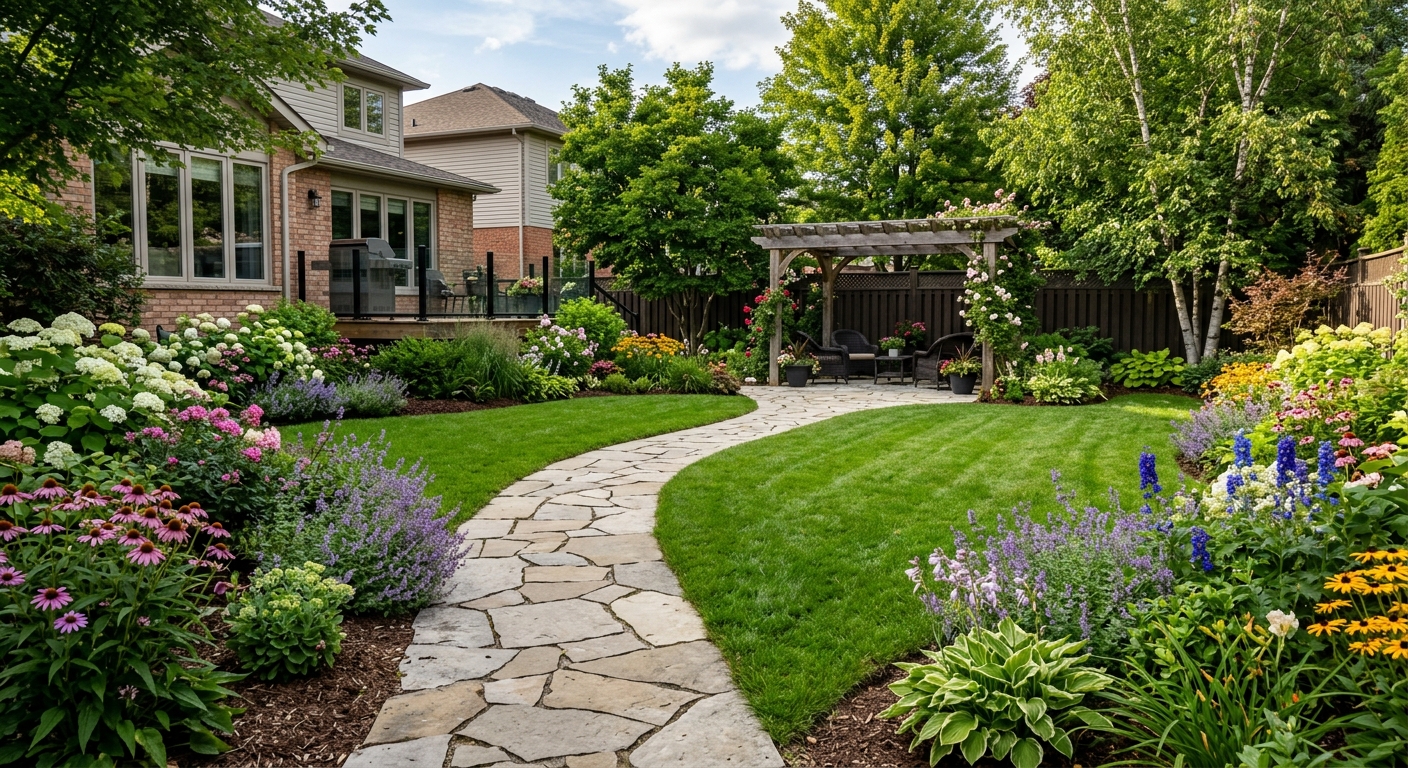
Landscaping options and costs in Grindrod
Grindrod, British Columbia is a small community (population 1,526 per the Statistics Canada, 2021 Census), and that scale shows up in how landscaping is planned: homeowners often have the motivation and yard space to upgrade front entrances, side yards, and drainage edges rather than “just patch” grass. In practice, one well-kept property can set the tone for the street, which is why full design-and-install projects (not only installs) are especially in demand. The Lower Mainland–Southwest market also benefits from steady contractor availability and a long working and growing season, so labour scheduling is usually smoother than in Prairie cities.
Because this region sits mostly in hardiness zones 7–8, you can use a broader palette—evergreens, long-blooming perennials, and layered shrubs—with less winter loss than you’d see in colder zones. That said, costs still move with site conditions: wet winters and freeze–thaw cycles mean patios, retaining walls, and drainage work must be built with deeper bases, proper compaction, and diversion of runoff to prevent foundation moisture and frost heave. In areas of Grindrod like the Shuswap Lake / Skeena Park side where lots tend to be sloped or naturally wet in spring, drainage corrections and grading are frequently the difference between a “pretty” install and a yard that stays tidy for years.
Below is a practical cost comparison for the most common landscape upgrades in Grindrod—use it to translate bids into like-for-like scope.
| Service |
Description |
Season |
Price Range |
| Full landscape design and installation |
Site check, grading plan, planting layout, hardscape/softscape build-out, cleanup |
Spring–Fall (often paused only during wettest weeks) |
$8,000–$45,000 |
| Sod installation (supply, grade, lay, roll) |
Topsoil/grade correction where needed, sod supply, lay/roll, first watering plan |
Best: late spring to early fall |
$2,500–$7,500 |
| Lawn seeding (grade, seed, starter fertilizer) |
Light grade, seed mix, starter fertiliser, straw/cover if required |
Spring and early fall |
$2,000–$5,500 |
| Interlocking patio or walkway |
Excavate, base/gravel, compaction, interlock pavers, edging, slope control |
Spring–Fall (base work protected from prolonged wet) |
$7,000–$35,000 |
| Retaining wall (interlocking block) |
Excavate/footings, interlocking block system, drainage layer, cap/finishing |
Spring–Fall |
$10,000–$60,000 |
| Tree and shrub planting |
Soil improvement, mulch, staking if needed, planting and initial care notes |
Spring–Fall |
$1,500–$12,500 |
Prices are estimates only and vary by project scope, site access and material selection.
What affects the price of landscaping in Grindrod
In Grindrod and across the Lower Mainland–Southwest region, two bids for “the same” landscaping can differ by 30–50% once you account for scope depth, drainage risk, and material tier. Even though Lower Mainland–Southwest has zones 7–8 (so plants establish well), crews still price for how many hours it takes to prep the site properly and how likely the job is to face weather delays. That variation is why you’ll see bigger swings than in many older small-town markets—contractors are balancing demand across a long season, and that influences labour availability and scheduling costs.
Zone and frost dates change what can be planted and what can be built. In zones 7–8, the growing season is long, but structural elements still must handle freeze–thaw cycles: bases for walls and patios are dug deeper and drainage is designed to keep soil from saturating and swelling. In the Prairies (zone 2–4), short frost-free windows and harsher winters force drought-tolerant, wind-hardy planting and tighter construction windows, while retaining wall base depth is planned to go below the frost line. Coastal BC’s longer season allows lush, layered planting palettes, but the trade-off is that heavy rainfall can make drainage corrections the cost driver. If you compare to the drier BC Interior, irrigation design changes (and water-use expectations) can materially affect project cost; southern Ontario tends to push irrigation spending during summer dry spells even with milder winters.
In Grindrod specifically, two common cost movers are (1) grading to correct standing water near foundations and (2) soil amendment where the existing ground is compacted. For example, a simple sod refresh might land in the $2,500–$7,500 band for typical lots, while adding a drainage bed and regrading before laying sod can push the project into a higher “full service” range due to excavation and extra base materials. Older housing stock with mature trees can also require stump removal and replacement planting—sometimes adding thousands before you even install new plants.
| Price Factor |
Why It Matters |
Cost Impact |
| Yard size in sq ft — the primary cost driver for softscape |
More area means more topsoil, labour hours, and either sod rolls or seed coverage |
$1,000–$20,000+ |
| Grading and drainage work — slope corrections add significant cost |
Proper pitch prevents pooling and foundation moisture, especially in wet seasons |
$1,500–$15,000 |
| Drainage bed or French drain installation |
Controls subsurface water and reduces frost-related heave risks for hardscape |
$2,000–$12,000 |
| Plant material tier — native shrubs vs. ornamental vs. mature specimen trees |
Mature stock costs more and may require larger planting pits, hauling, and staking |
$500–$12,000 |
| Hardscape vs. softscape ratio — walls and patios cost more per sq ft than lawn |
Interlock, base materials, and subgrade prep increase labour and equipment time |
$3,000–$30,000 |
| Irrigation system design and installation |
Efficient drip and smart controls reduce waste and help manage watering during restrictions |
$1,500–$10,000 |
| Soil amendment and topsoil required |
Improves rooting for shrubs and turf; required when existing soil is compacted or thin |
$700–$6,000 |
| Tree removal or stump grinding before new planting |
Clearing affects prep time, disposal, and the ability to grade and install borders |
$800–$7,500 |
Permits & regulations in British Columbia
In British Columbia, most straightforward yard work—planting, sodding, and the majority of softscape installations—typically does not require a permit. That means laying sod, seeding, adding shrub borders, and planting trees are generally handled under standard contractor practices and property owner consent. However, retaining walls are where homeowners should slow down: retaining walls above a height threshold (commonly around 1.0 m (3.3 ft) in many municipalities) usually require a building permit and sometimes engineered drawings, especially where site conditions and loading become more significant.
Also watch for approval triggers related to grading. If you’re changing lot grading in a way that redirects drainage toward neighbouring properties or ties into storm connections, you may need approval before construction. Before any digging—plant holes, trenching for drainage, or wall footings—ensure utility locates are done so you don’t hit buried services.
To verify contractor eligibility in Grindrod/BC, do it in this order:
- Licence/credentials: check the appropriate BC online registry listing for the contractor’s business status and any applicable professional coverage for the scope.
- Liability insurance: request a current Certificate of Insurance showing general liability limits and the business name matching the quote.
- Workers’ coverage (WSIB/WCB): ask for proof of coverage or a clearance letter where applicable; confirm the coverage is current.
- Permit responsibility: confirm who pulls permits (if required) and whether that cost is included in the quote.
- Written scope: ensure excavation, disposal, and drainage provisions are clearly described.
Planning a landscape that thrives in Grindrod's climate
Planning in Grindrod works best when you treat the yard as a system: plants, soil, drainage, and hardscape all have to cooperate with the area’s hardiness zone (mostly 7–8) and the wet/cool seasonal rhythm. Start with plant selection. Use zone-appropriate and preferably native species that handle cool seasons and don’t need constant winter protection. For lawns, decide based on timeline and tolerance for establishment time: sod gives instant coverage and is ideal when you want the yard usable quickly, while seeding is often a better choice if you can accept gradual thickening.
Drainage and grading are critical in Lower Mainland–Southwest because pooling can cause foundation moisture and can also reduce how stable paver bases remain during wet weeks. When you build patios and interlocking paths, base prep has to account for the freeze–thaw cycle—this is why contractors often dig deeper and compact more thoroughly than homeowners expect. Low-maintenance design strategies—mulch layers, groundcovers, and perennials planted in repeat “drifts”—reduce annual upkeep while keeping curb appeal high.
If you want to reduce water demand, consider xeriscape elements or rain-garden features: use porous surfaces where possible, add amended soil and select drought-tolerant plants for sunny edges, and capture roof runoff into a designed planting basin. For budget realism, here’s a common decision point: seeding typically sits in the $2,000–$5,500 band, while sod often lands in the $2,500–$7,500 band depending on prep and lot size. If you’re restoring a small front lawn for curb appeal before selling or hosting, the added cost of sod is usually justified. If you’re okay with a slower transition, seeding can be the smart value.
| Element |
Climate Consideration |
Maintenance Level |
Price Band |
| Sod lawn installation |
Best when soil is thawed and moisture levels are manageable; drainage prep prevents washouts |
Low (initial watering during establishment, then routine mowing) |
$2,500–$7,500 |
| Native perennial garden |
Zones 7–8 support longer blooming seasons; mulch helps moderate wet/cool winters |
Medium (seasonal weeding and cutback) |
$1,500–$6,500 |
| Mulched shrub border |
Helps manage surface moisture and reduces winter soil splash near foundations |
Low (refresh mulch and prune) |
$1,200–$5,000 |
| Interlocking stone patio |
Needs proper base depth and slope for freeze–thaw and wet-season run-off |
Low (occasional joint sand top-up) |
$7,000–$35,000 |
| Retaining wall (block) |
Requires drainage layer behind wall to manage water and reduce movement |
Low (periodic inspection of weep holes/cap) |
$10,000–$60,000 |
| Drip irrigation system |
Efficient watering supports plant health during any water-cost restrictions |
Medium (seasonal checks, controller updates) |
$1,500–$10,000 |
How to choose a landscaping contractor in Grindrod
Choosing a contractor in Grindrod, BC comes down to verification, clarity, and workmanship confidence. Start with coverage: ask for current general liability insurance and confirm the Certificate of Insurance matches the company on the quote. Next, request proof of WSIB/WCB coverage (or a clearance letter where applicable). If they can’t provide documentation, treat it as a serious risk—landscaping involves excavation, machinery, and working near utilities.
Then get 2–3 itemised written quotes so you can compare like-for-like. A good quote breaks labour and materials out separately (excavation, base, pavers/sod, soil amendments, drainage components, plant lists), states what’s included in equipment and disposal, and clarifies whether any permits are required and who applies for them. Avoid vague language like “preparing area” without explaining grading, compaction, and drainage measures.
Warranty matters. Ask for the workmanship warranty length, whether it’s tied to a season, and whether the warranty is transferable if you sell the home. Also confirm that plant materials have manufacturer guarantees where applicable.
Finally, payment schedule: never agree to pay more than about 10–15% upfront. Hold back a portion until the work is complete, cleaned, and established (for turf/planting, define what “complete” means).
- Request proof of general liability insurance (current COI).
- Request WSIB/WCB proof or clearance letter (current).
- Ask who pulls any retaining wall permits (if height triggers it).
- Confirm utility locates are included before digging.
- Get itemised quotes for labour vs materials (not a single lump sum).
- Ask for the plant list with common + botanical names and sizes.
- Confirm excavation depth and drainage details for patios/walls.
- Clarify disposal: is spoil hauled away or dumped on-site?
- Ask for site access notes (finish elevations, gates, path width).
- Get a written start date and completion estimate.
- Confirm cleanup and final grading/top dressing expectations.
- Review workmanship warranty terms in writing.
Red flags to watch for: (1) quoted “retaining wall” work without mentioning a drainage layer or base/footing depth, (2) no written scope for grading/drainage even when the yard is wet, (3) missing insurance or unwillingness to provide WSIB/WCB proof, (4) only accepting large deposits up front, and (5) inability to provide itemised materials/plant sizes (so comparisons become impossible).
Frequently asked questions — landscaping in Grindrod
Sod vs seed — which is better for a Grindrod lawn?
In Grindrod and surrounding British Columbia communities, sod is often the better choice when you want quick curb appeal and a yard that’s usable right away. Because this region experiences cool, wet winters and a longer planting season, grass can establish well—but sod still requires proper grading and drainage prep to prevent pooling at the edges. Seeding can be the better value when you can wait for germination and thickening, and when the soil is workable for good seed-to-soil contact. If you’re comparing budgets, sod typically sits around $2,500–$7,500 for common installs, while seeding often lands in the $2,000–$5,500 band. Choose seed if you want lower upfront cost; choose sod if you’re restoring a front lawn for sale/events or want instant coverage.
How much does a retaining wall cost in Grindrod?
Retaining wall pricing in Grindrod depends mainly on height, length, and how complex the drainage and base work must be. In the Lower Mainland–Southwest market, retaining walls usually require deeper excavation, proper compaction, and a drainage layer behind the wall to handle the wet-season runoff that can soften soils. Interlocking block walls are common, but the labour and equipment time increase quickly with site slope and access. A typical interlocking block retaining wall often falls in the $10,000–$60,000 range. If the wall triggers permit requirements (commonly around a 1.0 m height threshold in many municipalities), include permit/administration time and potential engineering requirements in your planning. If your yard is already wet or sloped toward the house, expect the drainage scope to be a major cost driver.
When is the best time to landscape in Grindrod?
For most landscaping in Grindrod, spring through fall is the practical window because Lower Mainland–Southwest weather supports steady planting and turf establishment. While last spring frost near the coast is often early March to early April, contractors commonly schedule by soil readiness—if the site is still saturated, base work and grading can get delayed. Early fall is also a strong time for planting and seeding because cooler temperatures reduce stress on new plants. That said, very wet weeks can slow excavation and compaction, especially for patios and retaining walls where base preparation needs firm, workable soil. If you’re planning sod or seeding, align with periods when watering and maintenance are manageable. For structural projects, build schedules around freeze–thaw risk and ensure proper drainage so the ground doesn’t hold water during winter transitions.
Do I need a permit for a retaining wall in British Columbia?
Often, yes—depending on the wall height and the local municipal requirements. In British Columbia, planting and most softscape typically do not require permits, but retaining walls above a threshold (frequently around 1.0 m (3.3 ft) in many municipalities) commonly require a building permit, and sometimes engineered drawings. Grading changes can also trigger approvals, especially if drainage patterns toward neighbours or storm connections are affected. The safest approach is to ask your contractor to confirm the height and scope and to specify in writing who is responsible for permit pulling. If you’re planning excavation for footings, make sure utility locates are completed before digging. Verifying this upfront prevents delays when inspections are required.
How do I improve drainage in my yard?
Drainage improvements start with understanding where water goes and why it pools—often it’s a combination of slope, compacted soil, and how hardscape edges meet the ground. In Grindrod, the Lower Mainland–Southwest wet-season pattern means standing water around foundations can show up quickly if grading isn’t corrected. Common solutions include regrading the yard to direct water away from the house, adding a drainage bed or French drain, and ensuring downspout runoff is managed so it doesn’t dump into low spots. For patios and retaining walls, proper base preparation and drainage layers are critical to reduce freeze–thaw movement. A contractor should propose a clear plan (sometimes including profiles/pitch targets), and include details on soil amendment, geotextile separation, and discharge location. If you’re getting multiple quotes, compare drainage scope line-by-line—not just the final surface finish.
What is xeriscaping and does it suit Grindrod?
Xeriscaping is a landscaping approach that reduces water demand by using drought-tolerant plants, efficient irrigation (often drip), and design choices that improve moisture retention where needed while limiting overwatering. In Grindrod, it can absolutely suit parts of a yard—particularly sunny slopes, roadside edges, and areas where you want fewer mowing cycles. That said, Grindrod is not the dry BC Interior, so you don’t have to go “desert-only.” A balanced approach works well in Lower Mainland–Southwest: pair zone-appropriate natives and perennials with mulch layers, groundcovers, and rain-garden or bioswale concepts to handle wet-season rainfall and capture roof runoff. If you’re adding a drip irrigation system, it often changes the upfront investment, commonly falling in the $1,500–$10,000 band depending on coverage and controller setup. The result is a yard that looks good through seasons with less ongoing fuss.