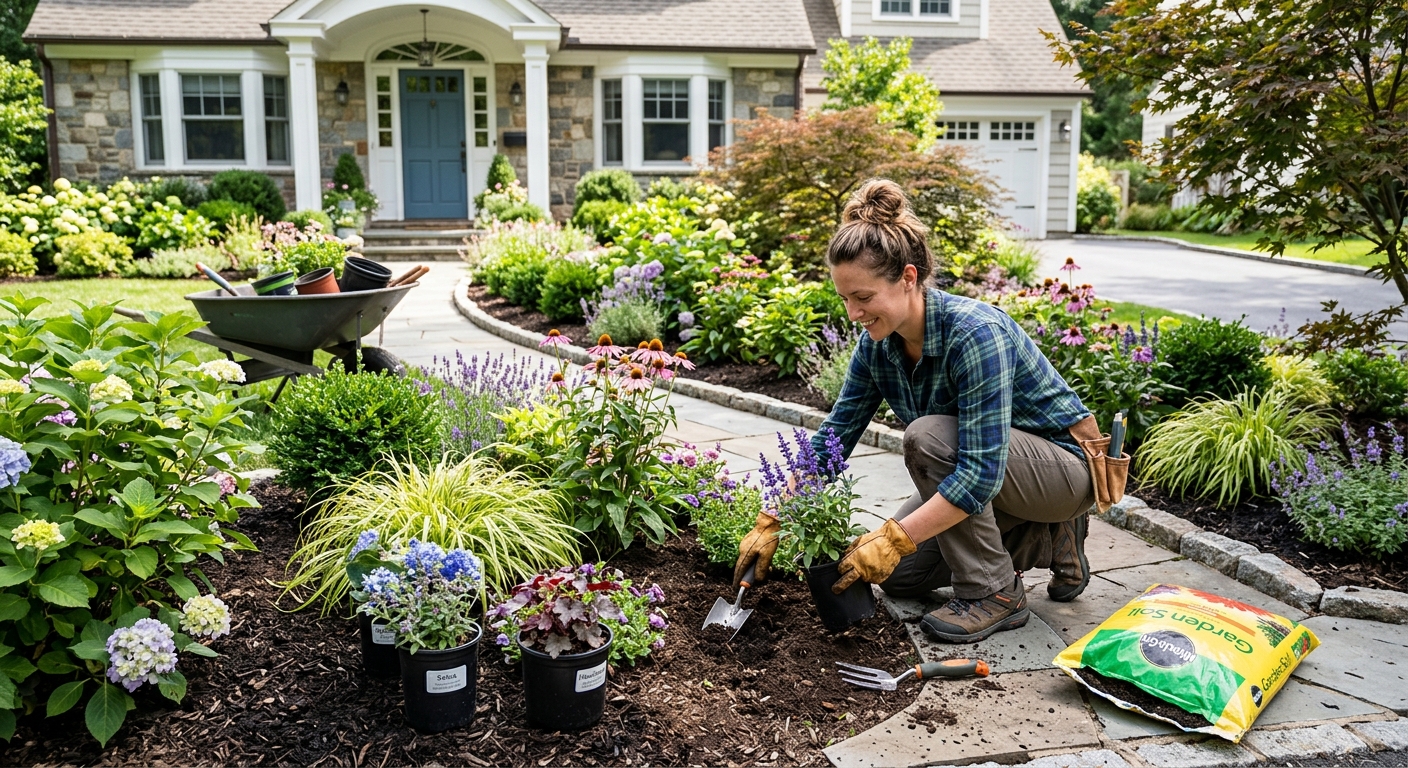
Landscaping options and costs in McLennan
Landscaping in McLennan is shaped by one big advantage: the Lower Mainland–Southwest climate that contractors commonly work in supports a long growing season, with mild, wet winters and a frost pattern that typically lets you plan and install both softscape and many hardscape elements for much of the year. That said, McLennan’s housing makeup matters—most owners have the motivation and yard space to improve curb appeal, and with a population of 1,476 (Statistics Canada, 2021 Census), you’ll often notice contractors travelling in for work, which can affect availability and scheduling. In practice, the smaller local market means a designer’s “option set” may be narrower (fewer crews available immediately), so earlier booking can reduce price pressure.
Typical Lower Mainland–Southwest pricing also reflects zone 7–8 planting palettes: broadleaf evergreens, long-blooming perennials, and layered planting beds are achievable with lower winter-damage risk than colder provinces. Meanwhile, structural work still must account for freeze–thaw and drainage performance—especially if you’re on a sloped or clay-leaning lot where pooling near foundations can become an ongoing cost if grading is missed. If you’re near the core residential areas around McLennan’s main neighbourhood blocks, upgrades like patios, walkways, and front-bed planting tend to be in demand because they visually “finish” a yard quickly while improving first impressions.
Below are realistic cost ranges you can compare across quotes, then we’ll break down why your final number can swing.
| Service |
Description |
Season |
Price Range |
| Full landscape design and installation |
Site visit, concept + layout, planting plan, grading notes, hardscape/softscape build coordination, labour and materials |
Spring–Fall (with some winter planning) |
$8,500–$32,000 |
| Sod installation (supply, grade, lay, roll) |
Soil prep, base grade, weed control, sod delivery and installation, rolling and start-up |
Late Spring–Summer |
$3,000–$7,500 |
| Lawn seeding (grade, seed, starter fertilizer) |
Light regrade, seed + starter fertilizer, rake-in, rolling, and establishment plan |
Spring–Early Fall |
$1,800–$5,200 |
| Interlocking patio or walkway |
Excavation, compacted base, geotextile, paver setting, edge restraints, jointing sand |
Spring–Fall |
$9,500–$28,000 |
| Retaining wall (interlocking block) |
Footing/gravel base, drainage, interlocking block, cap/finishing, minor landscape restoration |
Spring–Fall |
$15,000–$55,000 |
| Tree and shrub planting |
Soil amendments, planting, staking (as needed), mulching, watering-in, basic bed edging |
Spring–Fall (most forgiving window) |
$1,600–$12,000 |
Prices are estimates only and vary by project scope, site access and material selection.
What affects the price of landscaping in McLennan
In McLennan and across the Lower Mainland–Southwest, you can see the same “looking” job land 30–50% apart between quotes. The reason is usually not the labour crew—it’s the hidden scope: how much excavation and grading is truly required, what drainage is designed (or ignored), what plant sizes are included, and whether a contractor prices for proper base preparation and long-term maintenance. Because zone 7–8 supports lush growth, many homeowners want richer planting palettes and more layered beds, which raises material and labour, but it also reduces failure risk when the design is done correctly.
Zone and frost dates influence both what grows and how long crews can work. Coastal BC’s longer growing window lets contractors install and establish more plants, so planting labour is more available and schedules are less compressed than in Prairie zones (2–4), where short frost-free windows and harsher freezes often force drought-tolerant, wind-hardy choices. In McLennan-style lower coastal conditions, good drainage is the difference between “installed once” and “rebuilt later,” especially because water can sit in low spots during wet winters. That’s why a small grading correction can be a cost-saver compared with redoing turf. Also, irrigation design can swing price: efficient drip and smart controllers cost more upfront but reduce ongoing watering demands.
Two concrete examples from McLennan: first, a lawn job can look similar on paper, but sod installation typically costs roughly 3–4x what seeding costs for comparable coverage, so a smaller sod patch at the front walk is often a smarter budget than converting the whole yard—especially when the price difference between seeding (often $1,800–$5,200) and sod (often $3,000–$7,500) is quickly felt in material volume. Second, retaining walls often start with a paver-wall budget, but if site access forces crane/mini-excavator time and if proper base depth and drainage are required for freeze–thaw, the project can shift toward the higher retaining-wall bands (often $15,000–$55,000). If your yard has older fill or a long-neglected drainage path, expect more soil amendment and compaction work, which adds cost but prevents future settlement.
| Price Factor |
Why It Matters |
Cost Impact |
| Yard size in sq ft — the primary cost driver for softscape |
More square footage means more excavation, topsoil, seed/sod, mulch, and labour time. |
Major (+20% to +60% depending on coverage) |
| Grading and drainage work — slope corrections add significant cost |
Lower spots and foundation-facing runoff require regrading and verification of slope. |
High (+10% to +40%) |
| Drainage bed or French drain installation |
Sub-surface systems add materials (pipe, gravel, fabric) and additional excavation. |
High (+15% to +50%) |
| Plant material tier — native shrubs vs. ornamental vs. mature specimen trees |
Mature trees and specialty cultivars cost more and require careful handling/staking. |
Medium to major (+10% to +70%) |
| Hardscape vs. softscape ratio — walls and patios cost more per sq ft than lawn |
Base prep, compaction, paver quantities, and labour-intensive setting raise cost. |
Major (+20% to +80%) |
| Irrigation system design and installation |
Drip lines, zones, backflow prevention components, and smart controllers increase scope. |
Medium (+5% to +35%) |
| Soil amendment and topsoil required |
Poor or compacted soils need engineered amendments for rooting and long-term turf health. |
Medium (+5% to +25%) |
| Tree removal or stump grinding before new planting |
Extra machinery/time plus disposal affects total labour and equipment costs. |
Medium to major (+10% to +45%) |
Permits & regulations in British Columbia
In British Columbia, most typical yard work—planting, sodding, and most softscape installation—generally does not require a permit. That means you can usually add a garden bed, lay sod, plant shrubs/trees, or install mulch without municipal paperwork. The items that more often trigger permits are the “structural” pieces and any work that changes how water moves.
Retaining walls are the most common exception. In many BC municipalities, retaining walls above a threshold—typically 1.0 m (3.3 ft)—require a building permit and sometimes engineered drawings, particularly if soil conditions or height/surcharge loads are significant. Also, changes to lot grading that redirect drainage toward neighbouring properties or storm sewer connections may need review. Before you dig, always plan for utility locates; calling to mark buried lines is critical for planting holes and wall footings.
For irrigation, confirm water-use rules and bylaw limits, especially in drier periods where restrictions can shift. Even if McLennan isn’t a daily “watering ban” environment like some dry regions, rising water costs and seasonal limits make efficient systems more valuable (drip and smart controllers).
How to verify your contractor in McLennan/BC: (1) Ask for their business licence/registration details and check the applicable online registry for active status. (2) Request a current certificate of liability insurance showing adequate coverage and confirm the expiry date. (3) Ask for proof of coverage for workers—WSIB/WCB documentation as applicable—and keep a copy in your project file. (4) Get all references and the insurance/clearance details before work starts, not after.
Planning a landscape that thrives in McLennan's climate
To make a landscape succeed in McLennan, design for the way the Lower Mainland–Southwest actually behaves: mild winters, cool summers, and frequent moisture. Start with plant selection that suits the hardiness zone 7–8 palette and tolerates periodic wet spells. Using native or proven region-appropriate plants generally reduces winter protection needs and supports better long-term health in local soils. For turf, choose sod when you need instant cover (reducing erosion and visual downtime), but compare it to seeding when budget and patience matter.
Here’s the practical decision: sod gives immediate results, yet it costs roughly 3–4x more per sq ft than seeding once you include prep and installation. For example, if you have a front lawn patch where you want “done this month,” spending toward the sod ranges (often $3,000–$7,500 for typical installations) can be justified. If the area is larger or you can tolerate 6–10 weeks of establishment, seeding (often $1,800–$5,200) usually stretches your landscaping budget much farther.
Next, build drainage and grading into the plan. In this region, pooling can create foundation moisture issues and plant stress—so slope corrections, sub-surface drainage beds, and proper base preparation matter. For hardscape like patios and retaining walls, base work needs to account for freeze–thaw cycles: compacted granular base, deeper excavation where required, and clean drainage layers help prevent frost heave and wall movement on sloped sites.
Finally, reduce maintenance without losing curb appeal: mulch ringed shrub borders, groundcovers in bed fronts, and long-blooming perennials spread out annual work. If you want a water-smart twist, consider rain-garden planting in low swales to capture runoff, paired with efficient irrigation (drip and smart controllers) to handle occasional restrictions smoothly.
| Element |
Climate Consideration |
Maintenance Level |
Price Band |
| Sod lawn installation |
Works best when soils are warm enough to root; manage drainage so it doesn’t stay soggy in wet winters. |
Low to medium (needs watering-in and weed control early) |
$3,000–$7,500 |
| Native perennial garden |
Zone 7–8 compatible species handle cool summers and benefit from steady, but not stagnant, moisture. |
Low (mulch renewal and seasonal tidy-up) |
$2,500–$10,500 |
| Mulched shrub border |
Helps stabilize soil temperature and moisture through winter wet periods and spring thaw. |
Low (occasional pruning and top-up) |
$1,600–$6,800 |
| Interlocking stone patio |
Base preparation manages freeze–thaw movement and prevents settling near foundations. |
Low (sweeping and occasional joint sand refresh) |
$9,500–$28,000 |
| Retaining wall (block) |
Requires proper footing and drainage behind the wall to avoid wall push and saturation. |
Low to medium (monitoring drainage performance) |
$15,000–$55,000 |
| Drip irrigation system |
Better control in cool, wet seasons; supports efficient watering during brief dry spells. |
Low (seasonal adjustments and checks) |
$1,200–$6,500 |
How to choose a landscaping contractor in McLennan
Choosing the right contractor in McLennan comes down to proof and process, not just a price. In British Columbia, before any work begins, verify licensing/registration for the business, then confirm liability insurance and workers’ coverage (WSIB/WCB documentation as applicable). How to check: ask for the certificate of insurance and confirm it’s current (expiry date), matches the type of work, and names the correct insured entity. For workers’ coverage, request the clearance documentation or proof of account status and keep copies with your contract.
Next, get 2–3 itemised written quotes. You want labour and materials broken out—excavation quantities, base specs (geotextile, granular base depth, compaction), plant sizes (e.g., container size), and irrigation components if included. Avoid quotes that bundle everything into a single number without detailing what’s included. Ask what’s excluded: permit pulling, disposal/haul-away, topsoil source and quality, turf establishment guidance, and whether an irrigation tie-in is part of the job.
Warranty matters. Ask for workmanship warranty length, whether it covers settlement/plant failure due to improper installation, and the manufacturer warranties for plants/irrigation parts. If a plant guarantee is offered, confirm it’s measurable (replacement policy, timeframe, and coverage conditions) and whether it’s transferable to future owners.
For payment schedule, never pay more than 10–15% upfront; use a holdback until substantial completion and walk-through corrections are done. Also, lock in a start date and an estimated completion timeline in writing, with weather contingencies for wet weeks.
- Request their insurance certificate and confirm coverage is active before the first shovel-load.
- Ask for WSIB/WCB proof (as applicable) and keep the documentation.
- Use itemised quotes with quantities (sq ft, linear ft, number of plants/trees, wall height, excavation depth).
- Confirm who pulls any required permits (retaining wall permits are the common one).
- Clarify disposal/haul-away: is it included or a separate line item?
- Require base spec details for patios/walkways and drainage layers for retaining walls.
- Make plant lists specific: genus/species and size; avoid “assorted” without quantities.
- Check irrigation scope: drip vs. sprinkler, number of zones, and controller type if smart.
- Ask who sources topsoil and what quality/compaction testing (if any) is planned.
- Confirm protection plans for existing lawns/bed areas during construction.
- Ask about cleanup standards and final grading/turf establishment instructions.
- Set a payment schedule with a holdback until punch-list items are complete.
In McLennan, red flags include: quotes that don’t list quantities or plant sizes, refusing to provide insurance/clearance documents, vague scope language like “all work as needed” without specifications, no timeline in writing, and pushing you to pay most of the cost upfront before excavation and base prep are complete.
Frequently asked questions — landscaping in McLennan
What plants thrive in McLennan's climate zone?
In McLennan (coastal Lower Mainland–Southwest conditions, typically zone 7–8), plants that handle cool summers and mild, wet winters generally perform best. You’ll usually see success with broadleaf evergreens, long-blooming perennials, and hardy shrubs that tolerate periodic moisture as long as drainage is sound. Native and proven local cultivars often need less winter protection and fewer interventions than marginal ornamentals. Common “reliable” choices include layered shrub borders (varied heights), evergreen structure near foundations, and perennials that re-bloom through the shoulder seasons. The big cost-saving is choosing the right plant for the spot: shade vs sun, wet low spots vs drier beds, and wind exposure. If drainage is corrected, planting costs can align with typical tree and shrub planting budgets (often $1,600–$12,000), rather than turning into repeated replacements.
Sod vs seed — which is better for a McLennan lawn?
Sod is better when you need instant coverage—think erosion control, a fast curb-appeal upgrade, or reducing mud during a home sale. However, sod is more expensive per sq ft once you include prep and installation. In McLennan, many homeowners compare typical ranges of $3,000–$7,500 for sod versus $1,800–$5,200 for seeding. Seeding is a strong choice for larger areas or when you can wait through establishment (usually several weeks to reach reliable density). Both can work in BC’s wet/mild season, but drainage and soil amendment are what determine success. If your yard stays soggy, sod can fail too—so always address grading and weed control first, regardless of sod or seed.
How much does a retaining wall cost in McLennan?
Retaining wall pricing in McLennan depends heavily on wall height, length, base depth requirements, and how much drainage work is included behind the wall. Because freeze–thaw and saturation are real factors on sloped or clay-leaning sites in the Lower Mainland–Southwest, proper footing and drainage aren’t optional if you want stability. For typical interlocking block projects, many homeowners land in the range of $15,000–$55,000, with higher costs when access requires more equipment time or when engineering/permitting steps are needed. Your quote should show the granular base, geotextile/drainage layers, and whether weeping tile/French drain components are included. If you only budget for block and ignore drainage, the total cost often returns later as movement repairs.
When is the best time to landscape in McLennan?
For McLennan, the best general window is spring through fall, because it supports rooting for planting and establishment for turf. Softscape installation—tree and shrub planting, mulching, and most bed work—is usually most forgiving when the ground is workable and before persistent freezes. Sod and seed both perform best when soil temps support germination/rooting, so late spring and summer are common choices for sod, while spring and early fall work well for seeding. Hardscape like patios and walkways can be installed in many conditions, but crews typically avoid the wettest stretches to protect compaction and base quality. Retaining walls are also commonly scheduled for milder periods so excavation and drainage details are completed cleanly. If you’re aiming to save money, booking early for spring start dates is often the easiest way to balance cost and availability.
Do I need a permit for a retaining wall in British Columbia?
In British Columbia, retaining walls are the main landscape item that can trigger permitting. While exact thresholds vary by municipality, many BC areas require a building permit for retaining walls above a typical height threshold—often 1.0 m (3.3 ft)—and engineered drawings may be required depending on soil conditions and the wall’s loading. In addition, if your project involves changing lot grading in a way that affects drainage toward neighbouring properties or storm connections, approval may be needed. For McLennan homeowners, the practical step is to ask your contractor to confirm whether the intended height and design requires a permit and to include that in the quote scope. If permits are required, don’t start excavation until the approval process is underway—redoing base work after a stop-work notice can be costly.
How do I improve drainage in my yard?
Improving drainage in McLennan usually starts with diagnosing where water is going and why it’s pooling—low points, compacted soils, poor grading, downspout discharge, or runoff from a neighbouring slope. A quality approach combines surface grading (so water flows away from foundations), with sub-surface solutions where needed, such as a drainage bed or French drain tied into an appropriate discharge path. In Lower Mainland–Southwest conditions, keeping water from lingering matters for both turf and planting health; saturated roots can lead to patchy lawns and plant stress. Start by correcting slope before turf or sod goes down. If you need a drainage installation, it can raise project cost within the overall landscaping budget, but it often prevents bigger expenses later from foundation moisture or wall movement. A good contractor will show the planned drainage path and base layers in writing before digging begins.