Landscaping options and costs in McMillan
Landscaping options in McMillan are strongly shaped by the Lower Mainland–Southwest market: mild winters, a long growing and working window, and a steady supply of experienced crews who can plan around the wettest weeks rather than losing months to deep freeze. With a population of 9,250 (Statistics Canada, 2021 Census), there’s enough ongoing housing demand to support competitive estimating, but pricing still reflects labour and material costs across the region. In neighbourhoods with more detached homes (and the yard space that comes with them), homeowners typically invest earlier in layered planting, patios, and irrigation because the long frost-free stretch makes “build it once, maintain it lightly” practical.
In practice, your costs depend on how much of the project sits in the “softscape” category (soil, turf, plants) versus “hardscape” (pavers, retaining walls). Coastal BC’s plant hardiness conditions (zone 7–8) allow lush, layered designs and broader palettes—however, Lower Mainland rain means grading, drainage, and soil preparation can become the cost driver that many estimates underestimate. Structural work also has to account for freeze–thaw cycles; even though winters are milder here, contractor best practice still involves proper base depth and drainage to reduce heave and settlement on sloped lots you often see around the townhouse-and-detached mixed strips of the broader McMillan area.
To help you compare bids apples-to-apples, use the table below for typical project ranges, then we’ll unpack what moves pricing up or down in McMillan.
| Service |
Description |
Season |
Price Range |
| Full landscape design and installation |
Site visit, concept + planting plan, grading/drainage allowance, turf plan, installation of plants and hardscape as scoped |
Spring–Fall (often includes year-round scheduling around rain) |
$5,000–$50,000 |
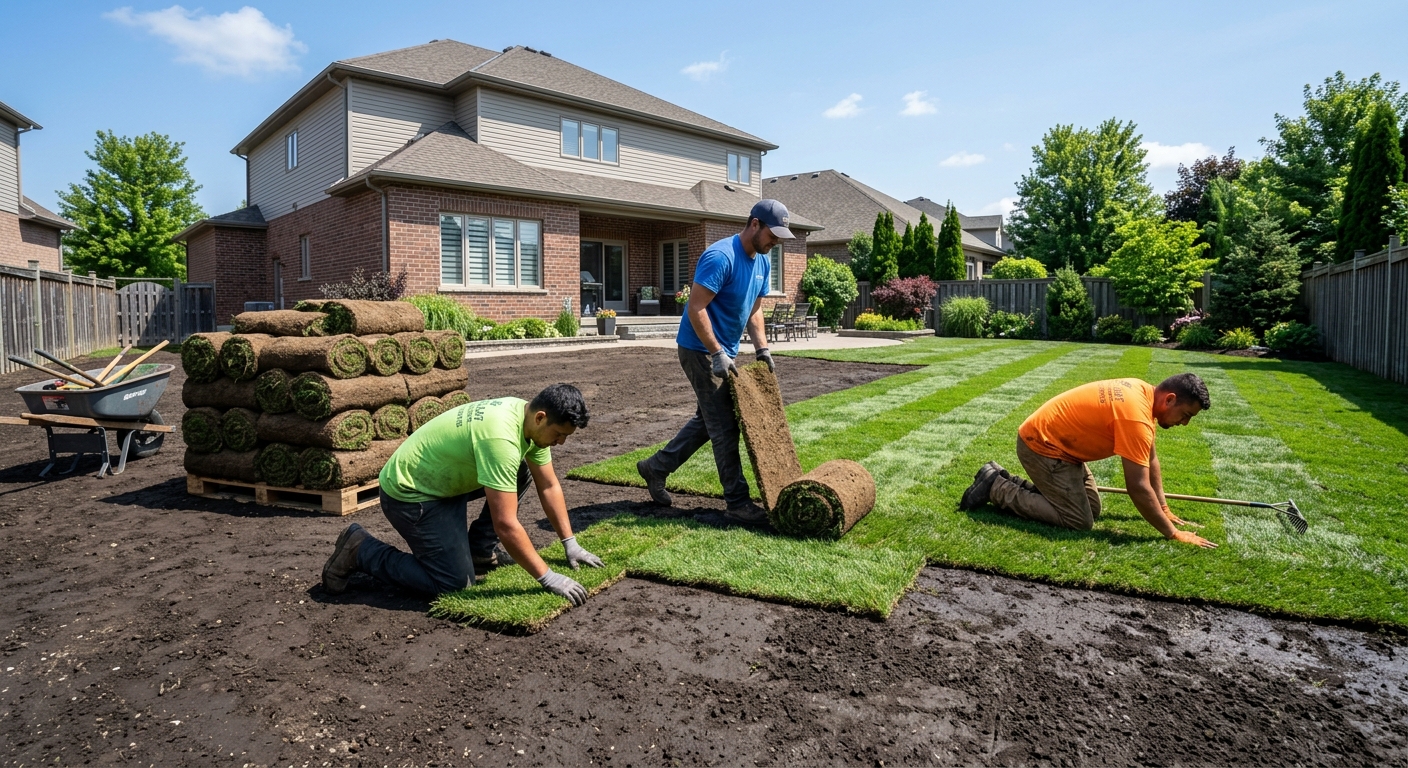
| Sod installation (supply, grade, lay, roll) |
Soil prep, grade correction, sod supply and installation, rolling and light starter fertilization |
Late Mar–Oct |
$2,000–$8,000 |
| Lawn seeding (grade, seed, starter fertilizer) |
Light grading, seed blend, starter fertilizer, raking and establishment care |
Apr–Jun; reseed in early Sept where needed |
$1,000–$4,500 |
| Interlocking patio or walkway |
Excavation, compacted base, geotextile, interlocking pavers, edging and levelling |
May–Oct |
$10,000–$35,000 |
| Retaining wall (interlocking block) |
Base preparation, drainage layer (weep holes/gravel), block install and cap/steps if included |
May–Oct |
$10,000–$80,000 |
| Tree and shrub planting |
Soil amendment, digging, planting, staking as needed, mulch rings, watering plan |
Mar–Nov (avoid saturated soil weeks) |
$1,000–$15,000 |
Prices are estimates only and vary by project scope, site access and material selection.
What affects the price of landscaping in McMillan
In Lower Mainland–Southwest, you can see the same “mid-sized backyard refresh” quoted 30–50% apart across British Columbia because bids often treat the hidden work differently—especially drainage, grading tolerances, and labour hours for hand excavation, removals, and clean-up. In a coastal zone like McMillan (roughly zones 7–8), contractors can plant longer into the year and use a wider palette, which can reduce replacement costs versus short-window regions. Still, that doesn’t mean the job gets cheaper: when weather stays workable and demand is steady, crews can be booked, and quality materials (better soil blends, higher-end topsoil, and premium drainage products) can raise total cost.
By comparison, Prairie regions (zone 2–4) often have short growing seasons and push clients toward drought-tolerant, wind-hardy plantings—so crews spend more on hardscape efficiency and fewer “luxury” plantings. Retaining wall base depth there must reach below deeper frost influence; in Ontario (zone 5–6), winter freeze is moderate but summer dry spells can increase irrigation and turf maintenance. Coastal BC, including McMillan, usually lowers winter-kill risk and supports more layered designs, but you still need proper drainage because soil and basements can stay damp for long periods.
Two common examples in McMillan that move price sharply: (1) fixing a slope that sheds rain toward the foundation—often requiring additional grading and drainage work—can push a patio project toward the higher end of typical hardscape budgets like $10,000–$35,000; and (2) upgrading from standard lawn seeding to sod for instant curb appeal can shift turf budgets dramatically within $2,000–$8,000 depending on grade correction, access, and sod quality. Housing age also matters: older lots frequently have compacted soil, buried debris, or uneven subgrades; correcting those conditions can add hundreds to thousands in excavation and soil amendment.
| Price Factor |
Why It Matters |
Cost Impact |
| Yard size in sq ft — the primary cost driver for softscape |
More area means more materials (soil, sod/seed, mulch) and more labour for prep and installation |
Small yards may land near the low end; larger properties can quickly multiply total cost |
| Grading and drainage work — slope corrections add significant cost |
Correct grades reduce pooling and foundation moisture risk; requires more excavation and re-compaction |
Can add thousands to a refresh, especially on sloped or uneven lots |
| Drainage bed or French drain installation |
Proper under-slab/under-bed drainage prevents long-term dampness and plant failures |
Frequently a major line item; increases both materials and trenching time |
| Plant material tier — native shrubs vs. ornamental vs. mature specimen trees |
Mature plants cost more and require careful handling, staking, and larger planting pits |
Upgrading to specimen trees and premium shrubs can raise the planting portion substantially |
| Hardscape vs. softscape ratio — walls and patios cost more per sq ft than lawn |
Pavers, base materials, labour, and finishing details drive cost; lawn installation is lower per sq ft |
Projects with more paving/blocks typically land at the higher end of hardscaping bands |
| Irrigation system design and installation |
Drip vs. spray, zoning, controllers, and trenching affect both material and labour |
Efficient systems add upfront cost but reduce long-term watering issues |
| Soil amendment and topsoil required |
Coastal soils can be heavy or inconsistent; amendments improve drainage and root health |
More hauling and material selection increases price, especially if existing soil is poor |
| Tree removal or stump grinding before new planting |
Removal adds specialized labour, hauling, and sometimes permits/coordination |
Can add a meaningful “surprise” cost if removals weren’t included in the first estimate |
Permits & regulations in British Columbia
In British Columbia, most common softscape work—like planting, sodding, and standard lawn seeding—typically does not require a building permit. For McMillan homeowners, the bigger regulatory triggers usually involve retaining walls, significant grading changes, and any work that touches utilities.
Work that typically DOES require a permit includes retaining walls above the local threshold (often around 1.0 m in many municipalities), especially if the wall is engineered or impacts safety and drainage. Also confirm whether changes to lot grading that alter runoff patterns—such as directing drainage toward neighbouring properties or modifying how surface water reaches storm connections—may require approval.
Work that typically does NOT require a permit includes mulch installation, shrub and tree planting (within typical setbacks and design plans), seeding or sod placement, walkway/patio builds at normal residential scale (still subject to municipal rules), and most garden bed construction without structural wall elements.
Before digging, have utility locates done (especially for planting holes and wall footings). Step-by-step, verify your contractor in British Columbia by: (1) checking their business/contractor licence details through the appropriate online registry resources they provide; (2) requesting a certificate of insurance with liability coverage that matches the job size; (3) confirming they carry applicable worker protection coverage (WSIB/WCB coverage—ask for a clearance letter or proof of coverage); and (4) keeping copies of those documents with your contract. If a contractor won’t provide clear paperwork, that’s usually a sign to pause.
Planning a landscape that thrives in McMillan's climate
To plan landscaping that thrives in McMillan, build around the zone conditions and wet-weather realities of the Lower Mainland–Southwest. With winter damage risk lower than many inland regions, you can focus on longer-lived structures—layered evergreens, persistent perennials, and hardy groundcovers—while still respecting the basics: drainage, soil improvement, and frost-safe construction. The typical last spring frost is early March to early April near the coast, and first fall frost often doesn’t land until November, so you have a generous window to install and establish plants before winter wet sets in.
Plant selection: choose native and zone-appropriate species that don’t demand constant winter protection. This keeps maintenance predictable and reduces replacement cycles. Sod vs. seed: sod gives instant visual results but usually costs 3–4x per sq ft compared with seeding once prep is included. For many McMillan yards, seeding plus a good soil amendment is the smarter value; sod is best when timing or curb appeal is critical.
Drainage and grading: heavy rain can cause pooling, foundation moisture, and root stress—so correct slopes early. Hardscape base preparation: even in milder coastal conditions, contractors should dig for proper base depth, compact correctly, and include drainage layers to manage freeze–thaw movement.
Low-maintenance strategies: mulch rings, groundcovers, and perennial beds reduce annual weeding and watering. Consider rain-garden swales or targeted xeriscape zones (limited lawn, drip irrigation, drought-tolerant plant groupings). For a dollar-anchored example: if your seeding and soil prep for a refreshed lawn area fits within $1,000–$4,500, but sod pushes you toward the turf band of $2,000–$8,000, sod becomes justified when you need fast play/use for kids, pets, or events—or when you’re converting an uneven grade that will otherwise take longer to establish from seed.
| Element |
Climate Consideration |
Maintenance Level |
Price Band |
| Sod lawn installation |
Works well in McMillan’s long growing window; ensure grading avoids standing water |
Low to moderate (watering during establishment; follow-up feeding) |
$2,000–$8,000 |
| Native perennial garden |
Zone-appropriate plants handle wet winters better with mulch and good drainage |
Low (seasonal weeding and light pruning) |
$1,500–$6,000 |
| Mulched shrub border |
Mulch buffers moisture swings and suppresses weeds in rainy periods |
Low (top up mulch 1–2 times/year) |
$1,000–$5,500 |
| Interlocking stone patio |
Base drainage prevents moisture issues under pavers during wet winters |
Low (occasional joint maintenance and cleaning) |
$10,000–$35,000 |
| Retaining wall (block) |
Proper weep/drainage layers manage water behind the wall in wet coastal seasons |
Low (inspections after heavy rain; keep drainage clear) |
$10,000–$80,000 |
| Drip irrigation system |
More efficient watering for occasional restrictions; drip helps reduce disease from overwatering |
Moderate (seasonal adjustments and controller checks) |
$1,500–$7,500 |
How to choose a landscaping contractor in McMillan
Choosing the right contractor in McMillan starts with proof. In British Columbia, ask for their liability insurance certificate and confirm the coverage limit is appropriate for your project (especially hardscape and retaining work). Next, verify worker protection coverage—request evidence of WSIB/WCB coverage (and, if available, a clearance letter). Many reputable landscapers will provide these without pressure; if they hesitate, that’s a red flag.
Then, get 2–3 itemised written quotes rather than a single lump sum. Itemisation matters because it shows whether drainage and base prep are included (or treated as “extra if needed”). Your quote should separate labour and materials—topsoil vs. amendments, sod/seed type, paver thickness, block system, drainage stone, edging, and irrigation components—so you can compare scope honestly.
Read exclusions carefully: Is disposal included? Are permits included where required (notably for taller retaining walls)? Will they repair and re-seed disturbed areas? Is there a warranty for workmanship, and how long does it last? Also ask if product warranties are transferable to you and how they handle plant replacement after establishment.
For payment, use a sensible schedule: never pay more than 10–15% upfront. Hold back the remainder until key milestones and the final walkthrough are complete. Finally, ask for a start date and a completion timeline in writing, plus how they manage wet-week delays common in the Lower Mainland.
- Request proof of British Columbia coverage: liability insurance certificate.
- Ask for WSIB/WCB coverage evidence (clearance letter if available).
- Confirm who pulls permits if the retaining wall threshold applies.
- Require an itemised quote: labour, materials, disposal, and taxes.
- Check whether grading/drainage is included or labelled “as required”.
- Verify base specs for patios (compaction, geotextile, and drainage layer).
- Ensure drainage behind retaining walls includes weep holes and gravel.
- Ask for turf scope: soil prep, seed/sod type, fertilizer, and establishment care.
- Confirm irrigation scope: zoning, drip vs. spray, and controller type.
- Get warranty terms in writing (workmanship length and what’s covered).
- Use milestone payments; keep a holdback until cleanup and final inspection.
- Schedule a site visit to confirm access constraints (gates, slopes, parking).
Common red flags I see in McMillan: contractors who won’t provide insurance/WSIB/WCB proof, quotes that omit drainage or base prep details, “lowest price” bids that lump everything into one number, no written timeline or warranty, and requests for large upfront payments without milestones.
Frequently asked questions — landscaping in McMillan
What is the best grass type for a McMillan lawn?
In McMillan and the broader Lower Mainland–Southwest, most homeowners do best with cool-season turf grasses that handle our long growing season and cool, wet winters without excessive winter stress. Many contractors commonly recommend blends containing Perennial Ryegrass for quick establishment and Tall Fescue for improved drought tolerance and wear resilience. The right choice also depends on sun exposure and whether your lawn area stays soggy after rain—if pooling is an issue, improving grading and drainage matters as much as grass type.
If you’re comparing options, seeding into a prepared base typically fits the lower turf band (for example $1,000–$4,500 depending on size and soil work), while sod starts closer to the $2,000–$8,000 range because of supply and installation. A good contractor will match the grass blend to your site, not just your budget.
When should I aerate and overseed my lawn in McMillan?
For McMillan, aerating and overseeding is usually most successful in spring or early fall when temperatures are mild and grass is actively growing. Spring is commonly the best window because it aligns with early frost timing near the coast (often early March to early April), giving new seedlings enough time to root before winter wet sets in. Early fall (around September into October) can also work well—just avoid overseeding right before persistent heavy rain that can smother seed and keep soil too saturated.
A proper process matters: aerate to reduce compaction, topdress lightly with amended soil if needed, then seed with a blend appropriate for coastal BC conditions. If your lawn is thin from foot traffic or shade, consider using more seed than you would for a thick lawn. Costs vary, but small overseeding/soil prep projects often sit well below sod installation pricing in the $2,000–$8,000 band.
What trees grow best in McMillan's climate zone?
Because McMillan sits in the Lower Mainland–Southwest with conditions roughly in plant hardiness zones 7–8, you can grow a wider set of trees than many inland regions. Common, reliable options often include Amelanchier (serviceberry), Japanese maple varieties (in suitable sites), and magnolia options that match your microclimate and sun exposure. For structure and long-term screening, many homeowners also consider cedars (arborvitae-type landscaping needs differ by species) and spruces where the site drainage supports healthy root growth.
That said, heavy rain means drainage and planting technique are crucial. Trees that sit in poorly drained soil can struggle—even in a mild zone. If you’re budgeting, a thoughtful tree and shrub planting typically starts around $1,000–$15,000 depending on size and whether staking, soil amendments, or replacements are required.
How much does sodding a yard cost in McMillan?
In McMillan, sod pricing is driven by yard size and how much prep is needed. At the high level, sod installation (supply, grade, lay, and roll) commonly falls into the $2,000–$8,000 band for many typical residential projects. If the grade needs correction—fixing low spots, improving drainage, or adding topsoil—that pushes the job higher within the band because excavation, hauling, and compaction take time.
Also consider access: narrow side yards, slopes, and limited equipment placement can add labour. If your lawn area is very uneven, seeding may be the more budget-friendly route initially, but sod is often worth the premium when you want an instant, usable lawn during the long coastal growing window.
How do I prevent weeds in my McMillan garden?
Weed prevention in McMillan comes down to reducing gaps, improving soil coverage, and controlling moisture conditions that encourage weed germination. A mulch layer is one of the highest value steps: use properly installed mulch in shrub borders and between perennial clusters to block light and limit weed seed germination. Over time, top up mulch as it breaks down.
Next, start with weed-aware bed prep: remove perennial weeds and root fragments before planting. If you use a landscape fabric, choose it carefully—heavy-duty fabric can trap moisture if drainage is poor, which matters in Lower Mainland wet winters. Many homeowners do better with mulch plus dense plantings (native perennials and groundcovers) that “close the canopy” so weeds don’t get space to establish.
Lastly, irrigation habits matter. Drip irrigation designed for efficient delivery can reduce overly wet zones where weeds thrive. When budgets allow, a drip system often pairs well with low-water, low-weed layouts.
How do I design a low-water yard in McMillan?
Even though McMillan has milder, wetter conditions than the BC Interior, designing a low-water yard still makes sense—especially for managing rising water costs and potential municipal restrictions. Start by reducing lawn footprint and increasing planted beds that can handle our seasonal rainfall patterns without constant top-up watering. Use mulch, groundcovers, and native or zone-appropriate perennials to maintain soil moisture and suppress weeds.
For the irrigation strategy, consider drip irrigation with smart controllers and zoning. Drip targets the root zone and avoids waste from overspray or evaporation—useful when you’re watering efficiently during dryer weeks. A well-designed drip system can also support a transition from sod to a mixed planting palette.
If you’re cost-comparing, a drip setup may fall roughly in the $1,500–$7,500 range depending on zones and trenching, but it can reduce ongoing maintenance and improve establishment of new plantings in British Columbia. Work with your contractor on grading so water lands where you want it rather than pooling or running off.