Landscaping options and costs in Sun Peaks
Sun Peaks homeowners typically have a strong incentive to invest in their outdoor space: the community includes many detached properties with enough yard area to make landscaping visible from the street, and with a 2021 population of 1,400 (Statistics Canada, 2021 Census), demand for reliable, locally scheduled contractors can be concentrated in the same few busy weeks. In Sun Peaks, that matters for pricing because crews are often juggling seasonal installs (planting, grading, irrigation) around mountain weather and access constraints.
In the Lower Mainland–Southwest, the mild, wet winters and long, cool summers in plant hardiness zones 7–8 support fuller planting palettes and a longer work window than many other BC Interior-style climates. That said, structural work still needs to plan around freeze–thaw cycles: even where frost is less brutal, improper drainage and shallow bases can lead to frost heave and wall movement. On the labour side, competition for good crews across the region can widen quote ranges—especially when you add hardscape, drainage, and irrigation design into the scope.
In Sun Peaks, the highest demand for landscape installs is often around newer builds and recently renovated neighbourhood pockets where homeowners want a “finished” yard quickly—particularly near the core recreation areas where curb appeal and walkability matter. From there, you can compare typical service scopes and budgets before you request itemised pricing in your area.
| Service |
Description |
Season |
Price Range |
| Full landscape design and installation |
On-site consult, plan & plant palette, grading/soil prep, planting, sod/seed, edging, and key hardscape as specified |
Spring to late fall (softscape most reliable when soils are workable) |
$8,000–$45,000 |
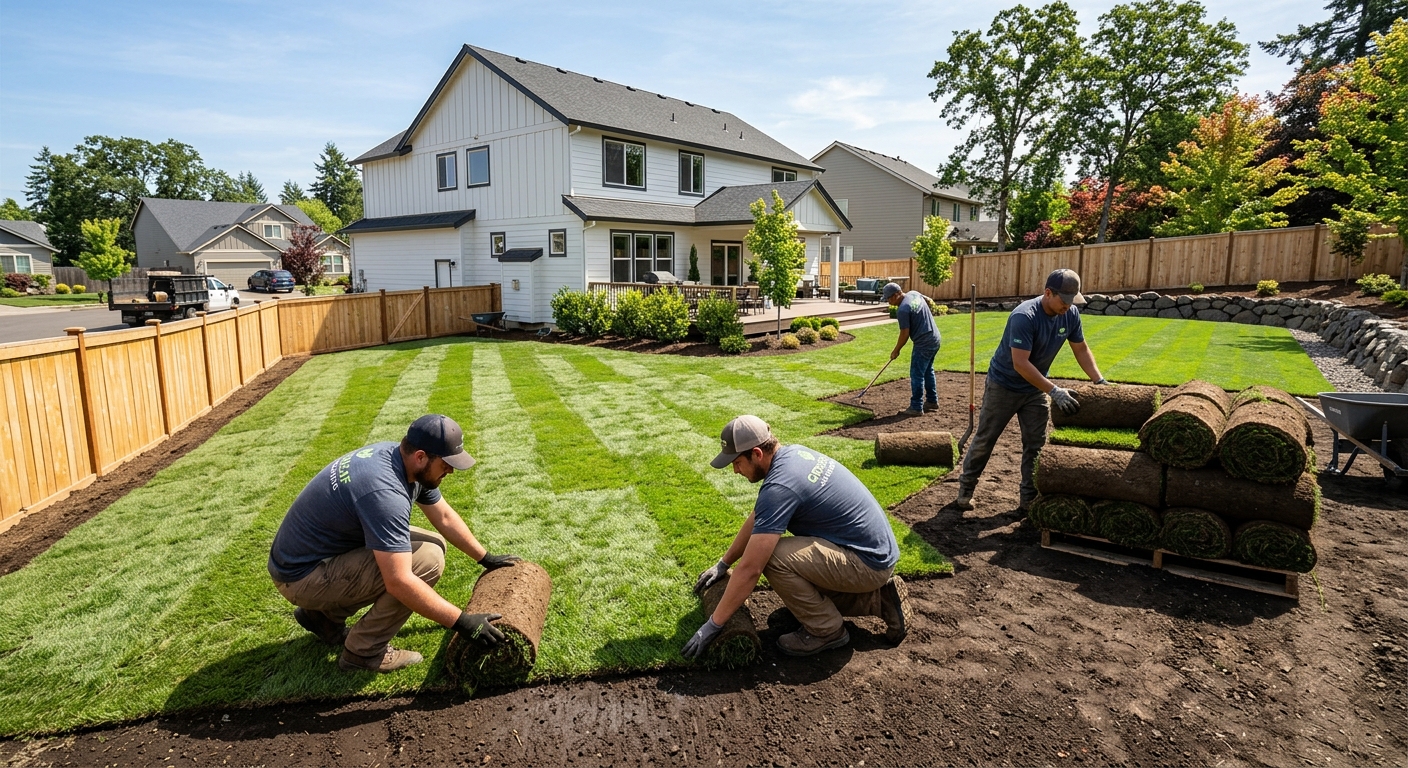
| Sod installation (supply, grade, lay, roll) |
Site grading, topsoil adjustment, sod delivery, layout, rolling, and initial watering guidance |
Late spring to early fall; avoid soggy/wet periods |
$2,500–$7,500 |
| Lawn seeding (grade, seed, starter fertilizer) |
Light grading, seed selection, starter fertiliser, seeding, and protective mulch approach |
Spring or early fall (cooler temperatures help germination) |
$2,000–$5,500 |
| Interlocking patio or walkway |
Excavation, base prep, compaction, sand setting bed, interlocking stone installation, jointing and finishing |
Spring to fall; plan drainage before install |
$10,000–$55,000 |
| Retaining wall (interlocking block) |
Wall layout, excavation to frost-aware depth, base, geotextile, block placement, drainage gravel and weep provisions |
Spring to early winter before heavy wet conditions |
$15,000–$70,000 |
| Tree and shrub planting |
Soil amendment, planting, staking/tying as required, mulch rings, and watering plan for establishment |
Early spring to fall (as weather allows) |
$1,200–$14,000 |
Prices are estimates only and vary by project scope, site access and material selection.
What affects the price of landscaping in Sun Peaks
In Sun Peaks and across British Columbia, quotes for what looks like the “same” project can differ by 30% to 50% because landscaping scope changes fast once you account for grading, drainage, soil volume, and how many trades are involved (excavation, base compaction, irrigation, stonework). Even in the Lower Mainland–Southwest—zones 7–8 with a longer working season—labour time still scales with terrain and access. Contractors who can coordinate utilities locates and manage wet-weather site constraints typically price more confidently because the plan reduces rework.
Local conditions affect both what can be planted and how long the job takes. In Prairie regions (zones 2–4), the short growing season and wind exposure push clients toward drought-tolerant, wind-hardy planting and more compressed build scheduling; retaining wall bases must be engineered deeper to manage frost. Coastal BC (zones 7–8) allows a richer planting palette because winter damage risk is lower and the ground is workable for longer, but heavy rainfall still demands proper drainage layers. The dry BC interior and Alberta contexts often require smarter irrigation design to handle occasional restrictions—this is why efficient drip and smart controllers are increasingly standard in modern proposals, even when watering bans aren’t the daily reality.
Concrete examples that commonly move Sun Peaks pricing: (1) a 1–2 ft (300–600 mm) slope correction can add significant excavation and hauling, pushing an interlocking walkway budget upward toward the higher end of the $10,000–$55,000 band; (2) planting costs jump when homeowners want mature specimen trees and additional soil amendment to improve root establishment—often moving projects toward the $1,200–$14,000 range; (3) installing a drainage bed or French drain can add cost, but it often prevents ongoing foundation moisture issues that become far more expensive later.
| Price Factor |
Why It Matters |
Cost Impact |
| Yard size in sq ft — the primary cost driver for softscape |
More area means more topsoil/soil prep, sod or seed, labour hours, and materials |
Low to high (often the biggest swing factor) |
| Grading and drainage work — slope corrections add significant cost |
Improper slope causes pooling and undermines foundations and walkways |
High (can add thousands) |
| Drainage bed or French drain installation |
Required when groundwater, downspout runoff, or persistent damp areas are present |
High (materials + excavation) |
| Plant material tier — native shrubs vs. ornamental vs. mature specimen trees |
Smaller plants cost less; mature specimens require higher handling and stronger establishment care |
Medium to very high |
| Hardscape vs. softscape ratio — walls and patios cost more per sq ft than lawn |
Stonework uses more base prep, compaction, and labour per square foot |
Medium to very high |
| Irrigation system design and installation |
Zones, pressure regulation, trenching depth, controller type, and drip layout affect cost |
Medium (can be high with complex layouts) |
| Soil amendment and topsoil required |
Clay, compacted fill, or poor topsoil needs bulk import and amendments for rooting |
Medium |
| Tree removal or stump grinding before new planting |
Stump removal adds disposal, equipment time, and root excavation for safe replanting |
Medium to high |
Permits & regulations in British Columbia
In British Columbia, most planting, sodding, and standard softscape work generally does not require a permit. For example, adding sod, seeding, mulched shrub borders, and typical garden bed installations are usually handled as routine landscaping. The work that more often triggers permitting is retaining wall construction above the usual height threshold—commonly 1.0 m (3.3 ft) in many municipalities—especially when drainage layers, footings, or structural considerations are involved. Also, if your project includes changes to lot grading that affect drainage patterns toward neighbouring properties or storm sewer connections, approvals may be required.
Before digging planting holes or wall footings, always arrange utility locates (BC One Call) so you don’t hit buried services. That applies whether you’re installing a tree, a drainage bed, or trenching for drip irrigation.
To verify a contractor’s standing in BC, ask for three things: (1) a BC licence/registration where applicable for their trade category—check the relevant online registry and confirm the company name matches the quote; (2) liability insurance—request a current certificate of insurance listing your property as an additional insured where possible, and ensure the coverage limits are appropriate; (3) WCB/WSIB coverage—confirm their workers are covered under their province’s system (ask for proof of clearance). Step-by-step, you should request these documents before work starts, not after scaffolding and excavation are already underway.
Planning a landscape that thrives in Sun Peaks's climate
Planning a landscape for Sun Peaks starts with working with the expected frost timing and zone performance, not fighting it. Even though the Lower Mainland–Southwest has a longer growing and working season than many parts of Canada, the yard still needs winter-proof drainage and root protection so plants can handle cool-season wetness and freeze–thaw cycles. Aim for a planting palette matched to the region’s zones 7–8: mix hardy broadleaf evergreens, long-blooming perennials, and dependable groundcovers so you’re not relying on one fragile species.
For lawns, choose sod when you need instant coverage and can manage initial establishment watering; otherwise, seeding is typically more budget-friendly. As a rule of thumb for value planning: sod often costs about 3–4x more per sq ft than seeding, even when both use good soil prep. For example, if you’re trying to cover 500 sq ft, seeding may land near the lower end of the $2,000–$5,500 band, while sod commonly pushes budgets toward the $2,500–$7,500 range depending on site prep.
Drainage and grading are the difference between a yard that looks great in year one and one that holds up in year three. In the Lower Mainland–Southwest, pooling can be caused by heavy rainfall patterns and downspout runoff; in Sun Peaks projects, we still build with a “water path first” mindset. For patios and retaining walls, base prep must be done with frost-aware depth, proper compaction, and drainage gravel so the subgrade doesn’t heave.
Low-maintenance strategies that still look rich include mulching with coarse, weed-suppressing layers; using repeating plant masses (native perennial garden beds); and adding drip irrigation in high-need areas only. If water efficiency is a priority, a rain-garden feature or xeriscape-adjacent planting (grouped by irrigation need) can reduce annual upkeep without turning the yard into a barren look.
| Element |
Climate Consideration |
Maintenance Level |
Price Band |
| Sod lawn installation |
Works well in cool-season growth; establishment depends on workable soil and controlled watering |
Medium (first season monitoring) |
$2,500–$7,500 |
| Native perennial garden |
Zone-appropriate plants handle winter variability better and build long-term structure |
Low to medium (spring cleanup, light weeding) |
$3,500–$12,000 |
| Mulched shrub border |
Mulch supports consistent soil moisture and reduces temperature swings around roots |
Low (refresh mulch yearly) |
$2,000–$8,500 |
| Interlocking stone patio |
Freeze–thaw requires strong base prep and proper slope away from the home |
Low (occasional joint refresh) |
$10,000–$55,000 |
| Retaining wall (block) |
Stability depends on frost-aware depth, drainage gravel, and geotextile separation |
Low (visual inspection) |
$15,000–$70,000 |
| Drip irrigation system |
Efficient watering supports plant establishment and reduces waste during potential restrictions |
Medium (seasonal checks of lines and controller settings) |
$1,500–$8,000 |
How to choose a landscaping contractor in Sun Peaks
Choosing a landscaping contractor in Sun Peaks means verifying credentials before you sign anything. For British Columbia, ask for documentation for: (1) licence/registration relevant to their scope (especially if they’re doing structural hardscape, retaining walls, or specialised work); (2) liability insurance—request an up-to-date certificate of insurance and confirm the project address is covered; and (3) WCB/WSIB coverage for workers—ask for proof of clearance or equivalent confirmation. A reputable contractor won’t hesitate; they’ll treat it like standard onboarding.
Next, request 2–3 itemised written quotes. You want a breakdown that separates labour and materials: excavation and base prep, drainage gravel, stone supply, soil/topsoil, plants, delivery, and irrigation components. Make sure the quote indicates what’s included for site access, disposal (spoils removal), and whether the contractor handles permits if your retaining wall exceeds the typical 1.0 m (3.3 ft) threshold.
Warranty matters. Ask for the workmanship warranty length and whether the product/manufacturer warranty is included and transferable. Payment should be conservative—never more than about 10–15% upfront. Hold back the balance until completion and cleanup are confirmed. Finally, get the timeline in writing: start date, weather contingencies, and a completion estimate that accounts for curing time on bases and paving.
- Ask for the site plan showing grades, drainage direction, and proposed plant locations.
- Confirm the soil prep scope: topsoil depth, amendments, and compaction method.
- Require a base section description for patios/walkways (stone type, depth, compaction passes).
- Verify utility locates are arranged before digging.
- Request disposal terms: is excavated soil hauled away or stockpiled on-site?
- Check if the contractor includes starter fertiliser and the seeding/sod establishment plan.
- Ask who supplies plants and whether substitutions are allowed—get substitution rules in writing.
- Confirm irrigation responsibility: does the quote include testing, set-up, and end-of-season adjustments?
- Get a schedule for inspections: when will you review staging and final grading?
- Review warranty in plain language: duration, exclusions, and response timelines.
- Ensure the payment schedule aligns with milestones (rough-in, then final completion).
- Look for clear exclusions: what’s not included (tree removal, stump grinding, pruning, snow removal during install windows)?
Red flags in Sun Peaks: a quote that’s only a lump sum with no drainage/base/soil details; unwillingness to provide proof of insurance and WCB/WSIB coverage; vague timelines (“weather permitting” without a range); no written scope for disposal and access; and offers to accept large upfront payments beyond about 10–15% without a signed contract and progress milestones.
Frequently asked questions — landscaping in Sun Peaks
Do I need a permit for a retaining wall in British Columbia?
In British Columbia, many landscaping tasks like planting and typical softscape work usually don’t require permits, but retaining walls are different. A common trigger is retaining wall height—often 1.0 m (3.3 ft) or more—where a building permit may be required and engineered details can be requested depending on the design. Changes to lot grading that redirect drainage toward neighbouring properties or storm connections can also require approval. For Sun Peaks homeowners, the best approach is to ask your contractor to confirm the anticipated wall height and drainage method in writing, then check with the local building/permits office before excavation starts. If your wall is kept under the threshold and grading doesn’t change drainage pathways, it’s more likely to be handled as routine landscaping.
How do I improve drainage in my yard?
Drainage improvements usually start with understanding where water travels after storms—downspout runoff, surface pooling, and groundwater seepage all behave differently in British Columbia. In Sun Peaks, we typically correct drainage by restoring proper slope away from the foundation, then adding targeted solutions like a drainage bed or French drain in the wettest low point. The key is building the layers correctly (geotextile separation and washed drainage gravel) so fines don’t clog the system. Many homeowners think this is optional until they see recurring damp patches or failing grass. Budget-wise, drainage can be a meaningful part of a project that otherwise falls around lawn installation pricing (like $2,000–$5,500 for seeding), but the return is avoiding ongoing damage and rework. A contractor should include drainage in the plan rather than treating it as an add-on.
What is xeriscaping and does it suit Sun Peaks?
Xeriscaping is a landscaping approach designed to reduce water use by grouping plants by water needs, improving soil, and using drought-tolerant species and efficient irrigation (often drip). While the Lower Mainland–Southwest typically has wetter winters and a longer season, Sun Peaks projects can still benefit from xeriscape principles—especially if you want to limit annual maintenance, reduce irrigation waste, or handle occasional watering restrictions elsewhere in BC. The most successful xeriscape-style yards aren’t “all rock”; they use mulch, groundcovers, and well-chosen shrubs and perennials so the look stays lush in the cool season and stable in dry spells. If you’re comparing options, a full softscape refresh often sits in the $5,000–$50,000 design/install range, while targeted beds and mulch borders can be more budget-aligned. The right answer depends on your soil and how much of your yard is high-traffic or visible.
How do I plan a low-maintenance yard?
A low-maintenance yard is planned around “right plant, right place” and a simple maintenance rhythm. In Sun Peaks and the broader BC environment, use zone-appropriate species (commonly built around zones 7–8 performance) and repeat plant groupings so you’re not constantly babysitting small, fussy specimens. Build soil health first: proper topsoil depth, amendments where needed, and mulching in beds reduces weeds and moisture loss. For lawns, sod gives instant results but needs a careful establishment phase; seeding can be lower cost while still working well when timed correctly—often within $2,000–$5,500 depending on site prep. For hardscape, plan proper base prep and drainage slope so patios and walkways don’t settle. Finally, include a practical irrigation plan (drip for beds, smart controller where appropriate). The goal is fewer annual tasks, not fewer good decisions.
How deep should a retaining-wall base be for local frost?
Base depth for a retaining wall isn’t one universal number; it depends on block size, wall height, soil type, and the engineered design (and it must account for frost and local drainage behaviour). In the Lower Mainland–Southwest context, freeze–thaw cycles still matter, so walls need excavation to a depth that supports stability and prevents frost heave. The contractor should specify the excavation depth, base material, compaction approach, and drainage gravel/weep provisions in the written proposal. If the wall is over the common 1.0 m (3.3 ft) threshold and permits apply, engineered or more detailed design information is often required. For homeowners in Sun Peaks, the best safeguard is to require that the quote and drawings show: geotextile separation, base thickness, drainage layer details, and how water will be relieved behind the wall (so the wall doesn’t “push” under wet freeze–thaw conditions).
How much does professional landscape design cost?
Professional landscape design pricing can vary widely based on how detailed the plan is (concept-only versus full construction-ready drawings and material take-offs), and it can be bundled with installation. For Sun Peaks homeowners budgeting for the whole outcome, a full landscape design and installation commonly falls in the $5,000–$50,000 range, with many projects landing somewhere inside that range depending on grading, drainage, and hardscape inclusion. If your request is primarily planting with some grading, you might see the project approach the $1,000–$15,000 tree and garden planting band or the lower end of full install scopes. A responsible contractor should explain what the design includes: on-site measurements, a plant palette matched to BC conditions, and clarity on drainage and access. Ask whether design is a separate line item or credited toward construction so you can compare quotes fairly.