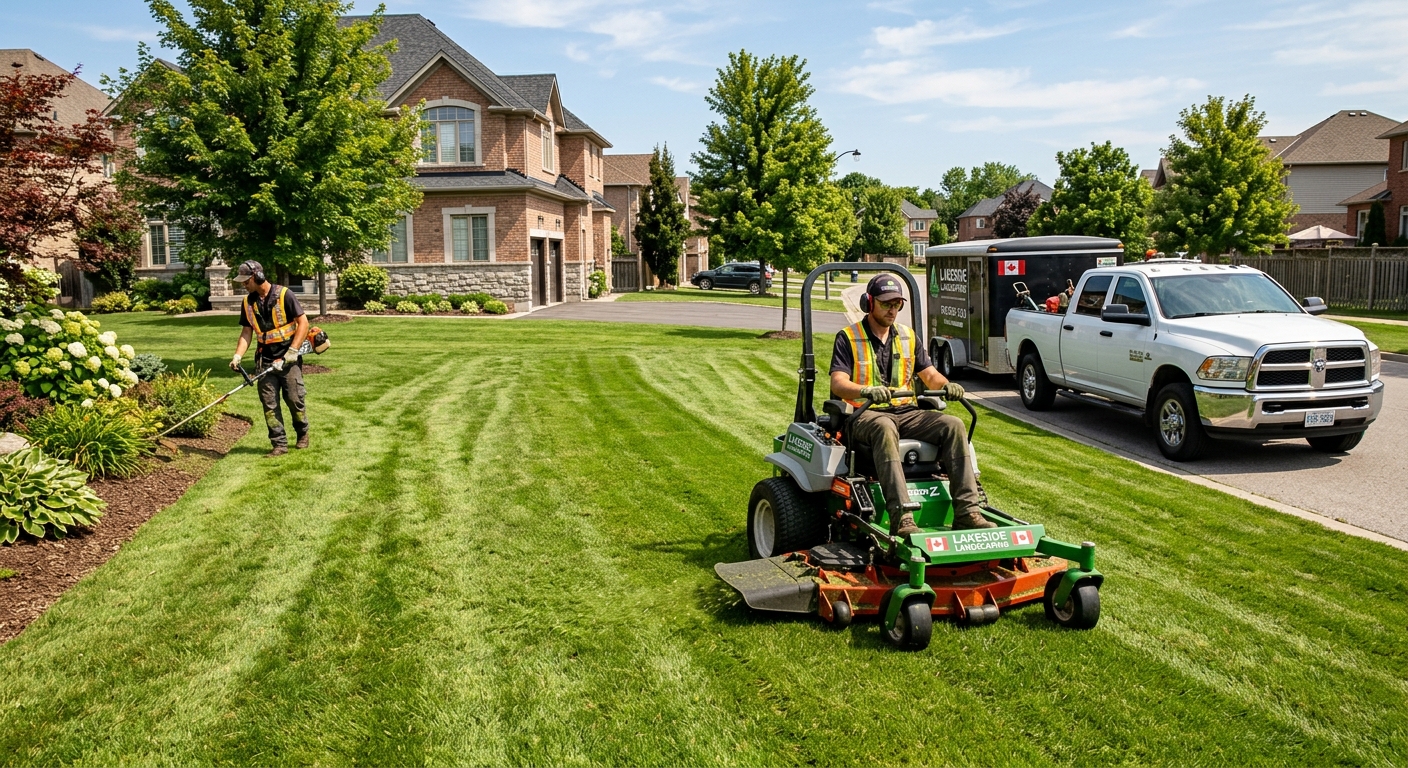
Landscaping options and costs in Dearborn
In Dearborn, Ontario, landscaping choices usually start with how your property is laid out—because yard space changes everything from plant selection to the cost of grading and hardscape. While Dearborn’s population is small (1,605 residents per the Statistics Canada, 2021 Census), many homeowners within the Toronto economic orbit still want curb appeal that holds up to freeze–thaw winters and humid summer growth. In practice, detached homes and larger lots in the wider Toronto area tend to create the demand that brings crews, trailers, and material stock—especially in neighbourhoods with older housing where gardens were never updated to handle today’s drainage and soil conditions.
Toronto-area costs are shaped first by climate and soil. The region sits in hardiness zones 6a–7a, so contractors plan around winter lows near –23 to –18°C, then a reliable frost-free window roughly from May to October. That seasonal rhythm affects availability (spring rush pricing) and what can be installed well. Clay and fill soils common around older homes often mean excavation, soil amendment, and sometimes subdrains—so “same scope” quotes can diverge quickly once drainage is included. Deep frost and frequent freeze–thaw cycles also make concrete/stone base preparation non-negotiable, which increases labour for patios, steps, and retaining walls.
If you’re comparing options—softscape, hardscape, and full-service build-outs—use the table below as your starting point for budgeting in Dearborn and nearby GTA neighbourhoods such as the more established pockets near the Don Valley/Scarborough corridor where exterior renovations are common.
| Service |
Description |
Season |
Price Range |
| Full landscape design and installation |
Site visit, layout + plant/hardscape plan, grading/drainage coordination, soil prep, planting and/or hardscape build-out |
Spring–early fall (best results before first heavy frosts) |
$8,000–$40,000 |
| Sod installation (supply, grade, lay, roll) |
Minor grading, topsoil/seedbed prep, supply and roll sod, start-up watering plan |
Late spring through summer |
$2,500–$8,000 |
| Lawn seeding (grade, seed, starter fertilizer) |
Light grading/compaction correction, seed blend, starter fertilizer, straw/mulch if needed |
Early fall or late spring (depending on watering) |
$1,800–$5,500 |
| Interlocking patio or walkway |
Excavation, compacted base, geotextile, bedding sand, pavers, edging |
Spring–fall (install bases while soils are workable) |
$6,000–$25,000 |
| Retaining wall (interlocking block) |
Block system, excavation, base/gravel structure, compaction, drainage weeps/pipe as required |
Spring–fall (dry working conditions help) |
$6,000–$30,000 |
| Tree and shrub planting |
Soil loosening, amendments, staking (if needed), watering plan, mulch rings |
Spring or early fall for best establishment |
$800–$6,000 |
Prices are estimates only and vary by project scope, site access and material selection.
What affects the price of landscaping in Dearborn
In the Toronto area, two quotes for the “same job” can easily differ by 30–50% because landscaping is rarely identical once you uncover the site realities—soil condition, drainage needs, slope, and how complex the install is. In Dearborn (and nearby GTA neighbourhoods), the biggest swing factors are climate-driven and frost-driven: your hardiness zone (6a–7a) influences which plants will survive, while the frost schedule affects how deep contractors must build bases and wall footings so they won’t heave after winter. That’s why, even though the calendar says spring–fall, crews are pricing for freeze–thaw stability, not just aesthetics.
Comparing regions helps explain the spread. In Prairie zones (often 2–4), short seasons and colder extremes push designs toward drought-tolerant, wind-hardy species—and retaining wall base depth must still reach below the effective frost depth, which can mean long, careful excavation and simpler layouts. Coastal BC (often 7–8) supports lush planting palettes with a longer growing season, but heavy-rain drainage detailing still matters. Dry BC interior municipalities with water limits often require drip irrigation and xeric beds, which can shift both material and irrigation labour. Southern Ontario provides a moderate season with summer dry spells that increase watering needs during establishment.
Concrete local examples that move prices in Dearborn: (1) a lawn replacement with sod can cost within the $2,500–$8,000 band when the grade is already right; if excavation and soil amendment are required, expect the high side. (2) interlocking patios and walkways often land in the $6,000–$30,000 hardscape bands when clay fill removal, deeper compacted base, and new drainage are included. (3) older homes may sit on less predictable drainage paths—one added subdrain line or regrading pass can add meaningful labour because you’re changing where runoff goes and protecting foundation moisture.
| Price Factor |
Why It Matters |
Cost Impact |
| Yard size in sq ft — the primary cost driver for softscape |
More area means more topsoil/topdressing, seed/sod, labour hours, and cleanup |
Large projects scale quickly, often creating the largest percentage differences |
| Grading and drainage work — slope corrections add significant cost |
Fixing pooling and directing runoff away from foundations requires excavation and re-compaction |
Can add major labour and granular material compared with “flat grade” sites |
| Drainage bed or French drain installation |
Clay soils and heavy spring rain can trap water; drainage beds protect plant roots and hardscape |
Material + trenching + perforated pipe + geotextile increases project totals |
| Plant material tier — native shrubs vs. ornamental vs. mature specimen trees |
Hardier, appropriately sized native plants cost less than large-caliper specimens that need more handling |
Material cost and labour rise for larger trees, staking, and transport |
| Hardscape vs. softscape ratio — walls and patios cost more per sq ft than lawn |
Pavers and retaining systems require excavation, base layers, and precise laying |
Swapping lawn area for patio/walls shifts totals sharply upward |
| Irrigation system design and installation |
Zone-appropriate coverage matters in Toronto’s summer dry spells to protect new grass and beds |
Can materially change cost depending on number of zones and control type |
| Soil amendment and topsoil required |
Clay and fill often need structured amendments for root development and drainage |
Hauling and bulk material can increase costs even if plant count stays the same |
| Tree removal or stump grinding before new planting |
Root disruption affects nearby beds and can delay planting schedules |
Extra equipment and disposal time adds labour and timeline |
Permits & regulations in Ontario
In Ontario, most routine landscaping activities—planting beds, sodding, seeding, mulching, and typical softscape installation—generally do not require a permit. However, retaining walls can be different. Many municipalities treat retaining walls above a threshold (commonly around 1.0 m / 3.3 ft in many local rules) as requiring a building permit, and sometimes engineered drawings depending on height, surcharge loads, and site conditions.
Also be careful with drainage-related changes. If you plan grading changes that affect how water moves toward a neighbour’s property or connect to a storm system, approvals or site plan review may be triggered. The safe approach is to ask for the local requirements before excavation. Regardless of permit needs, you should schedule utility locates before digging holes or wall footings—this is a practical requirement to avoid damage and expensive rework.
For Dearborn homeowners verifying a contractor is properly covered in Ontario, do this step-by-step: (1) confirm the contractor’s Ontario business registration (and any trade-specific licensing they claim) using official directories or their public listings; (2) request a clear certificate of insurance showing liability coverage limits; (3) ask for proof of WSIB coverage (or WCB coverage where applicable) and ensure it matches the legal entity name on the quote; (4) request a clearance letter or current status statement if the contractor offers it; (5) confirm the quote includes disposal and erosion/sediment controls where needed for the scope. This protects you from schedule delays, damage claims, and workmanship disputes.
Planning a landscape that thrives in Dearborn's climate
A yard that thrives in Dearborn starts with working with the zone-6a to 7a reality: winter lows near –23 to –18°C, frequent freeze–thaw cycles, and a growing season that typically runs from May through October. Plant selection is where you win or lose. Choose native and zone-appropriate shrubs and perennials that tolerate Ontario winter and rebound after cold snaps—this reduces watering and winter protection effort. For lawn establishment, match the approach to your timeline: sod gives instant visual results, while seeding can perform well if you time it and keep moisture consistent.
Drainage and grading are especially important in Toronto because pooled water and foundation moisture can be more damaging than winter-kill. For patios and retaining walls, base preparation must account for the frost line behavior—proper depth, compaction, and granular layers are what prevent lifting and uneven settling over repeated winters. Low-maintenance design strategies help you keep curb appeal without constant labour: use mulch beds, groundcovers, and a smaller number of hardy perennials rather than many high-maintenance varieties.
Where water use matters during summer dry spells, consider rain-garden style grading in depressions or xeriscape-adjacent plantings that still look “garden-ready” but use better-performing plants and mulch. If you’re deciding between sod and seed, here’s the common math: sod often costs 3–4x more per square foot than seeding. For example, if you’re budgeting a $2,500–$8,000 sod project, seeding a similar area may fit within a lower band, but you’ll wait longer for thickness—so the cost is justified when you need fast results for curb appeal, pets, or entertaining.
| Element |
Climate Consideration |
Maintenance Level |
Price Band |
| Sod lawn installation |
Requires reliable spring/summer moisture and good grading; roots must establish before deep winter |
Medium for the first season (watering and light mowing once established) |
$2,500–$8,000 |
| Native perennial garden |
Hardy to zone 6a–7a; benefits from mulch and protection for establishment winters |
Low to medium (weeding first year, then periodic pruning) |
$1,200–$6,000 |
| Mulched shrub border |
Helps buffer freeze–thaw and suppresses weeds; choose drought-tolerant Ontario-suitable varieties |
Low (top up mulch 1–2 times per year) |
$800–$4,500 |
| Interlocking stone patio |
Freeze–thaw demands deep compacted base, proper geotextile and edging |
Low (occasional joint sand refresh, spot cleaning) |
$6,000–$25,000 |
| Retaining wall (block) |
Needs stable subgrade and drainage weeps/pipe to avoid water pressure behind the wall |
Low (annual inspection of drainage and movement) |
$6,000–$30,000 |
| Drip irrigation system |
Improves establishment and reduces evaporation during summer dry spells |
Low once set (seasonal checks and winter blow-out if used) |
$2,000–$7,500 |
How to choose a landscaping contractor in Dearborn
Start with coverage. In Ontario, ask for proof of liability insurance and WSIB/WCB status before work begins. Then verify it: (1) liability certificate—make sure the name matches the quote and company you hired, and that the limits are clearly stated; (2) WSIB/WCB—request confirmation that the contractor is registered for the correct entity; (3) ask who is responsible for site labour when subcontractors are involved. A professional contractor won’t mind providing documentation during your bid process.
Next, get 2–3 written, itemised quotes. You want a breakdown that separates labour and materials, and clearly lists what’s included (grading, topsoil/compost, base depths, geotextile, drainage pipe, pavers/blocks, disposal). Avoid “lump sum only” pricing unless the scope is detailed—landscaping changes fast once crews discover clay, buried debris, or low spots.
Read the exclusions line-by-line: is permit work included if required for retaining walls? Is disposal included for excavation material? Are utilities locates included or is that your responsibility? Confirm warranty terms: workmanship warranty length, manufacturer warranty for plants/stone products, and whether warranties are transferable if you sell the home.
For payment schedule, use a sensible structure: never pay more than 10–15% upfront, then hold back a meaningful amount until the job is complete and cleaned up. Finally, lock in timeline details in writing—start date, milestones, and a realistic completion estimate given frost risk and material lead times.
- Ask for insurance and WSIB/WCB proof before signing any contract.
- Use itemised quotes: labour, materials, and quantities (sq ft, linear ft, units).
- Confirm excavation depth and base build-up details for patios/walls.
- Verify drainage components (French drain, downspout routing, weep holes) are listed if needed.
- Confirm disposal is included for excess soil, old sod, and concrete/asphalt removal.
- Require a planting plan or plant list with sizes (e.g., shrub height/spacing).
- Ask about geotextile, bedding sand, and compaction specs—these prevent future settlement.
- Confirm topsoil/soil amendment type and depth for lawns and beds.
- Check whether irrigation is included or if you’re responsible for taps/timing/controls.
- Get clear warranty coverage: workmanship duration and start date.
- Put the project schedule in writing, including weather-sensitive pauses.
- Make sure your contract matches the quoted scope—no “allowances” that hide costs.
Red flags in Dearborn: (1) refusing to provide insurance or WSIB/WCB documentation; (2) vague quotes that don’t specify drainage, base depth, or disposal; (3) demanding large upfront payments beyond 10–15%; (4) starting without confirming utility locates; (5) promising a “one-season guarantee” on lawns/sod without explaining establishment watering and weather risk.
Frequently asked questions — landscaping in Dearborn
How do I plan a low-maintenance yard?
A low-maintenance yard in Dearborn starts with fewer, hardier plant choices and smart site work. Pick zone-appropriate shrubs and perennials for zones 6a–7a, then support them with mulch and a dependable watering plan for year one. Since Toronto-area freeze–thaw cycles are real, prioritize drainage and base preparation so your beds and hardscape don’t shift and create maintenance headaches. If you want less annual upkeep, reduce lawn area and use groundcovers in part-sun/shade where grass struggles. For budget context, many homeowners begin with a plan that includes a sod install in the $2,500–$8,000 band for only the “must-have” lawn areas, then build surrounding beds with hardy natives.
How deep should a retaining-wall base be for local frost?
Retaining-wall base depth depends on wall height, soil conditions, and the block system used, but in southern Ontario you should expect the foundation/subbase to be designed to resist freeze–thaw movement. That usually means excavation deeper than people assume for small walls and using a properly compacted granular base plus drainage behind the wall (weep holes/pipe or approved drainage layer). For Dearborn and the GTA, the goal is to prevent water build-up and movement that can cause block displacement over winters. Because wall rules can also tie to permitting thresholds (often around 1.0 m in many municipalities), confirm with your contractor whether a permit is required and ensure the quoted design includes drainage details, not just “blocks and labour.”
How much does professional landscape design cost?
Landscape design can be built into a full installation quote or offered as a separate phase. In the Dearborn/Toronto market, homeowners commonly budget design-and-install in the $8,000–$40,000 range depending on scope—especially when grading/drainage, patios, and retaining elements are involved. If your project is more modest (for example, planting refresh plus minor grading), the overall cost may land closer to the lower portions because you’re not paying for large-scale hardscape or major excavation. The best way to estimate is to ask for a scoped design deliverable (layout + plant list + hardscape concepts) and ensure the quote is tied to measurable items—square footage, linear feet, and plant counts—so you can compare contractors fairly.
How do I compare landscaping quotes?
Compare quotes like a contract manager: line-by-line. Ask for itemised pricing that separates labour from materials and includes quantities—sq ft for lawn/patio, linear ft for edging and drainage, and number/sizes for plants. Confirm what’s included: disposal, topsoil and amendment depth, base build-up layers, geotextile, and whether drainage is part of the scope or an “extra.” In Ontario (including Dearborn), retaining walls may require permitting above a local height threshold, so check whether permit pulling is included. Finally, compare timeline and warranty, not just the total. If one quote is much lower but omits drainage or proper base specs, it often leads to settlement, washouts, or winter heaving—costs that will land back in your driveway later.
How long does a landscaping project take in Dearborn?
Typical timelines in Dearborn depend on weather, site conditions, and whether you’re doing softscape only or combining hardscape with drainage. Planting-only upgrades can sometimes be completed in a short crew window (often a few days), while full landscape builds can take longer because grading/drainage, curing time for concrete (if used), and base compaction must occur in the correct order. In Toronto-area seasons, late spring and early fall are often the most workable—rain and freeze risk can delay schedule, especially if excavation is needed. If you’re doing an interlocking patio or retaining wall, plan for a multi-step process rather than “one weekend,” because proper base prep and drainage detailing affect long-term performance through freeze–thaw cycles.
What is the best grass type for a Dearborn lawn?
For lawns around Dearborn in southern Ontario, the “best” grass is usually a blend chosen for cold tolerance, recovery after wear, and the ability to handle humid summers. Many contractors recommend cool-season turf types (rather than warm-season grasses) because Ontario winters and spring conditions suit cool-season performance. The exact mix depends on sun exposure, foot traffic, and your watering capability during establishment. If you’re choosing between sod and seeding, keep in mind sod gives instant coverage but costs more—often in the $2,500–$8,000 range for typical Dearborn projects—while seeding is more budget-friendly but takes time to thicken. Whatever the type, soil prep, grading, and watering consistency determine success more than the brand name.