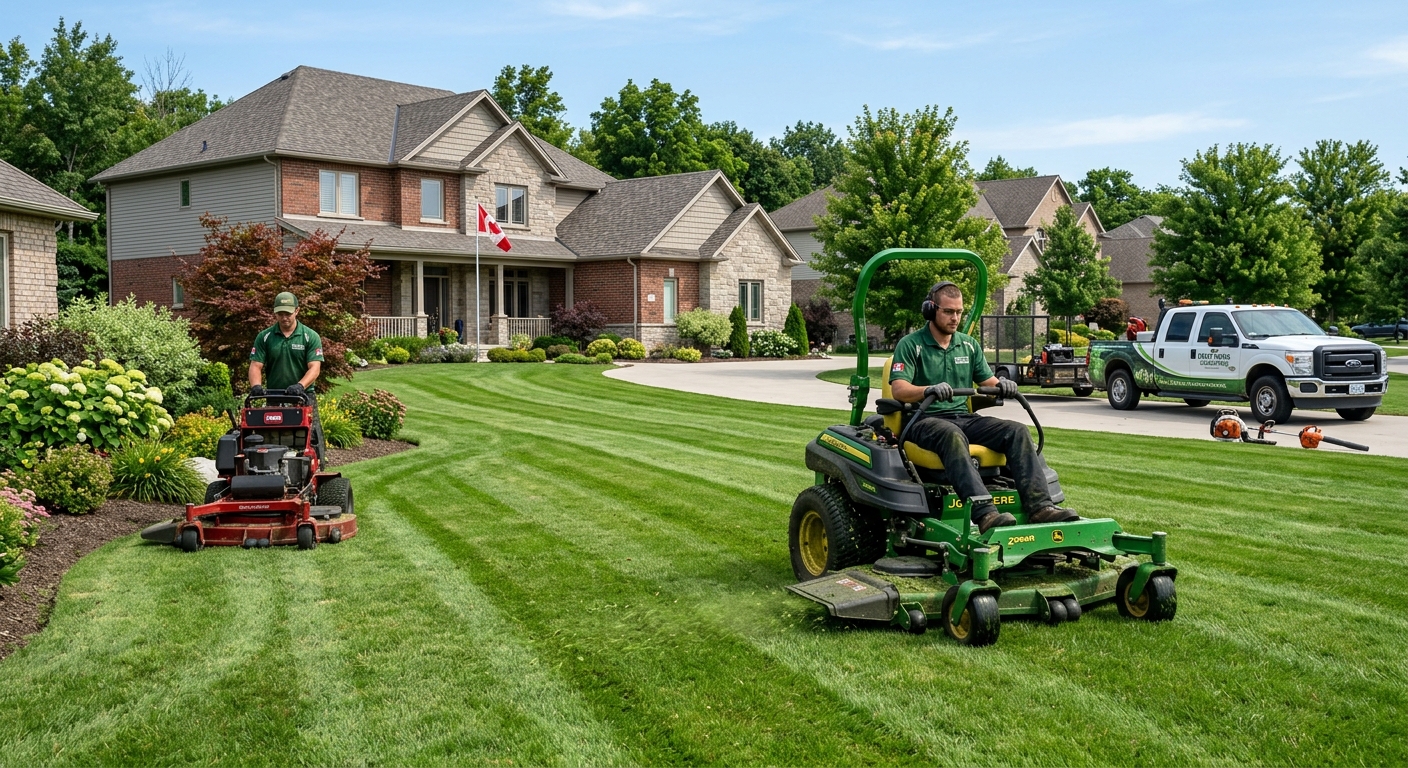
Landscaping options and costs in Orillia
Orillia homeowners typically have a lot of yard-focused options, from quick lawn upgrades to full-service design and hardscape builds. In Orillia’s housing mix, detached homes make up 55.7% of dwellings, so many lots can accommodate patios, drainage corrections, and tree planting. With homeowner households at 8,825 (61.2% of households own), it’s also common for budgets to move beyond “nice to have” and toward long-term value improvements.
In the Kitchener–Waterloo–Barrie market, landscaping costs are shaped by a defined frost window and freeze–thaw cycles. That means a project that looks “simple” on paper—like a patio or retaining wall—often requires deeper, well-compacted granular base and drainage detailing so frost heave doesn’t lift edges. Work is also concentrated roughly from mid-April through October, so contractors schedule crews tightly in spring and early fall, which can tighten availability and raise labour rates for short-notice projects. Demand is especially strong around East Ridge and the higher-turnover residential pockets along west-side growth corridors, where homeowners frequently refresh curb appeal before selling.
Below is a practical range of what you’ll commonly see for Orillia scope sizes, using typical Ontario material pricing and the regional installation approach used in Zone 5b–6a. Use it to compare proposals apples-to-apples, then tailor up or down based on yard size, access, and drainage needs.
| Service |
Description |
Season |
Price Range |
| Full landscape design and installation |
Site visit, layout, plant palette, grading/drainage plan, hardscape/softscape installation, cleanup |
Mid-April through October |
$8,000–$60,000 |
| Sod installation (supply, grade, lay, roll) |
Remove/grade existing surface, topsoil adjustment, starter fertilizer, sod placement and rolling |
Spring and early fall (best results) |
$5–$10 |
| Lawn seeding (grade, seed, starter fertilizer) |
Light grading, seed mix, starter fertilizer, mulching/blanket as needed |
Spring and early fall |
$5–$10 |
| Interlocking patio or walkway |
Excavation, compacted base, leveling sand, interlocking stone, edging, jointing sand |
May through September (weather permitting) |
$120–$300 |
| Retaining wall (interlocking block) |
Base prep below frost depth, geotextile, drainage gravel, block system and finishing |
May through September |
$120–$300 |
| Tree and shrub planting |
Soil prep, amendment, staking as required, planting, mulch rings, initial watering plan |
Spring and early fall |
$500–$15,000 |
Prices are estimates only and vary by project scope, site access and material selection.
What affects the price of landscaping in Orillia
For the same “headline” project, Orillia quotes can vary by 30–50% across the Kitchener–Waterloo–Barrie region and Ontario because the differences are rarely in the plants—they’re in the prep and risk management. Labour availability, crew size, equipment access, and how thoroughly drainage and frost-related base depth are handled can shift totals dramatically. In Southern Ontario’s Zone 5–6 climate, the plant hardiness zone and frost dates also define what you can install confidently and how long contractors have to work before temperatures and soil conditions slow down. When freeze–thaw hits, weak base compaction and poor drainage become expensive rework.
That’s why local conditions matter more than they do in colder Prairie regions, where you often need extra wind- and drought-tolerant species and you’re dealing with a shorter workable growing window. Compared to coastal BC (longer growing season), Ontario builds usually trade lush palettes for hardier, frost-resilient selections, and both pricing and schedules reflect the more limited season. Water restrictions in parts of dry BC also push irrigation design there; in Orillia we don’t face the same strict restrictions, but summer dry spells still occur, so efficient zoned irrigation and drought-tolerant turf can prevent costly patch-ups.
Concrete examples in Orillia: (1) a backyard patio that needs re-grading from a slight slope may add significant drainage and excavation time—often moving a job from the lower end of the $120–$300 range to the higher end. (2) A mature tree and privacy shrub package can swing totals widely: going from young stock to a larger specimen set can quickly land closer to the $500–$15,000 band, especially with staking, topsoil amendment, and careful planting to protect roots.
Home age plays in too. With 58.0% of Orillia homes built before 1981, you’ll often see older lot grading, older drainage patterns, and more frequent “findings” during excavation, which can increase costs for soil correction and drainage beds versus a newer build where utilities and grading are more predictable—sometimes by thousands depending on how far down the contractor must correct.
| Price Factor |
Why It Matters |
Cost Impact |
| Yard size in sq ft — the primary cost driver for softscape |
More coverage affects topsoil, seed/sod, mulch, and labour hours |
Higher material + crew time; often the biggest swing factor |
| Grading and drainage work — slope corrections add significant cost |
Correcting pooling or directing water away from the foundation requires excavation and re-compaction |
Can add substantial labour/equipment costs |
| Drainage bed or French drain installation |
Reduces hydrostatic pressure under patios and near walls |
Adds trenching, pipe, gravel, and disposal time |
| Plant material tier — native shrubs vs. ornamental vs. mature specimen trees |
Larger or more mature plants cost more and need extra handling |
Mature specimens can multiply planting costs |
| Hardscape vs. softscape ratio — walls and patios cost more per sq ft than lawn |
Interlocking base prep and stone quantities raise unit costs |
More hardscape pushes total toward the upper price bands |
| Irrigation system design and installation |
Zoned heads, controller, and coverage mapping prevent dry-stress and rework |
Can be a mid-project add-on with noticeable budget impact |
| Soil amendment and topsoil required |
Orillia soils often need correction for texture, drainage, and rooting depth |
May increase costs if existing soil is compacted or poor quality |
| Tree removal or stump grinding before new planting |
Roots and stumps affect planting layout and can add hauling/processing time |
Removal can meaningfully increase project totals |
Permits & regulations in Ontario
In Ontario, most planting, sodding, and typical softscape work (mulch, seeding, garden bed planting, general grading for landscaping) usually does not require a permit. Where permits commonly come into play is when a project involves structural or boundary-adjacent changes. Retaining walls above a municipal threshold—often around 1.0 m (3.3 ft) in many jurisdictions—may require a building permit and sometimes engineered drawings. Also, changes to lot grading that affect how water drains toward neighbouring properties or ties into storm connections can trigger approval requirements, because drainage design affects runoff and erosion risk.
Before anyone digs, have utility locates done so excavation doesn’t strike buried services. In Orillia, contractors should call for locates for planting holes, trenching for drains, and any wall footings. If you’re adding irrigation, confirm your local water-use rules and seasonal restrictions. While interior BC and parts of Alberta see tighter restrictions during dry periods, Ontario municipalities can still implement watering guidelines during hot stretches, and it’s wise to design around them with zoned irrigation and efficient scheduling.
To verify contractor credentials in Ontario, follow this sequence: (1) check the contractor’s business name and any relevant trade registration through appropriate provincial/registry sources, (2) request a certificate of liability insurance showing adequate coverage and effective dates, (3) confirm WSIB coverage or a valid clearance where applicable, and (4) ensure the certificate lists the correct legal company name used on your contract. Then compare the quote’s “what’s included” line to ensure permit work, disposal, and protection (like eaves/driveway edge protection) aren’t missing.
Planning a landscape that thrives in Orillia's climate
Planning in Orillia means working with a Zone 5–6 frost regime, not against it. Start with plant selection: choose native and zone-appropriate species that handle freeze–thaw well and don’t demand constant winter protection. In practice, that reduces watering and replacement costs over time, especially for shrubs and perennial borders.
For turf, decide between sod and seed based on how fast you need results and how much groundwork you’ll do. Sod gives instant coverage and helps prevent erosion, but it typically costs about 3–4 times more per sq ft than seeding once you factor in material. Seeding is slower, but it’s often the best fit for broader lawns if you can wait through establishment.
Drainage and grading are critical in the Kitchener–Waterloo–Barrie market because pooling water plus winter freeze can lead to heaving and edge failure. Even small changes—like correcting a slight slope away from the foundation—can prevent foundation moisture and keep patios and walks stable. For hardscape, base preparation needs to consider the local frost line and the region’s freeze mechanics: deeper, well-compacted granular bases with proper drainage reduce lift and cracking.
To keep maintenance reasonable, use low-maintenance strategies: mulch depth for weed suppression, groundcovers where lawns struggle, and perennials that return reliably. For water-conscious design, consider rain gardens and xeriscape-style planting beds around downspouts, with efficient drip irrigation where needed.
Dollar example: if your lawn area needs 400 sq ft of renovation, seeding may fit a tighter budget than sod. With sod often starting around the $5–$10 per sq ft band and full installs scaling upward with grading and prep, many homeowners justify sod for smaller “high-visibility” zones (front approach), while seeding larger backyard expanses where you don’t need instant curb impact.
| Element |
Climate Consideration |
Maintenance Level |
Price Band |
| Sod lawn installation |
Roots establish before frost; best in spring or early fall for Zone 5–6 |
Low short-term once established; requires proper watering during establishment |
$5–$10 |
| Native perennial garden |
Hardy plants tolerate freeze–thaw; seasonal dieback is expected |
Medium (spring cleanup, occasional dividing) |
$500–$15,000 |
| Mulched shrub border |
Mulch buffers temperature swings and helps protect roots |
Low to medium (weed control, watering in dry spells) |
$500–$15,000 |
| Interlocking stone patio |
Needs frost-aware base and drainage to prevent heaving |
Low (occasional joint sand top-up, basic cleaning) |
$120–$300 |
| Retaining wall (block) |
Footings and drainage gravel must handle freeze pressure and runoff |
Low after build (monitor drainage and weep holes) |
$120–$300 |
| Drip irrigation system |
Zoned delivery supports efficient watering during summer dry spells |
Medium (seasonal adjustments and maintenance) |
$8,000–$60,000 |
How to choose a landscaping contractor in Orillia
Choosing the right contractor in Orillia starts with verification. First, request proof of Ontario licensing/trade registration if applicable to the work you’re hiring for, and confirm the business name matches the quote and contract. Next, ask for a certificate of liability insurance—check coverage limits are adequate for excavation and hardscape work, and that the certificate is current. For labour coverage, confirm WSIB/WCB status: the contractor should provide either proof of coverage or a clearance letter, depending on their employment/operations. Don’t rely on verbal assurances; ask for documents before signing.
Then get 2–3 written, itemised quotes—not lump sums. A good proposal breaks out labour and materials (stone type, base materials, soil/topsoil, drainage components, plant sizes). Review what’s excluded: is disposal included, are locates included, and does the price include edge finishing, clean-up, and final grading? For permits, confirm whether permit pulling (if required for a higher retaining wall) is included or billed separately. Warranty matters too: look for a workmanship warranty length, separate from product/manufacturer warranties, and ask whether warranties are transferable to future owners.
Payment schedules should protect you. A safe guideline is never paying more than 10–15% upfront, with the remainder tied to milestones and a holdback until completion. Finally, lock the timeline in writing—get a start date and an estimated completion date that reflects the normal April-to-October installation season and weather dependencies.
- Use a contract that lists scope, materials, and exact quantities where possible
- Confirm insurance (liability) and WSIB/WCB coverage with documents
- Ask for the installation method: base depth/compaction, drainage approach, and weed-control plan
- Check whether sod/seed prep includes soil amendments and proper grading
- Verify plant sourcing: nursery, sizes (height/diameter), and replacement policy
- Get disposal details: topsoil spoils, sod waste, and stone off-haul included or not
- Confirm irrigation design includes zoning and controller setup (if you’re adding it)
- Ask how they protect lawns, driveways, and eaves during equipment access
- Ensure hardscape includes edging, jointing sand specifications, and final cleanup
- Clarify warranty terms in writing, including what triggers a service call
- Tie payments to milestones; keep a completion holdback
- Require a signed start/completion schedule and weather plan contingencies
Red flags in Orillia: (1) quotes that won’t provide insurance and WSIB/WCB proof, (2) “cheap” hardscape bids that skip drainage or base-compaction details, (3) lack of itemisation—no line-by-line materials and labour, (4) pushing for large upfront payments, and (5) no clear warranty or warranty that only covers “materials” while workmanship is excluded.
Frequently asked questions — landscaping in Orillia
What is the best grass type for a Orillia lawn?
For Orillia (Zone 5–6 conditions with winter stress and spring thaw), most homeowners do best with a cool-season turf that handles mowing and traffic while remaining hardy through freeze–thaw. Many contractors recommend a fine fescue–leaning mix or a blend that includes Kentucky bluegrass or turf-type tall fescue, depending on sun exposure and soil quality. If your yard stays damp or has shaded areas, a fescue-forward mix usually performs better because it tolerates variable moisture. When you price the approach, compare seeding to sod carefully: sod installs can start around $5–$10 per sq ft for many supply-and-install packages, while seeding is usually lower cost and works well if you can manage establishment watering.
When should I aerate and overseed my lawn in Orillia?
In Orillia, aeration and overseeding are typically done in spring or early fall, when soil temperatures support germination and grass can recover before winter. Spring is often the first window after the ground thaws and dries enough to avoid compaction; early fall is commonly preferred because seedlings face less heat stress and have more time to root before the first frosts. If you overseed, match seed type to your existing turf mix and improve soil contact—topdressing or a light rake-in can help. If you’re comparing options, seeding is usually the budget-friendly route versus full sod; sod is often priced around $5–$10 per sq ft for many packages, while overseeding is a smarter choice for thickening an existing lawn.
What trees grow best in Orillia's climate zone?
Orillia’s frost-driven winters (Zone 5–6) favour trees that are hardy and can tolerate freeze–thaw and periodic snow/ice loads. Common “works well here” choices include serviceberry (Amelanchier), white cedar for screening (where appropriate), and hardy deciduous options like sugar maple (where soils suit), lilac as part of layered planting schemes, and some ornamental crabapples for smaller yards. For faster privacy you’ll also see maples and other hardy selections used, but soil drainage and spacing matter—poor drainage can raise establishment costs because trees need more root protection and amendment. If you’re budgeting, planting packages vary widely based on size and maturity; many Orillia projects land somewhere within the $500–$15,000 band when you include soil prep, mulch, and proper staking.
How much does sodding a yard cost in Orillia?
Sodding costs in Orillia depend mainly on yard size, existing conditions, and how much grading/topsoil work is needed. For many full-service quotes, sod supply and installation is commonly priced in the $5–$10 per sq ft range, but total project cost can increase if the contractor needs to correct drainage, remove old dead sod, haul away debris, or add soil amendment. In the Orillia area, crews generally prefer spring and early fall for best establishment before winter and after heat stress fades. If you’re replacing a lawn that’s patchy due to drainage or compacted soil, ask whether your contractor includes grading and amendment; otherwise you may be paying for sod again after it thins.
How do I prevent weeds in my Orillia garden?
Weed control starts before planting. In Ontario yards like those around Orillia, the best prevention is a layered approach: remove established weeds thoroughly (especially in seeded beds), install clean edging so weeds don’t migrate from lawn, and use a consistent mulching strategy. A properly prepared soil base helps too—compacted soil creates weak plant growth, and stressed plants can’t outcompete weeds. For shrubs and perennial borders, weed-suppressing fabric is sometimes used under mulch, but it isn’t a magic fix; plants still need space to root. If you’re planning a new border, consider combining mulch with native perennial selections to reduce maintenance. For budgets, shrub and tree planting projects often fall within the $500–$15,000 range depending on plant sizes and soil preparation.
How do I design a low-water yard in Orillia?
A low-water yard in Orillia should still be realistic: we don’t have the strict year-round water limits seen in some dry interior regions, but summer dry spells are common, so efficient design matters. Start with grading and drainage so water goes where you want it rather than pooling or running off. Use drought-tolerant turf in the sun where appropriate and native perennials/groundcovers in beds; these are typically more resilient in Zone 5–6 than high-maintenance ornamentals. Add mulch to reduce evaporation and consider drip irrigation with zoning so you only water where plants need it. If you’re comparing up-front costs, sod and full installation can be pricey relative to seeding and targeted bed work; sod packages often start around $5–$10 per sq ft, so many homeowners justify focusing spending on drainage, mulched beds, and drip irrigation rather than converting every area to turf.