Landscaping options and costs in Canoe
In Canoe, British Columbia, homeowners usually start with either a softscape refresh (planting and lawn) or an upgrade that changes how the yard works (patios, walkways, drainage, and retaining walls). With a small local population of 1,081 (Statistics Canada, 2021 Census), contractor capacity can feel tight during busy spring weeks, which is one reason lead times sometimes shift between neighbourhoods. Canoe also has a housing pattern that leans heavily toward detached homes, so most projects are built around driveways, side yards, and usable ground space—exactly where good grading, soil prep, and layered planting make the biggest difference in curb appeal and long-term maintenance.
Because Canoe sits in the Lower Mainland–Southwest market context, you benefit from plant hardiness zones 7–8, mild, wet winters, and long cool summers. That extended season helps reduce weather delays compared with Prairie regions, so landscape design & installation commonly fits a steadier construction window. However, the region’s freeze–thaw cycles still matter for patios and retaining walls: bases need deeper excavation, proper drainage, and compacted gravel to limit frost heave and wall movement on sloped lots. On top of that, even when there aren’t constant drought bans like the BC Interior, water costs and municipal efficiency expectations encourage efficient irrigation—often drip and smart controllers—especially for new beds.
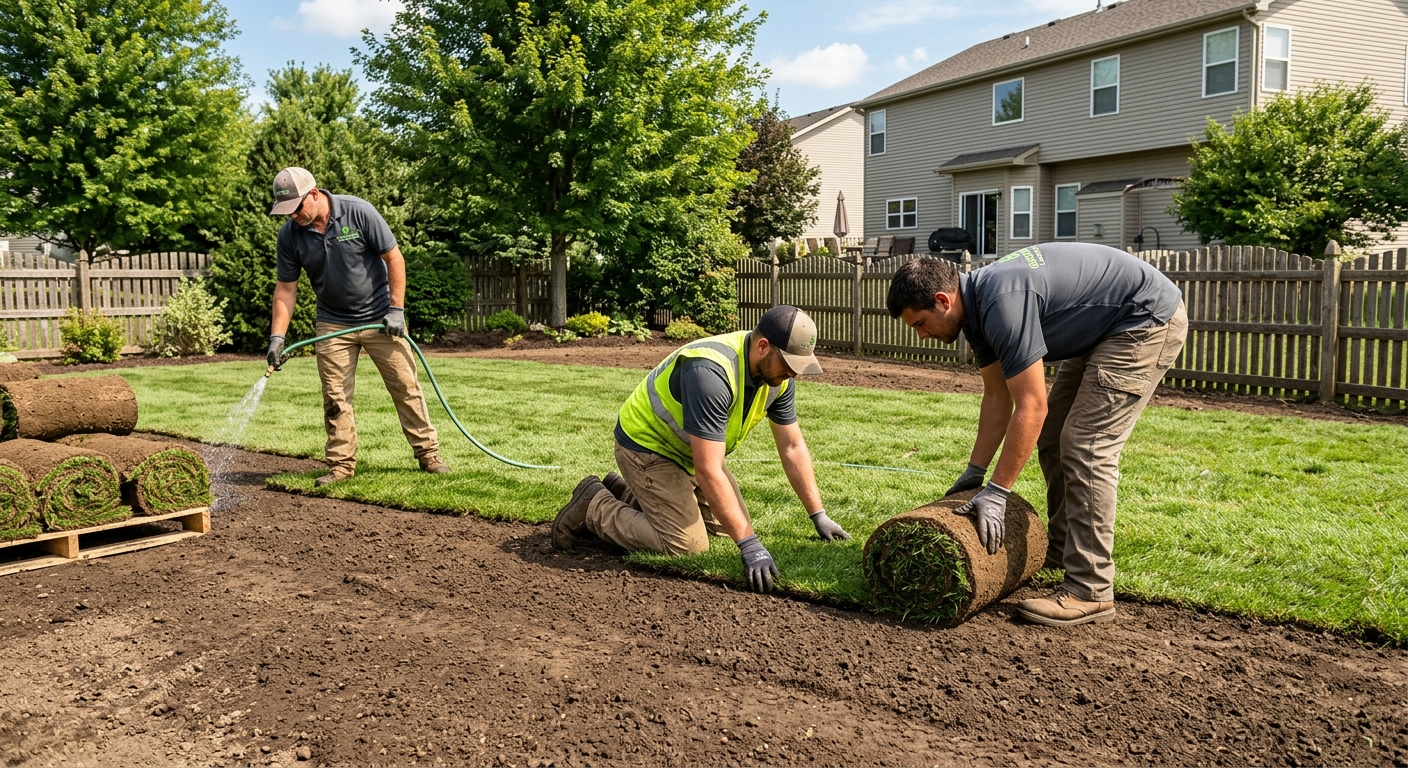
In Canoe’s North End area, where many yards back onto drainage swales or have grade changes, contractors are especially in demand for drainage improvements, terracing, and walkable hardscape connections. With that in mind, here’s how common landscaping options typically price out, moving from full-yard transformations to smaller upgrades.
| Service |
Description |
Season |
Price Range |
| Full landscape design and installation |
Site measurement, design, grading/drainage plan, planting + hardscape coordination |
Spring–Fall (winter work only for select soil moves) |
$5,000–$50,000 |
| Sod installation (supply, grade, lay, roll) |
Topsoil/grade prep, sod delivery, lay/roll, starter watering plan |
Best: late Mar–Jun; also Sep–early Oct |
$2,000–$8,000 |
| Lawn seeding (grade, seed, starter fertilizer) |
Light grading, seed blend, starter fertilizer, mulch or erosion control as needed |
Best: Apr–May; Sep for cooler germination |
$1,200–$5,500 |
| Interlocking patio or walkway |
Excavation, base (compacted), jointing sand, paver installation, edge restraint |
Spring–Fall (avoid wettest weeks) |
$4,000–$35,000 |
| Retaining wall (interlocking block) |
Terracing, block placement, drainage gravel, weeper provisions, backfill compaction |
Spring–Fall |
$10,000–$80,000 |
| Tree and shrub planting |
Soil amendment, planting, staking (if required), mulch rings, watering plan |
Spring–early summer; fall planting when conditions allow |
$1,000–$15,000 |
Prices are estimates only and vary by project scope, site access and material selection.
What affects the price of landscaping in Canoe
In the Lower Mainland–Southwest region and across British Columbia, two contractors can quote the “same” landscaping job and still end up 30–50% apart. The main reasons are site realities (how much earth needs moving), labour availability in peak weeks, and material tiering (the difference between young liners and mature specimen trees). Weather also plays a role: in Canoe’s zone 7–8 conditions, you can often work longer into the year than in colder regions, but the wettest winter weeks can slow structural hardscape work. When labour is busy, crews charge accordingly, and scheduling can push parts of a project into higher-demand months.
Local hardiness and frost timing affect both plant selection and the construction window. Even though coastal BC offers a longer growing season, freeze–thaw cycles still influence retaining wall and patio base depth—so drainage stone depth, compaction requirements, and excavation volume can raise costs versus “flat” yards. In contrast, Prairie areas (zone 2–4) typically need more drought-tolerant, wind-hardy planting and deeper frost-line considerations, often compressing timelines and increasing the likelihood of staged installs. Coastal BC allows lush layered palettes, but good drainage is non-negotiable where soils stay wet.
Here are a few concrete examples that raise or lower costs in Canoe. First, a sloped backyard that needs regrading can add significant labour and trucking; that’s why a full landscape may start around the lower end of the $5,000–$50,000 range, but climb quickly when grading and drainage are major. Second, choosing sod over seeding can justify higher spend when you need instant curb appeal—sod installations commonly sit in the $2,000–$8,000 band, while seeding is often far less, provided you accept a slower “fill-in” period. Third, if your planting plan includes larger trees, costs trend toward the upper part of the $1,000–$15,000 tree & garden planting range due to pit size, soil amendment volume, and hauling.
| Price Factor |
Why It Matters |
Cost Impact |
| Yard size in sq ft — the primary cost driver for softscape |
More area increases topsoil, labour hours, and plant/sod quantities |
Often the biggest swing; can change total by several thousand dollars |
| Grading and drainage work — slope corrections add significant cost |
Requires excavation, re-contouring, and proper fall away from foundations |
Can add major cost, pushing projects from mid-range into upper ranges |
| Drainage bed or French drain installation |
Subsurface control prevents pooling, foundation moisture, and plant failure |
Frequently adds a noticeable line item due to rock, fabric, and pipe |
| Plant material tier — native shrubs vs. ornamental vs. mature specimen trees |
Larger stock costs more and requires deeper pits and more labour |
Can double material spend on planting-heavy designs |
| Hardscape vs. softscape ratio — walls and patios cost more per sq ft than lawn |
Base preparation, materials, and equipment time drive cost |
Hardscape-heavy yards commonly exceed lawn-only budgets quickly |
| Irrigation system design and installation |
Smart controllers, efficient heads, and correct zoning reduce future water waste |
Adds cost up front, often lowering long-term maintenance and water use |
| Soil amendment and topsoil required |
Improves rooting in wet winters and supports strong growth through cool summers |
Bulk delivery and haul/disposal can raise the estimate |
| Tree removal or stump grinding before new planting |
Clears access and avoids root competition; affects schedule |
Can add both labour and equipment charges, especially with large stumps |
Permits & regulations in British Columbia
In British Columbia, planting, sodding, and most softscape work typically do not require a permit. That includes installing shrubs and perennials, laying sod, spreading topsoil, and adding mulch beds—provided you’re not significantly changing how water runs off your property. Where permits often come into play is structural work: retaining walls above the local threshold—commonly 1.0 m (3.3 ft) in many municipalities—usually require a building permit and sometimes engineered drawings. Also, if your project involves changes to lot grading that redirect drainage toward neighbouring properties or storm sewer connections, approvals may be required.
No matter what size job you’re planning, call for utility locates before digging planting holes, trenching for drainage, or excavating wall footings. That simple step helps avoid expensive utility strikes and delays. For watering rules, confirm your local irrigation and water-use bylaws, especially during drought conditions—Canada’s water restrictions can tighten quickly, and the Lower Mainland’s “mild climate” doesn’t always eliminate local compliance expectations.
To verify a Canoe contractor is properly set up, you can confirm these items step-by-step: (1) Licence/registration status—check the appropriate provincial registry where applicable for contractors in BC; (2) Liability insurance—request a current certificate of insurance and confirm the policy covers landscaping/hardscape work and the correct project address; (3) WCB coverage—ask for clearance evidence (or the contractor’s WCB status documentation) showing the firm is in good standing for workers. If a contractor won’t provide documents promptly, that’s a major warning sign.
Planning a landscape that thrives in Canoe's climate
To plan a landscape that thrives in Canoe, you want to work with zone 7–8 conditions, not against them. Start with plant selection: choose hardy, zone-appropriate species (native or well-adapted ornamentals) that can handle wet winters and cool summers with less intervention. Many homeowners also underestimate winter wetness; layered mulch and correct spacing help prevent rot and reduce winter cleanup.
Next, decide between sod and seed. Sod gives instant coverage and erosion control, but it’s typically about 3–4 times the cost per sq ft compared with seeding. If your priority is “ready-to-enjoy this season,” sod in the $2,000–$8,000 band can be worth it; if you’re patient and willing to baby the first growing window, seeding can be a smarter value approach. In either case, aim for a grade that drains away from foundations—pooling water is one of the fastest ways lawns and bed edges fail in this Lower Mainland–Southwest context.
Drainage and grading deserve top attention. For sloped yards and foundation-adjacent areas, consider a drainage bed or French drain where water collects. If you’re adding patios or retaining walls, base prep must account for the local freeze–thaw cycle: deeper excavation, compacted granular base, and restrained edges reduce movement. For low-maintenance design, use groundcovers, thick mulch layers, and long-blooming perennials to reduce weeding and seasonal replanting. Where water efficiency matters, a rain garden can capture downspout flow and infiltrate slowly, while xeriscape-style planting can supplement irrigation in drier stretches—without leaving your yard bare in wetter months.
For a dollar reality check: if you spend near the top of the sod range (for example, closer to $8,000) you’re buying immediate results and erosion protection. If your goal is long-term curb appeal and you can wait for gradual fill-in, seeding can keep more budget available for hardscape or drainage—often the items that protect your investment for years.
| Element |
Climate Consideration |
Maintenance Level |
Price Band |
| Sod lawn installation |
Best results with correct grading and spring/fall install around frost timing |
Low to moderate (watering until established) |
$2,000–$8,000 |
| Native perennial garden |
Zone-appropriate plants handle wet winters with mulch and good spacing |
Low (weeding early, then light seasonal tidy) |
$1,500–$10,000 |
| Mulched shrub border |
Improves soil moisture stability and reduces mud splash during wet weeks |
Low (refresh mulch annually) |
$1,200–$7,500 |
| Interlocking stone patio |
Proper base depth and drainage to resist frost movement |
Low (periodic sand/joint top-up) |
$4,000–$35,000 |
| Retaining wall (block) |
Drainage gravel and backfill compaction to manage water behind wall |
Low (inspection and minor patching) |
$10,000–$80,000 |
| Drip irrigation system |
Efficient watering suited to occasional restrictions and targeted bed needs |
Low to moderate (seasonal checks) |
$1,500–$10,000 |
How to choose a landscaping contractor in Canoe
Choosing the right landscaper in Canoe starts with proof. First, verify British Columbia licensing/registration where applicable and ask for the contractor’s liability insurance certificate—make sure it lists coverage appropriate for landscaping and hardscape scope. Next, confirm WCB coverage status: request clearance evidence or the current WCB documentation showing the company is in good standing for its workers. If you’re comparing multiple quotes, the firms that can provide these documents quickly (without hesitation) usually have more stable crews and clearer project planning.
Then get 2–3 itemised written quotes, not just a lump sum. Ask for a labour + materials breakdown for major scope pieces like excavation, drainage stone, soil/topsoil, plants, sod/seed, and paver base work. A good quote clearly spells out what’s included: permit pulls (if required), material substitutions, debris disposal, and whether site protection (hoses, lawn areas, driveway protection) is part of the plan. Watch for exclusions like “rock removal not included” or “grading assumed flat”—those are common cost traps.
Warranty matters too. Confirm workmanship warranty length for hardscape and drainage, plus the product/manufacturer warranty for plants and any irrigation components. Ask whether the warranty is transferable to you as the homeowner. For payment, avoid paying more than 10–15% upfront. Use a holdback until the final walkthrough is done and deficiencies (if any) are corrected. Finally, request a start date and an estimated completion timeline in writing, including weather contingency notes for wet weeks.
- Provide WCB/clearance documentation and a current certificate of liability insurance
- Use a site visit—quotes based only on photos often miss grading and drainage realities
- Itemise labour and materials (no blanket “landscaping package”)
- List included and excluded work (demo, hauling, disposal, utility locate allowance)
- Confirm whether permit pulls are included for retaining walls over the typical threshold
- Show drainage details: pipe size/placement, drainage stone depth, and fabric use
- For sod/seed, specify prep requirements and soil amendment (not just “lay sod”)
- For patios, specify base thickness, compaction, and edge restraint material
- Confirm irrigation design scope if included (zones, controller type, drip vs sprinklers)
- Ask about material sourcing timelines so you’re not stuck waiting on plants or pavers
- Put warranty terms in writing (workmanship and any manufacturer plant/irrigation coverage)
- Use milestone payments with a final holdback after cleanup and walk-through
Concrete red flags in Canoe include: (1) refusing to provide insurance and WCB evidence on request, (2) “cheap” quotes that omit drainage/grading details but still include retaining walls or large patios, (3) no written scope for disposal or hauling, (4) vague start dates (“weather permitting”) with no completion estimate, and (5) asking for large deposits (well above 10–15%) before any work begins.
Frequently asked questions — landscaping in Canoe
Sod vs seed — which is better for a Canoe lawn?
In Canoe, both sod and seeding can work well because zone 7–8 typically supports a strong growing season with fewer extended frozen stretches. Sod is the best choice when you want instant coverage, curb appeal right away, and faster erosion control—especially on slopes or newly graded areas. The trade-off is cost: sod installation often lands in the $2,000–$8,000 band, depending on yard size and prep. Seeding costs less in many projects, and it’s a good option if you can manage early watering and accept a fill-in period. If your soil drains poorly, either approach will struggle—so ask for grading/drainage prep in the quote. In short: choose sod for speed and reliability; choose seed when budget and patience matter most.
How much does a retaining wall cost in Canoe?
Retaining walls in Canoe typically fall within the $10,000–$80,000 range, depending on height, length, site access, and how much drainage work is required behind the wall. The biggest cost drivers are excavation volume, how deep the base must go to handle freeze–thaw conditions, and the amount of backfill and drainage gravel installed to keep water from building pressure behind the structure. Interlocking block walls also require careful compaction and drainage details (weep provisions and proper grading). If the design needs engineering or a permit due to height thresholds (commonly around 1.0 m in many BC municipalities), expect additional time and documentation costs. The most cost-effective quotes are usually the ones that clearly spell out drainage—because wall failures are expensive.
When is the best time to landscape in Canoe?
For most landscaping in Canoe, late March through June is prime for planting and lawn establishment, and September into early October is often excellent for fall planting and soil restoration. The Lower Mainland–Southwest context gives you a long workable season, but wettest stretches can slow earthwork and hardscape finishing—so scheduling matters. Structural work like patios and retaining walls is usually best during dryer weeks because proper base preparation and compaction need stable conditions. If you’re doing sod, aim for consistent spring or early fall weather so roots knit before heavy rains or cold snaps. For planting, you can often work longer than colder regions, but make sure the contractor accounts for wet winter soils and uses mulch and correct spacing to reduce winter stress. A written timeline from your contractor should include realistic weather contingency.
Do I need a permit for a retaining wall in British Columbia?
Often, yes—depending on the wall height and how your project changes the site. In British Columbia, planting and most softscape work usually do not require permits, but retaining walls above a local threshold commonly around 1.0 m (3.3 ft) typically require a building permit, and sometimes engineered drawings. Also, if your grading changes affect drainage patterns toward neighbouring properties or storm connections, approval requirements can apply. The best approach is to confirm with your local municipality and ensure your contractor’s plan aligns with those rules. In your quote, ask whether permit pulling is included and who is responsible for applications. For safety and compliance, also ensure utility locates are done before digging wall footings or trenches.
How do I improve drainage in my yard?
In Canoe and the broader Lower Mainland–Southwest context, drainage is often the difference between a yard that looks great for years and one that stays muddy or kills plants. Start with a drainage diagnosis: where does water pool after heavy rain, and does it move toward foundations or neighbour areas? Improvements commonly include regrading to create positive fall away from structures, installing a drainage bed or French drain in problem zones, and ensuring downspouts discharge to a safe infiltrating area rather than into low spots. In planting areas, using proper soil amendment and mulch helps, but it won’t fix a badly pitched lawn. For hardscape projects, the patio or wall base must include correct granular layers and weeper/drainage gravel behind retaining blocks. A good contractor will map out drainage before ordering stone or sod.
What is xeriscaping and does it suit Canoe?
Xeriscaping is a water-wise approach that uses drought-tolerant plants, efficient soil preparation, and smart irrigation (or no irrigation for parts of the yard) to reduce water use. In Canoe, it can still suit many properties—especially in sunnier areas, near driveways, or where municipal water costs make homeowners more mindful of irrigation—though you still need a design that handles wet winters without rotting roots. That means combining moisture-managing strategies: improve drainage where needed, use mulch and groundcovers, and select zone-appropriate plants that tolerate both cool wet periods and warmer dry spells. If your yard already experiences pooling, xeriscape alone won’t solve drainage issues; it works best when drainage and grading are corrected first. For budgets, xeriscaping can reduce ongoing upkeep, but you may still invest in drainage and irrigation layout—often a line item in $1,500–$10,000 depending on system complexity.