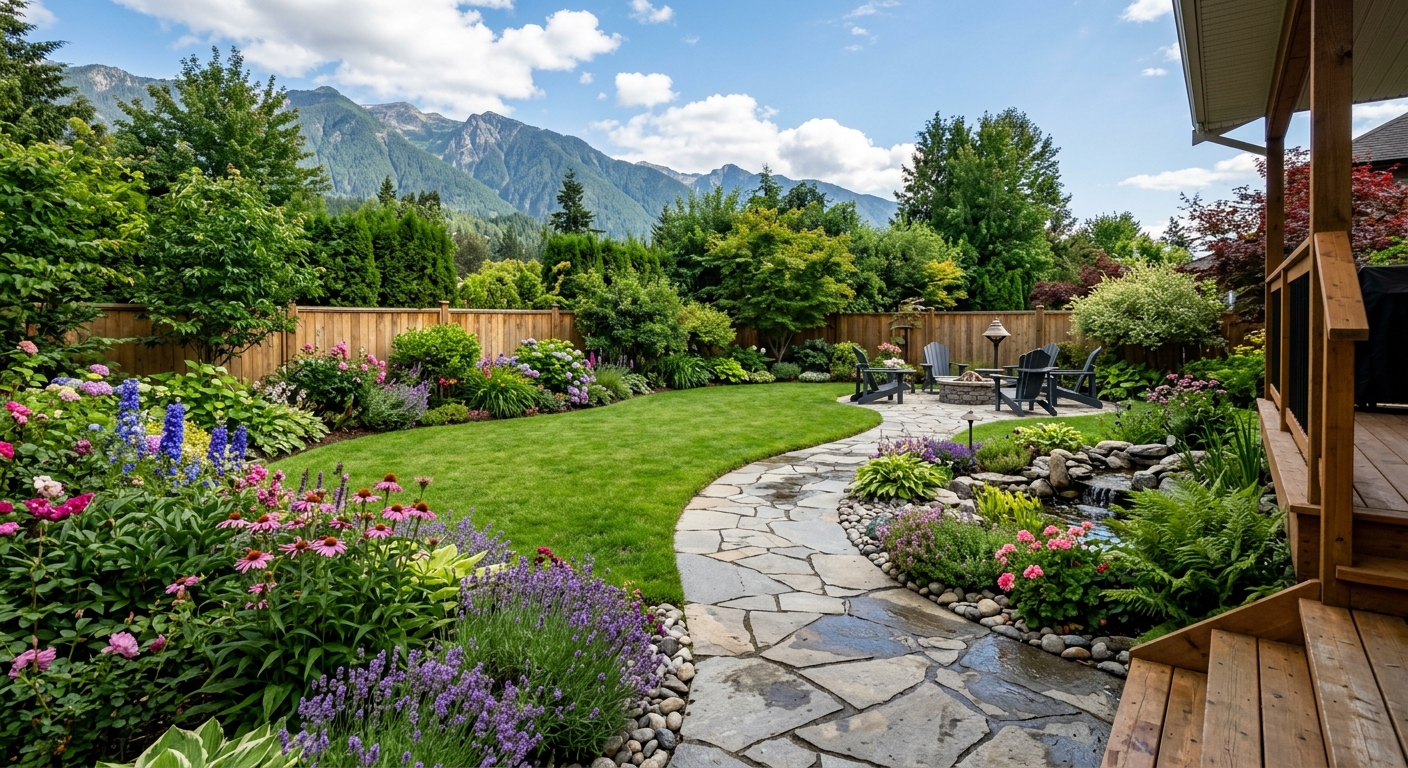
Landscaping options and costs in Strathcona
In Strathcona, British Columbia, homeowners usually want a yard that looks established quickly, but still performs through the region’s mild, wet winters and long cool growing season. With a local population of 12,585 (Statistics Canada, 2021 Census), there’s steady demand for trades, especially around high-traffic family areas where people invest in curb appeal and outdoor living. Strathcona’s housing stock also includes a meaningful mix of detached homes, and because detached properties often have more usable yard space, they’re where we most frequently see full-scope landscape makeovers—patios, layered planting beds, and irrigation.
Lower Mainland–Southwest pricing is shaped by two things: labour availability across a busy market, and the fact that contractors can work more months of the year than in colder provinces. That said, wet weather still interrupts excavation and compaction, so drainage work and hardscape base prep can swing a project higher or lower. Structural elements like retaining walls also have to respect freeze–thaw movement. Even though soil may not freeze solid for long stretches, proper base depth and drainage details prevent frost heave and wall movement on sloped lots, which is common in areas like Strathcona Heights.
Below is a realistic cost comparison you can use to shortlist scope with any contractor, before you get into site-specific numbers.
| Service |
Description |
Season |
Price Range |
| Full landscape design and installation |
Site visit, concept + layout, planting plan, grading notes, irrigation allowance, hardscape/softscape installation |
Spring to fall (softscape best Mar–Oct; hardscape as weather allows) |
$10,000–$45,000 |
| Sod installation (supply, grade, lay, roll) |
Minor grading, soil preparation, sod delivery and laying, rolling, starter fertilization |
Late spring to early fall |
$3,500–$7,500 |
| Lawn seeding (grade, seed, starter fertilizer) |
Light regrade, seed blend selection, starter fertilizer, mulch/blanket, light watering schedule |
Early spring and late summer |
$2,000–$5,000 |
| Interlocking patio or walkway |
Excavation, compaction, base (granular), edge restraints, geotextile, interlock pavers, finishing |
Spring to early winter (avoid wettest weeks) |
$12,000–$40,000 |
| Retaining wall (interlocking block) |
Engineering/permit allowance where needed, wall block system, compacted base, drainage gravel + weeping tile options |
Spring to fall |
$15,000–$65,000 |
| Tree and shrub planting |
Soil prep, amendments, staking (as required), mulching, watering-in plan |
Spring to fall |
$1,500–$14,000 |
Prices are estimates only and vary by project scope, site access and material selection.
What affects the price of landscaping in Strathcona
Even when two neighbours ask for “the same” landscaping, Strathcona quotes can land 30–50% apart across Lower Mainland–Southwest and the rest of British Columbia. The gap usually comes down to the mix of scope (design vs install), how much grading/drainage is required, and whether the contractor can build during optimal weather windows. In coastal BC (generally plant hardiness zones 7–8), the longer growing season supports more lush planting palettes and faster recovery—but it also increases expectations. Homeowners often want fuller beds, more perennials, and layered evergreens, which increases material cost compared with more minimalist, drought-tolerant palettes used in colder provinces.
Working season and frost dates also matter for both what grows and what can be built. When we excavate for hardscape or walls, freeze–thaw cycles still demand deeper bases and properly compacted granular layers to reduce frost heave and wall movement. In Strathcona, heavy-rain periods make drainage corrections more labour-intensive, and that can push hardscaping closer to the $10,000–$80,000 band for retaining walls & hardscaping. On the planting side, choosing a mature specimen tree or a higher-tier shrub (often longer spacing, more labour for planting and staking) nudges projects toward the $1,000–$15,000 tree & garden planting band.
Two concrete examples we see often: (1) If your yard slopes toward the house, adding a French drain and regrading can turn an “easy” shrub refresh into a drainage-and-bed rebuild. (2) If you want sod in a wet, silty area, preparation and compaction become more critical; sometimes seeding with better soil amendment is the cost-effective route. Lastly, housing age impacts cost—older lots may have compacted fill or unknown drainage patterns, which can add several days of excavation and soil replacement before we can plant or set pavers.
| Price Factor |
Why It Matters |
Cost Impact |
| Yard size in sq ft — the primary cost driver for softscape |
More area means more topsoil, amendments, labour hours, and material quantities |
Directly scales labour + material costs |
| Grading and drainage work — slope corrections add significant cost |
Proper cross-slope and away-from-foundation grading prevents pooling and foundation moisture |
Often adds substantial excavation and re-compaction time |
| Drainage bed or French drain installation |
Captures and redirects water during wet weeks; reduces soggy soil and plant failure |
Can shift a project upward quickly |
| Plant material tier — native shrubs vs. ornamental vs. mature specimen trees |
Higher-tier stock costs more and may require staking, extra manpower, and larger planting pits |
Varies widely based on maturity and quantity |
| Hardscape vs. softscape ratio — walls and patios cost more per sq ft than lawn |
Pavers, bases, and underdrains drive higher unit costs than turf or mulch |
Flips the budget from “planting” to “structural” pricing |
| Irrigation system design and installation |
Drip and smart controllers improve efficiency and help tolerate occasional restrictions |
Design + parts + installation can materially increase scope |
| Soil amendment and topsoil required |
Correcting heavy, wet soils and adding organic matter improves rooting and drainage |
Changes trucking, labour, and waste handling needs |
| Tree removal or stump grinding before new planting |
Access, disposal, and debris hauling can be significant on established properties |
Often adds unexpected days and equipment time |
Permits & regulations in British Columbia
In British Columbia, most planting and softscape work typically does not require a permit—things like sodding, lawn seeding, shrub and tree planting, and installing new garden beds usually fall under “landscaping” rather than municipal building activity. Where permits often come up is with retaining walls. In many municipalities, retaining walls above a threshold—commonly about 1.0 m (3.3 ft)—may require a building permit and sometimes engineered drawings. Also, if your contractor is changing lot grading in a way that affects drainage toward neighbouring properties or storm sewer connections, approvals may be triggered, because water management is a safety and infrastructure issue.
No matter what, call for utility locates before digging for planting holes, tree pits, or wall footings. Hitting buried services is costly and can delay work for weeks. For water rules, confirm any local irrigation and water-use bylaws—especially if your project includes a sprinkler or expanded irrigation coverage.
To verify a contractor in Strathcona, British Columbia: check their licence/registration information through the appropriate provincial business registry or trade listing, request a certificate of liability insurance and ensure it lists the correct jobsite coverage period, and ask for proof of coverage for workers (WCB/worker compensation coverage). Ask for the latest clearance/coverage letter details and match it to the company name on the quote. If they can’t produce current documentation promptly, treat it as a scheduling and liability risk.
Planning a landscape that thrives in Strathcona's climate
Designing for Strathcona’s conditions means working with the yard’s moisture behaviour, not fighting it. Strathcona sits in a Lower Mainland–Southwest environment commonly considered plant hardiness zone 7–8, with mild, wet winters and frost typically running from early March to early April for the last spring frost, and often into November for first fall frost. That long window is great for planting and softscape, but the wet periods demand correct grading and drainage so roots aren’t sitting in saturated soil.
Start with (1) plant selection: use native or zone-appropriate varieties that can tolerate cool, wet winters without heavy winter protection and that establish well during shoulder seasons. (2) For sod vs. seed, sod gives instant coverage, but it costs roughly 3–4x more per sq ft than seeding in most local scenarios. That cost is justified when you need quick visual impact (e.g., before a listing or event) or where erosion control matters right away. (3) Focus on drainage and grading: aim for water to move away from foundations; keep low points away from entryways and adjust bed slopes so runoff doesn’t pool.
For hardscape (4), ensure base preparation accounts for freeze–thaw movement: excavate to a properly compacted base, use geotextile where appropriate, and include drainage details behind walls. Finally, (5) keep it low-maintenance with mulch, groundcovers, and long-blooming perennials—then use drip irrigation and a smart controller to reduce waste during efficient watering windows.
If you want an example: a small turf refresh might be “cheap” with seeding at about $2,000–$5,000, while sod for the same area often lands closer to $3,500–$7,500. If you’re dealing with erosion on a slope, sod may be worth it; if you just need gradual coverage, seeding plus soil amendment usually performs better long-term per dollar.
| Element |
Climate Consideration |
Maintenance Level |
Price Band |
| Sod lawn installation |
Works well in long growing seasons, but needs tight preparation and drainage to avoid soggy roots |
Medium (watering-in and early mowing discipline) |
$3,500–$7,500 |
| Native perennial garden |
Zone-appropriate planting tolerates cool winters and reduces risk of winter burn and repeat failures |
Low to medium (seasonal pruning and occasional weeding) |
$2,500–$9,000 |
| Mulched shrub border |
Mulch moderates wet/dry swings and helps control weed flush during mild winters |
Low (top-ups 1–2x per year) |
$1,500–$6,500 |
| Interlocking stone patio |
Requires a properly compacted base and drainage to reduce heaving during freeze–thaw cycles |
Low (occasional joint topping and cleaning) |
$12,000–$40,000 |
| Retaining wall (block) |
Needs drainage gravel/weeping tile so saturated soil doesn’t push the wall |
Low (inspection, keep weep paths clear) |
$15,000–$65,000 |
| Drip irrigation system |
Efficient watering supports zone-appropriate plants and helps manage occasional water-use limits |
Low (seasonal checks and controller tuning) |
$2,000–$8,000 |
How to choose a landscaping contractor in Strathcona
Choosing the right contractor in Strathcona, British Columbia is mostly about proof: proof they’re insured, proof they’re accountable on-site, and proof they’ll build to the scope you actually want. Start by verifying coverage. Ask for (1) British Columbia business/contractor registration details appropriate to their work, (2) a certificate of liability insurance naming the correct legal entity and jobsite, and (3) confirmation of worker coverage (WCB/worker compensation) so you’re not left exposed if someone gets hurt. Request documents and check they’re current and match the company name on the quote.
Next, get 2–3 itemised written quotes—ideally with labour and material breakdowns. A lump-sum offer can hide scope gaps (like disposal, excavation depth, base thickness, or drainage ties). Read the exclusion list carefully: confirm whether the quote includes permit pull (if required), utility locates, topsoil supply and hauling, compaction passes, and disposal of unsuitable soil.
Warranty matters: ask for the workmanship warranty length and whether it’s transferable if you sell. Also confirm manufacturer warranties for plants or irrigation components and what “replacement” means (labour included or not). For payment, don’t let the contract require more than 10–15% upfront; keep a holdback until the job is complete and deficiencies are corrected. Finally, insist on a written timeline with a start date and completion estimate that reflects local weather realities.
- Request insurance and worker coverage documents before signing anything.
- Ensure the quote includes site protection (fencing, driveway protection, sediment control).
- Ask for a detailed breakdown: excavation depth, base materials, compaction method, and drainage details.
- Confirm whether utility locates are included.
- Verify disposal is included for excess soil/roots and where it goes.
- Check whether topsoil is screened and how much depth is being installed.
- Ask for plant list specifics: species/variety, pot size, and spacing.
- Confirm irrigation coverage: zones, heads/drip lines, controller type, and commissioning.
- Make sure the scope states what happens if weather delays occur.
- Get a written warranty for workmanship and how plant warranty claims are handled.
- Insist on a payment schedule tied to milestones and a clear holdback amount.
- Require a final walkthrough and a punch-list process.
Concrete red flags: (1) “We’ll figure out details later” quotes without drainage/base specifications, (2) refusal to provide insurance or worker coverage documentation, (3) no line items for disposal or drainage/grading, (4) asking for most of the money upfront, and (5) vague timelines with no weather contingency—especially risky in Strathcona’s wet winter weeks.
Frequently asked questions — landscaping in Strathcona
Do I need a permit for a retaining wall in British Columbia?
In British Columbia, most simple landscaping (like planting, sodding, and typical garden bed work) usually does not need a permit. Retaining walls are different. Many municipalities require a building permit when the wall is above a height threshold that’s commonly around 1.0 m (3.3 ft), and they may request engineered details depending on design and site conditions. If your project also changes grading to manage water flow toward or away from a property, approvals can be triggered as well. For Strathcona homeowners, the safest approach is to provide your contractor with site photos and your intended wall height, then ask them to confirm whether a permit will be required and whether it’s included in their quote. If your quote is in the $15,000–$65,000 retaining wall band, it should clearly state what’s included for permit/engineering if applicable.
How do I improve drainage in my yard?
Drainage fixes usually start with observation: where does water pool after a heavy rain, and does it sit near your foundation or in planting beds? In Lower Mainland–Southwest conditions, saturated soil can cause soft root problems and plant decline even if winters feel mild. The most reliable solutions tend to be a combination of regrading (to direct water away from the house), adding a drainage bed or French drain in the low area, and using clean drainage gravel with a proper outlet path. If the water issue is from runoff coming onto your property, you may need swales, catch basins, or re-routing. A contractor should also confirm soil compaction and use of geotextile where appropriate. Budget-wise, drainage can turn a “plants only” plan into a larger scope; it’s one of the reasons lawn projects that look like they should stay near $2,000–$5,000 can shift when drainage excavation and disposal are added.
What is xeriscaping and does it suit Strathcona?
Xeriscaping is a design approach that reduces irrigation demand by using drought-tolerant plants, efficient layouts, and soil practices (like mulch and improved soil structure). In Strathcona and the wider Lower Mainland–Southwest, water isn’t as scarce as in the BC Interior, so many yards still use a mix of lush perennials and shrubs. That said, xeriscape principles can still suit Strathcona—especially for areas that are hard to water, shaded spots, or sections where you want to cut maintenance and comply with occasional municipal watering rules. A good compromise is “water-smart planting”: native and zone-appropriate plants, deeper mulch beds, and drip irrigation where watering is needed. This keeps curb appeal high while using water efficiently. You may not eliminate irrigation entirely, but a drip system and smart controller can reduce wasted watering compared to traditional sprinklers. If your goal is fast results, you can still turf small areas and xeriscape the rest; the best plan depends on your slope and drainage.
How do I plan a low-maintenance yard?
A low-maintenance yard is usually planned in layers: fewer turf complications, smarter plant selection, and soil that holds the right moisture. Start by choosing plants that match Strathcona’s zone 7–8 conditions and that handle cool, wet winters without constant re-wintering. Use groundcovers and well-spaced shrubs so you’re not constantly weeding. Mulch depth matters—consistent mulch reduces weed flush and protects soil structure during wet periods. If you want less upkeep than a full sod lawn, consider seeding or mixing lawn with perennial beds; sod is great for instant coverage, but it often requires more careful watering-in. For budgeting, professional seeding projects are commonly in the $2,000–$5,000 range, while sod can be closer to $3,500–$7,500 for similar scope. Finally, if you add irrigation, use drip and a smart controller so you aren’t running schedules that waste water or encourage shallow root systems.
How deep should a retaining-wall base be for local frost?
Retaining-wall base depth depends on the wall height, block system, soil conditions, and engineering requirements. Even in coastal BC (zones 7–8), freeze–thaw cycles still affect how structures behave, so the base can’t be “minimal.” Practically, the contractor needs to excavate to a depth that allows for a properly compacted granular base and drainage layer, with compaction performed in lifts to reduce settlement. For walls that require a permit or engineered design, follow the engineer’s footing/base specifications—those are designed to manage frost movement and soil loading. For many homeowner questions in Strathcona, the key is that depth is not the only factor—adequate drainage (weeping tile and backfill gravel) prevents saturation pressure, which can move walls more than frost alone. Before anyone pours concrete or sets blocks, ask the contractor how they’re addressing drainage behind the wall and what base build-up they’re using. This is one reason retaining wall quotes can vary widely within the $15,000–$65,000 range.
How much does professional landscape design cost?
In Strathcona, professional landscape design can be purchased as part of a full design-and-build contract or as a standalone plan. Standalone design pricing isn’t the same as installation pricing, but when you combine design with installation, the overall project cost often lands in the local design & installation band of $5,000–$50,000 depending on complexity. A full-scope project—site assessment, concept, planting plan, and hardscape/softscape layout—tends to cost more when drainage studies, irrigation design, or significant grading is involved. The Lower Mainland–Southwest climate helps reduce some plant risk, but it doesn’t eliminate the need for correct drainage and base prep, and those elements are what protect your investment long-term. If you’re trying to compare quotes, ask what the design deliverables include (plant list with quantities, irrigation notes, and a grading/drainage overview). That’s the best way to see whether a quote near the lower end of the band is a basic concept only or a true install-ready plan.