Landscaping options and costs in Walnut Grove
Landscaping in Walnut Grove comes with a wide mix of home styles, from newer subdivisions to established lots with mature trees—and that yard diversity is one reason you’ll see different budgets for similar work. With a population of 25,683 in the 2021 Census (Statistics Canada, 2021 Census), the Lower Mainland–Southwest market has steady demand for curb appeal upgrades, especially in family-friendly neighbourhoods close to schools and retail corridors. In Walnut Grove, landscaping is particularly in demand in the older residential pockets where homeowners often refresh tired frontages, replace worn edging, and bring drainage back under control.
Costs are shaped by the region’s mild, wet winters and long, cool summers (plant hardiness zones 7–8). That longer working and growing season helps contractors schedule planting and softscape work more flexibly, but the same damp climate also raises the importance of proper base prep, drainage, and compaction for patios, pathways, and retaining walls. Structural work must be designed for freeze–thaw cycles—even in coastal BC—so excavation depth, granular base, and weeping/drainage details become “non-negotiables,” which can move labour and material costs.
On the pricing side, Walnut Grove quotes typically land anywhere from straightforward lawn refreshes to full design-and-build projects, with material availability and site access affecting speed and waste. Use the ranges below as a comparison starting point, then we’ll break down the main cost drivers and how to tighten your budget without cutting quality.
| Service |
Description |
Season |
Price Range |
| Full landscape design and installation |
Site measure, design concept, plant palette, grading/drainage plan, hardscape + softscape installation |
Almost year-round; best results in spring/fall (avoid the wettest windows for base work) |
$5,000–$50,000 |
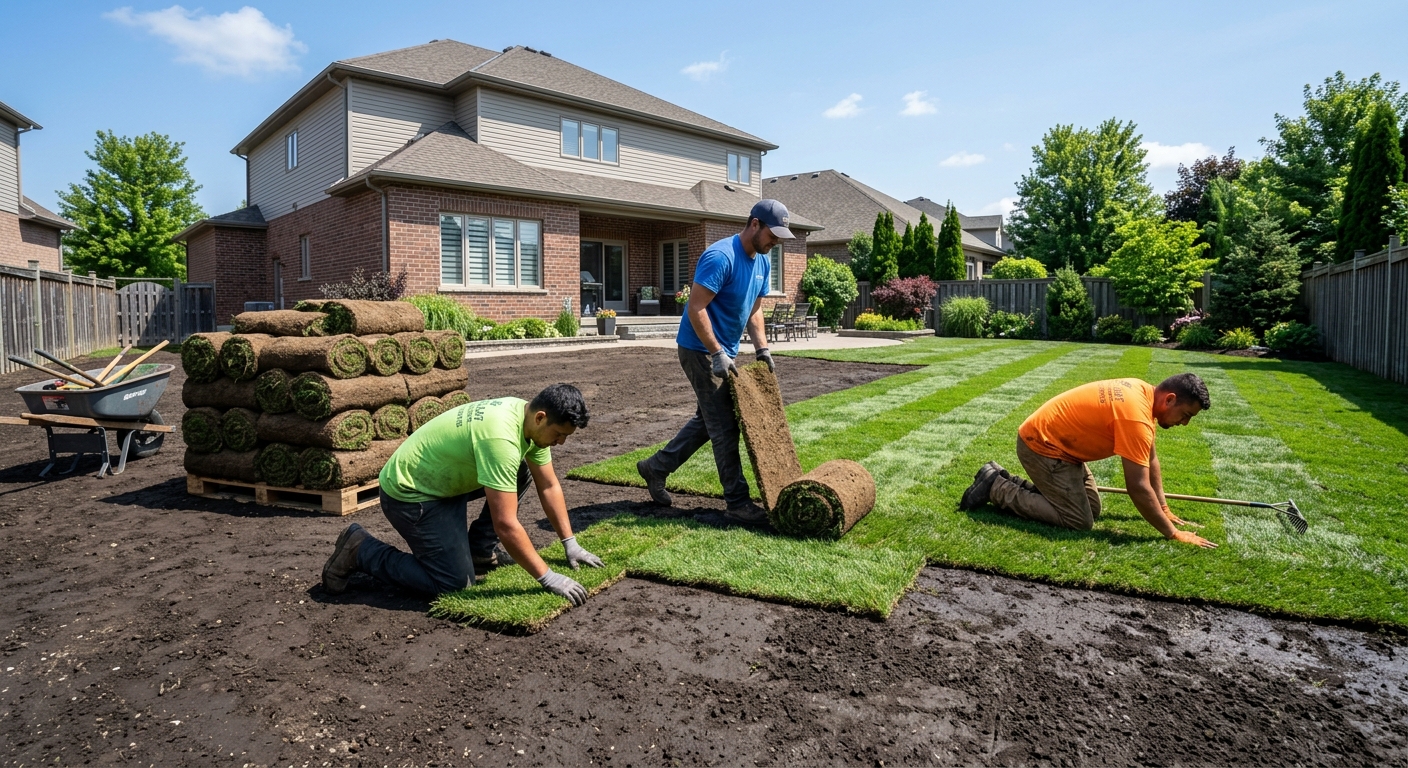
| Sod installation (supply, grade, lay, roll) |
Minor grading, soil prep, topsoil/loam adjustment where needed, sod supply and installation |
Late winter through spring and early fall (when soil is workable) |
$2,000–$8,000 |
| Lawn seeding (grade, seed, starter fertilizer) |
Grading touch-ups, seed mix, starter fertilizer, light raking and rolling |
Spring to early fall (good germination in cool-season conditions) |
$1,500–$6,000 |
| Interlocking patio or walkway |
Excavation, compaction, base/gravel, pavers, edge restraint, leveling sand, finish wash |
Spring through early fall (weather-dependent) |
$6,000–$35,000 |
| Retaining wall (interlocking block) |
Block system, drainage behind wall, geotextile, base prep/compaction, caps if applicable |
Spring to early fall (best for drainage installation and clean compaction) |
$10,000–$80,000 |
| Tree and shrub planting |
Soil amendments, planting holes, staking (if needed), watering plan, mulch ring |
Planting windows through spring and fall (winter protection if establishing late) |
$1,000–$15,000 |
Prices are estimates only and vary by project scope, site access and material selection.
What affects the price of landscaping in Walnut Grove
In the Lower Mainland–Southwest, you can see quote differences of 30–50% for the same “look” because landscaping pricing isn’t just the visible materials—it’s the unseen labour and engineering choices that make it last. Even within British Columbia, colder inland areas, heavier frost risk, and different contractor availability can compress or stretch timelines and drive different construction methods. In coastal BC (Walnut Grove), the long growing season helps planting work move steadily, but heavy wet spells mean scheduling and drainage work still demand extra time and careful sequencing.
How far things stretch comes down to frost dates, plant hardiness zones, and the working season. In Lower Mainland–Southwest zones 7–8, you can use broader palettes with fewer “survival” constraints than Prairie cities (zones 2–4). That said, freeze–thaw cycles still affect hardscape bases; a retaining wall often requires digging deeper, compacting more base, and adding proper drainage to limit frost heave and wall movement. In the dry BC Interior and Alberta, irrigation design is typically more intensive because drought conditions and water-use limits affect turf and plant survival—yet in Walnut Grove you still need smart efficiency to manage operating costs and avoid overwatering.
Concrete local examples that change your budget: (1) turning a flat lawn refresh into a graded “fix” for foundation splashback can add significant earthworks, because even small slopes often require reshaping and re-compaction; (2) switching from lawn-only upgrades to a patio plus drainage may move you from a smaller spend near the $2,000–$8,000 lawn band into the broader hardscape/design range where projects commonly sit closer to $10,000–$80,000 when retaining and drainage are involved; (3) adding mature trees or a premium shrub tier can raise planting costs due to size, root preparation, and staking labour.
| Price Factor |
Why It Matters |
Cost Impact |
| Yard size in sq ft — the primary cost driver for softscape |
More square footage means more soil prep, materials, and installation time. |
Large jumps; doubling turf area often increases both materials and labour proportionally. |
| Grading and drainage work — slope corrections add significant cost |
Proper slope directs surface water away from foundations and prevents pooling. |
Can add substantial labour and disposal fees, especially on wetter sites. |
| Drainage bed or French drain installation |
Subsurface drainage reduces soggy ground and helps keep hardscape bases stable. |
Usually a major line item; trenching and gravel layers increase cost. |
| Plant material tier — native shrubs vs. ornamental vs. mature specimen trees |
Premium plants cost more and often require more labour for handling and establishment. |
Can shift planting from a “light install” into a mid/high budget band quickly. |
| Hardscape vs. softscape ratio — walls and patios cost more per sq ft than lawn |
Pavers/blocks require excavation, engineered base, and careful compaction. |
Hardscape-heavy projects typically cost significantly more than turf/planting-only plans. |
| Irrigation system design and installation |
Efficient layout (zones, drip vs spray) improves survival and controls costs. |
Added plumbing, valves, and controller time increases labour/materials versus manual watering. |
| Soil amendment and topsoil required |
Healthy soil structure supports roots and reduces future lawn/plant failures. |
Cost rises when existing soil is compacted, clay-heavy, or poorly draining. |
| Tree removal or stump grinding before new planting |
Clearing is labour-intensive and often requires hauling and careful site protection. |
May add a separate crew day or disposal charges depending on access. |
Permits & regulations in British Columbia
In British Columbia, most planting and softscape work—including planting trees/shrubs, sodding, and seeding—typically does not require a permit. That usually includes tasks like installing mulch beds, laying sod, and planting perennials. However, retaining walls can trigger permits, especially when walls exceed a common height threshold—often 1.0 m (3.3 ft) depending on the municipality and the wall’s design. For taller walls, you may also need engineered drawings or additional documentation.
Also watch for grading and drainage changes. If your project changes lot grading in a way that could affect drainage toward neighbouring properties or storm sewer connections, approval requirements may apply. In all cases, plan for utility locates before digging—planting holes, trenches for drainage, or retaining wall footings all involve digging where lines may exist.
For Walnut Grove homeowners, the practical verification steps are: (1) ask for the contractor’s British Columbia business licence (and confirm it on the contractor’s provincial profile/registry where applicable); (2) request a certificate of insurance showing liability coverage appropriate for the work; and (3) confirm WCB coverage (workers’ compensation coverage) or clearance documentation if they provide labour. Insist on seeing documents before the first shovel goes in, and keep copies with your contract so you’re protected if something goes wrong.
Planning a landscape that thrives in Walnut Grove's climate
To plan a landscape that thrives in Walnut Grove, you design around the reality of coastal BC: hardiness zone 7–8, cool-season growth, and a frost calendar that usually keeps planting workable from late winter into fall—while still respecting wet soil periods and the region’s freeze–thaw impacts on structures. Start with plant selection: choose zone-appropriate, preferably native or locally proven species that can handle winter dampness and moderate cold without heavy winter wrapping or constant replanting. For curb appeal with less fuss, build in layered structure (evergreens for year-round form, perennials for colour, and groundcovers for texture) rather than relying on short-lived “one-season” plants.
Next, decide between sod vs. seed. Sod gives instant coverage, but it typically costs about 3–4x more per sq ft than seeding because you’re paying for pre-grown material and installation labour. If you have a weather-sensitive area or a front yard you want to look finished quickly, sod can be worth it; otherwise, seeding with correct grade and starter fertilizer is often the smarter budget move.
Drainage and grading are the local make-or-break items. In the Lower Mainland–Southwest, pooling water can saturate foundations and undermine hardscape bases, so use swales, grading corrections, and—when needed—a drainage bed or French drain. For patio and retaining walls, base preparation must account for frost heave: deeper excavation, proper granular base, and compaction matter.
Low-maintenance strategies that still look “designed” include mulched shrub borders, selective groundcovers, and repeatable planting modules. Where water efficiency matters (even without Alberta-style bans), a rain garden or xeriscape pockets can capture roof runoff and reduce turf stress. Example: if sod is near $2,000–$8,000 for your lawn refresh, seeding might let you reallocate part of that budget into drainage corrections that protect both your foundation and the new lawn—often a better long-term value.
| Element |
Climate Consideration |
Maintenance Level |
Price Band |
| Sod lawn installation |
Cool-season growth helps establishment; avoid the wettest stretches so roots seat properly. |
Low-to-medium (initial watering/monitoring, then normal mowing) |
$2,000–$8,000 |
| Native perennial garden |
Zone-appropriate plants handle BC winters and seasonal rains with less intervention. |
Low (mulch refresh and seasonal pruning) |
$1,500–$10,000 |
| Mulched shrub border |
Mulch helps steady soil moisture and reduces winter splash and surface erosion on slopes. |
Low (weed control and top-ups) |
$1,000–$7,000 |
| Interlocking stone patio |
Needs proper base and drainage to survive damp winters and freeze–thaw movement. |
Low (occasional joint sand top-up) |
$6,000–$35,000 |
| Retaining wall (block) |
Drainage behind the wall is critical in heavy rain periods to prevent hydrostatic pressure. |
Low (periodic inspection of joints/weep outlets) |
$10,000–$80,000 |
| Drip irrigation system |
Efficient watering matches coastal conditions while supporting smart operation costs. |
Medium (seasonal adjustments) |
$1,200–$6,500 |
How to choose a landscaping contractor in Walnut Grove
Choosing the right landscaping contractor in Walnut Grove is mostly about checking proof—before you sign—and then getting quotes that show the real scope. In British Columbia, ask how they verify licensing where required for their work, and request a certificate of insurance naming you as the client (or showing liability coverage for the project value). For jobsite safety, confirm their workers’ compensation status: in BC this is typically WCB coverage. How to check: (1) ask for the insurance certificate and review effective dates and coverage limits; (2) confirm WCB coverage documentation or clearance letter upon request; and (3) verify their business information (company name, address, and trade details) through the relevant provincial business/registration listings available online.
Next, get 2–3 itemised written quotes with labour and materials clearly separated (not one lump sum). Make sure exclusions are explicit: is there allowance for hauling/disposal, tree removal, erosion control, utility locating, and base excavation? Also confirm whether permits are included for retaining walls if your wall is near the common 1.0 m (3.3 ft) threshold, and whether drainage design is included or treated as an add-on.
For warranty, look for a clear workmanship warranty length (e.g., grading settles, paver base performance) and understand how the product/manufacturer warranty works for plants, sod, or irrigation components. Payment should be structured responsibly—never more than 10–15% upfront, and hold back a portion until completion and walkthrough.
- Ask for start date and completion estimate in writing.
- Require itemised pricing (labour, equipment, materials, disposal).
- Confirm utility locate included before digging.
- Check that drainage/grading is described, not just “level as needed.”
- Verify what happens if soil is unsuitable (extra topsoil/soil amendment terms).
- Ask about base depth, compaction method, and drainage behind walls.
- Confirm sod/seed warranty terms (duration, replacement conditions).
- Look for an irrigation plan if water efficiency is part of the scope.
- Ensure liability insurance and WCB coverage are current.
- Get a disposal/hauling line item or allowance clarified.
- Ask how site protection is handled (fences, landscaping adjacent beds, turf protection).
- Put change-order rules in writing (what triggers extra cost and how it’s approved).
Red flags to watch in Walnut Grove: vague scopes (“we’ll take care of grading”), quotes without itemisation, missing insurance/WCB documentation, zero discussion of drainage or base prep for patios/walls, and payment requests that exceed 10–15% upfront or demand cash-without-contract.
Frequently asked questions — landscaping in Walnut Grove
What plants thrive in Walnut Grove's climate zone?
Walnut Grove sits in Lower Mainland–Southwest conditions with hardiness typically around zones 7–8, which supports a broad, layered palette compared with colder Prairie regions. Homeowners often do well with broadleaf evergreen structure, such as many native-to-BC or zone-appropriate shrubs, plus long-blooming perennials that handle cool summers and wet winters. Because wet periods are common, favour plants that tolerate “damp but drained” soil, and build raised/mulched beds where your lawn is struggling with pooling. If you’re starting from scratch in an area with mature trees, use species that share root space well rather than aggressive spreaders. For context on budget, a focused tree and shrub planting package often falls in the $1,000–$15,000 band depending on plant size and soil amendments (Statistics Canada, 2021 Census).
Sod vs seed — which is better for a Walnut Grove lawn?
For Walnut Grove lawns, both work, but they’re best for different goals. Sod gives immediate coverage and is ideal when you need fast curb appeal or you’re repairing traffic areas. The trade-off is cost: sod installation commonly lands in the $2,000–$8,000 range for many typical front-yard refreshes, while seeding is often the lower-cost option when you can wait for establishment. Seeding requires correct grade, good seed-to-soil contact, and a period of careful watering through germination; it’s less forgiving on poorly drained spots. In coastal BC’s cool-season climate, seeding can perform very well if drainage isn’t an issue. If you have pooling near foundations, address drainage first—otherwise both sod and seed can fail.
How much does a retaining wall cost in Walnut Grove?
Retaining wall costs in Walnut Grove depend heavily on height, site access, base preparation, and whether proper drainage is included behind the wall. For interlocking block retaining walls, typical estimates fall within the $10,000–$80,000 range, with the biggest swings caused by excavation depth, the need for a drainage bed/French drain, and how much re-grading is required. Coastal BC still experiences freeze–thaw cycles, so walls need adequate base and compaction to reduce movement. If your wall approaches common permit thresholds (often around 1.0 m (3.3 ft) in many municipalities), budgeting for approvals or engineered support can also affect price. A contractor who talks clearly about weep outlets and drainage detailing is usually the one delivering the long-term performance you want.
When is the best time to landscape in Walnut Grove?
In Walnut Grove, you can often plan work across multiple seasons because the Lower Mainland–Southwest has a long working and growing season. Planting is typically strongest in spring and fall—when temperatures are cool enough to establish roots without heat stress. Softscape projects like planting and seeding can be done outside those peaks, but the wettest weeks can slow installation and affect soil handling. Hardscape work (patios, walkways, retaining walls) is best done in drier windows when bases can be excavated, levelled, and compacted properly; damp conditions can increase labour time and reduce compaction quality. Since winters can still bring freeze–thaw movement, it’s smart to finish base-sensitive projects before the wettest, coldest stretch. If you’re replacing a lawn, aim for spring or early fall so the roots establish quickly.
Do I need a permit for a retaining wall in British Columbia?
In British Columbia, many softscape tasks like planting and sodding typically don’t require permits. Retaining walls are different: walls that exceed common height thresholds—often around 1.0 m (3.3 ft) in many municipalities—commonly require a permit, and some projects may need engineered documentation. Also consider permits if your project involves lot grading changes that could affect drainage direction toward neighbours or storm sewer connections. For Walnut Grove homeowners, the practical step is to ask your contractor to confirm whether your specific wall height and design triggers permitting, then ensure that responsibility is written into the quote. If your contractor says “no permits ever,” that’s a risk. Finally, regardless of permit, ensure utility locates are completed before digging footings or trenches.
How do I improve drainage in my yard?
Improving drainage in Walnut Grove usually starts with identifying where water actually goes: downspouts, swales, soil type, and whether water pools near foundations or in low corners. Common solutions include re-grading to direct runoff away from the house, adding a drainage bed or French drain, and improving topsoil structure with appropriate amendments. In heavy-rain periods, a well-designed drainage plan prevents saturated ground that can harm both plants and hardscape bases. Because coastal BC can be wet, drainage solutions should consider performance through winter dampness, not just summer. If you’re planning a patio or retaining wall, it’s often cost-effective to integrate drainage now—otherwise you may pay twice to correct later. If drainage work isn’t in the quote, ask where it’s handled and request clear details before work begins.