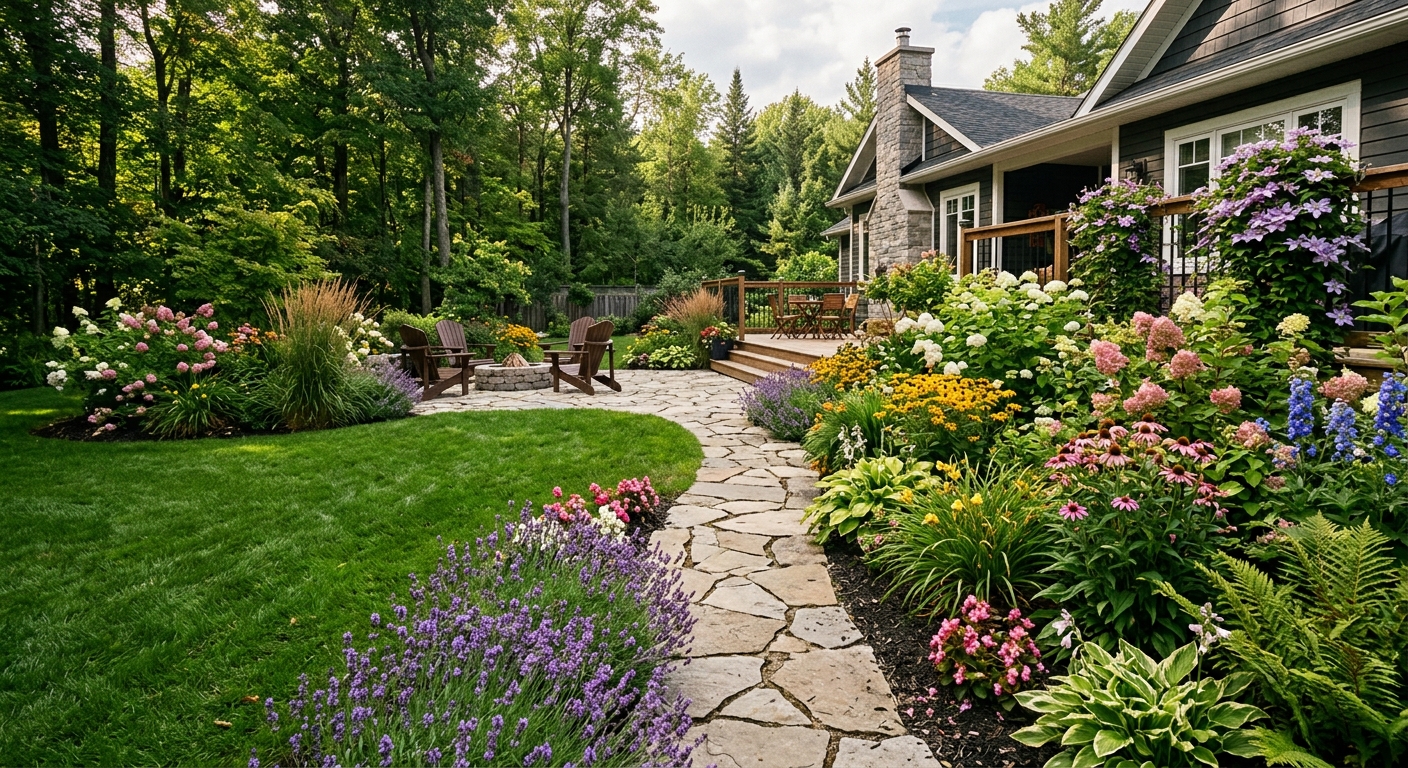
Landscaping options and costs in Gloucester
Gloucester, Ontario (Ottawa region) is a place where good landscaping decisions pay off for decades—especially because the yard is part of everyday living in a community that supports investment in curb appeal. With Ottawa’s population at 150,012 (Statistics Canada, 2021 Census), demand is steady for crews across seasons, and that steady workload can influence scheduling and labour availability. In a typical Gloucester household, the practicality of landscaping is also shaped by housing stock: many detached properties have enough frontage and yard depth to justify a full design that includes grading, planting beds, and at least one hardscape feature.
Ottawa’s plant hardiness zones (4b–5a) and a pronounced freeze–thaw cycle drive both material selection and build cost. The frost-free window is roughly May to October, so soil work, sod, interlocking base prep, and wall footings are time-sensitive. When projects include deep granular bases and proper drainage (rather than quick “topsoil fixes”), costs rise—yet those same details prevent heaving, pooling, and early failures. On the supply side, reliable contractors can also charge more during peak summer weeks when crews are booked, particularly in neighbourhoods like Orléans (where family lots and larger properties are common and full-yard renovations are frequent).
Below is a practical comparison of common Gloucester landscaping scopes so you can align expectations before you request quotes.
| Service |
Description |
Season |
Price Range |
| Full landscape design and installation |
Site visit, layout, grading/drainage plan, soil prep, planting plan, lawn/seed or sod, and hardscape (patio/walk) as applicable |
May–October |
$12,000–$55,000 |
| Sod installation (supply, grade, lay, roll) |
Fine grading, topsoil amendments, sod delivery and installation, rolling, first watering plan |
Late April–June; early September |
$2,500–$9,500 |
| Lawn seeding (grade, seed, starter fertilizer) |
Light grading, seed selection for shade/sun, starter fertilizer, mulching, watering schedule |
May–June; early September |
$1,200–$6,000 |
| Interlocking patio or walkway |
Excavation, deep compacted granular base, edge restraints, interlocking stone, slope and drainage details |
May–October |
$6,000–$30,000 |
| Retaining wall (interlocking block) |
Engineering/standard block installation as required, excavation, base/granular bedding, drainage weeping tile and backfill |
May–October |
$5,000–$28,000 |
| Tree and shrub planting |
Soil amendment, digging, root collar placement, staking (if needed), mulch rings, plant warranty handling |
April–June; September–October |
$1,200–$10,000 |
Prices are estimates only and vary by project scope, site access and material selection.
What affects the price of landscaping in Gloucester
In Gloucester, the same general landscaping “type” can produce quotes that differ by 30–50% across Ottawa and Ontario because the real drivers are often hidden in the site conditions. Two yards that look similar from the street may have very different clay density, drainage patterns, excavation depth, and disposal needs. Labour availability during the peak May to October window also matters—when crews are booked, scheduling and mobilization costs can climb.
Our plant hardiness zone (4b–5a) and local frost timing shape both plant selection and the working window for installs. In Prairie regions (Zone 2–4), a shorter season and harsher wind often pushes buyers toward ultra-drought-tolerant choices and very conservative watering plans; in contrast, Southern Ontario (Zone 5–6) has a moderate season but can still require summer irrigation during dry spells. Coastal BC (Zone 7–8) benefits from longer growing periods and lush palettes, but heavy rainfall increases the importance—and cost—of drainage solutions. In Gloucester, freeze–thaw means walls, steps, and patios need deep, well-compacted granular bases; skipping those details tends to be cheaper upfront and expensive later.
Here are a few local examples of what raises or lowers cost. First, clay-rich soils that hold water often require more grading and soil amendment to prevent spring saturation—this can add material and labour on top of a typical lawn project budget like $1,500–$8,500 for sod. Second, a small interlocking patio with the wrong base depth will fail; correct construction and edge restraint can move the project into the $4,000–$30,000 retaining walls & hardscaping band. Third, older lots with foundation-water history sometimes need drainage bed work (which can increase the quote substantially compared with “plant-only” jobs). If the property is near full-yard renovation level budgets—common in mid-five-figure comprehensive installs—the cost mix shifts toward hardscape, drainage, and soil remediation rather than just greenery.
| Price Factor |
Why It Matters |
Cost Impact |
| Yard size in sq ft |
The larger the softscape area, the more topsoil, amendments, seed/sod, and labour time are required |
Higher linear cost; often the biggest swing in total price |
| Grading and drainage work |
Fixing slopes to prevent pooling and redirect runoff away from foundations requires excavation and proper re-compaction |
Can add significant cost beyond planting or sod alone |
| Drainage bed or French drain installation |
Ottawa’s freeze–thaw punishes weak drainage; proper systems reduce heaving and basement seepage risk |
Commonly one of the largest “hidden scope” adders |
| Plant material tier |
Native shrubs versus ornamental types versus mature specimen trees vary widely in sourcing and planting labour |
Smaller quantities of mature stock can quickly raise totals |
| Hardscape vs. softscape ratio |
Patios and walls require deep bases, stone block, compaction, and more detailed labour |
Hardscapes tend to cost more per sq ft than lawn |
| Irrigation system design and installation |
Sprinkler layouts, controllers, and winterization add complexity—especially with clay and slope |
Often increases price, but can reduce long-term watering cost |
| Soil amendment and topsoil required |
Clay soils need quality amendments for root health and to reduce waterlogging |
Material hauling and labour can be a major line item |
| Tree removal or stump grinding before new planting |
Access, stump size, debris hauling, and grinding time directly affect cost |
Can shift a “planting” job into a larger excavation scope |
Permits & regulations in Ontario
In Ontario, most typical landscape work—like planting, seeding, sodding, mulch and planting-bed installation, and most softscape upgrades—usually does not require a permit. However, retaining walls can be different. As a rule of thumb in many municipalities, retaining walls above a height threshold (commonly 1.0 m, or 3.3 ft) may require a building permit and sometimes engineered drawings. Your contractor should confirm this before construction starts.
Also consider grading: if proposed changes to lot grading affect drainage direction toward neighbouring properties or connect into storm services, approvals may be required. Another practical must-do in Gloucester: call for utility locates before digging for planting holes, French drains, or wall footings. Hitting buried services is a costly, disruptive mistake—and proper locates are standard good practice.
To verify a Gloucester contractor, homeowners should take five steps. First, confirm they are properly licensed for the work they’re advertising (where applicable) by checking the relevant Ontario registry or professional listing they provide. Second, ask for a certificate of insurance and verify it matches the scope (general liability for landscaping and hardscapes). Third, confirm WSIB coverage where required; for workers, coverage status is often shown on documentation or a clearance letter—request it before any work begins. Fourth, verify that disposal/haul-away is included if excavation is part of the scope. Finally, ask them to put permit responsibility in writing: whether they pull permits (if required) and what documentation you’ll receive at completion.
Planning a landscape that thrives in Gloucester's climate
Planning in Gloucester is about working with our Zone 4b–5a conditions and the Ottawa freeze–thaw cycle, not fighting them. Start with plant selection: choose hardy, zone-appropriate species (often with native influence) that can handle winter dieback and spring wet soils without constant fuss. Next, decide between sod and seed. Sod gives instant curb appeal and erosion control, but it costs about 3–4x more per sq ft than seeding; it’s worth it when you need quick results, have erosion risk, or want the lawn usable immediately.
Drainage and grading come next—especially around foundations. Ottawa clay can stay saturated in spring, and pooled water increases the odds of heaving near patios and settlement in walkway bases. For hardscape, correct base prep is crucial: interlocking patios and retaining walls must be built on deep, well-compacted granular layers designed for frost movement.
For low-maintenance design, use mulch, groundcovers, and grouped perennials to reduce weeding and keep roots stable through winter. Rain-garden and xeriscape-style elements can still work in Gloucester; “xeriscaping” isn’t about zero water—it’s about efficient irrigation, drought-tolerant planting pockets, and capturing runoff where plants can use it. If you’re budgeting tightly, you can sometimes justify investing in drainage first, then plant strategically.
Here’s a concrete pricing example: if you’re choosing between sod and seeding for a similar lawn area, a sod install often lands in the $1,500–$8,500 range depending on size and prep, while seeding with grade and starter fertilizer might fall closer to $1,200–$6,000. That difference can be justified when you need fast coverage, but if your priority is long-term cost control, seeding plus good drainage prep is often the smarter value.
| Element |
Climate Consideration |
Maintenance Level |
Price Band |
| Sod lawn installation |
Best when installed during the cooler shoulder seasons to establish roots before freeze |
Low to moderate first season; mowing and irrigation management during establishment |
$2,500–$9,500 |
| Native perennial garden |
Hardy perennials tolerate Zone 4b–5a winters with good winter cover from mulch |
Moderate (weeding in year one, pruning and cleanup in spring/fall) |
$1,800–$8,500 |
| Mulched shrub border |
Mulch buffers freeze–thaw swings and helps prevent soil heaving around roots |
Low (top up mulch annually; occasional shaping) |
$1,600–$7,200 |
| Interlocking stone patio |
Requires deep compacted base to resist frost lift; slope and drainage prevent pooling |
Low (routine cleaning; occasional minor joint sand maintenance) |
$6,000–$30,000 |
| Retaining wall (block) |
Backfill and weeping-drain details are key to prevent blowouts during spring melt |
Low once built correctly (inspection after freeze–thaw cycles) |
$5,000–$28,000 |
| Drip irrigation system |
Helps target water to roots during summer dry spells; winterization is essential |
Moderate (seasonal checks and winter shutoff; adjustments) |
$2,000–$9,500 |
How to choose a landscaping contractor in Gloucester
Choosing a landscaping contractor in Gloucester should start with proof, not promises. Verify Ontario coverage and legitimacy in a straightforward way. Ask for a current certificate of insurance showing general liability limits and that it covers work at your address. For workers on site, confirm WSIB/WCB coverage (where applicable) by requesting documentation such as a clearance letter or coverage proof—before the first shovel goes in. If a contractor does hardscape, drainage, or excavation, make sure their coverage is aligned with the risks of that scope.
Next, get 2–3 itemised written quotes, not lump sums. A good quote breaks labour and materials separately and includes key specifics: quantities (sq ft, linear feet), excavation depth assumptions, granular base specs, and topsoil/amendment amounts. Scope clarity protects you from surprises—check what’s excluded (old debris hauling, tree removal, utility locates, permit fees if required). Confirm whether disposal is included and where spoils will go.
Warranty matters in Ottawa’s freeze–thaw environment. Ask for a workmanship warranty length and what it covers (settlement, cracking, drainage failures attributed to workmanship). Also ask whether product/manufacturer warranties apply to plants, blocks, interlock stones, and whether warranties are transferable to future owners.
Payment schedules should be conservative. Never pay more than 10–15% upfront; hold a portion until the job is complete, graded correctly, and cleanup is verified. Finally, insist on a written timeline with a start date and an achievable completion estimate that matches the May–October window.
- Request proof of insurance (certificate of insurance) before signing.
- Confirm WSIB/WCB coverage for workers and ask for clearance/coverage documentation.
- Ask whether they pull permits when retaining walls exceed the typical height threshold.
- Demand itemised quotes with quantities and unit rates (labour + materials).
- Check if grading and drainage corrections are included or treated as “extra”.
- Require written base specifications for interlocking/patios (deep, compacted granular layers).
- Verify soil amendment and topsoil depth/volume assumptions for your clay-rich yard.
- Confirm disposal and haul-away of excavated material are included (or priced separately).
- Ask how plants are guaranteed (replacement policy, installation standards, warranty timeline).
- Confirm irrigation winterization responsibilities if an irrigation system is included.
- Keep a holdback until you verify drainage function and final grading after materials settle.
- Get a written schedule with weather contingencies and who makes the call to pause work.
In Gloucester, red flags include: refusing to provide insurance/WSIB documentation, quoting only lump-sum numbers without base-depth or drainage details, starting work without utility locates, promising “quick installs” on patios/walls without granular base specs, and offering vague warranties (or no warranty terms in writing). If you see two or more of these, slow down and ask for revisions to the proposal.
Frequently asked questions — landscaping in Gloucester
When is the best time to landscape in Gloucester?
The best time for most landscaping in Gloucester is the frost-free window, roughly May through October, with the most reliable results coming from planning in spring and finishing installs before the first cold snaps. For lawns, seeding or sod typically performs best in late spring and early autumn when temperatures are milder and the grass can establish roots before freeze. For planting trees and shrubs, many homeowners get strong survival rates by installing in spring (after the worst cold) or in fall, when the soil still isn’t rock-hard. If your project includes interlocking patios or retaining wall work, crews usually target May to October as well because base construction requires compaction and drainage that are difficult in frozen ground. If your quote is in the $5,000–$50,000 design & installation range, scheduling early helps lock in availability during Ottawa’s busiest summer weeks. (Statistics Canada, 2021 Census)
Do I need a permit for a retaining wall in Ontario?
In Ontario, many landscaping tasks like planting and sod generally do not require a permit, but retaining walls can. In most municipalities, retaining walls above a typical height threshold—commonly 1.0 m (3.3 ft)—may require a building permit and sometimes engineered drawings. Grading changes that affect how water drains toward neighbouring properties or storm connections can also trigger requirements. The easiest way to handle this for your Gloucester project is to ask your contractor to state in writing who will confirm permit needs and whether permits are included in the quote. Before construction, plan for utility locates and discuss drainage details (weeping tile or French drain) because winter freeze–thaw makes drainage failures show up quickly. If your project’s budget is around $4,000–$30,000 for retaining walls & hardscaping, permit and engineering decisions can affect both price and timeline.
How do I improve drainage in my yard?
Improving drainage usually starts with identifying where water is coming from and where it goes—especially because spring melt and Ottawa clay can keep yards saturated. A practical first step is re-grading: gentle slopes should direct water away from your foundation, not toward it. If you see persistent pooling, consider a drainage bed or French drain system installed with the right granular materials and proper outlet routing. It’s also important to consider downspout discharge—sometimes you need to redirect it before you spend on new plantings. For Gloucester properties, drainage work is often what separates a one-season “look good” job from a long-term solution that survives frost heave and freeze–thaw cycles. If you’re budgeting for lawn or full installs, drainage scope can move the project up within the common Ottawa ranges; for example, interlocking/patio and wall builds often sit in the $4,000–$30,000 hardscape band when proper bases and drainage are included.
What is xeriscaping and does it suit Gloucester?
Xeriscaping is landscaping designed to reduce water use by matching plants to local conditions—using drought-tolerant or hardy species, improving soil, mulching, and watering efficiently. It does suit Gloucester, but it should be approached realistically: our summers can dry out, yet we also get spring saturation and cold winters, so you still need plants that handle freeze–thaw and clay moisture swings. Good xeriscape-style designs often include mulch layers, groundcovers, rainwater capture, and targeted drip irrigation rather than broad spray lawns. If you want to keep a lawn, you can still use xeriscape principles for beds and borders to reduce watering demand. In practice, it’s not “no watering”; it’s “right watering” with better plant spacing and soil amendment. For budgets, converting parts of a yard from sod to efficient planting can help you stay within mid-range softscape costs like the $1,500–$8,500 sod band while reallocating funds to drainage and foundation-safe grading.
How do I plan a low-maintenance yard?
A low-maintenance Gloucester yard is planned around three things: fewer plant types that do well locally, mulch to control weeds, and hardscape/drainage that prevents recurring problems. Start by choosing hardy shrubs and native-influenced perennials suited for Zone 4b–5a, then group plants so you’re not constantly trimming or replanting fragile varieties. Use mulch in beds (with proper edging) and consider groundcovers to reduce bare soil. For the lawn, seeding can be a cost-effective way to establish turf, while sod can be justified when you need fast coverage—often in the $1,500–$8,500 range for many typical installs depending on area and prep. Also prioritize drainage: if water pools, even “easy” plants will struggle. In Ottawa-area projects, interlocking patios and borders can reduce muddy tracking and annual repairs, but only if built on deep, compacted granular bases that handle frost movement.
How deep should a retaining-wall base be for local frost?
For retaining walls in Gloucester, the key is not a single magic number but a frost-safe approach: your base and backfill need to be designed to resist freeze–thaw movement. In practice, that means excavation down to below frost-affected soils and building a properly compacted granular base (with drainage details behind the wall) rather than relying on “topsoil + block.” Many installations in Ottawa require deep, well-compacted layers to prevent shifting and heaving, and the required depth can vary with wall height, soil conditions, and local frost depth assumptions. This is exactly why the permit/engineering question matters for taller walls, and why your contractor should include granular base and drainage specifics in the proposal. If your project budget is in the $4,000–$30,000 hardscaping band, the better builders spend more time on excavation, drainage bedding, and compaction—costing more up front but reducing the risk of costly repairs after winter freeze cycles.