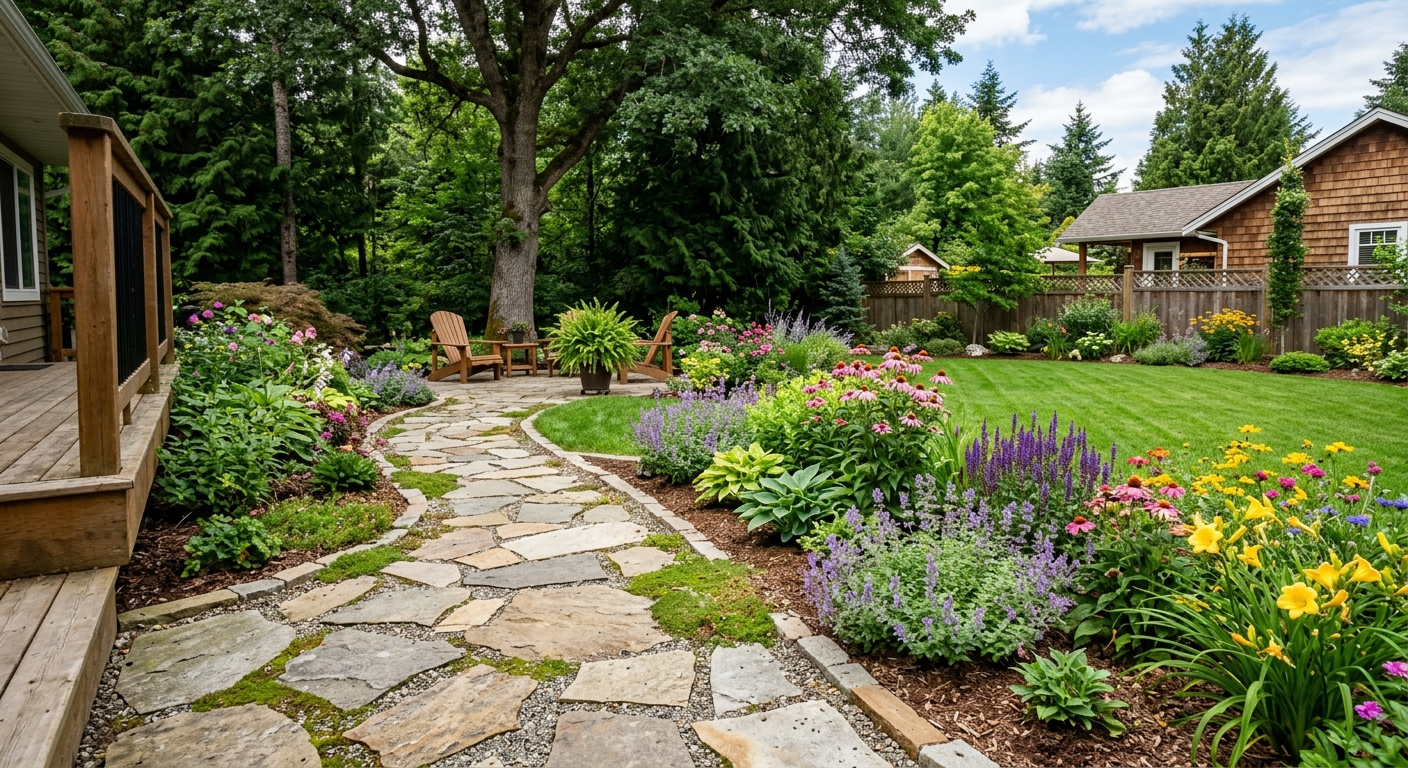
Landscaping options and costs in Meaford
Meaford homeowners typically start with a few core landscape goals: better curb appeal, a lawn that stays green, and hardscaping that handles the region’s freeze–thaw cycles. With 11,485 people in the town area (Statistics Canada, 2021 Census) and 80.8% of households owning their homes (Statistics Canada, 2021 Census), many properties—often detached houses, where 81.2% of dwellings are single-detached—have the yard space to invest in proper grading, drainage, and planting rather than quick fixes. The age of housing also matters: 58.3% of homes were built before 1981 (Statistics Canada, 2021 Census), which often means mature trees, older soil, and sometimes foundation drainage that needs attention before you lay sod or build a patio.
In the Stratford–Bruce Peninsula region (plant hardiness zones 5b–6a), last spring frost is often in early May and first fall frost in early October, so most installation work concentrates in the shoulder-to-mid summer window. That timing affects labour availability and can push “full landscape” schedules upward when multiple neighbours are doing projects around the same time. Also, because freeze–thaw off Lake Huron and Georgian Bay is a major cost driver, patios and retaining walls need deeper, well-drained bases and quality aggregate—raising costs versus milder climates. If you’re in a high-demand area like central Meaford and the Penetanguishene Road–to–main-street corridor (where curb appeal upgrades are common), you’ll usually see faster booking and more competitive pricing when crews are already mobilized.
Below is a practical comparison of common services and realistic price ranges for Meaford, Ontario. Use it to sanity-check quotes before you compare contractors.
| Service |
Description |
Season |
Price Range |
| Full landscape design and installation |
Site walk, layout, grading/drainage plan, planting palette, hardscape and softscape installation (typical mid-range residential scope) |
Late spring to early fall (best May–September) |
$8,000–$35,000 |
| Sod installation (supply, grade, lay, roll) |
Minor grading, topsoil/compaction prep, sod supply and installation, starter fertilizer, first-watering plan |
May–June and early September |
$1,500–$6,000 |
| Lawn seeding (grade, seed, starter fertilizer) |
Grading touch-ups, seed selection, starter fertilizer, light topdressing, straw/mulch protection as needed |
April–May and late August–September |
$900–$3,500 |
| Interlocking patio or walkway |
Excavation, well-drained base and compaction, sand setting bed, pavers/stone, edging, and slope to drain |
May–October (base preparation must dry/behave properly) |
$5,000–$30,000 |
| Retaining wall (interlocking block) |
Excavation to below frost-influenced footing depth, geotextile, granular base, wall block, drainage system behind wall |
May–September for easiest scheduling |
$6,000–$28,000 |
| Tree and shrub planting |
Soil prep, compost/topsoil amendments, proper planting depth, staking where needed, mulching rings |
Spring and fall (best planting windows) |
$800–$8,000 |
Prices are estimates only and vary by project scope, site access and material selection.
What affects the price of landscaping in Meaford
In Meaford and the broader Stratford–Bruce Peninsula region, two contractors can quote the “same” job and still land 30–50% apart because the real drivers are often hidden in the details: excavation depth, drainage design, soil condition, and labour time for fine grading and installation. The working season is also narrower here than in milder climates, so mobilization and scheduling matter—especially around May and early fall.
What makes this region distinct is the combination of hardiness zones 5b–6a and the frost calendar: last spring frost often hits in early May, and first fall frost is typically in early October. That defines what can be installed without risk, and it also dictates construction specs. In southern Ontario (Zone 5–6), you get a moderate growing season, but you still design for periodic summer dryness and winter cold. Compared to Prairie cities (Zone 2–4), you can often use a broader plant palette, but for cost control you still prioritize winter-hardy selections. Compared with coastal BC (Zone 7–8), where long seasons encourage lush growth, Ontario projects lean harder on winter-resilient turf, woody shrubs, and perennials that establish quickly. Retaining walls also need base work that’s deeper and better drained to reduce freeze–thaw heaving costs.
Concrete cost examples we see in Meaford: (1) a small patio that requires only a shallow base might land in the mid-range of typical hardscaping, but once you add more excavation for poor drainage and a proper granular base, that same square footage moves toward the higher end—often pulling a project from the lower part of a $5,000–$30,000 band toward the upper end. (2) If your lawn area needs new topsoil and more grading, sod can jump from the lower portion of $1,500–$6,000 toward the higher figure—because prep time is where labour costs hide. And (3) older (pre-1981) properties often have compacted soils around foundations; upgrading soil amendments can add up, but it prevents recurring drainage problems that otherwise undermine both planting and turf investment.
| Price Factor |
Why It Matters |
Cost Impact |
| Yard size in sq ft — the primary cost driver for softscape |
More area means more labour, soil, seed/sod, mulch, and time for finishing work |
Often scales up quickly; can account for a large share of total cost |
| Grading and drainage work — slope corrections add significant cost |
Proper slope prevents pooling, foundation moisture issues, and premature turf failure |
Can add substantial labour and machine time; pushes quotes higher |
| Drainage bed or French drain installation |
Managing water during spring melt and heavy rain reduces freeze–thaw damage |
Material + excavation increases costs versus surface fixes |
| Plant material tier — native shrubs vs. ornamental vs. mature specimen trees |
Mature specimens cost more and require heavier handling and longer planting time |
Can swing the “tree & garden planting” budget by thousands |
| Hardscape vs. softscape ratio — walls and patios cost more per sq ft than lawn |
Hardscape requires excavation, aggregate base, compaction, and careful edging |
Shifts the project toward higher band pricing (hardscape-heavy jobs) |
| Irrigation system design and installation |
Smart controllers and drip zones improve watering efficiency during summer dryness |
Adds upfront cost but can protect sod and reduce long-term failures |
| Soil amendment and topsoil required |
Quality topsoil and compost affect rooting and turf/plant performance |
More hauling/import can move a “starter” job toward mid-range |
| Tree removal or stump grinding before new planting |
Root zones and debris removal are time-consuming and require proper disposal |
Often adds cost and may affect the planting schedule |
Permits & regulations in Ontario
In Ontario, most landscaping work does not require a permit—planting, sodding, and typical softscape installations are usually considered routine improvements. However, retaining walls can be the exception. In most municipalities, retaining walls above a threshold typically around 1.0 m (3.3 ft) require a building permit, and some projects may need engineered drawings depending on height, soil conditions, and design. Also watch grading: if your project changes lot grading in a way that impacts drainage toward a neighbouring property or ties into storm sewer connections, it may trigger approval requirements.
Before any digging, have utilities located. Call for locates before you dig planting holes, trench for drainage, or install footings for walls—this is essential for worker safety and to prevent service disruption.
For a homeowner in Meaford, verifying a contractor’s credentials is straightforward and should be done before work begins:
- Ontario licence: confirm the contractor’s business registration and any relevant qualifications for the scope (for example, fencing, excavation, or masonry-related work where applicable).
- Liability insurance: request a certificate of insurance showing active coverage for the project.
- WSIB/WCB: ask for proof of coverage (or a clearance letter confirming compliance, if they’re eligible).
- Written scope: ensure the quote lists what requires a permit, who pulls it, and what “included” means.
Finally, always confirm local irrigation and water-use bylaw expectations. While Meaford is in Ontario (not the BC interior), irrigation still matters—municipal water costs and summer dryness affect how contractors design drip zones and smart controllers.
Planning a landscape that thrives in Meaford's climate
Planning for Meaford’s climate means designing with the hardiness zone (5b–6a), frost timing, and seasonal moisture patterns in mind. The goal isn’t to fight winter—it’s to build structure and plant choices that establish quickly, drain properly, and survive the freeze–thaw cycle common around Lake Huron and Georgian Bay.
1) Plant selection: choose native and zone-appropriate species that can handle cold winters and short frost-free windows without constant watering or heavy winter protection. In this region, the best results usually come from mixing shrubs with perennials that bloom reliably and mulch well. 2) Sod vs. seed: sod gives instant curb appeal and faster functional coverage, but it costs more. As a rule of thumb for Ontario pricing, sod typically costs about 3–4x more per sq ft than seeding once you include grading and prep. If you have a small area and want “finished” fast, sod is often worth it; if you’re restoring a larger lawn, seeding can be the smarter budget move.
3) Drainage and grading: this is the make-or-break factor for turf and planting. Pooling water during spring melt increases winter damage risk and can lead to foundation moisture concerns—especially on older properties built before 1981. 4) Hardscape base prep: patios and retaining walls should be built with base preparation that accounts for the local frost line influence. Proper aggregate, compaction, and drainage layers reduce heaving and cracking over time.
5) Low-maintenance strategies: groundcovers, shredded bark mulch, and layered perennials reduce annual upkeep without sacrificing visual quality. If you want to reduce watering costs, consider a rain-garden in a low spot and use mulch plus drip irrigation only where plants need it.
Dollar example: if your front lawn is 1,000 sq ft, switching from seeding (often around the lower band of seeding budgets) to full sod installation (commonly within the $1,500–$6,000 range depending on prep) can feel expensive—but sod may justify the cost if you need quick results for a home listing or you’re correcting bare, compacted areas that seed struggles to recover. For purely cosmetic, seed is usually the better value; for high-traffic “look now” areas, sod can be worth the premium.
| Element |
Climate Consideration |
Maintenance Level |
Price Band |
| Sod lawn installation |
Establishes before summer dryness and within the May–June or early September window |
Low-to-medium (watering + mowing while establishing) |
$1,500–$6,000 |
| Native perennial garden |
Zone-appropriate plants survive winter cold and spring frost cycles better once rooted |
Medium (seasonal weeding, mulch refresh) |
$800–$8,000 |
| Mulched shrub border |
Mulch buffers temperature swings and supports consistent moisture through hot spells |
Low (pruning and occasional topping up) |
$1,000–$6,500 |
| Interlocking stone patio |
Freeze–thaw demands proper base drainage and compaction to prevent settling |
Low (routine cleaning; occasional joint sand top-up) |
$5,000–$30,000 |
| Retaining wall (block) |
Needs deep, well-drained base to reduce heaving during winter cycles |
Low (inspect and clear drainage lines) |
$6,000–$28,000 |
| Drip irrigation system |
Improves water efficiency during summer dryness while protecting plants in shoulder seasons |
Low (smart controller adjustments) |
$1,200–$5,000 |
How to choose a landscaping contractor in Meaford
Start by verifying compliance and capacity. In Ontario, ask for proof of liability insurance (a current certificate of insurance naming the project), and confirm their WSIB/WCB status by requesting either a clearance letter or documentation that coverage is active for their workers. For licensing, confirm the contractor’s business registration and any required qualifications that match the scope you’re hiring for—especially where excavation, masonry-style work, or construction-adjacent services may be involved.
Then get 2–3 itemised written quotes. You want line items that separate labour from materials and clarify assumptions like excavation depth, topsoil import, aggregate type, underlayment, edging, and disposal. A quote should state whether a permit is needed for features like retaining walls above the typical threshold (often around 1.0 m) and who pulls it if required. Also confirm what’s excluded: tree removal, stump grinding, site drainage corrections, temporary protection for gardens, or extra labour if access is difficult.
Look for workmanship warranty (length and what it covers), plus the product/manufacturer warranty for sod/seed, pavers, wall block, and irrigation components. Clarify whether warranties are transferable to you as the homeowner.
For payments, avoid large upfront deposits. A safe approach is to keep upfront payments around 10–15% and hold back a portion until key milestones are complete and the area is cleaned and finished to spec. Get a start date and completion estimate in writing so you’re not stuck waiting through early fall frost conditions.
- Ask for proof of liability insurance before the first shovel goes in.
- Request WSIB/WCB clearance letter or coverage documentation.
- Confirm what exact frost-sensitive work is scheduled first (grading, drainage, bases).
- Get a written scope with measurements (sq ft, linear ft) and assumptions listed.
- Ensure disposal/haul-away is included or clearly excluded.
- Confirm whether permits are included for retaining walls above the common threshold.
- Check soil/topsoil and aggregate specs: type, depth, and source if relevant.
- Ask about edging details and compaction/testing practices for hardscape.
- Request irrigation design details if included (zones, controller type, backflow protection where applicable).
- Get a warranty document in writing for both workmanship and materials.
- Confirm payment schedule aligns to milestones, not “all at once.”
- Make sure they include cleanup and final detailing (jointing sand, mulch finish, topsoil grade corrections).
Concrete red flags I see in Meaford: (1) quotes that lump “excavation” with no depth or drainage base details, (2) no proof of WSIB/WCB or liability insurance, (3) retaining walls above typical permit thresholds discussed vaguely with “we’ll handle it” but no paperwork plan, (4) asking for more than 30% upfront without milestone completion, and (5) schedules that assume work can continue indefinitely into late fall without accounting for early October frost risk.
Frequently asked questions — landscaping in Meaford
How do I compare landscaping quotes?
To compare landscaping quotes in Meaford, focus on apples-to-apples scope. Ask each contractor to include line items for excavation depth, soil/topsoil type and amount, aggregate base layers, geotextile usage, drainage features (like a French drain), edging, and disposal. For softscape, confirm whether sod/seed includes starter fertilizer and whether grading and compaction are part of the price. For hardscape, ensure pavers/wall block specs and base preparation are spelled out, because Ontario freeze–thaw can expose weak builds quickly. If one quote is much lower than others, it often omitted drainage base work—especially important near foundations on older homes (many built before 1981). As a quick anchor, full landscape design and installation commonly lands in the $8,000–$35,000 range, but the “why” should be clear in the itemized breakdown.
How long does a landscaping project take in Meaford?
Timeline depends on the scope and weather window in southern Ontario. In Meaford, most crews target May through September because frost risk rises as you head toward early October. A sod-only job is often the fastest to schedule and can take a day or two once access, grading, and prep are ready. Seeding typically takes longer in the sense that it needs careful preparation and aftercare, even though the physical install might be quicker. Interlocking patios and retaining walls usually require multiple steps—excavation, base compaction, drainage setup, then final paver/block installation—so they often take several days to a couple of weeks depending on size and crew. If you’re doing a full landscape (often $8,000–$35,000), expect longer coordination for design confirmation, material delivery, and staged work. Always request a start date and completion estimate in writing.
What is the best grass type for a Meaford lawn?
For Meaford lawns (Zone 5b–6a), the “best” grass depends on sunlight, foot traffic, and how much effort you want for maintenance. Many successful Ontario lawns use a mix of cool-season turfgrasses that handle spring recovery and withstand winter dormancy. If your lawn gets decent sun and you mow consistently, a strong blend of perennial rye and fine fescues often performs well across the region. For shadier or drier pockets, fine fescues can be more forgiving. If you’re renovating a lawn that’s already struggling, contractors may recommend improving soil first (topsoil and compaction correction) because even the best seed won’t root well in compacted ground. If you’re weighing costs, seeding is usually the budget-friendlier route compared with sod, which commonly sits in the $1,500–$6,000 band depending on prep needs.
When should I aerate and overseed my lawn in Meaford?
In Meaford, aeration and overseeding are typically timed for the lawn to establish before heat stress in summer and before cold sets in. Most homeowners do better with late spring (after you’re sure hard frosts have passed) or late summer into early fall—often aligning with a window in late August and September. Aeration helps if you have soil compaction from foot traffic or if your lawn feels spongy on top but hard underneath; it improves seed-to-soil contact. When overseeding, use starter fertilizer appropriate to seeding and keep traffic off the area while germination happens. If you’ve had drainage issues—common on older properties—addressing grading/drainage first can matter more than the seeding schedule. For a broader renovation, compare seeding budgets (often in the $900–$3,500 range) versus sod ($1,500–$6,000) based on how quickly you need results.
What trees grow best in Meaford's climate zone?
In Meaford’s Zone 5b–6a, you can plant a range of hardy trees, but “best” depends on your soil moisture and sun exposure. Common options that perform well in southern Ontario include serviceberry (often as a multi-season shrub/tree), white pine (for structure and privacy), and hardy ornamental or shade trees that tolerate winter conditions. If you want a small-to-mid canopy tree, consider species known to handle Ontario winters and moderate summer dryness once established. Where drainage is a concern, avoid planting moisture-sensitive species in areas that pool after spring melt. If you’re near foundations or need a long-lived screening tree, you may also want a plan for spacing—especially on lots with mature-growth constraints. Tree and shrub planting budgets often land in the $800–$8,000 range, depending on whether you’re adding young saplings or a few larger specimens.
How much does sodding a yard cost in Meaford?
Sodding a yard in Meaford commonly falls into the $1,500–$6,000 range, depending on yard size, how much grading is needed, and whether topsoil and compaction corrections are included. The biggest cost swing is usually prep: if the lawn is uneven, compacted, or draining poorly, contractors spend more time and materials getting the base right before laying sod—critical in Ontario because uneven surfaces and water pooling can worsen winter damage. Timing matters too: sod generally does best when installed in May–June or again in early September, which means demand can affect scheduling. If you need instant coverage for a front yard before an event, sod’s “fast win” can be worth it. If you’re working with a larger area and can wait, seeding is often the more budget-friendly alternative.