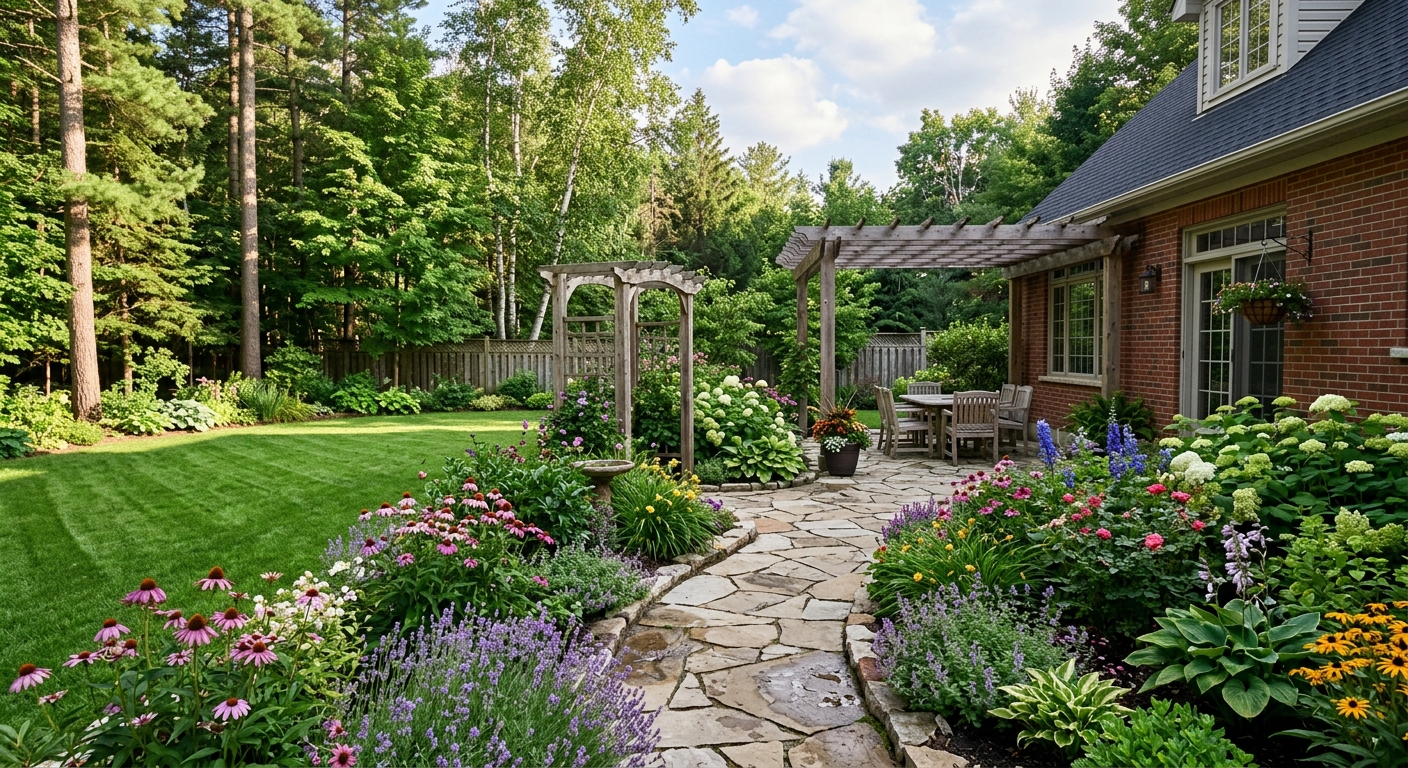
Landscaping options and costs in Vickers Park
Vickers Park, Ontario is the kind of neighbourhood where curb appeal is more than aesthetics—most houses sit on lots with enough yard space to actually use a landscape, and that incentive matters when you’re planning improvements around day-to-day living. In the GTA, the local profile shows a population of 4,317 (Statistics Canada, 2021 Census), and that smaller community feel typically means homeowners are more likely to invest in visible front-yard upgrades and practical back-yard comfort. Add in the reality that Toronto’s frost–thaw cycles can be intense, and you’ll see costs rise for any work that affects structure: retaining walls, patios, step systems, and drainage all need deeper base preparation, proper compaction, and dependable drainage detailing.
In Vickers Park, landscape contractors also price around the working season: we’re generally planning installations around the reliable frost-free window (roughly May to October). In winter-cold months, projects shift to design, procurement, and hardscape prep; during the active season, labour availability can tighten, especially when multiple homeowners are updating interlocking patios and front walks at the same time. That’s why you’ll sometimes see a 30–50% spread between bids on the “same” scope—one contractor may include more excavation, soil amendment, and subdrain work, while another assumes existing grades will perform.
Demand is especially strong in older established pockets near Bayview Avenue and the surrounding corridor, where many lots have mature trees, older drainage patterns, and classic walkout layouts that benefit from new planting beds and reworked stone paths. With those realities in mind, here’s a practical cost range comparison to help you line up what to budget before you request quotes.
| Service |
Description |
Season |
Price Range |
| Full landscape design and installation |
Site measurement, planting plan, grading and drainage coordination, softscape + hardscape install, cleanup |
May–October |
$8,000–$40,000 |
| Sod installation (supply, grade, lay, roll) |
Final grading/rolling, soil testing or amendment as needed, sod delivery and installation |
Late April–June (best) and Sept–early Oct |
$2,500–$8,000 |
| Lawn seeding (grade, seed, starter fertilizer) |
Topdressing, seed selection, starter fertiliser, light raking and rolling |
April–June (spring) and Sept (fall) |
$1,500–$6,000 |
| Interlocking patio or walkway |
Excavation, granular base with compaction, edging, pavers/stone installation, jointing and clean finish |
May–October |
$3,500–$20,000 |
| Retaining wall (interlocking block) |
Block wall build with base/granular layers, drainage gravel, weeping provisions where required |
May–September |
$6,000–$30,000 |
| Tree and shrub planting |
Soil prep, planting holes, amendments, staking (if needed), mulch rings and initial watering plan |
April–June and Sept–October |
$800–$6,000 |
Prices are estimates only and vary by project scope, site access and material selection.
What affects the price of landscaping in Vickers Park
In Vickers Park and the wider Toronto area, the same landscaping project can land in very different quote ranges—often 30–50%—because bids reflect risk, site conditions, and how much “hidden work” is included. Hardscape and drainage are especially variable on GTA properties where clay and fill soils can hold water, and where freeze–thaw stresses require proper base depths and compaction. Contractors also manage seasonal labour availability: during peak summer weeks, crews may be booked solid, which can increase labour rates and push scheduling fees into quotes.
Climate and hardiness are a cost factor too. Toronto sits in plant hardiness zones 6a–7a, so we select woody plants and perennials that tolerate winter lows near –23 to –18°C and thrive through hot, often humid summers. Those zone-appropriate choices help reduce rework, but they also affect plant size and variety. In contrast, Prairie regions (Zone 2–4) need a simpler, ultra-hardy palette and often prioritise drought and wind tolerance, while retaining wall base depth generally must be engineered to reach below the frost line. Coastal BC (Zone 7–8) supports a longer growing season and lush planting, but still demands drainage in heavier rainfall zones; dry BC interiors require irrigation design that reflects water restrictions.
Two examples that commonly raise costs in Vickers Park: (1) a sloped front yard that needs grading corrections and fresh topsoil can add significant labour beyond “just installing sod,” and (2) clay soils that show pooling after spring rains often require a drainage bed or French drain, which moves the project closer to the higher end of the interlocking and retaining-wall bands. If you’re adding a patio while reworking grades, it’s common to see total pricing shift into the $6,000–$30,000 retaining-wall range for the wall and drainage scope, and into the higher band of the design-and-install range for the full solution.
Local housing age can also matter. Many Vickers Park homes have older drainage patterns and compacted backfill; when a contractor has to excavate, rebuild base material, and amend soil, the “softscape” part of your budget effectively becomes a mixed hardscape/earthworks job—so the lowest estimate rarely matches what the site truly demands.
| Price Factor |
Why It Matters |
Cost Impact |
| Yard size in sq ft — the primary cost driver for softscape |
More area means more topsoil, mulch/seed/sod, labour hours, and materials delivery |
Often the biggest swing; scaling can change totals by thousands |
| Grading and drainage work — slope corrections add significant cost |
Fixing pitch and directing water away from foundations prevents settlement and washouts |
Can add major earthworks cost; commonly pushes toward higher quote range |
| Drainage bed or French drain installation |
Clay soils may trap water; subdrains protect patios, walls, and planting beds |
Material + labour intensive; frequently a key driver of 30–50% spread |
| Plant material tier — native shrubs vs. ornamental vs. mature specimen trees |
Specimen trees and premium ornamentals cost more and may require specialist handling |
Planting budgets can multiply quickly from small shrubs to larger installs |
| Hardscape vs. softscape ratio — walls and patios cost more per sq ft than lawn |
Stone, base, edging and proper compaction are labour- and aggregate-heavy |
Shifting from lawn to pavers can materially change the project’s band |
| Irrigation system design and installation |
Zones, heads, pressure checks, backflow planning and layout affect material and labour |
Usually adds meaningful cost, but improves plant survival during dry spells |
| Soil amendment and topsoil required |
Existing soil may be compacted, sandy, or clay-heavy; amendments improve root performance |
Can raise costs depending on haul distance and volume needs |
| Tree removal or stump grinding before new planting |
Removal changes access and can require extra protection, disposal and sequencing |
Often adds costs outside the original softscape estimate |
Permits & regulations in Ontario
In Ontario, most planting and softscape work—like lawn seeding, sod installation, mulch, shrub beds, and typical fence repairs—generally does not require a permit. Tree planting and most garden bed work also typically proceed without permits. The work that most often does require a permit is retaining-wall construction when the wall height exceeds the threshold used by many municipalities, commonly around 1.0 m (3.3 ft). Some projects also trigger permit requirements when drawings or engineering are necessary for stability, particularly if the wall supports surcharge loads or sits near a property boundary.
Another area to confirm is grading. Any change to lot grading that can affect drainage—especially directing water toward a neighbouring property or altering how water reaches storm infrastructure—may require municipal approval. And before digging postholes, trenching for drains, or installing wall footings, you should request utility locates (so you don’t hit buried service lines). This matters in Vickers Park because many lots have older infrastructure runs that aren’t always obvious from the surface.
Finally, irrigation and water-use rules vary by time of year and local context. Ontario homeowners should verify their municipality’s irrigation bylaws during summer restrictions and design irrigation accordingly. To protect yourself, verify contractor coverage: confirm their Ontario licence status and obtain a certificate of insurance plus proof of WSIB/WCB coverage. Then request a clearance letter if your contractor uses subtrades—most reputable firms can provide documentation promptly, before work starts.
Planning a landscape that thrives in Vickers Park's climate
Planning for Vickers Park means designing around the GTA’s hardiness zone (6a–7a) and the practical reality of a frost-free window that typically runs from May through October. Start with plant selection: choose native and zone-appropriate shrubs and perennials that can handle winter lows near –23 to –18°C and return strongly in spring. For areas exposed to wind off the street or where snow piles sit, build a “winter-proof” structure—evergreens for consistency and tougher perennials for colour—so you don’t spend next season replacing what didn’t survive.
When deciding between sod and seed, think timing and expectations. Sod gives instant curb appeal, but it’s usually 3–4x more per sq ft than seeding once you account for subgrade preparation and material costs. A common “justified” price example: if you need a uniform front lawn before a major event or if the lawn area is small and highly visible, the sod investment can be worth it. If you’re redoing a wider backyard where you can tolerate a slower establishment, seeding is often the smarter value.
Drainage and grading are non-negotiable in Toronto. Pooling water around foundations and basements can lead to maintenance headaches, so we routinely address slope corrections and consider drainage beds or French drains where soils hold moisture. For hardscape—patios and retaining walls—base preparation has to account for freeze–thaw movement: the granular layers, compaction, and footing depth are what keep stonework stable. To reduce annual upkeep without sacrificing looks, use mulch rings, groundcovers, and a repeatable perennial structure. Where water efficiency is a priority, consider rain-garden pockets and xeriscape-style planting zones that still respect Ontario’s winter survival needs.
| Element |
Climate Consideration |
Maintenance Level |
Price Band |
| Sod lawn installation |
Best establishment during reliable growing periods; winter desiccation risk means proper watering before cold |
Low to moderate (mowing + early watering) |
$2,500–$8,000 |
| Native perennial garden |
Zone-appropriate selections handle Toronto winters and summer humidity with less replacement |
Moderate (seasonal pruning and weed control) |
$1,500–$7,500 |
| Mulched shrub border |
Mulch buffers freeze–thaw heaving and reduces moisture stress on clay-adjacent soils |
Low (spring tidy + occasional top-up) |
$800–$5,000 |
| Interlocking stone patio |
Requires freeze–thaw-rated base compaction and correct drainage slope |
Low (occasional cleaning and joint upkeep) |
$3,500–$20,000 |
| Retaining wall (block) |
Freeze–thaw and soil pressure demand proper drainage gravel and base depth |
Low (annual inspection for drainage and settlement) |
$6,000–$30,000 |
| Drip irrigation system |
Helps manage summer dry spells efficiently while protecting plants from inconsistent watering |
Moderate (seasonal start-up/shut-down and checks) |
$1,800–$6,500 |
How to choose a landscaping contractor in Vickers Park
Choosing the right landscaper in Vickers Park starts with verification, not just price. In Ontario, confirm the contractor is properly licensed where applicable and ask for their proof of insurance: general liability is the minimum, and you should also verify they carry WSIB/WCB coverage (or the Ontario equivalent for their work arrangements). How to check: (1) request a current certificate of insurance (make sure it lists your address/project site where possible), (2) ask for WSIB/WCB clearance or proof of coverage for the workers assigned to your job, and (3) verify business details and trade standing through the relevant online registries your contractor references during bidding.
Next, get 2–3 itemised written quotes. You want a breakdown that separates labour and materials (excavation, base gravel, geotextile, pavers/blocks, drainage stone, topsoil, plants), not just a lump sum. Read exclusions carefully: disposal of excess soil, restoration of lawn edges, replacing damaged downspout connections, and whether permit applications (where needed) are included. Warranty matters: ask for a workmanship warranty length, confirm what product warranties cover (and whether they’re tied to you as the owner), and whether the warranty is transferable if you sell.
For payment, use a sensible schedule. Never pay more than 10–15% upfront; hold back a portion until the job is complete and cleaned up. Get your timeline in writing with a stated start date and an estimated completion date based on the crew’s availability and material lead times.
- Verify insurance certificate is current and includes liability for landscaping work.
- Confirm WSIB/WCB coverage (or clearance) for workers on your site.
- Ask what permits are required for your specific scope (e.g., retaining walls over typical thresholds).
- Request itemised quotes with labour and materials separated.
- Check if excavation and disposal of spoils are included.
- Confirm base specs: granular type, thickness, compaction method for patios/walkways.
- Ask how drainage will be handled near your foundation and how water will be directed.
- Look for a written planting plan (spacing, plant sizes, mulch depth, warranty on plants if offered).
- Make sure materials are listed by type/grade, not just brand names.
- Confirm the warranty for workmanship and what it covers (settlement, uneven pavers, plant failures due to installation).
- Use a payment schedule with a holdback until final inspection/cleanup.
- Ensure the contract includes start date, duration, and conditions that trigger schedule changes.
Red flags in Vickers Park: (1) contractor won’t provide insurance/WSIB documentation on request, (2) quote is only a single lump-sum with no excavation/base/drainage details, (3) promises “no drainage needed” on clay-heavy lots or near foundations, (4) asks for most payment upfront (beyond 10–15%), and (5) avoids putting timeline and warranty terms in writing.
Frequently asked questions — landscaping in Vickers Park
How do I design a low-water yard in Vickers Park?
If you want a low-water yard in Vickers Park, focus on efficient watering and climate-appropriate planting (Toronto is typically zone 6a–7a, with hot, humid summers and winter freezes). Start by grouping plants by water needs, then use mulch (proper depth and coverage) to reduce evaporation from the soil surface. Consider groundcovers and native perennials that can tolerate Ontario winters without needing constant replacement. For irrigation, a drip system with properly placed emitters reduces wasted water compared to sprinklers, especially on slopes where runoff happens.
Where water pooling is an issue, improve drainage first—low-water designs fail if water can’t infiltrate where plants need it. If you’re adding a lawn, note that sod is usually a higher upfront cost (commonly $2,500–$8,000 for typical installs), so you can balance spend by mixing seeded lawn areas with planted beds. In dry spells, an irrigation plan timed to soil moisture matters more than watering on a calendar.
How do I find a licensed landscaper in Vickers Park?
In Ontario, “licensed” can mean different things depending on the contractor’s trade scope, so the best approach in Vickers Park is verification by documentation. Start by asking for your contractor’s proof of liability insurance and their WSIB/WCB coverage for workers assigned to your site; reputable landscapers will provide certificates immediately. Next, request their contractor information package (business details) and, if applicable to their work, confirmation of registration status in Ontario for the relevant trade activity.
Then verify coverage before signing: obtain the certificate of insurance and check the effective dates; ask for WSIB/WCB clearance or proof of coverage; and keep all documentation with your contract. Finally, compare at least two itemised quotes so you can see whether they include drainage, base compaction, disposal, and—when needed—permit-related steps like retaining walls above common thresholds (often around 1.0 m).
How much does landscaping cost in Vickers Park?
Landscaping costs in Vickers Park vary mainly by yard size, drainage/soil work, and whether you’re adding hardscape. For budgeting, Toronto-area ranges commonly put full landscape design and installation around $8,000–$40,000, depending on how much excavation, drainage, stonework, and planting are included. If your project is focused, sod installs often land in the $2,500–$8,000 band, while interlocking patios and walkway projects can vary widely based on base prep and labour complexity.
Retaining walls are another major cost driver due to structural base and drainage requirements; a typical interlocking-block retaining wall package is commonly budgeted in the $6,000–$30,000 range for many residential scopes. When quotes differ, it’s usually because one contractor includes proper drainage correction and soil amendment while the other assumes existing grades will be adequate. That’s why itemised quotes matter.
What plants thrive in Vickers Park's climate zone?
For Vickers Park, you’ll be planning for Toronto’s plant hardiness band (commonly zone 6a–7a), meaning plants must handle winter lows near –23 to –18°C and return reliably after frost. Choose a mix of woody structure (spruces, junipers, and other hardy evergreens), plus perennials and shrubs that tolerate cold winters and humid summers. Native-oriented planting is a practical starting point because it’s often better adapted to local conditions and typically supports less frequent replacement.
Also consider exposure: street-facing beds can dry out and get wind-chilled in winter, while shaded areas hold moisture longer. Use mulch to stabilise soil temperature during freeze–thaw cycles and help keep roots insulated. If you’re doing a lawn-to-bed transition, pair shrubs and groundcovers to reduce bare soil and future weed pressure. A well-designed shrub border often sits comfortably in the low-maintenance approach and can be sized to your budget (for example, planting packages frequently start around $800–$6,000 depending on plant sizes and quantity).
Sod vs seed — which is better for a Vickers Park lawn?
Sod is usually better when you need fast results, want a consistent finish right away, or the area is highly visible from the street in Vickers Park. It also helps reduce erosion on slopes if the installation includes proper base grading and seeding/topsoil preparation beneath. The trade-off is cost: sod installs commonly fall in the $2,500–$8,000 range for typical residential jobs. Seeding is generally more budget-friendly and works well for larger areas, especially if you can water properly during germination.
In Toronto-area freeze–thaw conditions, the “best” choice also depends on timing and site prep. If your lawn has thin soil or drainage issues, both sod and seed can fail—so address grading and soil amendment first. For many homeowners, a hybrid approach is ideal: sod in smaller prominent areas, seeding in broader backyard zones. Your contractor should recommend seed blends and mowing/watering timing for Ontario conditions rather than treating all lawns the same.
How much does a retaining wall cost in Vickers Park?
A retaining wall in Vickers Park commonly costs more than most homeowners expect because it’s not just block installation—it’s the base build, drainage provisions, and stability work required through Toronto’s freeze–thaw cycles. For many interlocking-block retaining walls, a realistic budget range is $6,000–$30,000, depending on wall length, height, excavation depth, and whether drainage gravel/subdrain solutions are included.
Cost can rise if you need soil removal due to clay/fill conditions, if there’s limited access for equipment delivery, or if the wall is near a foundation where additional drainage detailing is required. Permits are another consideration: retaining walls above common municipal thresholds (often around 1.0 m) may require a building permit and sometimes engineering support. A clear, itemised quote will show base thickness, drainage components, and how water will be directed away—this is where you’ll see the biggest differences between bids.