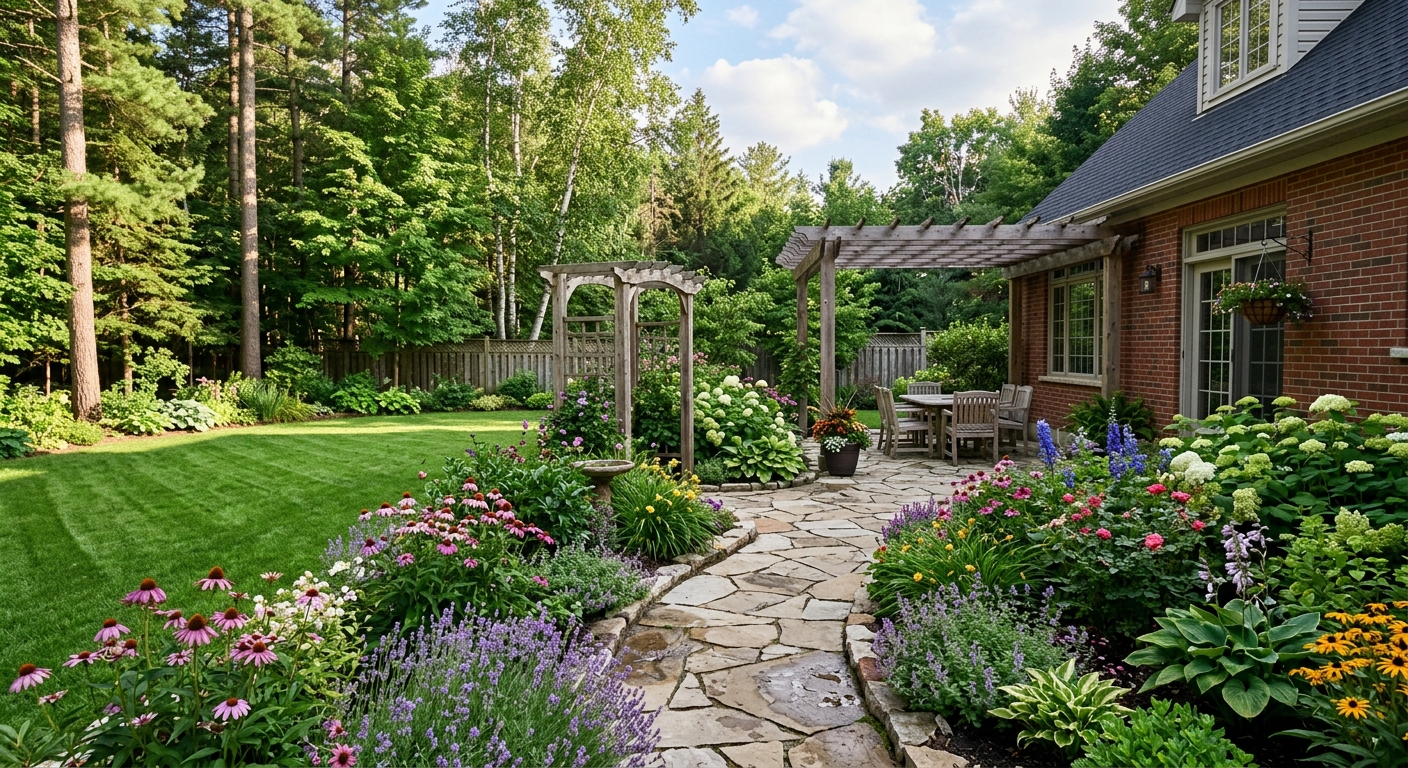
Landscaping options and costs in East Wellington
East Wellington, British Columbia is a small community (population 1,444 per the 2021 Census, Statistics Canada) where homeowners can actually see the pay-off of a well-planned landscape—especially on properties with room for softscape and layered planting. In the Lower Mainland–Southwest market, yards are frequently updated for curb appeal and lifestyle: when you live with a long growing season and wet winters, you’re able to refine drainage, add evergreens and perennials, and still complete major work outside the worst weather windows. That “almost year-round” reality is also reflected in the availability of landscaping crews and the number of repeat clients in nearby neighbourhood pockets that favour walkable, front-yard upgrades, particularly around the more established residential lanes where people notice changes quickly.
Because East Wellington sits in hardiness zones 7–8, contractors can design richer planting palettes than in colder inland regions, but costs still hinge on site prep. Structural elements like patios and retaining walls must be built to handle freeze–thaw cycles and prevent frost heave, which means digging depth, drainage, and compaction matter. Similarly, while BC interior water restrictions are more common there, rising water costs and municipal expectations for efficient irrigation have shifted many projects toward drip lines and smart controllers. If you’re comparing options, use the table below as a starting point for realistic ranges in this area—then match the scope to your actual site access, removal work, and material tier.
| Service |
Description |
Season |
Price Range |
| Full landscape design and installation |
On-site measurements, layout, soil and drainage recommendations, planting plan, hardscape/softscape build-out, cleanup |
Mar–Jun and Aug–Nov (structural work possible year-round with weather windows) |
$12,000–$38,000 |
| Sod installation (supply, grade, lay, roll) |
Minor grading, base prep, sod supply and placement, rolling, starter watering plan |
Late Mar–Jun and Sept–Oct |
$3,500–$7,000 |
| Lawn seeding (grade, seed, starter fertilizer) |
Top up/grade, seed selection, starter fertilizer, light raking, initial watering guidance |
Apr–May and Sept |
$2,000–$4,500 |
| Interlocking patio or walkway |
Excavation, granular base, compaction, base edging, interlocking stone installation and jointing |
Apr–Jun and Aug–Oct |
$10,000–$32,000 |
| Retaining wall (interlocking block) |
Block wall build with drainage fabric, weep holes and base preparation for soil stability |
Apr–Oct |
$12,000–$48,000 |
| Tree and shrub planting |
Soil improvement, tree staking (as needed), shrub/evergreen placement, mulch beds |
Mar–May and Sept–Nov |
$2,500–$12,500 |
Prices are estimates only and vary by project scope, site access and material selection.
What affects the price of landscaping in East Wellington
In East Wellington and across the Lower Mainland–Southwest, two bids for the “same” job can differ by 30–50% because the underlying variables aren’t the same: site conditions, access, drainage complexity, and the quality tier of materials. Contractors also price labour with weather risk and crew availability in mind. In coastal BC (zones 7–8), you can build longer—so crews spread overhead differently than in Prairie regions where frost-free windows are shorter and projects often compress into tighter scheduling. By contrast, in Zone 2–4 areas you’d typically need drought-tolerant, wind-hardy choices and deeper, more conservative base plans for retaining walls to address the short season and frost mechanics. Southern Ontario (Zone 5–6) usually lands in the middle for growing time and irrigation timing during summer dry spells, whereas coastal BC allows lush layering but punishes poor drainage with pooling and foundation moisture concerns.
For East Wellington specifically, cost changes fast with a few common realities. First, a front-yard “refresh” on a gently sloped lot that needs only topsoil and new borders can stay near the lower end of a tree-and-shrub planting budget (for example, roughly $2,500–$12,500). But if the same yard needs grading correction to redirect water away from the foundation, you can quickly add several thousand dollars because excavation and compaction expand. Second, structural hardscape can drive a wider swing: a basic interlocking walkway is often far below a larger patio plus wall combination; that’s why you’ll see patio-style packages nearer the $10,000–$32,000 range, while adding a block retaining wall or drainage system can push totals upward. Finally, older housing stock often has compacted soils and hidden drainage problems—when contractors uncover these, soil amendment and drainage bed work can become necessary, shifting a project from “planting only” to a full softscape reset.
| Price Factor |
Why It Matters |
Cost Impact |
| Yard size in sq ft — the primary cost driver for softscape |
More area means more labour hours, more soil/topsoil, and more plants or turf material |
Small yards: tighter range; larger yards can double material and install time |
| Grading and drainage work — slope corrections add significant cost |
Fixing grading prevents pooling, helps foundations stay drier, and reduces washout |
Often adds thousands depending on how much excavation is required |
| Drainage bed or French drain installation |
Captures and routes water below planting and away from structures |
Can be a major swing factor when downspouts or seepage are present |
| Plant material tier — native shrubs vs. ornamental vs. mature specimen trees |
Mature specimens and premium cultivars cost more and may require bigger root balls and stakes |
Material cost can outrun labour when you choose larger sizes |
| Hardscape vs. softscape ratio — walls and patios cost more per sq ft than lawn |
Stone, base rock, edging, and compaction are labour- and material-intensive |
Changing even 100–200 sq ft from lawn to patio can noticeably increase totals |
| Irrigation system design and installation |
Efficient layout (drip, bubbler, zones, controllers) reduces long-term water use |
Small upgrades are manageable; full system builds raise costs quickly |
| Soil amendment and topsoil required |
Coastal soils can be clay-heavy in patches; good amendments support root growth |
Bulk material delivery and labour can add significant cost on poor soils |
| Tree removal or stump grinding before new planting |
Removal changes timelines and often requires disposal and extra excavation |
Can add a standalone line item that affects the whole project schedule |
Permits & regulations in British Columbia
In British Columbia, planting, sodding and most softscape work typically does not require a building permit. That usually includes: laying sod or seed, installing mulch beds, planting trees and shrubs, and constructing many non-structural paths and small landscape elements. Where permits commonly become relevant is with retaining walls that exceed local height thresholds—often around 1.0 m (3.3 ft) in many municipalities—because the wall can behave like a structural element and may require engineering or engineered drawings.
Another trigger can be lot grading changes. If your project alters drainage in a way that affects neighbouring properties or directs water toward storm sewer connections, approval requirements may apply. Also, before any digging for planting holes, French drains, or wall footings, homeowners should arrange utility locates to avoid hitting buried services.
To verify a contractor in East Wellington, start with licensing and insurance documents in writing. Ask for: (1) proof of current business registration or the relevant contractor licensing status through the appropriate provincial registry, (2) a certificate of liability insurance naming you as additionally insured if applicable, and (3) confirmation of workplace coverage where required (WSIB/WCB) for the workers involved. Then request clearance letters or coverage documentation directly from the insurer/admin body if your contractor operates in a way that requires it. Always verify dates match the project window, and confirm the scope on the insurance certificate aligns with landscaping/hardscape work—not just general contracting.
Planning a landscape that thrives in East Wellington's climate
Planning a landscape in East Wellington means working with hardiness zone 7–8, wet winters, and long, cool summers—rather than fighting them with “one-size” turf and fragile ornamentals. Start with plant selection: choose zone-appropriate, preferably native or proven locally adapted species that handle winter wet without constant replanting and that don’t demand heavy winter protection. Lower Mainland–Southwest yards also benefit from smart layering—evergreen structure for winter presence, perennials for summer colour, and groundcovers to limit bare soil and weeds.
When deciding sod vs. seed, remember the speed difference comes at a real cost. Sod gives instant, uniform coverage but typically costs 3–4x more per sq ft than seeding because you’re buying turf rolls and adding handling labour. If your goal is quick curb appeal before a family event or a listing, that premium can be justified. For example, a smaller seeding-and-topup lawn might land around $2,000–$4,500, while sod installation often begins nearer the $3,500–$7,000 range for many typical residential yards. However, if you can wait for germination and establishment, seeding is usually the better long-term value.
Drainage and grading are critical in this region to prevent pooling and foundation moisture. Plan drainage before planting: correct slopes, add a drainage bed or French drain where needed, and keep mulch beds from touching foundations. For patios and retaining walls, proper base preparation and drainage outlets protect against freeze–thaw movement. Low-maintenance strategies that still look lush include mulch (weed suppression and moisture moderation), perennial drifts instead of scattered single plants, and drip irrigation for efficiency. Where water efficiency matters, consider rain gardens or a xeriscape-inspired approach using drought-tolerant selections in the drier micro-zones, while keeping moisture-loving plants where rainfall naturally accumulates.
| Element |
Climate Consideration |
Maintenance Level |
Price Band |
| Sod lawn installation |
Works best in mild spring/fall windows; needs correct grade so roots aren’t sitting in wet pockets |
Low first season, then moderate (mowing and periodic feeding) |
$3,500–$7,000 |
| Native perennial garden |
Stays resilient through cool, wet winters when soil is well-drained and planted by zone |
Low to moderate (annual tidy-up, seasonal mulch top-ups) |
$2,500–$10,500 |
| Mulched shrub border |
Mulch buffers winter moisture swings and reduces splashback that can carry soil-borne issues |
Low (weed control and occasional pruning) |
$2,000–$8,500 |
| Interlocking stone patio |
Must account for freeze–thaw by using proper granular base and drainage slope |
Low (cleaning and occasional joint sand refresh) |
$10,000–$32,000 |
| Retaining wall (block) |
Built for local drainage; weep holes and drainage fabric reduce backfill pressure during wet months |
Low (regular inspection of drainage outlets) |
$12,000–$48,000 |
| Drip irrigation system |
Efficient delivery for mixed plant zones; helps avoid overwatering in wet seasons |
Low (seasonal adjustments and controller checks) |
$1,800–$6,500 |
How to choose a landscaping contractor in East Wellington
Choosing a contractor in East Wellington starts with proof. Ask for current British Columbia licensing/business registration details (if applicable to their work category) and a certificate of liability insurance. For the work crew, confirm workplace coverage for employees through WSIB/WCB documentation where required—then verify the dates cover your installation period. Request that paperwork be emailed before signing, not presented only on the day the crew arrives. A trustworthy contractor will also explain who is responsible for permits (if any), scheduling, disposal, and protection of existing services during digging.
Next, get 2–3 itemised written quotes. You want line items that separate labour from materials: excavation and disposal, granular base, geotextile/drainage fabric, irrigation components, soil amendments, and plant quantities/sizes. Avoid lump-sum only proposals where important scope items are hidden. Carefully check what is excluded: does the price include topsoil and haul-away? Are utility locates included? Is edging included? Does the quote include final grading and cleanup to a walkable finish?
Warranty matters too. Ask for a workmanship warranty length and what it covers (settling, lifting, plant replacement criteria). Confirm whether plant warranties pass through from the nursery or manufacturer, and whether they’re transferable to you as the homeowner. For payment, never pay more than about 10–15% upfront; use a holdback until key completion milestones (base work, drainage verification, final install) are complete. Get the start date and a completion estimate in writing, with weather-based contingencies noted, especially for wet winter weeks and spring ground conditions.
- Provide written proof of liability insurance and coverage dates
- Confirm workplace coverage documentation (WSIB/WCB) for workers
- Show a detailed scope: what exactly is being removed, supplied, installed, and hauled away
- List quantities: sq ft, linear feet, tree/shrub counts, and pot/tree sizes
- Include drainage plan notes if grading is involved
- State whether geotextile, drainage fabric, and base rock are included
- Clarify irrigation: is it drip-only, how many zones, and who programs the controller
- Confirm edging and finishing (turf roll layout, joint sand, compaction steps)
- Detail disposal: where debris is taken and whether burning/composting is included
- Provide a workmanship warranty in writing and the length
- Set a payment schedule with a holdback until final inspection/cleanup
- Offer a realistic timeline with weather contingencies for coastal moisture conditions
Red flags to watch in East Wellington: quotes that are not itemised (no quantities or line items), contractors who can’t produce insurance or coverage paperwork, “verbal-only” schedules or warranty promises, missing drainage/base details for patios/retaining work, and requests for large upfront payments beyond 10–15% without a clear milestone plan.
Frequently asked questions — landscaping in East Wellington
What is the best grass type for a East Wellington lawn?
In East Wellington, British Columbia, most homeowners do best with cool-season grasses because our summers are long but typically not as hot as inland climates. A common, practical choice is a perennial ryegrass blend for faster establishment and good colour, often mixed with fine fescue for toughness under shade and variable watering. If your yard stays damp near a downspout or low area, prioritise correct grading and drainage first—no seed or sod type will perform well on saturated soil. For a lawn refresh budget, many East Wellington projects land in the lawn seeding range of $2,000–$4,500 depending on sq ft and soil prep.
When should I aerate and overseed my lawn in East Wellington?
Because East Wellington sits in hardiness zone 7–8 with cool, wet winters and mild spring/fall windows, plan aeration and overseeding when the grass can regrow quickly. The most reliable timing is early fall (September into early October) or late spring after the ground is workable and frost risk has passed. Aerating is about reducing compaction and improving seed-to-soil contact, so avoid doing it on waterlogged turf. If you’re also doing major soil fixes, it’s usually smarter to correct grading first, then aerate and overseed. If your goal is rapid improvement, homeowners sometimes compare seeding (typically $2,000–$4,500) versus sod (often $3,500–$7,000) depending on how quickly they need results.
What trees grow best in East Wellington's climate zone?
In East Wellington (Lower Mainland–Southwest, zone 7–8), homeowners generally have success with broadleaf trees that tolerate winter moisture and cool summers. Common options include serviceberry (Amelanchier) for multi-season interest, Japanese maple cultivars for sheltered spots, and hardy ornamental cherries in appropriate light. For structure and long-term curb appeal, many yards also do well with evergreen options such as cedars or hemlock varieties, especially when soil drainage is managed. The key is matching the species to your microclimate: avoid planting moisture-loving trees in areas that stay soggy. Also consider mature size—older lots may have close-to-foundation placement risks, which can affect future hardscape and drainage plans. A typical tree and shrub planting scope often falls around $2,500–$12,500 depending on sizes and quantities.
How much does sodding a yard cost in East Wellington?
Sodding in East Wellington usually depends on sq ft, how much grading is required, and whether any drainage issues need correction before sod is laid. Many residential projects land in the sod installation range of $3,500–$7,000 when minor base prep is needed. If your yard has dips, uneven slope toward a foundation, or compacted soil layers, expect added cost for excavation, base rock, and improved topsoil layers—because healthy sod needs consistent root conditions. Compare that with lawn seeding, which is often lower upfront (commonly $2,000–$4,500), but takes longer to look “finished.” A reliable contractor will assess drainage first, then recommend sod vs. seed based on your timeline.
How do I prevent weeds in my East Wellington garden?
Weed prevention in East Wellington is mostly about controlling the conditions weeds need: light, bare soil, and moisture stress. Start with proper soil prep—remove roots and weed seeds during bed creation, then avoid leaving soil exposed longer than necessary. Use a thick, consistent mulch layer (commonly several centimetres) around shrubs and perennials, and keep mulch off direct contact with plant stems. Edge the beds so grass doesn’t invade, and consider landscape fabric only as a targeted tool under specific scenarios—many homeowners get better results using geotextile with drainage-friendly base layers where appropriate. Dense planting also helps: a native perennial garden tends to smother weeds once established. If your plan includes drainage correction, do that first; pooling water increases weed pressure. A mulched shrub border is typically planned in a range of $2,000–$8,500 depending on linear feet and plant counts.
How do I design a low-water yard in East Wellington?
Even in British Columbia, low-water design is increasingly popular because water costs and efficiency expectations are rising. In East Wellington, you can reduce irrigation demand by zoning plants by moisture needs, grouping drought-tolerant species where the ground dries fastest, and keeping moisture-loving plants only where drainage naturally holds water. Use drip irrigation with proper zone control instead of sprinklers that wet walkways. Add organic mulch and groundcovers to reduce evaporation. For hardscape, choose permeable edging where appropriate so water infiltrates rather than running off. If you want a practical “Lower Mainland” compromise, install rain-garden style beds in low spots (for runoff capture) and keep ornamental turf minimal—especially in sunny, exposed areas. If your irrigation plan and planting layout are done together, many homeowners see strong long-term savings versus watering a full lawn. For budgeting, drip irrigation often starts around $1,800–$6,500, depending on zones and complexity.